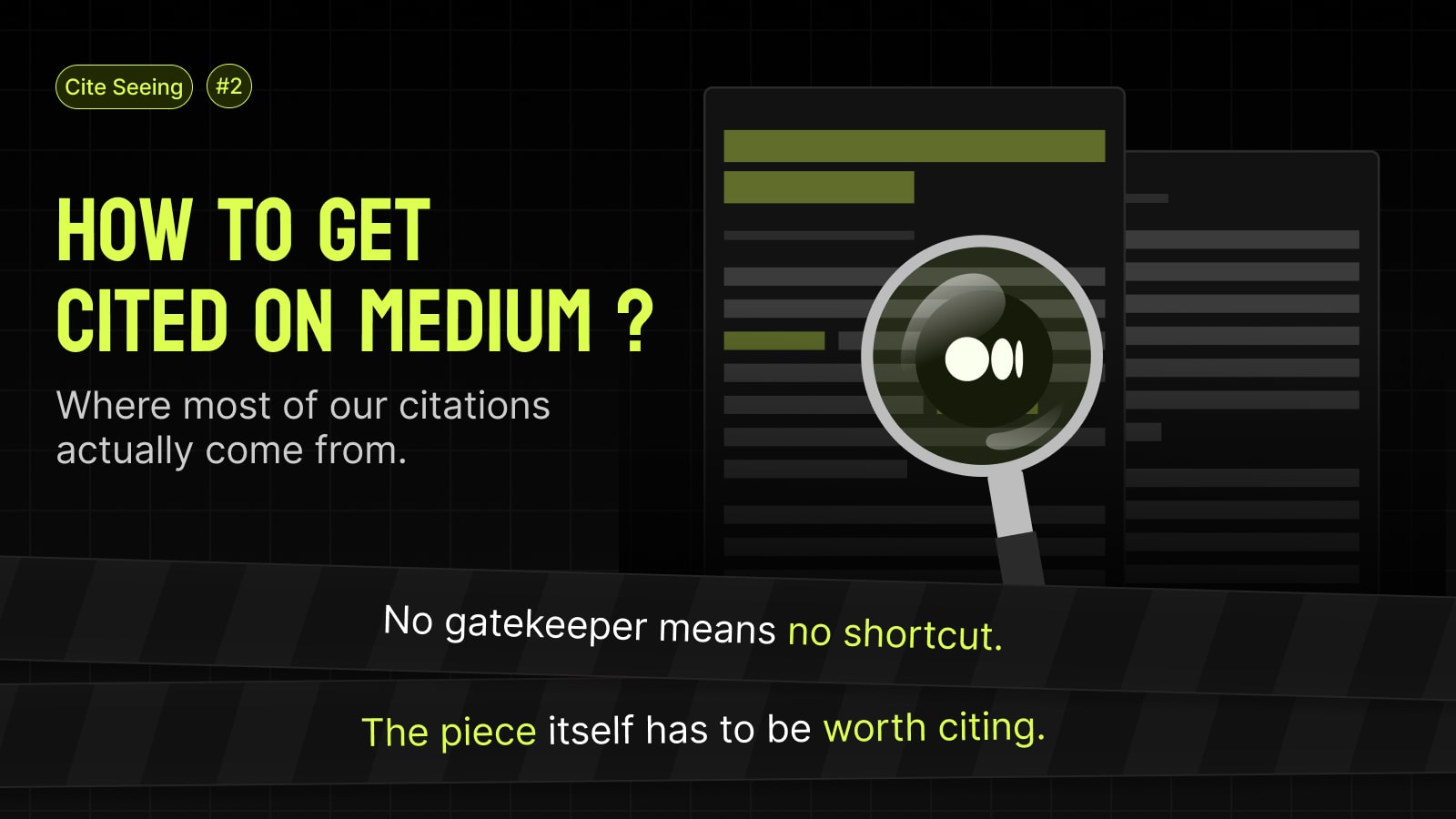
Medium is the easiest platform to publish on, which is exactly why it's hard to get cited there. This is the second in our Cite Seeing series, a platform-by-platform guide to being the source AI answers pull from. It's also where most of our cited creators come from.
Short answer: To get cited on Medium, don't rely on the platform, rely on the piece. Medium has almost no gatekeeping, so publishing is easy and standing out is hard. What earns citations is a genuine answer to a specific query, structured so an AI model can lift it: a clear headline that matches how people actually ask, the answer stated up front rather than buried, and specific, first-hand detail. The ease of publishing is the trap. The quality of the individual piece is the whole game.
If Reddit is the hardest platform to get cited on, Medium is close to the easiest place to publish, and that's precisely the problem.
There are no moderators removing your post. No karma threshold to clear. No community whose norms you have to learn before you're allowed to contribute. You write, you hit publish, you're live. That frictionlessness is Medium's gift and its trap. Because when everyone can publish anything instantly, publishing stops being an achievement, and the thing that gets you cited is no longer getting in. It's being the one piece worth citing among everything else that got in just as easily.
Here's the part that makes this worth taking seriously: across the creators we work with, Medium is where the most citations come from. Not because the platform has some special relationship with AI engines, but because it's where creators tend to do their most deliberate, structured writing, and deliberate, structured writing is exactly what gets cited.
Why Medium's ease is the challenge
On Reddit, the community is the filter. Human moderators and skeptical users remove anything that reads as low-effort or promotional, and the stuff that survives is, by definition, stuff people found worth keeping. AI models trust it partly because it was pre-filtered by humans.
Medium has almost none of that filtering. Which means the filter has to come from somewhere else, and the only place left is the piece itself. There's no community deciding your post is worth trusting before a model sees it. The model is evaluating your article more or less on its own merits: does it answer the question, does it carry real substance, can the answer be extracted cleanly.
So the strategy on Medium isn't about access. It's entirely about quality and structure.
What actually gets cited on Medium
The Medium pieces that get pulled into AI answers share a shape:
They answer one specific query, head-on. Not "some thoughts on the category" but a direct answer to a question someone actually asks, phrased the way they'd ask it. If someone would type or say "best cross-chain swap in 2026" or "how does X compare to Y," the piece answers exactly that.
They lead with the answer. A disproportionate share of AI citations come from the opening of a piece, not the middle. If your clearest, most citable claim is buried in the eighth paragraph after a long windup, it may never be reached. Say the useful thing early, then support it.
They're structured to be lifted. Clear headline, clear subheadings that map to sub-questions, short scannable sections, specific claims a model can extract without ambiguity. Not keyword-stuffed, just clean and well-organised, so both a human skimmer and a machine can find the answer fast.
They're specific and first-hand. A real comparison, a real number, a genuine point of view, the things a model can't generate on its own and therefore has reason to cite. Vague, general, could-be-about-anyone writing gets averaged into the background.
None of that is a trick. It's just genuinely good writing aimed at a real question, which on a platform with no gatekeeper is the only thing that separates you from the pile.
For creators versus for brands
If you're a creator, Medium is likely your highest-leverage platform: a low barrier to publishing and a high citation rate. But the low barrier cuts both ways. Because it's so easy to publish, it's tempting to coast, to post something quickly because you can. Resist that. On Medium, the ease of getting published is exactly why the writing itself has to carry more weight. Your competition isn't a moderator. It's every other easily-published piece answering the same question.
If you're a brand or marketer, Medium is one of the rare places your owned content can genuinely earn AI citations, but only if you drop the brand-content reflexes. No SEO padding, no throat-clearing introductions, no funnel toward a call to action. Just answer the exact question your buyer is asking, more clearly and more completely than anyone else has. The reason most brand Medium posts get ignored isn't the platform. It's that they read like marketing instead of like answers.
The takeaway
Medium removes almost every obstacle to publishing, and in doing so it removes every excuse. There's no community to blame, no gatekeeper to get past, no karma to grind. It's just you, your idea, and the question of whether your piece is the best answer to a real query that someone, or something, is looking for.
That's why it's simultaneously the easiest platform to publish on and one of the hardest to be cited on. And it's why, when creators do the work, it's the platform that rewards them most.
Keep reading
How to get cited on Reddit, the first in the Cite Seeing series
Before you publish your next Medium piece, run it through the Scribble GEO checker. It scores how citable your content is and shows you where to strengthen it, so on a platform with no gatekeeper, your piece is the one worth citing.
This is the second in Cite Seeing, our series on how to earn AI citations platform by platform. Next up: [platform]. On Scribble, getting cited is how creators get paid.
Frequently Asked Questions
Is Medium good for getting cited by AI?+
Yes. It's one of the most productive platforms for AI citations, because it's where a lot of deliberate, well-structured writing lives, exactly the kind AI models extract from. But that's contingent on the quality of the individual piece, not on the platform itself.
Why is Medium hard to get cited on if it's easy to publish on?+
Because ease of publishing means no gatekeeping, and no gatekeeping means the only filter left is the quality of your piece. You're competing against everything else that was just as easy to publish. Standing out requires genuinely answering a query better than the alternatives.
What kind of Medium article gets cited?+
One that answers a specific query directly, leads with the answer rather than burying it, is cleanly structured so a model can extract the point, and carries specific, first-hand detail. Vague or general pieces rarely get cited.
Can brands get cited on Medium?+
Yes, if the article answers the query head-on and carries real facts, rather than reading like promotional content. Brand-owned articles earn citations when they're built as genuine answers, not marketing.
Written by

I’m Ramaa, a writer and creator at Scribble. I’ve written two books, and writing is something I always find my way back to, whether that’s articles, scripts, captions, or overly long notes app rambles I swear will “be useful later.” I enjoy thinking about why people create, how ideas spread online, and what makes content feel genuinely human. When I’m not writing, I look after regulatory compliance and legal admin at Scribble, and I’m a graduate of the School of Policy, New Delhi. Outside of work, I’m a musician and an avid reader.