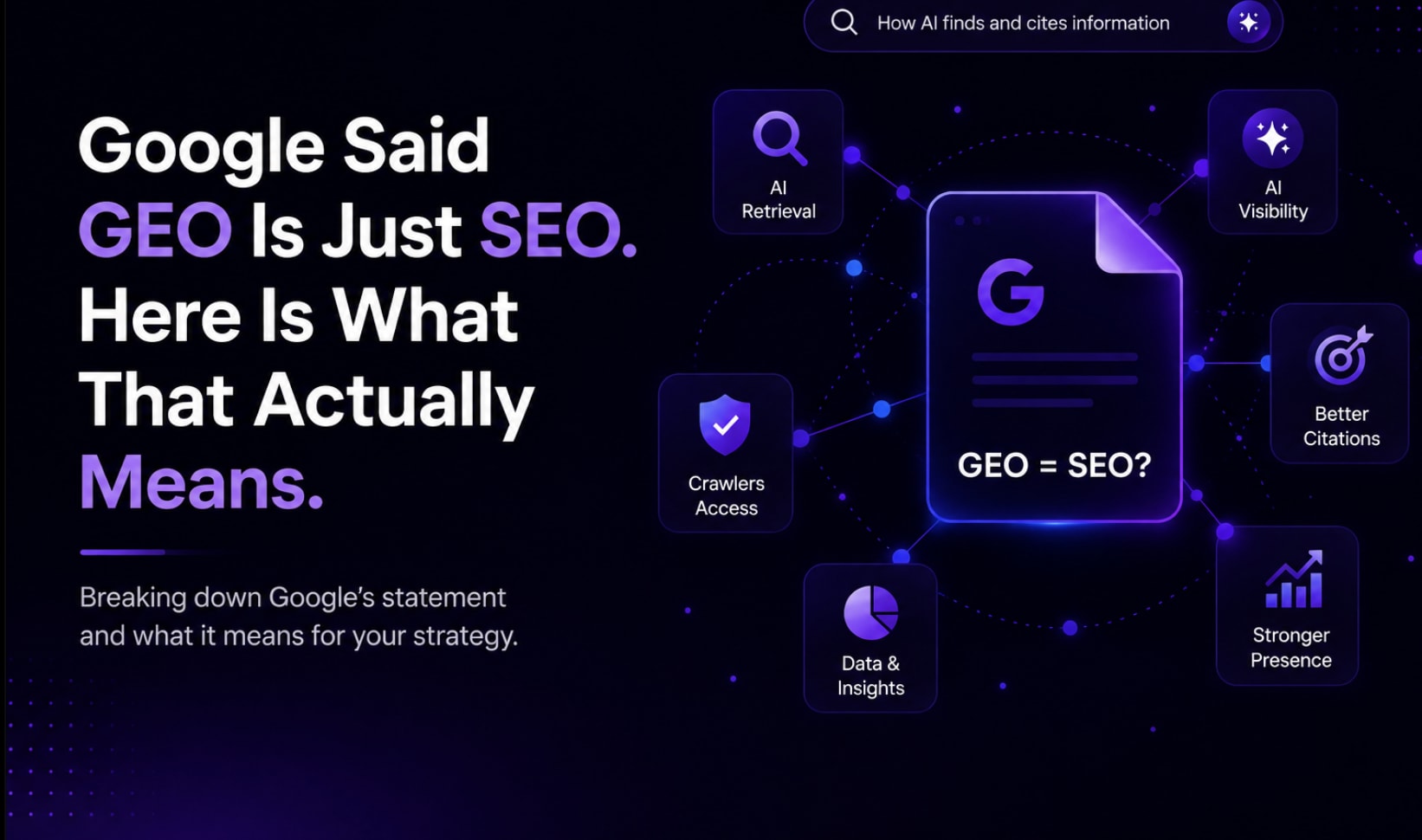
On May 15, 2026, Google published its first official consolidated guide on optimizing for AI features in search. The document is titled "Optimizing your website for generative AI features on Google Search" and it contains a sentence that the industry has been arguing about for two years without resolution: "From Google Search's perspective, optimizing for generative AI search is optimizing for the search experience, and thus still SEO."
That is now in official, citable documentation from Google Search Central.
The reaction was predictable. One camp declared GEO dead. Another said Google was covering its commercial interests. A third said nothing had actually changed. All three reactions are missing the more interesting and useful reading of what the document actually does and does not settle.
Here is the honest breakdown.
What Google Actually Said
The guide covers five areas: applying existing SEO best practices to AI search, technical structure requirements, local and ecommerce optimization, a mythbusting section addressing specific tactics, and a brief forward-looking section on agentic experiences.
The most substantive section for practitioners is the mythbusting list. Google named specific tactics that a growing ecosystem of GEO and AEO services has been selling, and stated they are not required for visibility inside Google's AI features.
llms.txt files: Google says its crawler may discover these files but treats them like any other text file, with no special treatment for generative AI search inclusion. Content chunking: no requirement to break articles into small pieces. Google's systems can understand multi-topic pages and extract the relevant passage without the author pre-fragmenting content. Rewriting for AI: AI features understand synonyms and general meaning, so rewriting to capture every long-tail keyword variation is unnecessary. Special schema for AI: structured data remains relevant for rich results, but there is no unique schema required to appear in AI Overviews or AI Mode.
The technical requirements that do apply are notably similar to standard SEO: content must be indexed and eligible for snippets, crawling best practices apply, semantic HTML is recommended, JavaScript SEO practices matter, and page experience signals remain relevant. The same crawl infrastructure that feeds traditional search feeds AI features. No separate technical track needed, at least not for Google.
One addition that is genuinely new: Google simultaneously confirmed that its spam policies now explicitly apply to generative AI responses in Search. Manipulating or purchasing citations inside AI Overviews or AI Mode carries the same policy risk as gaming traditional rankings. The full catalog of Google spam policies, scaled content abuse, site reputation abuse, link spam, and the rest, is formally in scope for AI citation attempts.
What the Guide Does Not Settle
This is where the reaction to the document has been most muddled.
Google's guide is scoped explicitly to "generative AI features on Google Search." It is not a guide to AI visibility in general. As of May 2026, ChatGPT processes approximately 250 to 500 million search-intent queries per week. Perplexity, Claude, and Microsoft Copilot collectively handle a significant additional volume. Google's own guide explicitly notes that it does not cover ChatGPT, Claude, and other AI engines, which may play by different rules.
The territory the guide does not address is where most of the practical AI visibility work for B2B and considered-purchase categories now sits. When a B2B buyer asks ChatGPT which software vendors lead their category, that query does not go through Google. When a consumer asks Perplexity to compare two products, Google's AI Overviews are not involved. The guide tells you how to appear in one part of the AI search landscape, the part Google operates, while leaving the wider ecosystem unaddressed.
This is not a criticism of the guide. It is a legitimate scope. But the "GEO is just SEO" framing, taken outside Google's own context, is incomplete. The signals that drive citation in ChatGPT or Perplexity are meaningfully different from the signals that drive inclusion in Google's AI Overviews, which run on the same core ranking infrastructure as traditional search.
A September 2025 arXiv study found AI engines outside Google favor earned media sources at 57 to 92 percent depending on query type, a dramatically higher share than Google's own results. Research from Muck Rack across more than one million AI prompts found 85.5 percent of non-paid AI citations come from earned media rather than brand-owned pages. None of that changes because Google published a guide saying its own AI features run on standard SEO signals.
The One Substantive Point Everyone Should Take Seriously
Buried in the mythbusting section is the most genuinely useful line in the entire document, and it has received less attention than the llms.txt and chunking debunks.
Google draws a contrast between "commodity" and "non-commodity" content and uses a specific example: "7 Tips for First-Time Homebuyers" is commodity. Content built on direct experience, original perspective, or information that cannot be generated from existing sources is not. The reasoning connects directly to how retrieval-augmented generation works: if your content is essentially a synthesis of what others have already said, AI has no particular reason to cite it specifically rather than going to the original sources.
AI Overviews now appear on roughly 48 percent of all Google search queries, up from around 6.5 percent a year earlier. The model is synthesizing more answers itself and linking out to supporting sources less. What it still needs external sources for is the thing it cannot generate on its own: original data, direct experience, proprietary perspective, and primary research. That is the content category where owned brand content can genuinely compete with third-party sources for AI citations, on Google's platform and everywhere else.
The practical instruction from this: original research, benchmark data, case evidence, and perspective built on direct experience are the highest-return content investments under the current AI search model, regardless of which platform a buyer is using. The commodity content category is being absorbed by AI synthesis. The original content category cannot be.
What This Means for GEO as a Discipline
Google's document does not kill GEO. It draws a clearer boundary around what GEO means for Google's specific ecosystem and separates it from the tactics that have been sold under the GEO label without evidence.
Lily Ray, one of the more measured voices in the immediate reaction, noted that the "inauthentic mentions" language in the spam update probably applies to self-serving listicle pages and paid or reciprocal brand mentions, the exact tactics some agencies were promoting as AI citation building. Those tactics now carry explicit policy risk on Google.
What the guide leaves untouched is the broader discipline of building genuine AI visibility across the full landscape of where buyers are asking questions. That work still involves content structure, earned media, entity clarity, and third-party corroboration, because those are the signals non-Google AI platforms actually weight. The guide is Google saying "our house, our rules." It says nothing about the other houses.
For a fuller picture of where AI search stood before this document and where the landscape has been heading, the State of AI Search 2025 covers the structural shifts that preceded this week's official codification and the patterns that are still playing out across the wider ecosystem.
The Practical Takeaway
Settled (for Google's AI features) | Not settled |
|---|---|
You do not need llms.txt files, content chunking, or AI-specific rewrites to appear in Google AI Overviews or AI Mode | How to earn citations in ChatGPT, Perplexity, Claude, and other non-Google AI platforms, which are where a large and growing share of buyer research happens |
The same foundational SEO work that feeds traditional search feeds Google's AI features | What makes content genuinely worth citing rather than synthesizing past — the commodity versus non-commodity framing gestures at this but does not fully answer it |
Trying to game AI citations on Google now carries formal spam policy risk |
The guide is useful, honest within its stated scope, and worth reading in full. The scope is just narrower than the reaction has treated it.
Google's AI features run on your existing SEO. The other engines do not. Run your GEO Check to see where you stand outside Google.
Frequently Asked Questions
Does this mean I can stop thinking about GEO separately from SEO?+
For Google's own AI features, the guide supports treating them as part of the same optimization work. For non-Google AI platforms, including ChatGPT, Perplexity, and Copilot, the signals are meaningfully different and the guide explicitly does not apply. A complete AI visibility strategy still needs to address both.
Is llms.txt worth implementing at all after this guidance?+
Google's position is that it does not treat llms.txt files specially for its own AI features. Other AI systems and agentic tools may engage with the standard differently. Implementing it carries no significant downside beyond the time to create and maintain the file, and several non-Google systems have engaged with it positively. It is not a priority for Google-specific visibility, but it is not harmful.
What is "non-commodity content" in Google's framing?+
Content that cannot be generated from existing sources: original research, data from direct experience, proprietary perspective, and primary reporting. Google contrasts it with content assembled from what is already widely available, which AI can synthesize without needing to cite you specifically. The non-commodity category is where brand-owned content has the strongest citation case, both on Google and elsewhere.
Did Google's spam update change anything for AI citation tactics?+
Yes, and it is worth treating seriously. Purchasing or manipulating citations to appear inside AI Overviews or AI Mode is now explicitly covered under Google's spam policies. The same rules that apply to traditional ranking manipulation apply to AI citation manipulation. This closes a gap that some agencies were quietly using.
What changed for brands with mostly educational content?+
The pattern observed before this guide, and unaddressed by it, is that AI systems are increasingly synthesizing educational and explanatory content themselves rather than citing the source pages. Educational domain citations dropped from 14 percent to under 10 percent of brand query citations in a recent measurement period . The guide's non-commodity framing is Google's answer to why: if the content adds no perspective or information beyond what already exists, AI has no reason to surface it.
Written by

I’m Ramaa, a writer and creator at Scribble. I’ve written two books, and writing is something I always find my way back to, whether that’s articles, scripts, captions, or overly long notes app rambles I swear will “be useful later.” I enjoy thinking about why people create, how ideas spread online, and what makes content feel genuinely human. When I’m not writing, I look after regulatory compliance and legal admin at Scribble, and I’m a graduate of the School of Policy, New Delhi. Outside of work, I’m a musician and an avid reader.