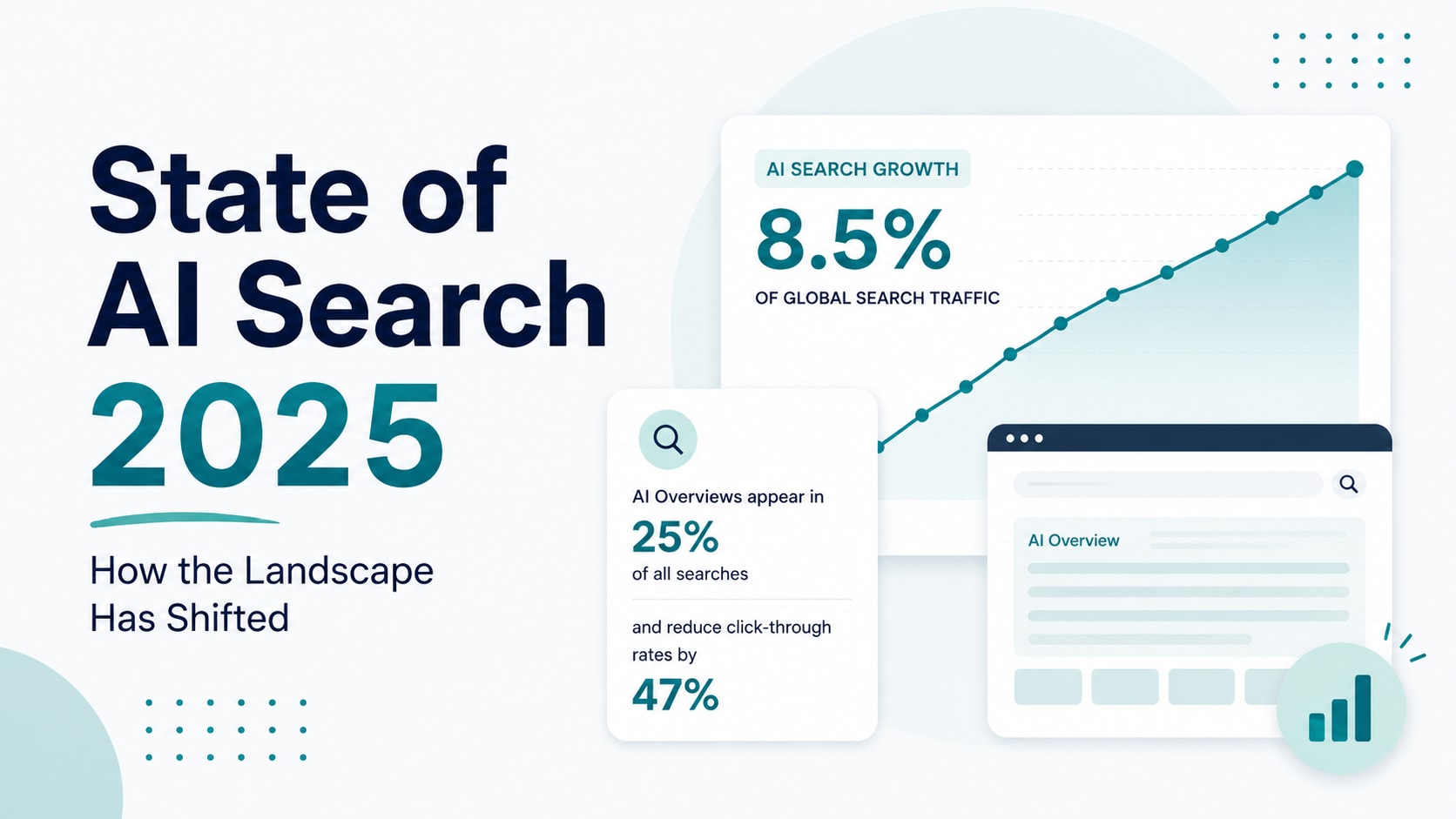
AI platforms now account for 8.5% of global search traffic, and their visitors convert at 4.4× the rate of traditional organic (Semrush, 2025). At the same time, Google AI Overviews appear in 25% of all searches and cut click-through rates by 47% when they do. This piece breaks down what shifted in 2025 across six AI platforms, what they actually cite, and what changes in 2026.
The number most marketers are misreading
As of October 2025, AI platforms collectively account for 8.5% of global search traffic, according to Similarweb. Google still holds 91.5%. Most marketing teams see that 8.5% figure and conclude the AI search story is overblown.
That reading misses what the 8.5% is doing.
Visitors arriving from AI platforms, ChatGPT, Perplexity, Gemini, convert at 4.4× the rate of traditional organic visitors, according to Semrush. These are not curious browsers. They are people who have already had a conversation with an AI, been pointed toward a specific answer, and clicked through to verify or act on it. By the time they land on a page, the decision is largely made.
Meanwhile, the zero-click problem is real and measurable. When Google serves an AI Overview, which now appears in 25.11% of all searches, per Conductor, users who see it click on a traditional search result in only 8% of visits. Users who don't see an AI Overview click through 15% of the time. That's a 47% reduction in click probability just from the presence of an AI summary.
The search landscape in 2025 is not AI replacing Google. It is AI intercepting the highest-intent queries before they become clicks, while simultaneously sending a smaller, far more qualified stream of visitors to content that gets cited.
Six platforms, six different citation logics
The single biggest mistake in AI search strategy right now is treating "AI search" as one channel. ChatGPT, Google Gemini, Perplexity, Grok, DeepSeek, and Microsoft Copilot each pull from different data sources, weight different signals, and send traffic in very different ways.
Platform | Monthly uniques | Data source | Top citation sources | Outbound referrals (2025) |
ChatGPT | 415M | Bing index | Reddit, Wikipedia, Forbes, Amazon | 4.1B visits |
Gemini | 117M | Google index | Google properties, Wikipedia, YouTube | 533M visits |
DeepSeek | 65M | Own index | Academic, technical sources | 131M visits |
Grok | 23M | X corpus | X posts, news, real-time sources | 71M visits |
Perplexity | 22M | Multiple indexes | Reddit, news, academic | 409M visits |
Microsoft Copilot | N/A | Bing + Microsoft 365 | LinkedIn (dominant for professional queries) | Low, closed ecosystem |
A few things worth noting from the table. Perplexity punches far above its user base on outbound referrals, its UX explicitly surfaces and links sources, so users expect to click through. Gemini's referral growth was nearly 400% year-on-year, but much of it is invisible in standard analytics because it registers as Google traffic rather than a distinct source. Copilot's referral volume is low, but its influence on enterprise purchasing decisions is disproportionately high, it operates inside closed Microsoft 365 ecosystems where decisions happen without a click.
Citation rates, brand mention patterns, and sentiment vary up to 615× across these platforms for the same brand, per Semrush research. A strategy optimised for one platform is structurally incomplete.
The prompt is not the keyword
The most consequential behavioural shift of 2025 is one that doesn't show up in search console data at all.
Traditional Google queries average 3.5 words. ChatGPT prompts average more than 10, and approximately 60% of all prompts are 10 words or longer, according to research published by Statista and Activate this year. This is not the same behaviour occurring in a different interface. It is a different behaviour entirely.
People use Google to navigate and retrieve. They use AI to think through decisions they haven't fully formed yet. The prompt "what CRM would you recommend for a 15-person B2B sales team that wants something simpler than Salesforce but more powerful than HubSpot Starter?" is not a search query with extra words. It is a reasoning request, and it arrives at the bottom of the funnel, not the top.
Statista data from 2025 shows that 68% of Americans use AI search to learn about a topic in general, 62% use it to retrieve a specific fact, and only 32% use it to find a specific website. The implication for any brand: AI is forming opinions about you before users ever navigate to you. What appears in those opinion-forming conversations is content that got cited, not content that ranked.
The further implication is generational. Among Millennials, 30% use AI tools for product research. Among Gen Z, 20%. Gen X sits at 13%, Baby Boomers at 12%. Brands whose buyers skew younger are already operating in an AI-first research environment for a meaningful share of their funnel. Brands whose buyers skew older have more time, but the window is compressing.
Walk-through: what a buyer's AI search journey looks like in 2025
Here is what the research actually describes when a mid-funnel buyer researches a purchase in 2025.
A marketing manager at a 40-person company wants to evaluate analytics tools. In 2022, she opens Google, types "best marketing analytics tools," scans the top results, visits three or four pages, and compares features.
In 2025, she opens ChatGPT and types: "I run marketing for a B2B SaaS company with about 40 people. We're outgrowing our current analytics setup. What should I look at, what are the tradeoffs, and what do companies our size usually end up regretting about their choice?"
ChatGPT generates an answer. It cites three or four sources, not necessarily the highest-ranking pages for "marketing analytics tools," but pages that contained direct, quotable answers structured clearly enough for the model to extract. The manager reads the summary, clicks one of the cited links to verify a specific claim, and has effectively pre-qualified two vendors before she opens Google at all.
When she does open Google, she's not browsing. She's navigating to a specific tool she already has a view on.
This is what the Pew Research Center data captures: users who encounter a Google AI Overview end their browsing session 26% of the time without clicking anything. The decision happened upstream, in a conversation the brand wasn't tracking.
The content that appeared in that ChatGPT answer was not the content with the most backlinks. It was the content with the clearest structure, the most direct answer in the first paragraph, and a specific verifiable claim the model could extract and attribute.
What AI models actually cite, and what they ignore
The Ahrefs finding from August 2025 is the one that most directly challenges current content strategy: approximately 80% of URLs cited in AI-generated answers are not in Google's top 100 organic results for the same query.
The Google ranking game and the AI citation game are largely separate competitions. Winning one does not reliably predict winning the other.
The Wix AI Search Lab analysed 253,000 websites between January 2024 and September 2025 to identify what structural signals correlate with AI visibility. High AI performers had 60% longer meta descriptions and 57% longer meta titles than average. They had higher SEO setup completion rates. They published to niche topics rather than broad ones. They updated content frequently, pages refreshed within two months earned 28% more AI citations than older content.
The referral source data adds another layer. A single referral visit from Notion in a given month increased a site's AI discovery rate by 28%, according to the Wix study. Medium presence increased visibility by 25%. Quora by 22%. Wikipedia by 19%. Reddit by 13%. LinkedIn by 12%. YouTube by 11%.
These are not organic SEO signals. They are signals that the content exists in the ecosystems AI models treat as authoritative, the platforms their training data weights most heavily. Content that lives only on a brand's own domain, however well-optimised, starts with a significant citation disadvantage compared to content that has been published, engaged with, or referenced on platforms the models already trust.
In terms of format, listicles account for 21.9% of AI citations. Articles account for 16.7%. Product pages account for 13.7%. Bottom-funnel content, comparison guides, pricing pages, case studies, earns the highest AI referral traffic of any content type. Top-of-funnel content explaining basic concepts is increasingly answered by the AI itself, without citing anyone.
The structural requirement that earns a citation is specific: a direct answer in the first paragraph (44.2% of all AI citations come from the first 30% of text), at least one verifiable data point, and heading hierarchy clear enough for the model to extract sections cleanly.
[What is GEO? The complete guide for marketers →]
The trust gap that nobody talks about
The adoption data for AI search is unambiguous. The trust data is more complicated, and it matters for how brands think about what AI search actually does to their reputation.
Overall, 54% of U.S. adults do not trust AI to make unbiased decisions, per YouGov and Statista research published in 2025. That figure rises to 65% among adults over 45. Among 18-to-29-year-olds, only 35% lack trust, meaning the cohort most likely to use AI search is also the cohort most likely to act on what it finds.
The multi-platform verification behaviour is important context here. In early 2025, 24% of U.S. consumers said they compared AI search results against traditional search engines. Another 17% went on to check the sources cited in the AI summary. This is not passive consumption. A meaningful portion of AI search users treat it as a starting point for a research process, not an ending point.
What this means practically: AI search shapes the frame of a buyer's research even when they ultimately verify the answer elsewhere. The brand that appears in the initial AI response, even if the buyer clicks through to verify, has set the terms of the conversation. The brand that doesn't appear has to overcome a frame that was set without them.
The Lululemon case documented in 2025 illustrates the dynamic clearly. AI models were consistently surfacing criticism about fabric pilling when users asked about Lululemon quality. The response that worked was not counter-messaging. It was a sustained body of thought leadership content about garment care, how to wash athletic wear, which fabrics to avoid washing together, why fabric softeners cause damage. Over time, Reddit threads shifted. The community began generating positive signals about fabric durability. AI models drawing from that more recent corpus started presenting a more balanced picture.
The mechanism is slow and requires genuine content investment. But it is the only mechanism that works at scale, because AI citation behaviour responds to the weight of evidence across sources, not to a single authoritative page.
What shifts in 2026
The trajectory from 2025 data points in a few clear directions.
Personalization will complicate everything. Gemini already draws on Gmail, Google Calendar, Chrome history, and Maps activity to personalise responses. A user who once complained about a brand in a Google Meet transcript may receive deprioritised recommendations for that brand regardless of how well the brand has optimised for AI visibility. Meta's AI, drawing from WhatsApp, Instagram, and Facebook data, will introduce the same dynamic at an even more intimate data layer. Brand authority will increasingly compete with personal data signals that brands cannot see or influence.
Agentic search will change what "citation" means. ChatGPT, Perplexity, and Claude all released or announced AI-native browsers in 2025. When an AI agent browses the web on a user's behalf, booking a flight, comparing insurance quotes, researching a vendor, the visit may never appear in referral analytics at all. The LLM visits the page, extracts the relevant information, and returns an answer. The brand receives a crawl, not a session. Measurement frameworks built around sessions and referrals will miss this traffic entirely.
The search volume forecast is directional. Gartner projects traditional search engine volume will drop 25% by 2026 as users shift to generative AI assistants. Research from Semrush suggests AI-powered search could match traditional search in economic value, even at lower volume, as early as Q4 2027, driven by the conversion rate differential. By 2030, most forecasts place AI-driven search at over 50% of global query volume.
Weekly monitoring is the minimum viable cadence. Citation share, brand mentions across AI platforms, and AI referral traffic can shift significantly within a month. One study documented a brand losing a third of its AI search presence in five weeks. Quarterly SEO reporting cycles are insufficient for a channel that moves this fast.
The search landscape did not collapse in 2025. It bifurcated. One track still runs through Google, where traditional ranking signals determine visibility. The other track runs through AI models, where content structure, platform distribution, and citation authority determine whether a brand appears in the conversations that shape decisions before anyone opens a browser.
Both tracks matter. They require different inputs, different metrics, and, increasingly, different content strategies to win.
Not sure where your brand stands across these six platforms? Run a free GEO audit to see how you're performing, which platforms cite you, which cite your competitors, and where the gaps are.
Sources: Ahrefs (August 2025), Semrush, Conductor (September 2025), Pew Research Center, Similarweb, Statista/Activate, YouGov, Wix AI Search Lab (September 2025), Datos, Position.Digital (2026), Whitehat SEO, Superlines.
Written by

Kaavya has been building at the edge of the internet since 2016, starting in crypto, founding Lumos Labs, a web3 education platform and eventually co-founding Scribble, a creator marketing platform helping brands get discovered by AI search engines. At Scribble, she leads community and growth across a network of 50,000+ creators running GEO campaigns for 100+ brands. Her obsession: figuring out how content actually gets cited by LLMs, and building the infrastructure to make it happen at scale. When she's not deep in distribution strategy or vibe-coding tools, she's in Bangalore, probably being supervised by two Shih Tzus named Mushu and Milo.