There's a version of your brand that exists inside ChatGPT, Perplexity, and Google AI Overviews right now. The question is whether it's accurate, visible, or even there at all.
That's what Generative Engine Optimization is about. Not rankings. Not clicks. Whether AI systems trust your content enough to use it when someone asks a question you should be answering.
This guide breaks down what GEO actually is, why it matters for marketers specifically, how it differs from everything you've done before, and what it practically takes to show up.
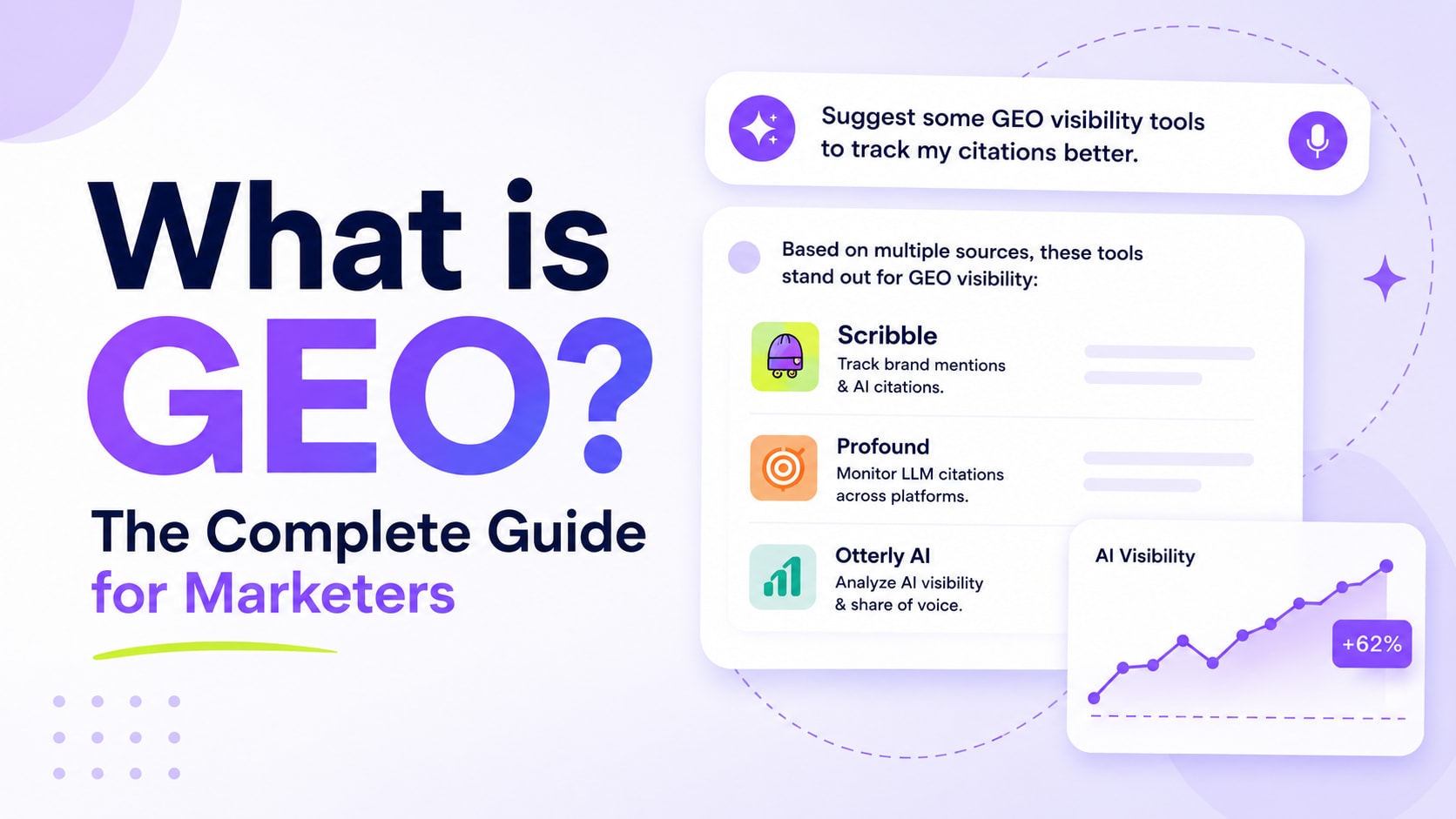
What is GEO (Generative Engine Optimization)?
Generative Engine Optimization (GEO) is the practice of structuring your content and online presence so that AI-powered search engines understand, trust, and cite you when generating answers for users.
When someone asks ChatGPT "what's the best project management tool for remote teams" or asks Perplexity "which protein powder is good for women over 50," those systems don't return a list of links. They generate a synthesized answer, pull from multiple sources, and name a small set of brands and references they consider credible. GEO is the discipline of making sure your brand is one of those names.
The term was formally defined in a peer-reviewed study by researchers at Princeton, Georgia Tech, and IIT Delhi (Aggarwal et al., KDD 2024), which proved that targeted GEO methods can boost content visibility in AI-generated answers by up to 40%.
Why GEO Matters Right Now
AI search is not a future trend. It's the current reality and the 2025 data makes the scale of the shift impossible to ignore.
Here's how the landscape has shifted →
ChatGPT crossed 900 million weekly active users (OpenAI, February 2026)
Google AI Overviews now appear in approximately 54% of all Google searches globally (Nobori, April 2026)
AI chatbot referral traffic reached 1.1 billion visits in June 2025, a 357% increase year-over-year (Similarweb, 2025 Generative AI Report)
AI-referred sessions jumped 527% year-over-year in the first five months of 2025 and more in 2026
Here's what makes this genuinely different from previous search shifts: when AI systems answer a question, they typically cite two to eight sources. Not ten, not twenty. If your brand isn't one of them, a competitor is.
The conversion numbers make the stakes even clearer. LLM-referred visitors convert at 15.9% from ChatGPT and 10.5% from Perplexity, compared to just 1.76% for traditional Google organic traffic (Seer Interactive, June 2025). People who find your brand through an AI-generated answer are already deep in the consideration process. The AI already pre-qualified your product. That's a very different kind of visitor than someone clicking a blue link.
How is GEO Different from SEO?
SEO and GEO share a foundation but optimize for completely different outcomes. SEO gets you a high position in a list of links. GEO gets you named inside the answer itself. That's a meaningful distinction.
One number worth internalizing: 80% of URLs cited by AI platforms do not rank in Google's top 100 results for the same query (Ahrefs, August 2025). The two visibility surfaces simply don't correlate the way most marketers assume.
What Changes | Traditional SEO | GEO |
Primary goal | Rank pages high in organic results | Be cited in AI-generated answers |
Success metric | Rankings, clicks, traffic | AI citations, brand mentions, share of voice |
Optimization unit | Keywords, backlinks, pages | Entities, questions, content chunks, authority signals |
Content strategy | Target keywords, build topic clusters | Map natural-language questions, cover full intent space |
Structure emphasis | On-page basics, crawlability | Self-contained paragraphs, FAQs, comparison tables |
Where credibility comes from | Domain authority, backlinks | Consistent mentions across trusted platforms |
Where users encounter you | They click through to your site | AI names you inside the response |
The core SEO fundamentals still apply — fast site, clean technical setup, quality content. GEO builds on that foundation. But it shifts what you're optimizing for and where your brand needs to exist on the web.
How AI Systems Actually Read Your Content
When an LLM reads your site, it doesn't see your design, animations, or formatting. It sees text and structure: basically headings, lists, links, and structured data. Content is broken into chunks, converted into vectors, and stored so the model can retrieve relevant passages when generating an answer. This process is called Retrieval-Augmented Generation (RAG), formalized in a 2020 NeurIPS paper by Lewis et al.
The practical implication is that AI systems pull individual passages, not entire pages. Research confirms that 44.2% of all LLM citations come from the first 30% of a piece of content (Superlines, analysis of 34,234 AI responses, January–February 2026). Your opening isn't a warm-up. It's prime citation real estate.
A paragraph that contains a complete idea, a definition, a comparison, a specific fact, can be lifted and used directly. A paragraph that only makes sense in context of the paragraph above it is much harder to extract cleanly. Pages with well-organized headings are 2.8x more likely to earn citations in AI search results (AirOps, 2025).
AI systems also look for consistency. If your homepage says your product does X and your blog says it does Y, that creates uncertainty. Systems that aggregate across sources will find the conflict and deprioritize your domain as a reliable reference.
What Signals Do AI Systems Use to Decide Who Gets Cited?
There are a few consistent patterns in what gets cited and what doesn't.
Extractability
Content that answers a specific question clearly and early in a section gets pulled more often. The first one to two sentences of each section carry the most weight, that's where the answer is. Everything after is elaboration.
Authority Signals Across Platforms
AI systems don't all look at the same sources. The most comprehensive breakdown comes from a Profound study of 680 million citations across ChatGPT, Google AI Overviews, and Perplexity
Platform | Top Citation Sources |
ChatGPT | Wikipedia (7.8%), Reddit (1.8%), Forbes (1.1%), G2 (1.1%) |
Google AI Overviews | Reddit (2.2%), YouTube, established editorial publications |
Perplexity | Reddit (6.6%), YouTube (2.0%), Gartner (1.0%), LinkedIn (0.8%) |
What this means practically: a brand that only exists on its own website is harder for AI to verify as credible. Presence across the platforms these systems actually pull from isn't optional.
Entity Clarity
AI needs to categorize you accurately. Your brand description should be consistent across your site, LinkedIn, Crunchbase, G2, and any third-party directories. If these descriptions conflict, AI systems default to brands where it isn't ambiguous.
Structured Data
Schema markup (JSON-LD) gives AI systems a machine-readable layer confirming what each page contains. FAQPage schema for Q&A sections, Article schema for editorial content, Organization schema for your brand entity. These aren't ranking hacks, they're consistency signals that make your content easier to trust and interpret. Google's own May 2026 AI optimization guide confirms structured data remains a useful part of overall SEO strategy, even if it isn't strictly required for AI citation.
Freshness
Perplexity's freshness sensitivity is significant. Content updated within 30 days earns an 82% citation rate, dropping to 37% for older content. Seer Interactive found that 85% of AI Overview citations were published within the last two years, with recently updated content appearing 4.3x more often.
How to Actually Do GEO: A Practical Approach
Step 1 - Start from Questions, Not Keywords
Instead of building a keyword list, map the exact natural-language questions your audience would type into an AI assistant. Not "project management software" but "what's the best project management tool for a team of 10 people." These are fundamentally different queries, and AI systems respond to the latter.
Pull these questions from People Also Ask, your own support tickets, community forums, Reddit threads in your niche, and by querying AI tools directly about your category. Cluster them by intent:
Intent Type | Example Query |
Definition | "What is generative engine optimization?" |
Comparison | "GEO vs SEO — what's the difference?" |
How-to | "How do I get cited in Google AI Overviews?" |
Use case | "How does GEO work for B2B SaaS brands?" |
Pricing / tools | "What tools help with AI search visibility?" |
Step 2 - Build Content That Answers Each Question Directly
The structure that works for AI citation: answer first, elaborate second. Lead each section with a direct two to three sentence answer to the question the heading poses. Don't bury the answer. State it, then expand.
Use H2 and H3 headings framed as explicit questions. Include a FAQ section, Q&A blocks are among the most extractable content formats. Comparison tables are also valuable: comparison articles lead all content types with 32.5% of AI citations (Previsible, 2025 AI Traffic Report).
Every key paragraph should make sense if you read it completely out of context. That's the test. If it only makes sense because of what came before, restructure it.
Step 3 - Build Presence Beyond Your Website
Your website alone is not enough. AI systems discover brands through the broader web. Off-site content isn't a nice-to-have, it's how AI systems corroborate that your brand is real, credible, and relevant.
Reddit threads in your category, YouTube content demonstrating expertise, LinkedIn articles, G2 reviews, industry publications, all of these create a pattern of presence that AI systems pick up on. Scribble.network helps brands build exactly this kind of structured, distributed content presence at scale, connecting them with a creator network publishing across Medium, Substack, Reddit, LinkedIn, and Paragraph, specifically targeting AI citation.
Step 4 - Keep Your Entity Consistent Everywhere
Pick a consistent way to describe what you do and use it everywhere. Same category, same value proposition, same key claims, across your site, your LinkedIn about section, your Crunchbase profile, your G2 listing. If these descriptions conflict, AI systems have less certainty when deciding whether to cite you.
Step 5 - Measure What's Actually Happening in AI
Traditional analytics won't show you this. GA4 doesn't track AI citations. You need to manually query your target topics in ChatGPT, Perplexity, and Google AI Overviews and record whether and how you appear. Do this regularly, track competitors, and treat it like a channel with its own reporting.
Metric | What It Measures | Why It Matters |
Citation frequency | How often you appear for target prompts | Your baseline AI visibility |
Share of voice | Your citation rate vs. competitors | Competitive positioning in AI answers |
Sentiment | Whether AI describes you positively or negatively | High citation rate with negative framing is still a problem |
Prompt coverage | Which queries trigger your citation | Reveals gaps and opportunities |
What Google's May 2026 AI Guide Actually Says
In May 2026, Google published its official guide to optimizing for generative AI features in Search — their first formal statement on AEO and GEO as a category. The core message is simple: GEO is SEO, not a separate discipline. Their AI Overviews and AI Mode are built on the same core ranking and quality systems as traditional search.
What Google says to focus on:
Non-commodity content with a unique point of view - first-hand reviews, original experience, expert takes that go beyond what anyone else has published
Clear technical structure - crawlable pages, good page experience, semantic HTML where practical
Content written for your human audience, not engineered for AI extraction
What Google explicitly says to ignore for AI Overviews:
llms.txt files - not treated in a special way
Manual content "chunking" - their systems understand nuance across a full page
Rewriting content specifically for AI - their systems understand synonyms and general meaning
Pursuing inauthentic mentions - their spam systems are built to catch this
One important nuance: this guidance applies specifically to Google's AI Overviews and AI Mode. For Perplexity, ChatGPT, and Claude - which pull from the broader web using their own retrieval systems - structured content, answer-first paragraphs, and off-site presence still matter significantly, as the platform data throughout this article shows.
The practical takeaway: don't build a separate GEO content strategy. Build better content, structured more clearly, with a genuine point of view. That wins in Google's AI features and gives you the strongest foundation for citation everywhere else too.
The Content Formats AI Cites Most
Content Format | Why It Gets Cited | Best Used For |
Comparison articles / tables | Lead AI citations at 32.5% of all cited content | Tool, category, and approach comparisons |
Definition paragraphs | Self-contained, extractable without context | "What is X" queries |
Step-by-step numbered lists | Easy to extract as structured answers | How-to and process queries |
FAQ blocks | Mirror exactly how AI constructs answers | High-volume informational queries |
Original data and research | Forces AI to cite you as the primary source | Benchmark and trend queries |
What doesn't get cited: long editorial paragraphs that mix multiple ideas, content requiring a previous section to make sense, and anything behind a login or form, invisible to AI crawlers entirely.
GEO Implementation Checklist for Marketers
Area | Action |
Core pages | Answer a specific AI query per page, clear H1, H2/H3s as questions, answer-first sections |
Structured data | Organization schema (homepage), Article/BlogPosting (editorial), FAQPage (Q&A), HowTo (guides) |
Off-site presence | Active on Reddit, YouTube, LinkedIn, G2 platforms AI systems actually cite |
Monitoring | Weekly prompt testing across ChatGPT, Perplexity, and Google AI Overviews |
Entity consistency | Same description across site, LinkedIn, Crunchbase, G2, and all relevant directories |
Freshness | Update key pages regularly - 85% of AI Overview citations are less than 2 years old |
Technical access | Verify robots.txt allows OAI-SearchBot, PerplexityBot, and Claude-SearchBot |
Frequently Asked Questions
What is GEO in marketing?+
GEO (Generative Engine Optimization) is the practice of structuring content and online presence so that AI-powered search engines like ChatGPT, Perplexity, and Google AI Overviews cite your brand when generating answers for users. The discipline was formalized in a 2024 research paper from Princeton, Georgia Tech, and IIT Delhi , which showed that specific optimization strategies can increase content visibility in AI answers by up to 40%.
Is GEO replacing SEO?+
No. GEO builds on SEO fundamentals, technical accessibility, quality content, authority signals but shifts the target from ranking in link lists to being cited inside AI-generated answers. Google's own May 2026 guidance confirms this: optimizing for AI search is still SEO. Both matter in 2026 and beyond.
How do I know if my content is being cited by AI?+
Manually query your target topics in ChatGPT, Perplexity, and Google AI Overviews. Track whether and how your brand appears. Tools like GEO Checker score your content's AI-readability out of 100 across six structural properties that correlate with citation frequency and show you the specific gaps between your content and what's currently being cited for your target query.
What content formats get cited most by AI?+
Comparison articles lead with 32.5% of all AI citations, Self-contained definition paragraphs, direct Q&A blocks, and step-by-step how-to sections also perform consistently. Content with verifiable statistics and named citations achieves 30-40% higher AI visibility than unoptimized content.
How long does GEO take to show results?+
Initial improvements appear within two to four weeks for well-optimized content. Perplexity responds fastest due to its freshness bias. Building consistent visibility across all major AI platforms typically takes 60 to 90 days.
Does my brand need to be large to show up in AI answers?+
No. 80% of URLs cited by AI platforms don't rank in Google's top 100 meaning AI visibility and traditional domain authority are largely independent. A focused brand with strong entity clarity, well-structured content, and genuine off-site presence can outperform larger brands with scattered or inconsistent information. GEO is still early enough that most brands haven't taken it seriously yet. The ones building for it now are going to have a significant head start by the time AI search becomes the default starting point for most discovery. Run a free GEO audit on your brand to see where you currently stand - GEO Checker
Written by

I’m Tanmay Tarte, a community builder at Scribble and an engineering graduate from Priyadarshini College of Engineering. Over the years, I’ve worked across community management, content, hosting, and social media, mainly within the Web3 and creator ecosystem space. Outside of work, I’m a huge sports enthusiast and can genuinely play cricket all day, every day.