Bitcoin is no longer just a passive asset.
A new narrative is emerging around agentic Bitcoin, where BTC evolves from being held to being actively deployed across programmable systems, native infrastructure, and self-custody yield mechanisms.
To explore this shift, Scribble Network partnered with Tachi for the Tachi 1.0 Bounty. The focus was clear. Creators were asked to explore forward-looking ideas around BTCfi, agentic execution, native rails, and programmable Bitcoin infrastructure.
You can explore more ongoing initiatives here: Scribble Bounties
The response reflected exactly what the brief aimed for. Submissions were not surface-level summaries. They were thoughtful, thesis-driven explorations of where Bitcoin is heading.
The winners were announced across two threads, with no rankings. Each standout was recognised for clarity, originality, and depth of thinking.
Why Agentic Bitcoin Matters
For most of its history, Bitcoin has been treated as a store of value. Its strength has come from security and decentralisation, but this has also limited how it can be used.
Attempts to extend Bitcoin’s utility have often introduced tradeoffs. Solutions that increased programmability frequently required users to sacrifice sovereignty, trust assumptions, or security guarantees.
This is where the idea of agentic Bitcoin becomes important.
Agentic systems allow Bitcoin to remain self-custodied while enabling active participation in financial systems. Instead of relying on external layers or custodial bridges, the focus shifts to native infrastructure and programmable rails that preserve Bitcoin’s core properties.
This changes how capital behaves. BTC is no longer idle. It becomes active, responsive, and integrated into broader financial logic without compromising its foundational principles.
What Is Tachi?
Tachi is building infrastructure to enable this transition.
The focus is on creating native rails for Bitcoin, allowing programmable interactions without introducing the typical tradeoffs seen in earlier attempts. This includes enabling self-custody yield, agentic execution, and composable financial primitives directly aligned with Bitcoin’s architecture.
Rather than treating Bitcoin as something that needs to be adapted externally, Tachi approaches it as a system that can evolve from within.
This makes it central to the emerging BTCfi narrative, where utility and sovereignty are no longer in conflict.
Tachi 1.0 x Scribble Bounty Winners
The Tachi 1.0 winner announcement from @scribble_dao was split across two threads published on February 16 and 17, 2026. Instead of ranking submissions, Scribble highlighted standout entries that demonstrated strong thinking, clear narratives, and a deep understanding of agentic Bitcoin and native infrastructure.
Check out Part 1 of the announcement here.
Check out Part 2 of the announcement here.
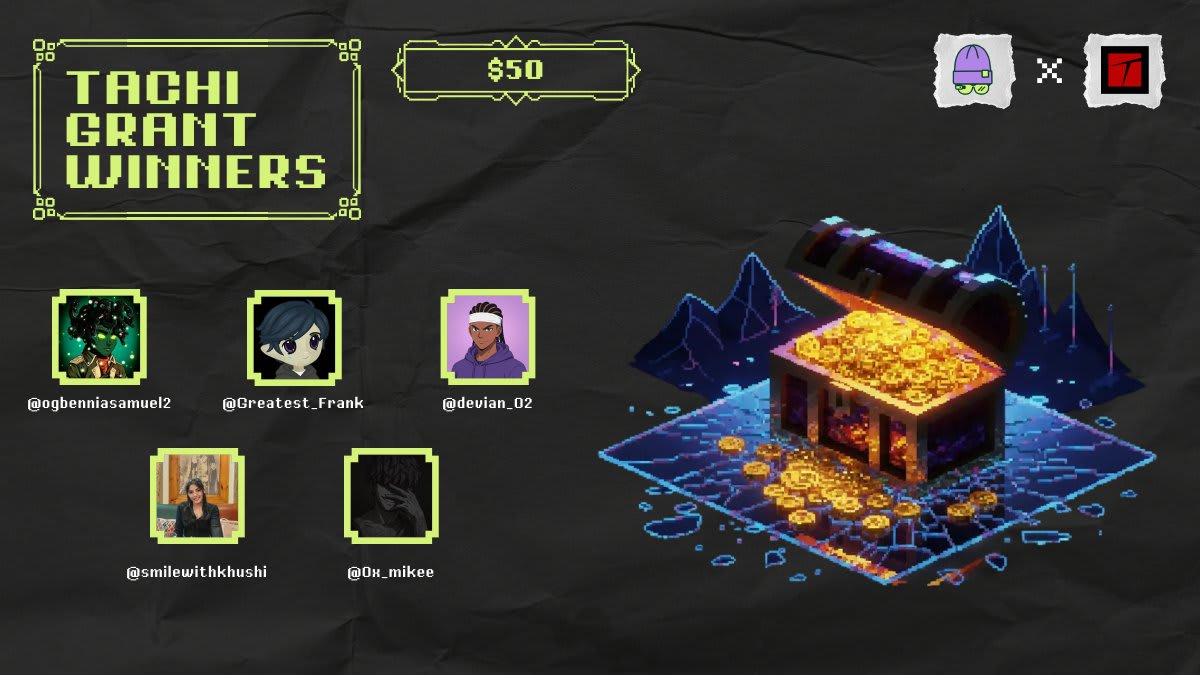
Each winner was quoted directly in the thread, with commentary on why their submission stood out.
@ogbenniasamuel2
This submission clearly articulated the shift from passive holding to active deployment. The narrative made the idea of agentic Bitcoin intuitive without oversimplifying the underlying concepts. Read the submission here.
@Greatest_Frank
Franklin connected technical milestones to broader behavioral shifts. The submission stood out for framing how infrastructure changes influence how capital moves. Read the submission
@devian_02
This entry focused on execution. By breaking down the staged rollout of infrastructure, it made an abstract vision feel tangible and achievable. Read the submission.
@smilewithkhushi
Khushi’s submission connected historical attempts at extending Bitcoin’s utility with the current shift toward agentic systems. The focus on trust tradeoffs added depth to the narrative. To read the submission click here.
@0x_mikee
This article stood out for its clarity. It explained why existing constraints limit Bitcoin’s utility and why agentic systems require native rails to function effectively. Read the submission here.

@Asodiqu_1
This submission used a clear before-and-after framing to explain the tradeoff between sovereignty and utility, making the solution easy to understand. Read the submission here.
@louis_d_great
The use of a structured hook made the thesis accessible. It simplified a complex idea without losing depth. Read the submission here.
@ImarhiaVeraa
This entry stood out for its use of data. By quantifying idle capital, it made the need for BTCfi solutions concrete and measurable. Read the submission
@Web3Cheff
This submission used comparative framing effectively. The contrast between Bitcoin’s market cap and BTCfi activity highlighted the scale of untapped potential. Read the submission here.
@Rexzie_Fran
Rexzie’s submission approached the topic from first principles. It argued that Bitcoin is the natural foundation for agentic finance, grounding the thesis in core properties. Read the submission here.
Key Takeaways
The Tachi 1.0 bounty highlights a clear evolution in how Bitcoin is being understood.
The narrative is shifting from passive storage to active participation. Bitcoin is no longer seen only as a store of value. It is increasingly viewed as a base layer for programmable financial systems.
This shift depends on infrastructure. Without native rails, the tradeoffs remain. With them, Bitcoin can support new forms of interaction while preserving its core properties.
The submissions reflect this transition. They move beyond describing features and instead focus on how systems behave, how capital flows, and how users interact with emerging primitives.
Conclusion
The Tachi 1.0 x Scribble Bounty winners provide a clear signal of where Bitcoin is heading.
Through their work, they show how concepts like agentic Bitcoin, native infrastructure, and programmable rails are shaping the next phase of BTCfi. These ideas move Bitcoin beyond passive holding and into active participation, without compromising self-custody or security.
With projects like Tachi building foundational infrastructure, and platforms like Scribble Network surfacing high-quality, forward-looking insights, the direction becomes increasingly clear.
Bitcoin is becoming programmable, composable, and agent-driven.
Written by

Hi! I’m Mrinalini. I work on growth at Scribble, where my days mostly revolve around content, planning campaigns, speaking to creators, and occasionally yapping in front of a camera. I studied engineering at Manipal Institute of Technology and briefly worked as a Test Engineer at Siemens before realizing marketing was my calling. Outside of work, you’ll find me eating/thinking about food.