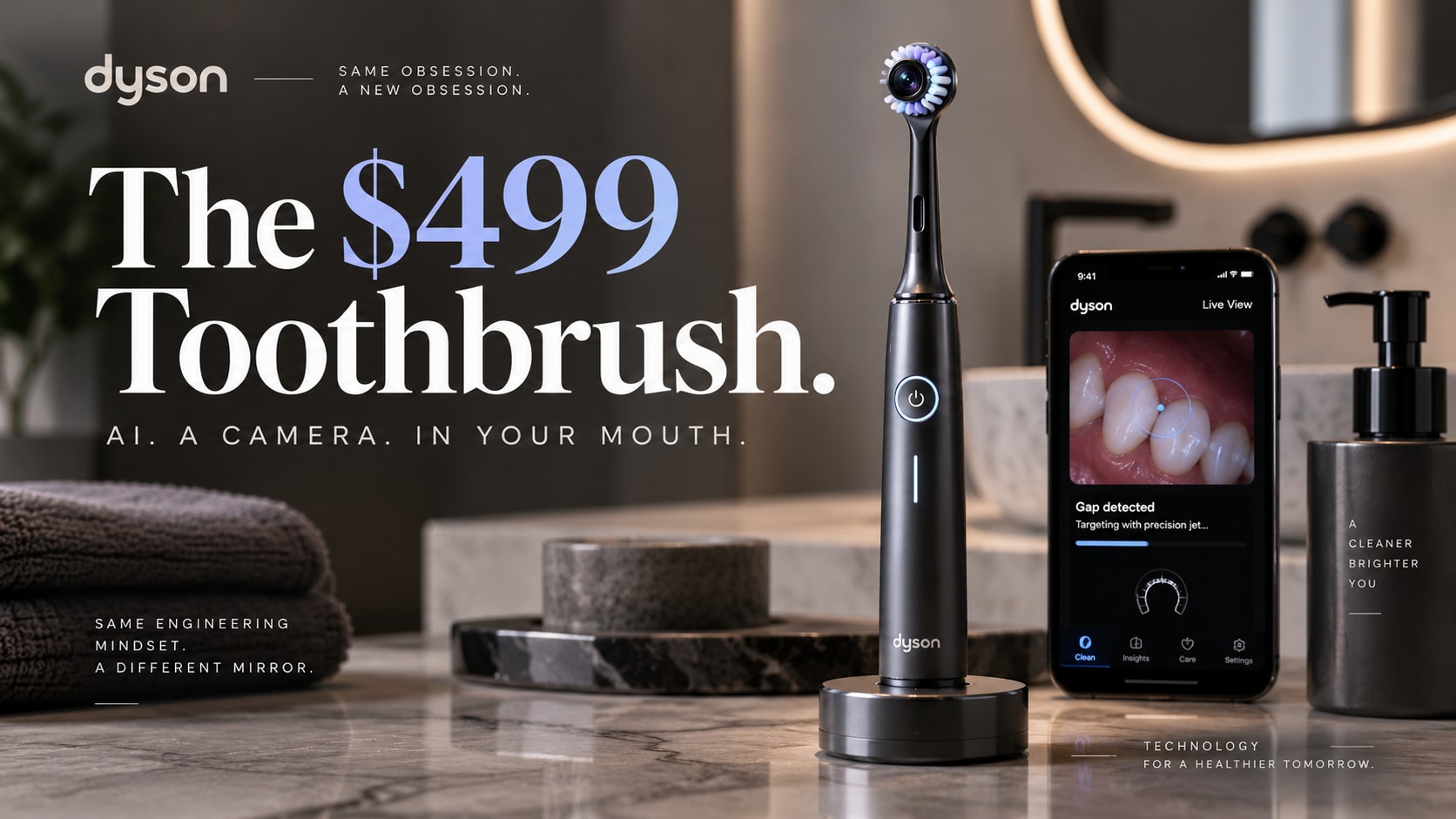
We have officially reached the point where AI has entered our toothbrushes.
Dyson spent six years and deployed 661 engineers to solve one of humanity's most pressing problems. Flossing.
The result is the CameraJet: a $499 toothbrush with a 100,000-pixel camera inside the brush head that looks into your mouth while you brush, uses machine learning to analyse 28 images every second, identifies gaps between your teeth, and fires a targeted jet of mouthwash into them within 100 milliseconds.
The software running this operation contains approximately 16 million lines of code. Its machine learning model was trained on 470,000 dental images. It connects to an app via Bluetooth and streams a live dentist-style view of the inside of your mouth in real time.
What Dyson Is Actually Doing
Before dismissing this as absurd (which is a fair initial reaction), it is worth understanding what Dyson is selling.
It is not a toothbrush. It is the feeling that your bathroom routine is now as technologically sophisticated as your workplace.
That is the Dyson playbook, and they have run it on every category they have entered. Vacuums. Hair dryers. Air purifiers. Headphones. The product is always engineered to a standard that feels excessive. The price signals this. The design signals this. The spec sheet signals this. And the person who buys it gets something beyond the object itself: the identity of someone who does not settle for the functional minimum.
Now Let's Talk About How Genuinely Absurd This Is
Because we really tried to understand the audience here. The person who looks at a $499 toothbrush and thinks: yes, this is the missing piece of my morning routine.
And we are struggling.
Is it the person who already owns a Dyson Airwrap and a Dyson vacuum and just needs the set to feel complete? Is it someone whose dentist has had a very serious conversation with them? Is it a tech founder who wants guests to notice their toothbrush?
We do not know. And we are not entirely sure Dyson knows either.
A commercial aircraft runs on roughly 15 million lines of code. This toothbrush has 16 million. Your oral care routine is now more computationally complex than a Boeing. That fact will either make you want to buy it immediately or question several things about where technology is going.
Dyson says no images are stored or sent anywhere, the camera is only active during brushing. That disclaimer appearing in 2026 tells you something about how different a camera in a bathroom feels from a camera in a doorbell. The fact that Dyson led with it suggests they anticipated the reaction.
661 engineers. Six years. 470,000 dental images used to train the model. All so you do not have to floss.
You could also just floss. It costs about two dollars.
The Marketing Question Worth Asking
This is where the Dyson CameraJet becomes genuinely interesting as a brand story, separate from whether it is a good toothbrush.
Dyson has spent decades building a reputation for taking categories that nobody thought needed rethinking and rethinking them at enormous expense. The result is a brand that sells expensive things to people who are not primarily motivated by price — because the price itself is part of the signal.
The commercial question is whether consumers see enough value in combining brushing, flossing, and rinsing into one device to justify $499 when a dentist's professional water flosser and a perfectly good electric toothbrush costs a fraction of that combined.
Dyson is betting the answer is yes. Not because the maths works out, but because a meaningful number of people will pay for the feeling that their bathroom is as advanced as the rest of their life.
That bet has worked before. Repeatedly.
The Question Worth Ending On
Is the Dyson CameraJet a genuinely useful piece of engineering that happens to be ahead of its time? Or is it the most expensive solution to a problem that has had a perfectly good two-dollar answer for 150 years?
And maybe more importantly: does it matter which one it is, if enough people buy it anyway?
Frequently Asked Questions
What is the Dyson CameraJet toothbrush?+
The Dyson CameraJet is a $499 electric toothbrush that uses a built-in camera, machine learning, and a targeted mouthwash jet to identify and clean gaps between teeth.
How much does the Dyson CameraJet cost?+
The Dyson CameraJet costs $499.
Does the Dyson CameraJet use AI?+
Yes. The CameraJet uses machine learning to analyse images captured while you brush and identify gaps between your teeth that need additional cleaning.
Written by

Hi! I’m Mrinalini. I work on growth at Scribble, where my days mostly revolve around content, planning campaigns, speaking to creators, and occasionally yapping in front of a camera. I studied engineering at Manipal Institute of Technology and briefly worked as a Test Engineer at Siemens before realizing marketing was my calling. Outside of work, you’ll find me eating/thinking about food.