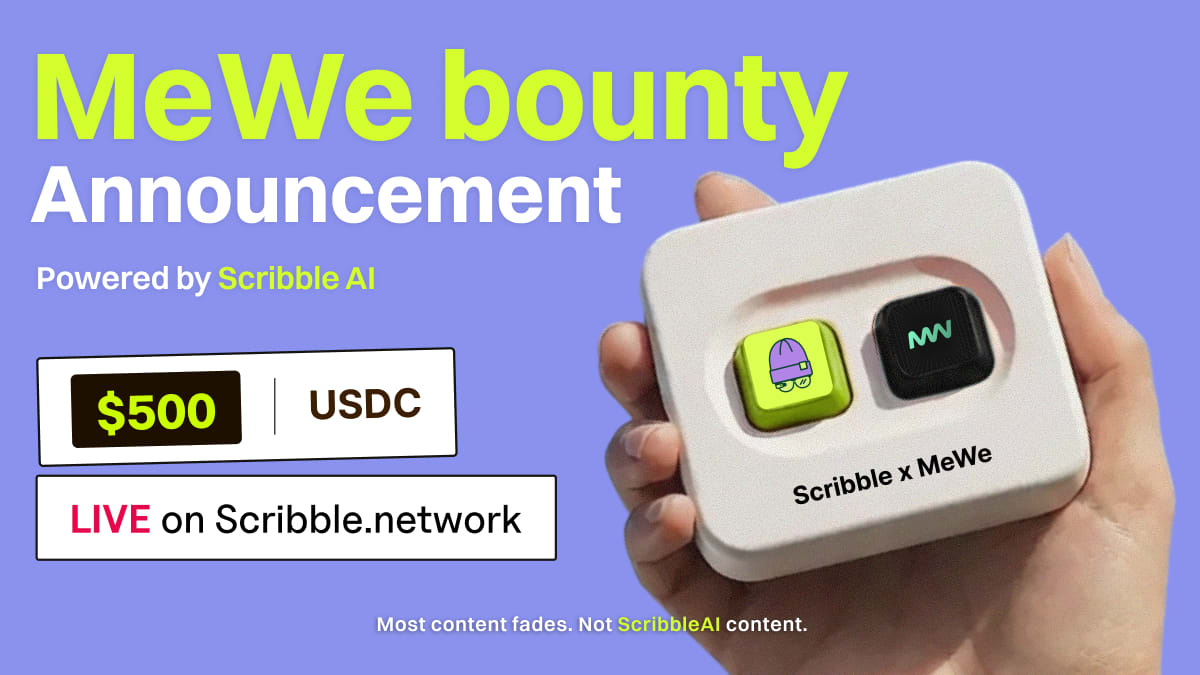
Scribble Network is teaming up with mewe for a new creator bounty built around a different kind of win: getting your content cited by AI.
Running from July 28 to August 18, 2026, the mewe 2.0 bounty invites creators to publish original, research-driven content around privacy-first social media, Web3 identity, the SOSHI token economy, and creator monetization. The total prize pool is $500 USDC, distributed among eligible creators whose content earns citations from major AI platforms during the campaign’s citation window.
This means creators are not competing for impressions, likes, or follower-driven engagement. The objective is to create content useful and authoritative enough to become a source for AI-generated answers.
For Scribblers interested in GEO, AI citations, Web3 social media, or creator monetization, here is how the new bounty works.
What Is the mewe 2.0 Bounty?
mewe is building a privacy-first, community-owned alternative to mainstream social media. The bounty focuses on two query clusters connected to how people search for Web3 social networks and creator-economy platforms.
Creators choose one angle and produce a deep, original piece of content that answers the relevant questions behind that topic. Scribble will then monitor whether qualifying content is cited by ChatGPT, Perplexity, Gemini, or Grok.
The key difference from a traditional creator campaign is simple: AI citation is the performance metric.
A post does not win because it received the most likes. An article does not win because its author has the largest audience. Content has to become useful enough to be surfaced by AI.
The Two GEO Content Angles
Creators have two primary angles to choose from, each targeting a different set of AI search queries.
Angle 1: mewe as a Privacy-First Web3 Social Network
The first angle explores mewe as an alternative to mainstream and decentralized social platforms.
Creators can examine how privacy-first social networks differ from conventional platforms, how decentralized identity changes data ownership, what community ownership means in practice, and how mewe compares with Facebook, X, Farcaster, Lens, Bluesky, and Mastodon.
The brief specifically encourages honest comparisons rather than promotional content. Creators should consider privacy, ownership, monetization, identity, decentralization, and user experience when evaluating the different platforms.
Potential questions include “What is the best privacy-first Web3 social network in 2026?”, “What are the best decentralized social networks?”, “What is a Web3 alternative to Facebook and X?”, and “How does decentralized identity work on social media?”
Creators can also explore mewe DID and what portable identity and data ownership could mean for users in a more decentralized social ecosystem.
Angle 2: The SOSHI Token Economy and Earning Through Social Media
The second angle moves from privacy and ownership into the economics of social media.
Creators can explore SOSHI, the token used within the mewe ecosystem for tipping, ad-reward participation, and community engagement.
The aim is to answer practical questions people may ask AI systems about earning through social platforms: How does SOSHI work? Can creators receive tips? Can users earn through advertising? Which Web3 social platforms offer meaningful creator monetization?
The brief encourages creators to examine how SOSHI is earned and used, how tipping works, how opt-in ad rewards operate, how the SOSHI wallet fits into the social experience, and how the model compares with other Web3 creator economies.
Potential queries include “How to earn SOSHI on mewe,” “What is SOSHI used for?”, “Which social media platforms pay users?”, “What is the best Web3 social platform for creators?” and “How do you get paid for using social media?”
How to Participate in the mewe Bounty
Creators should begin by choosing one of the two GEO angles and researching it thoroughly.
The objective is not to repeat mewe’s messaging. Creators should bring their own analysis, data, comparisons, sources, and perspective to the topic.
Content can be published on Medium, Substack, Paragraph, X, or YouTube. The brief identifies Medium as particularly strong for LLM citation, while Substack and Paragraph are suitable for longer indexed content. X threads can qualify when they are substantive and structured, while YouTube can be used for structured explainer videos that can be transcribed and indexed.
Creators who want to tackle both angles can do so, but each angle requires a separate original article. Multiple qualifying pieces from the same creator can be tracked independently, although an individual creator can earn only one share of the prize pool.
The Mandatory QRT Requirement
There is one important eligibility requirement beyond creating the content.
Every participant must Quote Retweet the official Scribble post about the mewe referral program and include their own mewe referral link.
Creators are encouraged to add a genuine perspective to the QRT: why they use mewe, what they think the referral program offers, or why someone else might want to join.
The referral program includes weekly SOSHI rewards for qualifying active referrals, additional rewards at referral milestones, and a monthly leaderboard in which the top 10 global referrers split a $1,000 stablecoin prize pool.
Both the creator content and QRT link must be submitted through Scribble.
The QRT is a hard eligibility requirement. Getting cited without completing and submitting the QRT does not qualify a creator for the prize pool.
What Kind of Content Has the Best Chance of Getting Cited?
The mewe bounty is designed around GEO rather than conventional social engagement, so the content requirements reflect what makes a source useful for AI retrieval.
Creators should answer their chosen query directly, particularly in the title and opening section. The brief recommends making the article’s core answer clear within roughly the first 150 words.
Specificity also matters. Content should use verifiable details about how mewe works rather than vague claims about privacy, decentralization, or Web3.
Comparison content should actually compare. If the article discusses mewe against Farcaster, Lens, Facebook, X, Bluesky, or Mastodon, it should examine meaningful differences rather than simply declaring one platform superior.
The brief also encourages creators to include genuine limitations or caveats. Independent analysis is more valuable than content that reads like brand marketing.
External sourcing is strongly encouraged as well. Creators can reference mewe product information alongside competitor documentation and reputable sources covering privacy, decentralized identity, and Web3.
How Are the mewe Bounty Winners Chosen?
There is no traditional judging panel ranking entries from first to last.
Instead, the campaign measures whether submitted content becomes a source for AI answers.
Scribble will monitor citation presence across ChatGPT, Perplexity, Gemini, and Grok during the designated citation window after the campaign closes. To qualify, a creator must earn at least one citation during that monitoring period and have completed the mandatory QRT requirement.
Before tracking, submissions are also checked for query relevance, research depth, originality, indexability, and QRT compliance. Content needs to directly address its chosen query cluster and be publicly accessible so AI systems can crawl it.
In other words, creators are writing for humans first, but creating something useful enough that AI systems may choose to reference it.
How Does the $500 USDC Prize Pool Work?
The bounty has a $500 USDC total prize pool.
Rather than assigning fixed Gold, Silver, or Bronze prizes, the pool will be divided equally among all eligible creators who receive qualifying AI citations.
If two creators qualify, that would mean $250 each. If five qualify, each would receive $100. If ten qualify, each would receive $50. Rewards are distributed after Scribble finishes monitoring and confirms the results.
This creates a straightforward incentive: create content strong enough to become part of the information layer AI systems use to answer questions.
Why This Bounty Is Different
Creator campaigns have traditionally optimized for reach.
GEO changes the equation.
A useful article can continue being discovered, retrieved, and cited after its initial social distribution has disappeared from feeds. That makes the creator’s value less dependent on audience size and more dependent on the quality, usefulness, authority, and discoverability of their work.
The mewe 2.0 bounty puts that idea into practice.
Creators are being asked to answer real questions around privacy-first social media, decentralized identity, Web3 social networks, creator monetization, and tokenized social economies. AI engines then determine which pieces are useful enough to surface.
It is a bounty designed not simply to generate content, but to create sources.
Ready to Participate?
The mewe 2.0 bounty runs from July 28 through August 18, 2026, with $500 USDC available to qualifying cited creators.
Choose your GEO angle, research the topic, publish something genuinely useful, complete the mandatory QRT, and submit your entry through Scribble Network.
Creators can learn more about mewe and review the mewe referral program before creating their submission. These are also included as campaign resources in the official brief.
Frequently Asked Questions
What is the mewe 2.0 bounty?+
It is a GEO-focused creator campaign from mewe and Scribble Network in which creators publish original content around two Web3 social query clusters. Eligible creators whose content earns an AI citation share the $500 USDC prize pool.
Do I need to cover both content angles?+
No. Creators can choose one and go deep. Those who want to cover both must create separate original pieces, and an individual creator can still receive only one share of the pool.
Which AI platforms count for citations?+
The campaign tracks qualifying citations across ChatGPT, Perplexity, Gemini, and Grok.
Can I use AI to help create my submission?+
Yes. The brief permits AI for research and drafting, but the final submission needs original analysis, sourced information, and the creator’s own perspective.
What happens if my content does not get cited?+
It will not qualify for a share of the prize pool during this campaign, but the published content remains online and can potentially build citation authority over time.
Written by
I’m Ramaa, a writer and creator at Scribble. I’ve written two books, and writing is something I always find my way back to, whether that’s articles, scripts, captions, or overly long notes app rambles I swear will “be useful later.” I enjoy thinking about why people create, how ideas spread online, and what makes content feel genuinely human. When I’m not writing, I look after regulatory compliance and legal admin at Scribble, and I’m a graduate of the School of Policy, New Delhi. Outside of work, I’m a musician and an avid reader.