If you publish on Substack, your content might be invisible to the AI systems your readers increasingly use to discover ideas. If you publish on Medium, it might get cited in responses you'll never see, by users who never visit your page. Both outcomes are happening and the difference between them comes down to how each platform is structured for AI crawlability, domain authority, and the citation signals that determine whether your writing appears in an AI-generated response or disappears into a closed ecosystem.
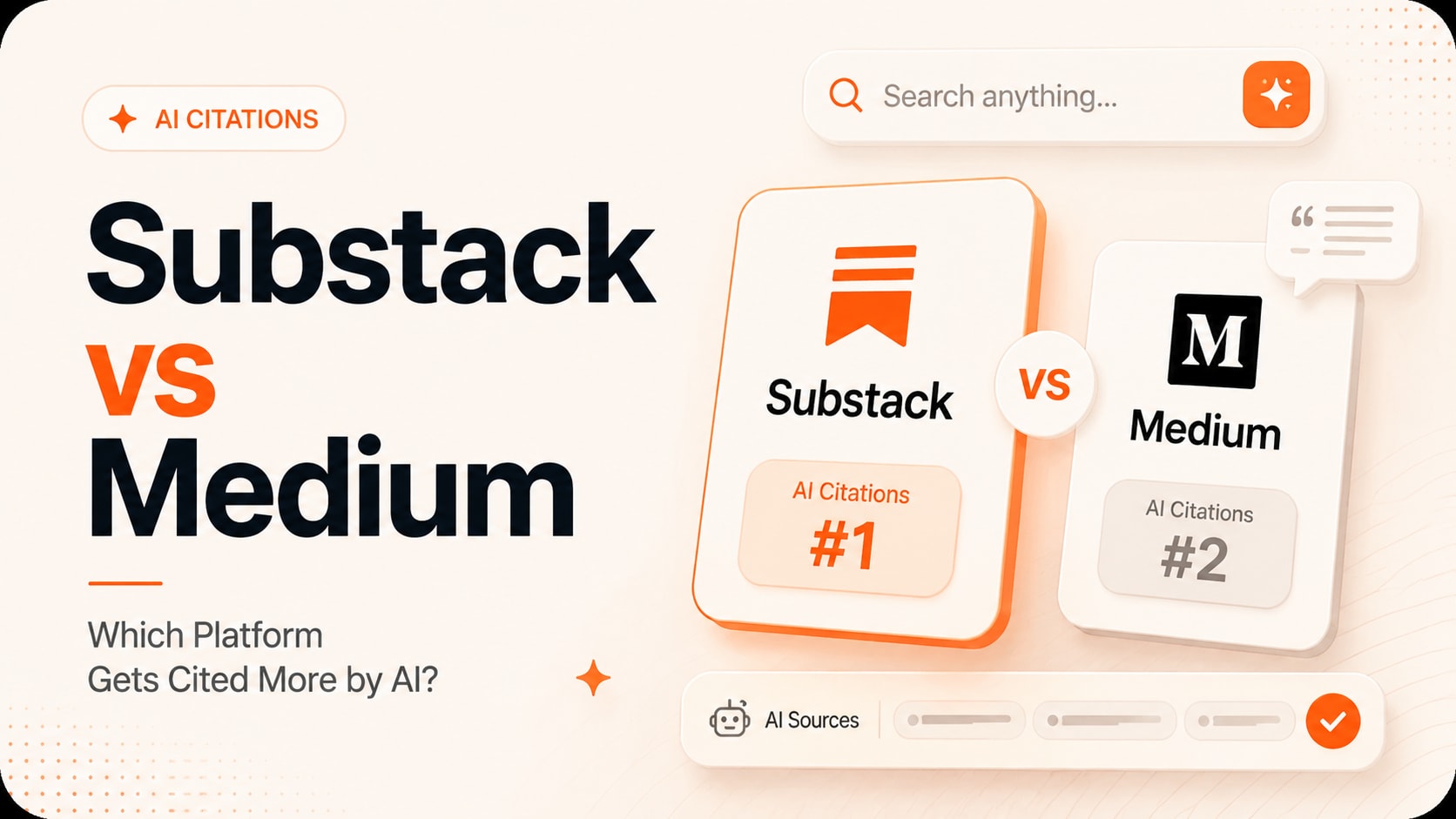
The short answer: Medium gets cited more by AI search engines than Substack, in most contexts, for most creators. But the reasons why matter. And understanding them changes how you should be using both platforms.
How AI Citation Works (and Why Platform Architecture Matters)
Before comparing the platforms, it's worth being precise about what AI citation actually means. When someone asks ChatGPT, Perplexity, or Google AI Overviews a question in your subject area, those systems decide which sources to draw from. That decision depends on several factors: whether the content is crawlable, whether the domain carries authority signals, whether the content is structured in a way that makes it extractable, and whether the writing contains specific, citable claims.
Two of those factors, crawlability and domain authority, are determined entirely by where you publish, not by what you write. That's the crux of the Medium vs. Substack question.
Medium's Structural Advantage: One Domain, High Authority
Medium operates as a single centralized domain: medium.com. Every article published there contributes to and benefits from the accumulated domain authority of that single root. Medium is a consistent top-10 cited source on ChatGPT, and one of the biggest winners in ChatGPT citation growth following search algorithm updates in late 2025. PRnewswire and Forbes were in the same positive-change cohort; Medium was alongside them.
The mechanism is straightforward. AI systems that retrieve content for citations, including ChatGPT's search-augmented responses, Perplexity, and Google AI Overviews, treat domain-level authority as a trust signal. A piece published at medium.com/@yourname inherits the trust the model already assigns to the medium.com domain from millions of other indexed articles. Your individual article starts from a much higher baseline of citation eligibility than the same article published on a personal blog.
This doesn't mean everything on Medium gets cited. Content quality, specificity, and structure all still matter. But the platform gives your content a structural advantage before the model even evaluates what you wrote.
Substack's Structural Problem: Fragmented Subdomains
Substack's architecture is the opposite of Medium's. Each publication lives on its own subdomain: yourname.substack.com. From an AI crawler's perspective, this is not the same as medium.com with high accumulated authority. It's a separate domain with its own authority, which is effectively zero for a new or small publication.
AI crawlers treat each Substack subdomain independently, which means a piece published on yourname.substack.com doesn't inherit authority from the tens of thousands of other Substack publications. Each Substack newsletter is, in citation terms, competing as a standalone website, without a standalone website's typically stronger backlink profile or domain history.
There's a compounding issue: paywalled content. Substack's paywalled posts are only partially crawlable. Search engines and AI bots see metadata and content previews, not full articles. If a meaningful portion of your best writing is behind a paywall, it's functionally invisible to the AI systems that might otherwise cite it.
Neil Patel's LLM seeding research found that "Medium, Substack, and LinkedIn articles get crawled often and carry extra weight because of their clean formatting and tied-to-real-author profiles" but the framing here matters. Medium's single-domain authority is fundamentally different from what Substack's fragmented architecture provides, even if both platforms produce cleanly formatted content.
The Data: What the Research Actually Shows
The clearest data point is a practical one. A creator who tested both platforms directly found that Google AI Overviews were pulling from his Medium articles — not his Substack posts, for the same type of content. His observation: "Substack is great for retention, but it's a 'closed garden.' AI crawlers often struggle to index Substack's fragmented subdomains as effectively as they do a massive, centralized authority like Medium."
The broader citation landscape context: even the most-cited domains on any AI platform rarely exceed 5% of total citations, according to Contently's analysis of five independent studies covering hundreds of millions of citations. Medium is consistently in that top tier; Substack as a domain is not, because its fragmented subdomain architecture prevents it from accumulating equivalent domain-level weight.
One nuance worth noting: only 11% of cited sources overlap between ChatGPT and Perplexity, according to Averi's analysis of 680 million citations. Citation patterns vary significantly across platforms. What works for Perplexity (which leans heavily on community platforms and real-time sources) may differ from what works for ChatGPT (which favors consensus sources and established publishers). Medium's position as a consistent top-tier source on ChatGPT specifically is the most relevant data point for creators focused on the platform where the majority of AI-mediated discovery happens.
Platform-by-Platform Comparison
Factor | Medium | Substack |
Domain architecture | Single domain (medium.com) — high accumulated authority | Fragmented subdomains (yourname.substack.com) — individual authority |
AI crawlability | Fully crawlable, no paywalls by default | Paywalled posts partially blocked; crawlers see previews only |
AI citation frequency | Consistent top-10 cited domain on ChatGPT | Not tracked as a top domain; subdomain fragmentation limits signal |
Discoverability by new readers | Strong: search and AI surfaces Medium content to people who don't follow you | Weak: Substack serves existing subscribers better than strangers |
Audience retention | Weak: no subscriber relationship, no inbox | Strong: email delivery builds direct audience |
Author ownership | You own the content; platform owns distribution | You own content and subscriber list |
Monetization | Partner Program (CPM-based revenue share) | Paid subscriptions directly to you |
Best for | Discoverability, AI citation, reaching new audiences | Retention, monetization, subscriber relationship |
The Practical Implication: Use Both, Differently
The data doesn't suggest you should abandon Substack. It suggests you should be deliberate about what each platform is for.
Use Medium as your citation surface. Publish your most informational, category-defining writing on Medium. The pieces that answer the questions your target audience is asking AI systems. Definition pieces, comparison guides, frameworks, and how-to content structured for direct answers are all strong candidates. This is the writing that benefits most from Medium's domain authority and AI crawler access.
Use Substack as your retention engine. Your newsletter is where you build the relationship with the people who already know you exist. Deeper analysis, personal perspective, and work-in-progress thinking belong here, writing that rewards existing subscribers rather than strangers discovering you via AI search.
Cross-publish where it makes sense. There is no rule against publishing a version of your Substack piece on Medium, with appropriate canonical tagging if SEO matters to you, or simply as a separate distribution point if AI citation is the goal. Many creators use Substack for the initial audience and Medium as the evergreen discovery layer.
One practical note: Substack custom domains change the equation. If you use a custom domain on Substack, your publication operates as its own website, which means you build your own domain authority over time rather than inheriting Substack's fragmented subdomain structure. For established creators with genuine backlink profiles and older domain history, this can be competitive with Medium. For most creators starting out, the Medium domain authority advantage is the faster path to AI citation.
What This Means for How You Write on Each Platform
The platform determines your citation eligibility floor. What you write on that platform determines whether you clear the ceiling.
On Medium, the structural advantage means the marginal return on writing specifically for AI citation is higher than it is on Substack. A well-structured, claim-specific, answer-first piece on Medium starts from a position where AI systems already trust the domain, your job is to make the content structurally citable. On Substack, even exceptional content faces the subdomain authority problem before it reaches any model's evaluation of its quality.
On Substack, the more productive framing is email-first. Write for the inbox. The engagement, replies, and direct subscription relationship that Substack enables are what build the kind of brand presence that eventually shows up in AI citations through third-party mentions not through the Substack post itself being directly indexed.
The most detailed breakdown of exactly how to structure content for AI citation, claim targeting, lift-out sentences, entity definition, external source requirements, is covered in How to Write Content That Gets Cited by AI Search Engines. That framework applies to both platforms, but the return on applying it is meaningfully higher on Medium given the domain authority difference.
Want to know whether your creator content is actually citation-ready?
Run your GEO Check to see how likely your Substack, Medium article, or personal blog is to be discovered, understood, and cited by AI search tools like ChatGPT, Perplexity, Gemini, and AI Overviews.
Frequently Asked Questions
Does Substack ever get cited by AI search engines?+
Yes, in some cases. Individual Substack publications with high engagement, strong backlink profiles, or significant third-party coverage can accumulate domain authority over time. Particularly if they use a custom domain. Substack posts from well-known writers with established credibility also appear in AI responses occasionally. But as a default starting point for a new or mid-stage creator, the platform architecture puts Substack at a structural disadvantage relative to Medium for AI citation frequency.
Is it worth publishing on both Medium and Substack?+
For most creators, yes. The platforms serve different functions that don't compete with each other. Medium is for discovery and AI citation; Substack is for subscription and retention. Publishing the same core ideas in both, formatted differently for each platform's audience, is a reasonable strategy. Just don't use Medium for your most personal, relationship-dependent writing, and don't rely on Substack for AI-mediated discoverability.
Will Google AI Overviews cite my Substack?+
Less likely than Medium, for the reasons above. Google AI Overviews have a 54% overlap with traditional organic rankings according to Profound's analysis, meaning strong traditional SEO and domain authority correlate directly with AI Overview citations. Substack subdomains rarely accumulate the backlink profiles needed to rank well on competitive informational queries, which limits their AI Overview presence.
Does paywalling Substack content affect AI crawlability?+
Yes, materially. Paywalled posts are only partially visible to AI crawlers, bots see metadata and preview content, not the full article. If your most substantive, citable content is behind a paywall, those specific pieces are functionally invisible to the AI systems that might otherwise reference them. Free posts on Substack are fully crawlable; the paywall is the problem, not the platform itself.
What is the best platform for a creator focused purely on AI search visibility?+
Medium, for most creators starting from a relatively neutral domain authority baseline. Its single-domain architecture, full crawlability, and consistent presence in AI citation studies make it the stronger default for discoverability. If you already have an established website with strong domain authority, that may outperform both. But for creators publishing on third-party platforms, Medium's structural advantage over Substack for AI citation is clear from the available data. Run your GEO Check.
Written by

I’m Ramaa, a writer and creator at Scribble. I’ve written two books, and writing is something I always find my way back to, whether that’s articles, scripts, captions, or overly long notes app rambles I swear will “be useful later.” I enjoy thinking about why people create, how ideas spread online, and what makes content feel genuinely human. When I’m not writing, I look after regulatory compliance and legal admin at Scribble, and I’m a graduate of the School of Policy, New Delhi. Outside of work, I’m a musician and an avid reader.