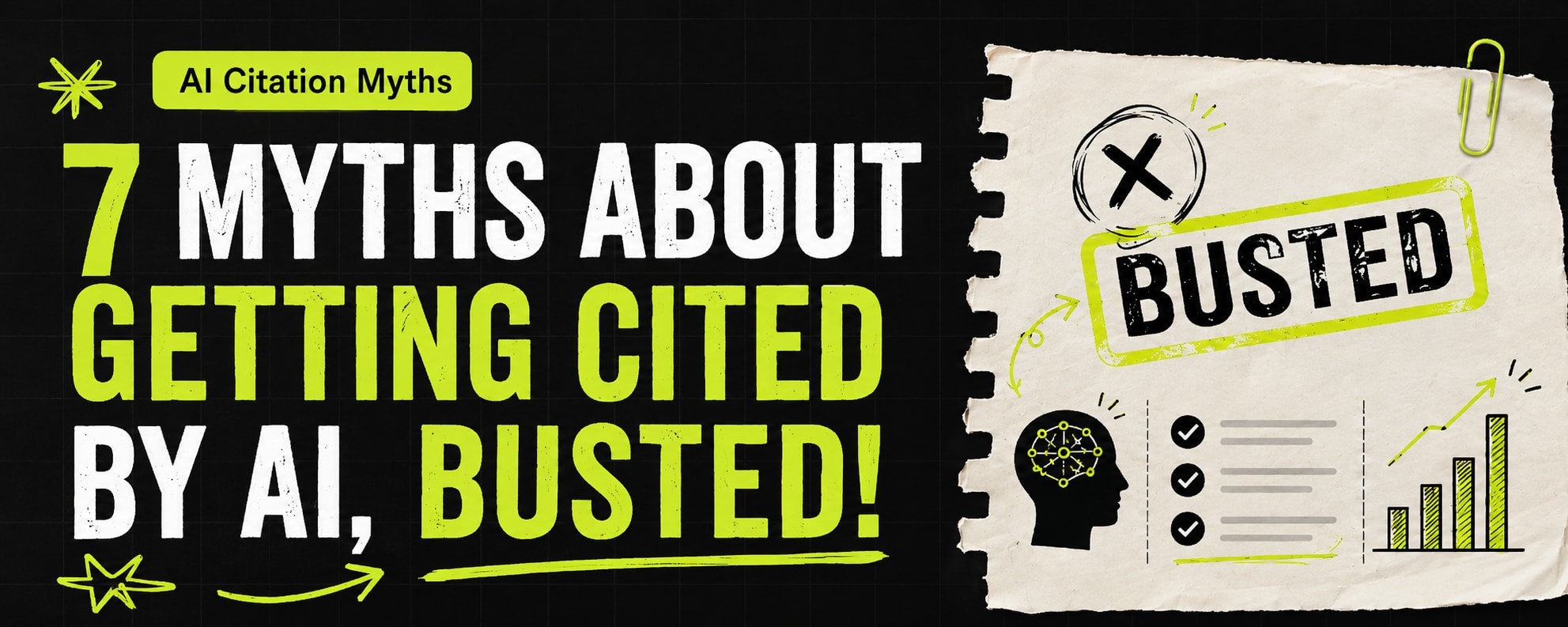
Every week we bust common beliefs about what gets creators cited in AI answers, using real data from the creators we work with. Here are the first seven in one place, and the single pattern underneath all of them.
There is a whole industry right now selling shortcuts to AI citation. Do this one thing, they promise, and the models will start quoting you. Get the followers. Post on the right platform. Format your content for the crawler.
We've spent the last few weeks testing those claims against something most people don't have: real data on which creators actually get cited, across everywhere they publish. The claims keep failing. And they fail in a way that's worth paying attention to, because they all fail for the same reason.
Here are the seven most common myths about getting cited, why each one is wrong, and the pattern that connects them.
Myth 1: You need a big audience
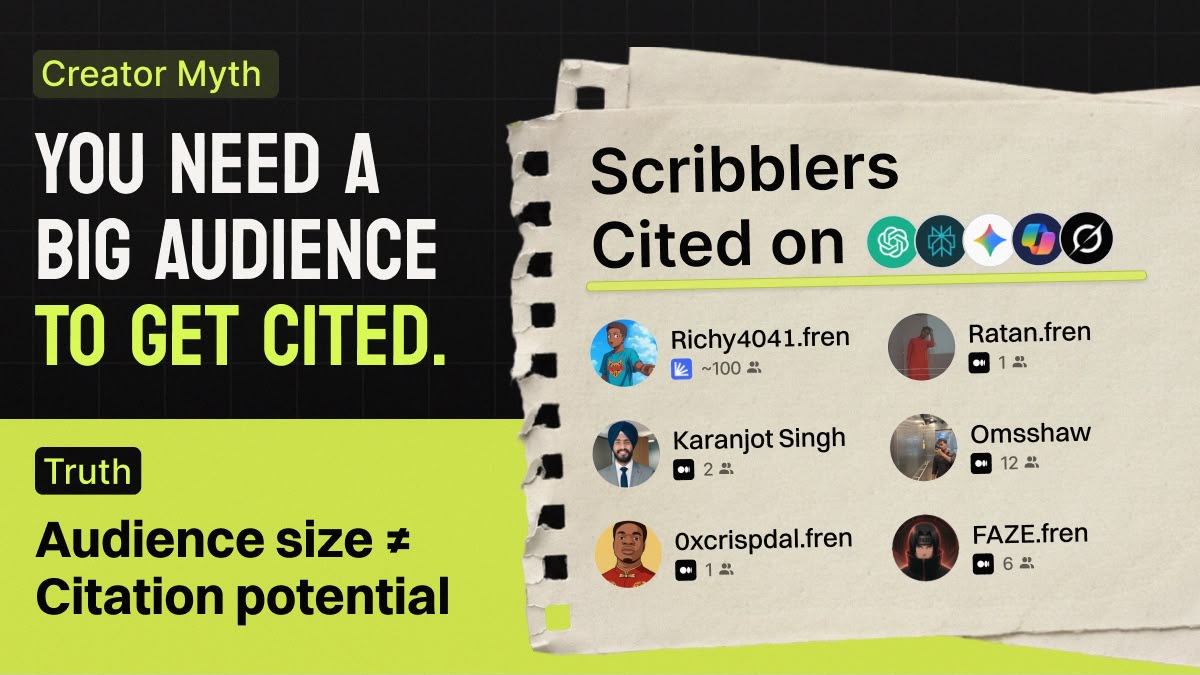
The intuition is that the biggest accounts get pulled into AI answers, because that's how reach has always worked. It isn't how citation works.
Across the creators we've seen cited, audience size barely predicted anything. Some of the most-cited had followings you could count on two hands, a few followers on the platform where the cited work actually lived. Combined, five of our cited creators in one week had an audience you couldn't run a campaign with.
Models don't check your follower count. They check whether the content is worth citing. Reach is who might see your post. Citation is whether your post answered the question well enough to be used. Those are different things, and the second one doesn't require the first. We watched this play out in a campaign that went from near-zero to 9% AI share of voice in 15 days, without a large audience doing the work.
Myth 2: Reddit is the easy way in
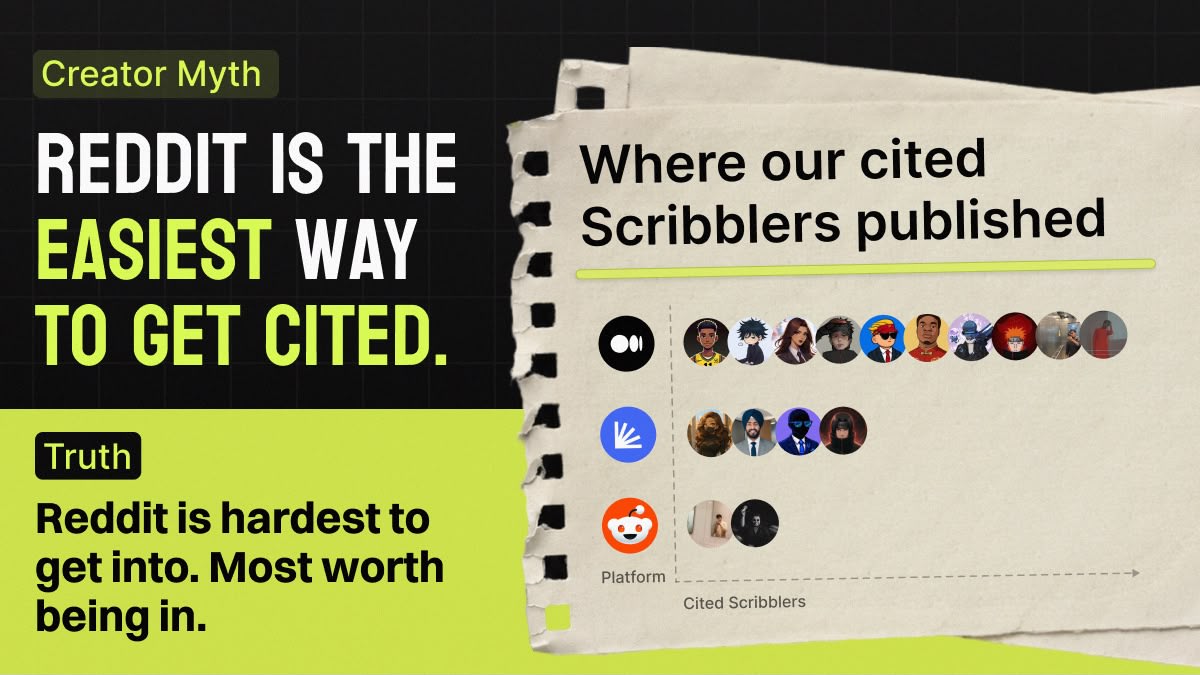
Everyone in the GEO world will tell you Reddit is a citation goldmine, and they're right that it's one of the most-cited sources in AI answers. So the assumption follows: post on Reddit, get cited.
In practice, Reddit is the hardest platform our creators publish on. It's moderated by humans who remove anything that reads as promotional, and most attempts to show up there for visibility get filtered out before they can be cited at all.
But that difficulty is the point. The reason models trust Reddit is precisely that it removes what smells like marketing. The gate that keeps you out is the same gate that makes the citation worth having. Reddit isn't easy. It's valuable because it's hard.
Myth 3: AI-written content can't get cited
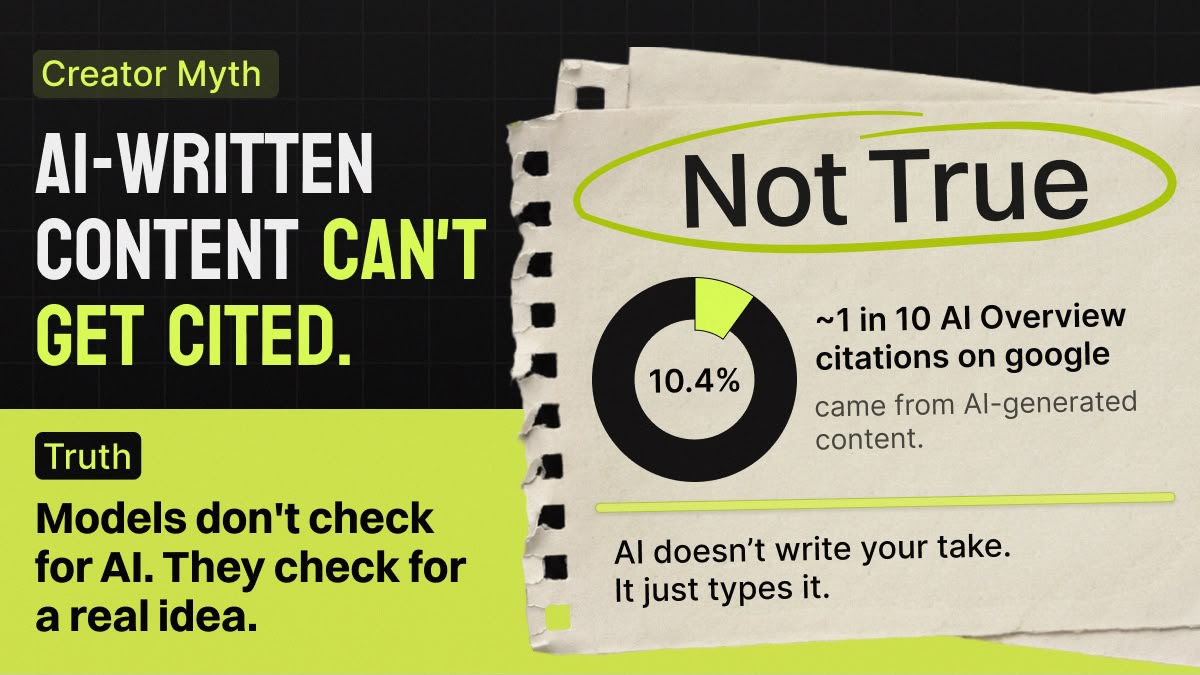
There's a growing belief that if you used AI to write something, the models won't cite it, as if there's a detector that filters machine-assisted work.
There isn't. Plenty of cited work had AI somewhere in the drafting. The models aren't checking who typed the words. They're checking whether there's a real idea in them.
The distinction that matters isn't human versus machine. It's whether the part that was supposed to be you, the take, the first-hand detail, the thing only you would say, is actually there. If the idea is yours and the machine helped you get it down, nothing is missing and nobody can tell. Slop isn't a tool problem. It's an empty-idea problem, and empty content fails whether a person or a machine produced it.
Myth 4: You need to be an expert
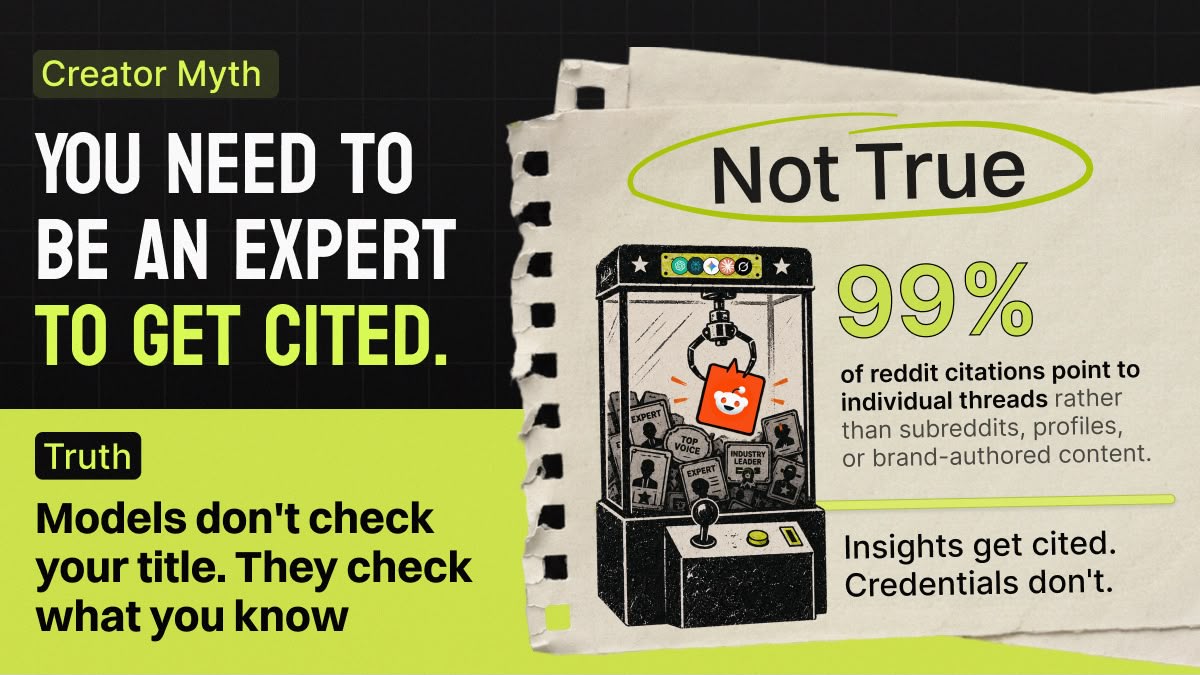
The assumption is that citations go to credentialed authorities, the people with titles and bylines at established institutions.
Most of the creators we've seen cited aren't that. They're people with a genuine point of view and first-hand experience of the thing they wrote about. The models weren't checking their bios.
There's a difference between having authority and having something to say. A title gets you trusted by people. A genuine, specific insight gets you cited by machines. You don't need permission to be a source. You need to actually know something and say it clearly.
Myth 5: You have to post constantly
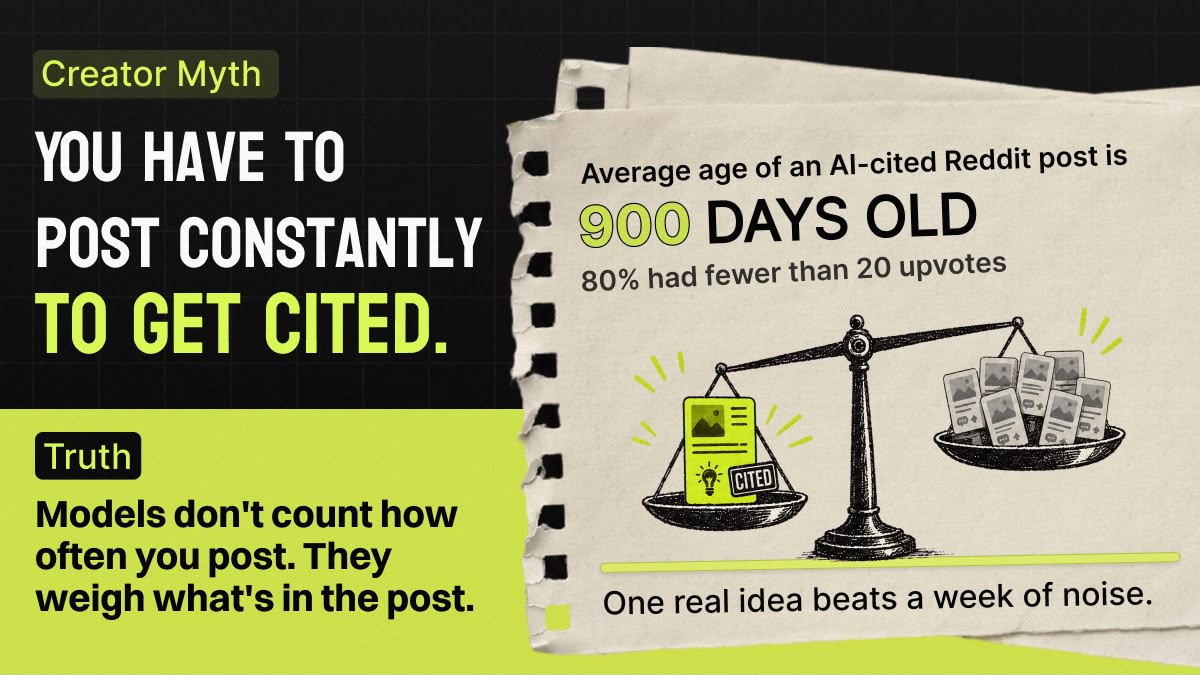
This one is imported straight from social media, where the algorithm forgets you if you go quiet. So people assume citation rewards frequency too.
It doesn't. Our cited creators aren't the highest-volume posters. A single piece, published once, can get pulled into AI answers for months afterward. Frequency is a social-feed rule, not a citation rule.
In fact, chasing volume can work against you. Ten forgettable posts don't add up to one citable one, they just bury the signal under your own noise. A viral post peaks in a day. A citable one keeps working long after you publish it. Frequency decays. Substance compounds.
Myth 6: You have to write for the algorithm
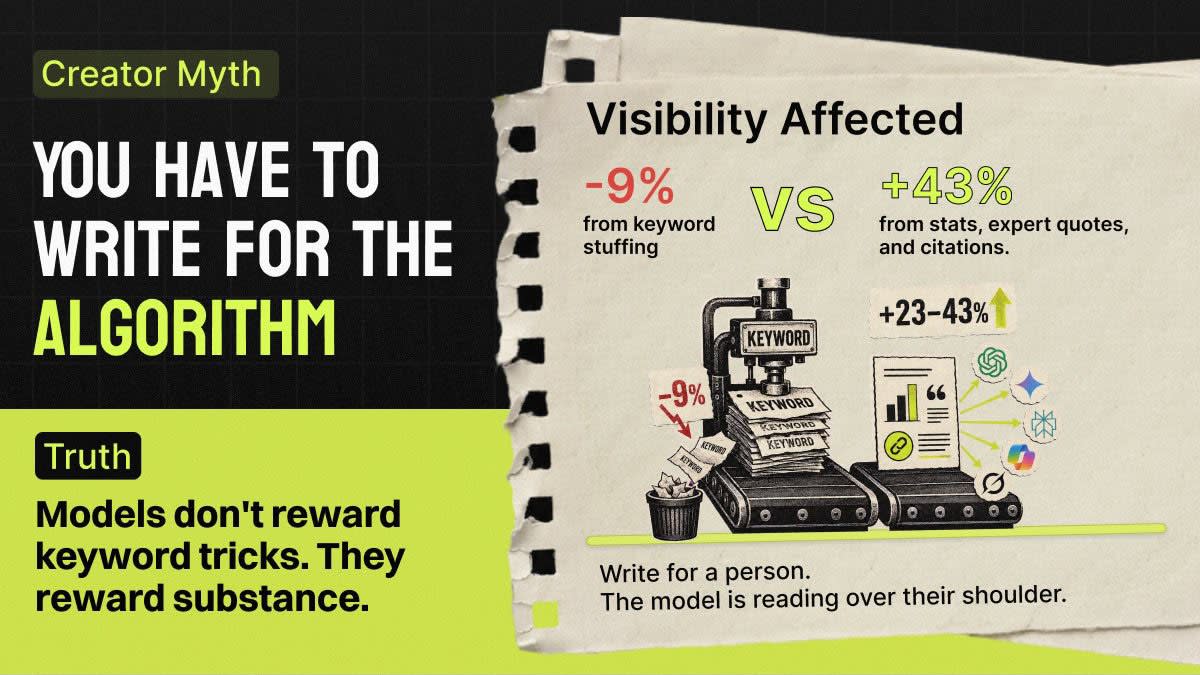
This is the instinct the whole optimisation industry sells: structure it for the crawler, hit the keyword density, chop it into machine-readable snippets, write for the model.
It's the 2011 keyword-stuffing playbook wearing new clothes, and it fails for the same reason it did then. The content we've seen cited isn't optimised for machines. It's genuinely useful to a human, and the machine noticed.
Modern models are trained to spot the thing worth citing, not the thing trying to game them. The robotic subheads and keyword-stuffed paragraphs are exactly the kind of content search engines spent a decade learning to bury. Write for a person. The model is reading over their shoulder. There is a real craft to structuring a genuine idea so a model can extract it cleanly, which is a different thing from writing for the algorithm, and we broke down the writing frameworks AI models extract most reliably separately.
Myth 7: You need to go viral
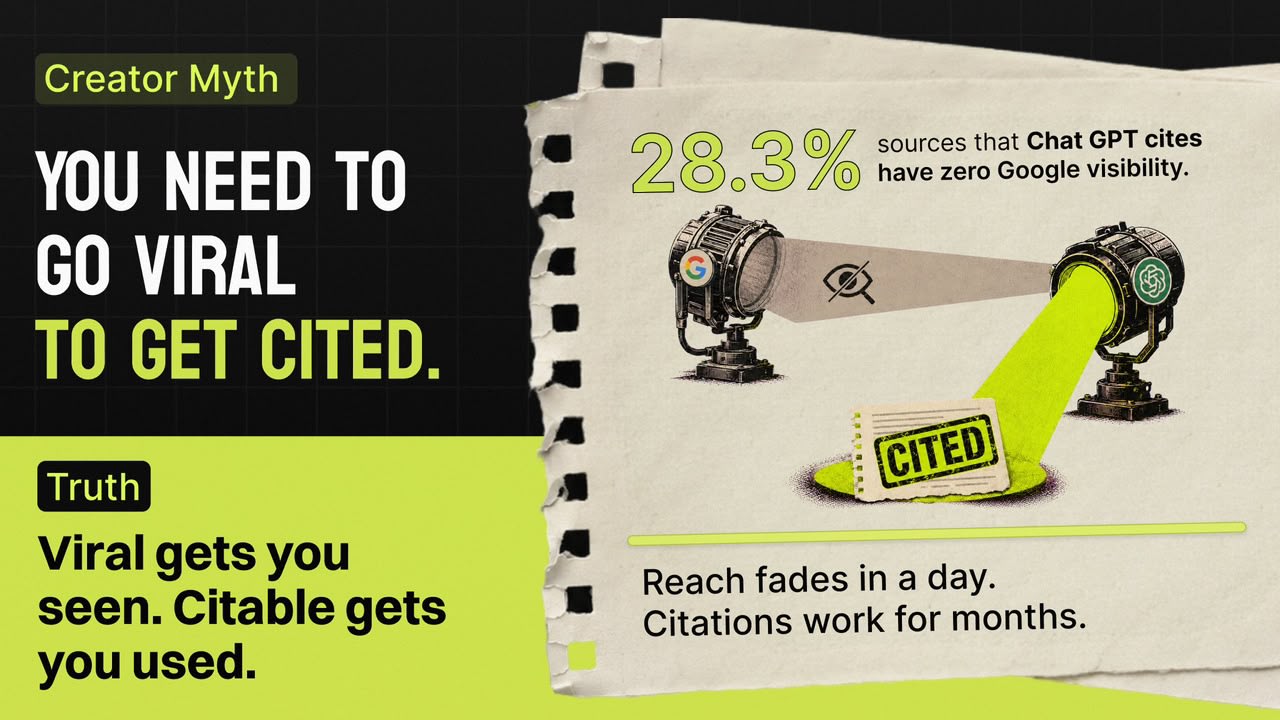
Finally, the belief that reach and citation are the same event, that if a post goes big enough, the citations follow.
They don't. Most of the cited work we've seen never went viral. Some of it barely got seen when it was first posted. It simply answered something clearly, and the models found it later.
A viral post is built to be shared right now. A citable one is built to be useful whenever someone asks. Views and citations are two different scoreboards, and optimising for the first can actively cost you the second.
The pattern behind all seven
Notice what every one of these myths has in common. Each is a shortcut, a single thing you can do to guarantee a citation. Get the followers. Post on Reddit. Go viral. Get the credentials. Post daily. Format for the machine.
None of them work, because a citation was never one lever you pull. It's a bar you clear.
That bar has more than one requirement, and they have to be met together. Is the space you're publishing in one that models trust, often because it's moderated? Is the content genuinely high effort, or thin? Is anyone actually referring to it and passing it on? Does it hold more than one side, or is it a one-note pitch? Citation sits at the intersection of all of these, not on any single one.
Which is why the shortcuts keep failing. They each optimise one variable and ignore the rest. The creators who get cited aren't doing one clever thing. They have a real idea that's genuinely theirs, first-hand knowledge of the subject, the clarity to say it plainly, and the discipline to publish it where models actually read. That's not a hack. It's just being worth citing.
So if you've been hunting for the trick, that's the myth behind all the other myths. There is no trick. There's a standard. Clear it, and you get cited.
On Scribble, that's also how creators get paid, being the source is the whole model. And it's within reach of anyone willing to stop chasing the shortcut and start doing the work the shortcut was pretending to replace.
If you want to see the standard in practice rather than the theory, our month-one wrap covers what we published, what performed, and what's next.
We bust new citation myths every week, and we're starting a companion series on how to get cited platform by platform. Follow along on x here.
Written by

I’m Ramaa, a writer and creator at Scribble. I’ve written two books, and writing is something I always find my way back to, whether that’s articles, scripts, captions, or overly long notes app rambles I swear will “be useful later.” I enjoy thinking about why people create, how ideas spread online, and what makes content feel genuinely human. When I’m not writing, I look after regulatory compliance and legal admin at Scribble, and I’m a graduate of the School of Policy, New Delhi. Outside of work, I’m a musician and an avid reader.