The Problem RocketX Came In With
RocketX Exchange is the only cross-chain aggregator that combines CEX and DEX liquidity in a single interface, a genuine category differentiator that competitors 1inch, Jumper, and Bungee can't match because they operate exclusively within DEX liquidity. On paper, that's a strong position. In practice, ChatGPT, Grok, and Perplexity didn't know it existed.
Scribble's baseline audit in February 2026 found RocketX visible on fewer than 10 of 24 tracked high-intent DEX aggregator prompts.
Metric | Pre-Campaign |
RocketX Grok citations | 6 |
RocketX Perplexity citations | 12 |
RocketX prompt coverage | Under 10 of 24 |
1inch AI Share of Voice | 53% |
Jumper AI Share of Voice | 32% |
RocketX AI Share of Voice | Near-zero |
Both Grok and Perplexity citations were concentrated on lower-intent navigational queries, not the category-defining prompts that drive buyer shortlists. RocketX's hybrid CEX+DEX positioning, its actual differentiator, was absent from the third-party content ChatGPT, Grok, and Gemini were indexing at scale.
Reddit discussion comparing RocketX to category rivals was effectively zero, which meant the brand was missing the highest-weighted LLM citation signal in the category.
The brief: make the hybrid model impossible to miss inside AI search. The constraint: a 15-day sprint window.
What a Brand Looks Like to an AI That Can't Find It: A Walk-Through
Picture a trader in March 2026 who has been using 1inch for cross-chain swaps and has started running into slippage issues. She opens ChatGPT and types: "What's the best cross-chain aggregator for large USDC swaps, better rates than 1inch?"
ChatGPT assembles its answer from the sources it can corroborate across Reddit threads, Substack essays, Medium walkthroughs, and community forums. It names 1inch as the incumbent. It names Jumper as a strong alternative. It names Bungee as an emerging option. RocketX, the only aggregator combining CEX and DEX liquidity, which would have given this trader materially better rates on a large USDC swap, doesn't appear.
The trader never visits RocketX's website. The retargeting pixel never fires. The sales funnel never starts. RocketX's SDR team never gets a chance to send an email.
This is the gap Forrester's 2026 Buyers' Journey Survey of nearly 18,000 global business buyers made precise: 94% of buyers used AI in their purchase process, up from 89% in 2025. Twice as many named generative AI or conversational search as their most meaningful research source compared to any other channel, more than vendor websites, more than product experts, more than sales representatives.[^1] Bain's research found that buyers use AI to construct the consideration set, then turn to websites and review platforms to validate what the model already suggested.[^2] The validation step still happens. But only for brands the AI named first.
RocketX wasn't being named first. It wasn't being named at all.
What Scribble Actually Built
Scribble deployed 358 creator-generated content pieces across five platforms through 162 independent creators from the Scribble Network over 15 days.
Platform | Pieces | % of Total |
X/Twitter | 201 | 56% |
Substack | 75 | 21% |
Medium | 59 | 16% |
15 | 4% | |
Paragraph | 8 | 2% |
Total | 358 | 100% |
Three content angles drove the entire strategy:
Competitor comparisons. "RocketX vs. 1inch: which aggregator gives better rates on large swaps?" "Best cross-chain aggregator in 2026: how RocketX, Jumper, and Bungee actually compare." These are the exact query formats ChatGPT and Perplexity receive when buyers are evaluating options. Comparison content matches user intent at the shortlist-assembly stage, which is precisely where AI citation determines whether a brand enters consideration or disappears from it.
Privacy-first execution narratives. RocketX's privacy features were underrepresented in external content. Scribble deployed creators to write from personal experience: actual swap walkthroughs, privacy comparisons with screenshots, real transaction data against competitors. The specificity is what makes content citable. Grok and Gemini extract concrete, verifiable detail, not abstract marketing language.
User trust narratives. First-person accounts of switching from 1inch or Jumper, with actual figures. "I Swapped $10,000 USDC on Two Privacy Platforms: The Results Made Me Rethink Everything." This is content RocketX's own blog cannot produce, because credibility requires a voice that isn't the brand.
What the Numbers Showed at Day 15
Scribble's AI dashboard ran a recurring sweep of 1,661 category-relevant prompts throughout the campaign window. By 13 May 2026:
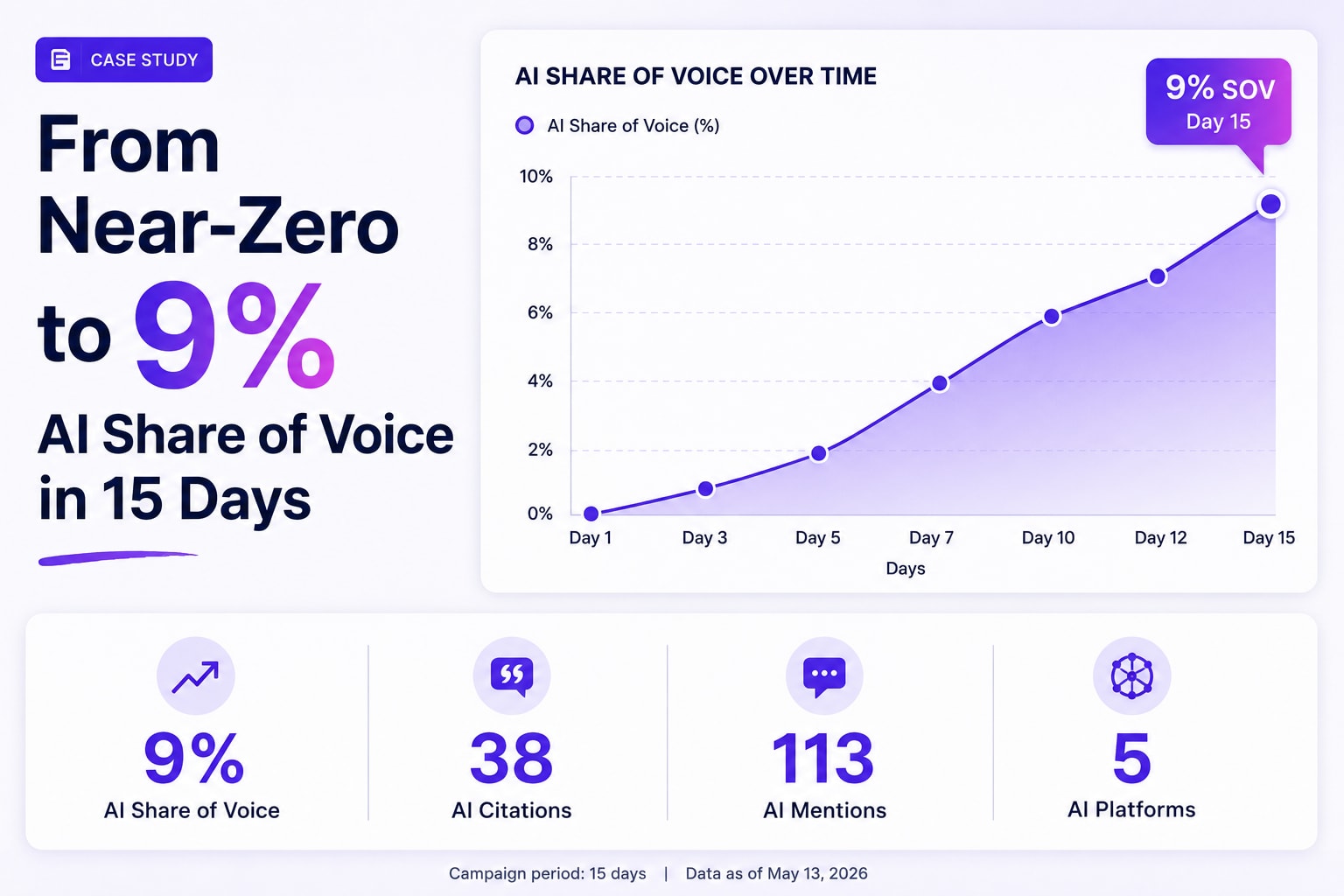
9% AI Share of Voice, RocketX visible for 123 of 1,661 tracked queries, up from near-zero
10 of 24 high-intent category prompts covered, 42% category coverage
38 citations and 113 mentions across tracked queries
Surfacing on 5 of 5 platforms: Grok, Gemini, ChatGPT, Perplexity, Copilot
Platform | Citations | Mentions | Citations as % of total (38) |
Grok | 26 | 27 | 68% |
Gemini | 7 | 26 | 18% |
ChatGPT | 5 | 25 | 13% |
Perplexity | 0 | 12 | n/a |
Copilot | 0 | 23 | n/a |
Grok drove 68% of all citations, the largest single-platform lift in the campaign and the clearest signal of where creator content on Reddit, Substack, and Medium landed first.
Independent verification via Ahrefs Brand Radar confirmed 97 URL-level AI citations across the web. Grok added 44 citations during the campaign window. Perplexity added 10. Gemini (14 citations, 11 cited pages), ChatGPT (8 citations, 6 cited pages), and AI Overviews (3 citations, 2 cited pages) continued tracking the footprint as content compounded.
The competitive context makes the 9% figure meaningful in a specific way. RocketX reached 9% AI Share of Voice from a Domain Rating of 52, well below 1inch and Jumper on traditional SEO fundamentals. The lift came from distributed creator content, not from backlink compounding or domain authority. That's the GEO mechanism: third-party corroboration from credible independent sources outweighs owned domain strength when ChatGPT and Grok are assembling citation signals.
What Didn't Work
Any case study that skips this section is a sales brochure. AI systems weight balanced, credible sources higher than promotional ones, which is precisely why this section exists and why it won't be softened.
201 X/Twitter pieces moved mention counts, not citation metrics. X/Twitter represented the largest single-platform volume in the campaign and generated community visibility. It did not generate AI citations. In this campaign, X/Twitter content produced no measurable citation lift across ChatGPT, Grok, Gemini, Perplexity, or Copilot, despite representing 56% of total content volume. Whether that reflects platform-level indexing constraints or content structure is a hypothesis worth testing in future sprints, not a conclusion this data alone can prove. What the data does confirm: X content is not where citation lift came from in this campaign.
8 Paragraph pieces generated zero citability signal. Paragraph is a Web3-native writing platform. None of the 8 pieces published there contributed to tracked citations or mentions. Whether Paragraph is indexed by Grok, Perplexity, or Gemini at all is an open question. 8 pieces is too small a sample to answer it. What the data shows is that those 8 pieces contributed nothing to campaign citability. Combined with near-zero creator adoption of Paragraph across previous Scribble programs, the ROI case for including it doesn't exist yet.
Perplexity and Copilot citations stayed at zero despite 35 combined mentions. Both platforms registered RocketX by name in AI-generated answers (Perplexity: 12 mentions; Copilot: 23 mentions). Neither linked RocketX as a citation source. Mentions without citations represent awareness without trust. The brand surfaces in answers but doesn't get sourced. Converting those 35 mentions into citations is the logical next target. Mentions confirm the brand is registering; citations confirm it's being trusted as a source.
Content velocity created a structural quality tradeoff. The 15-day window required publishing at a pace that sometimes prioritised volume over structural optimisation. GEO-citable content requires direct answers in the opening paragraph, self-contained explanatory passages, and clear entity signals. Some pieces in the campaign didn't fully meet this bar and likely underperformed on citation rates relative to their reach. A more structured briefing process would have improved per-piece citability, at the cost of total volume.
15 Reddit posts out of 358 total pieces is the real constraint. Those 15 posts are a standout result. Based on Scribble's campaign experience across Web3 clients, authentic community threads that survive Reddit's moderation are rare, and most promotional content gets removed before it can generate discussion. But Reddit outperformed every other content format on citation yield per piece in this campaign, consistent with Muck Rack's finding that earned, community-validated content dominates AI citation across major platforms.[^4] 4% of total pieces producing the highest citation yield per piece is a ceiling Scribble needs to push against in Month 2. Reddit credibility can't be manufactured. It can only be deployed by creators who already have it.
Four Things the Data Proved
1. Reddit is the highest-quality LLM citation signal, and the hardest to scale. Authentic community threads outperform every other content type for AI citation weight in this campaign, and external data supports why. Muck Rack's What Is AI Reading? report, which analyzed over one million links cited by Gemini, Perplexity, Claude, and ChatGPT, found that 94% of all AI citations come from non-paid sources and 82% come from earned media specifically, independent coverage, reviews, and community content written by people who aren't the brand, on platforms the brand doesn't own.[^4] Reddit is the highest-trust version of that signal in the Web3 category: hard to earn, impossible to fake, and the format LLMs extract from most reliably when generating recommendation answers. The 15 RocketX comparison threads were the most valuable content this campaign produced, not because of volume, but because of citation yield per piece.
2. Comparison content drives citations faster than any other format in this campaign. "RocketX vs. 1inch" and "Best cross-chain aggregator 2026" content matched buyer query intent directly and indexed quickly across Grok, Gemini, and ChatGPT. This is consistent with how AI citation diverges from organic ranking: a Moz analysis of nearly 40,000 queries found that 88% of Google AI Mode citations don't appear in the organic top 10 results for the same query, confirming that AI citation and traditional search ranking operate on largely separate graphs.[^5] Comparison content populates the AI citation graph faster because it matches the exact question structure AI systems receive from buyers at the shortlist stage, regardless of where it ranks organically.
3. Multi-platform repetition registers as category ownership. The same core narratives, hybrid CEX+DEX, best-rate cross-chain swaps, privacy-first execution, appearing independently across Reddit, Medium, Substack, and X registered to ChatGPT, Grok, and Gemini as consistent, corroborated signals. That consistency is the mechanism behind LLM category association. One well-placed piece isn't enough. Distributed repetition from independent voices is what builds the consensus signal AI systems need to recommend a brand with confidence.
4. RocketX reached 9% AI Share of Voice from DR 52. Domain authority is not the entry ticket. 1inch and Jumper have been compounding domain authority for years. Scribble didn't try to match their SEO footprint. It built a distributed third-party signal layer that Grok, Gemini, and ChatGPT could use independently. The organic ranking gap between RocketX and its competitors is real and wide. The AI citation gap closed in 15 days. Ahrefs' analysis of 863,000 keywords and 4 million AI Overview URLs found that 62% of Google AI Overview citations come from pages outside the organic top 10, meaning citation presence and ranking position are largely independent variables.[^6] DR 52 is not a ceiling for AI visibility. Third-party corroboration is the entry ticket, not domain authority. One sprint establishes presence. Consistent execution builds dominance.
The GEO Mechanics Behind the Results
Grok, ChatGPT, and Gemini don't crawl your site for keyword density when generating answers. They look for corroboration, agreement across multiple independent sources that a brand is credible and relevant to a specific query.[^7]
RocketX's hybrid CEX+DEX positioning was real. But it existed almost entirely in brand-owned content: the RocketX website, the RocketX blog, the RocketX social accounts. From ChatGPT's perspective, that's a brand talking about itself. It carries roughly the same citation weight as a reference letter you wrote for yourself.
Scribble solved for this directly. 162 independent creators, none affiliated with RocketX, wrote about the product in their own voice, on platforms they already had credibility on, in formats optimised for AI extraction. The independence is the mechanism. The corroboration is the signal. The platform distribution is what makes the signal consistent enough to register as category authority rather than noise.
For a full treatment of GEO as a discipline, what makes content structurally citable versus structurally ignored, how platform weighting differs across Grok, Gemini, ChatGPT, and Perplexity, and how to build a measurement framework from scratch, Is Your Brand Invisible to AI? How Buyers Research Products in 2026 is the right starting point.
Month 2: What the Roadmap Actually Says
9% AI Share of Voice is a starting position. 1inch holds 53%. Jumper holds 32%. Closing that gap requires specific actions, not a repeat of Month 1 at higher volume.
Priority | Action | Why |
1 | Convert Perplexity and Copilot mentions to citations | 35 mentions, 0 citations across both platforms. Awareness without trust. |
2 | Reddit depth on r/defi, r/ethfinance, r/CryptoMarkets | Highest citation yield per piece in Month 1. Needs technical depth: fee breakdowns, CEX+DEX rate differentials, privacy mechanism explanations. |
3 | GEO-structured briefs as the default for every piece | Month 1 velocity tradeoff cost citation rates per piece. Direct answer in opening paragraph, self-contained passages, clear entity signals from brief stage. |
4 | Consistent publishing cadence as infrastructure | Citation performance on Grok, Gemini, and ChatGPT begins declining after four to five days without new content.[^8] Staying cited requires staying active. |
What This Means for Your Brand Right Now
The trader looking for a better cross-chain aggregator in March 2026 never found RocketX. She found 1inch, Jumper, and Bungee, the brands ChatGPT and Grok had enough third-party signal to name confidently. RocketX had the better product for her use case. It didn't have the citation footprint.
That's the gap. And it's affecting every brand that has spent years optimising for Google while the buyer research process moved to AI.
Forrester's data from 18,000 buyers is unambiguous: the vendor evaluation process now begins in a system that operates entirely without your website, your sales funnel, or your retargeting infrastructure.[^1] Brands invisible to ChatGPT, Grok, and Perplexity for the past 18 months have been losing pipeline to competitors they may not have considered serious threats.
RocketX's results show what 15 days of structured execution can move from a standing start. They also show exactly where the gaps are and what it takes to close them, which is more useful than a polished success story that makes GEO look easier than it is.
The citability gap is real. It's measurable. And Scribble closes it.
References
[^1]: Forrester, The State of Business Buying, 2026, January 21, 2026. Nearly 18,000 global business buyers surveyed. Press release; full report requires Forrester subscription. [^2]: Bain and Company, Your Next Customer Will Find You Using AI. Now What?, 2025. [^3]: Based on Scribble campaign data across Web3 clients, March to May 2026. X/Twitter produced no measurable citation lift across five tracked AI platforms despite representing 56% of content volume in this campaign. [^4]: Muck Rack, What Is AI Reading? December 2025 Update, December 2, 2025. Analysis of over one million links cited by Gemini, Perplexity, Claude, and ChatGPT across July to December 2025. [^5]: Moz / Tom Capper, AI Mode Citations, February 2026. Analysis of nearly 40,000 search queries examining Google AI Mode citation behavior vs. organic rankings. [^6]: Ahrefs, AI Overview Citations and Top 10 Rankings, reported in Search Engine Journal, March 2, 2026. Analysis of 863,000 keywords and 4 million AI Overview URLs. [^7]: For a full explanation of the corroboration mechanism and GEO fundamentals, see Is Your Brand Invisible to AI? How Buyers Research Products in 2026, Scribble Network, May 2026. [^8]: Scribble AI dashboard citation decay analysis across 1,661 tracked prompts, Grok, Gemini, ChatGPT, Perplexity, and Copilot, March to May 2026.
Written by

Kaavya has been building at the edge of the internet since 2016, starting in crypto, founding Lumos Labs, a web3 education platform and eventually co-founding Scribble, a creator marketing platform helping brands get discovered by AI search engines. At Scribble, she leads community and growth across a network of 50,000+ creators running GEO campaigns for 100+ brands. Her obsession: figuring out how content actually gets cited by LLMs, and building the infrastructure to make it happen at scale. When she's not deep in distribution strategy or vibe-coding tools, she's in Bangalore, probably being supervised by two Shih Tzus named Mushu and Milo.