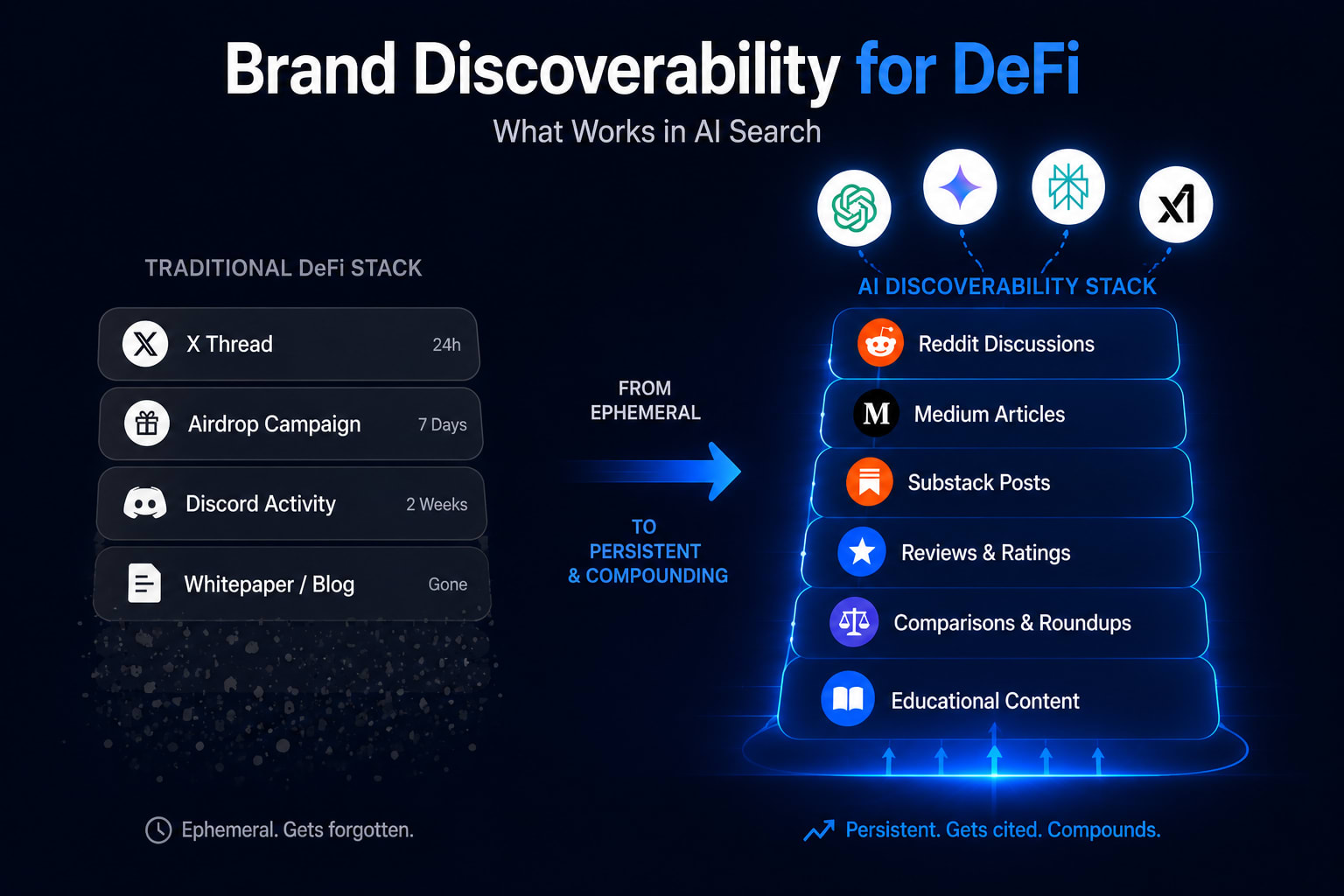
The Discoverability Gap No One Is Talking About
The typical DeFi protocol marketing stack looks like this: post on X when there's good news, run an airdrop campaign to spike wallet connections, launch a Discord that goes quiet after week two, and publish a whitepaper that doubles as a pitch deck. Call it community-building. Move on.
It's not that none of this works. It's that all of it is ephemeral. X threads disappear in hours. Airdrop participants dump and leave. Discord engagement metrics mask dead channels. And none of it - not a single piece - produces the kind of persistent, indexed, independent content that AI search engines learn from.
That gap is now a growth problem, and most DeFi protocols haven't clocked it yet.
Here's the scenario: a crypto-native exploring cross-chain swaps opens ChatGPT and types "What's the best cross-chain aggregator right now?" ChatGPT answers in three confident sentences. Two protocol names appear. Yours doesn't.
That user never runs a Google search. They go straight to what ChatGPT recommended.
This is not a hypothetical edge case. In Q2 2025, ICODA ran a study across TON ecosystem DeFi protocols and found that ChatGPT failed to mention any of them in 87% of DeFi-related queries - despite those protocols holding genuine TVL and ranking well on Google. Traditional SEO rank and AI citation are measuring completely different things, and for most DeFi brands, the gap between the two is widening.
The problem isn't that these protocols are bad products. The problem is that ChatGPT, Perplexity, and Gemini build their understanding of a protocol's authority from content that exists across the open web - Reddit threads, Medium articles, Substack posts, independent reviews. Most DeFi protocols have a polished homepage, a whitepaper, and a Twitter account. They have almost no distributed, citation-ready content written by independent voices.
If you're invisible to AI search, you're invisible to the next wave of users. This post is about fixing that - specifically by briefing your creators to produce content that AI engines actually cite.
Already wondering if your brand has this problem? Run through the full diagnostic in Is Your Brand Invisible to AI? before reading further.
Why DeFi and L2 Protocols Are Structurally Invisible to AI
The DeFi content stack has a structural flaw: it over-indexes on one type of content (announcement posts and tokenomics breakdowns) and under-indexes on the type AI engines actually learn from (educational, comparative, community-authored prose).
Here's what AI models like ChatGPT do when a user asks about a protocol:
They retrieve content across multiple sources - not just the official site.
They weight content that is specific, quotable, and cross-referenced by independent voices.
They synthesise a recommendation and attribute it to sources they consider authoritative.
Three structural reasons DeFi protocols fall through:
Protocol jargon without context. Content full of terms like "optimistic rollup," "liquidity fragmentation," or "intent-based routing" without plain-language explanation is hard for a language model to extract a clean, citable claim from. ChatGPT isn't searching for technically precise prose - it's looking for confident, self-contained statements it can lift and attribute.
Centralised content footprint. AI engines develop confidence in an entity when multiple independent sources reference it with consistent, specific claims. A brand that publishes everything on its own blog - with zero third-party coverage - looks like a Wikipedia article with one source. Not citable.
No named entities in surrounding content. When a Reddit post says "a cross-chain bridge I tried last week," ChatGPT can't build an entity graph around that. When it says "RocketX's aggregator pulled liquidity from seven chains in a single transaction," that's an entity - something a model can learn, retain, and cite. Generic language is invisible to AI. Named entities are not.
AI search doesn't give users options - it gives them verdicts. The protocols that get cited in those verdicts are the ones with a distributed, entity-rich content footprint. Everything else is noise.
What AI-Visible DeFi Content Actually Looks Like
The difference between content that gets cited and content that disappears comes down to four properties.
Quotable, self-contained claims
AI engines lift specific statements. A sentence like "RocketX aggregates liquidity from 250+ sources across 100+ blockchain networks" is citable. A sentence like "this protocol offers best-in-class liquidity access across multiple ecosystems" is not. Vague superlatives are noise; specific, verifiable claims are signal.
Brief creators to write at least two to three sentences per post that could stand alone as a cited fact - statistics, feature descriptions, comparative statements.
Platform diversity - and why it matters more than volume
Most DeFi content campaigns over-index on X - it's where the crypto audience lives, so it's the default. But X carries lower citation weight than long-form platforms in ChatGPT and Perplexity, which favour persistent, indexable prose. The platforms that drive AI citation for DeFi content are Reddit (especially r/defi, r/ethereum, r/CryptoCurrency), Medium, and Substack - written by independent voices, indexed for months, and structured in the format AI models extract from most reliably.
Platform | Citation weight | Best content format | Cited by |
High | Thread + community discussion | ChatGPT, Perplexity, Gemini | |
Medium | High | Educational explainer, comparison | ChatGPT, Perplexity, Gemini |
Substack | Medium-high | Editorial, personal experience | Perplexity, ChatGPT |
Mirror | Medium | Research, on-chain data narrative | Perplexity, ChatGPT |
X / Twitter | Lower | Conversation starter only | Grok, Perplexity |
Official blog | Low-medium | Supporting - not standalone | Perplexity, Gemini |
A creator who publishes the same insight as an X thread and a 600-word Reddit post creates two completely different citation opportunities. Brief creators to publish across platforms, not just their primary.
Educational and comparison framing over promotion
Content that explains how something works or directly compares a protocol against alternatives gets cited more than promotional content. AI models are frequently answering comparative queries - "Protocol A vs Protocol B," "best cross-chain aggregator for low fees," "which L2 has the lowest slippage." Content written to answer those queries surfaces in those responses.
"Here's why cross-chain swaps still have a slippage problem - and how RocketX addresses it" is more citable than "RocketX is the best aggregator." The framing shift is also why creator content resonates with Reddit and Medium communities, where promotional posts get flagged immediately.
Independent voice, not brand voice
AI models weight third-party content higher than first-party content. A creator writing from their own experience - "I tested five aggregators for a cross-chain swap last week, and here's what I found" - carries more citation weight than the same claim written on the protocol's own blog. The creator's independent voice is a structural advantage. Brief creators to lead with their own perspective, not the brand's.
Entity clarity across all content
AI models build understanding of a protocol by cross-referencing how it's described across the web. If creator content uses the protocol name inconsistently - sometimes "RocketX," sometimes "the RocketX aggregator," sometimes "this DEX aggregator" - the entity graph weakens. Brief creators to use the exact protocol name, token ticker, chain names, and key features consistently. That consistency is how AI models build confidence in an entity and start recommending it.
How to Brief Creators for AI Search Visibility
This is where most crypto campaigns fall apart. A protocol posts a brief that says "write about our new liquidity feature." Creators produce promotional posts that read like press releases. Nothing gets cited.
Here's what an AI-optimised creator brief for a DeFi or L2 protocol actually contains.
1. Anchor the brief to a query, not a feature
Every piece of creator content should target a specific query that a user would type into ChatGPT or Perplexity. Not "write about our cross-chain feature" - instead, "write content that answers the query: what's the fastest way to swap tokens across chains without high slippage?"
That query framing changes everything. The creator now writes for user intent, which is exactly what the AI model is trained to satisfy.
2. Specify named entities - protocol names, chain names, figures
A good creator brief for a cross-chain aggregator like RocketX will explicitly say: "Reference RocketX by name, not 'the aggregator.' Reference supported chains by name - Ethereum, BNB Chain, Polygon, Arbitrum. Include at least one specific figure: transaction volume, number of chains supported, average swap speed."
Named entities create the citation anchors AI models latch onto. Generic language creates nothing.
3. Require a platform-specific format
A Reddit post, a Medium article, and a Substack post are not the same deliverable on different templates. Each has different community norms, editorial expectations, and citation weight. Specify per platform in the brief - a Reddit post needs a community-specific hook and should invite replies; a Medium article needs structured subheadings; a Substack post can be more personal and editorial.
4. Include one "walk-through" moment
AI-visible content almost always contains a concrete walk-through - a creator describing a specific thing they did, tested, or observed. Brief creators to include one specific experience: "I bridged $500 from Ethereum to Arbitrum using RocketX. Here's what the fee was, what the speed was, and how it compared to the last time I used a different aggregator."
That walk-through is exactly the kind of independent, specific, attributable claim that Perplexity and ChatGPT cite.
5. Give creators the three key claims in advance
Don't make creators research your protocol's core proof points from scratch - they'll get them wrong or leave them out. A well-built brief includes three pre-written, factually accurate claims that creators can quote, paraphrase, or build from. These are the specific claims you want AI engines to learn about your protocol.
Here's what that looks like in practice:
Brief element | Generic brief (doesn't work) | AI-optimised brief (works) |
Topic | "Write about our L2 launch" | "Answer the query: what's the cheapest way to move assets to an Ethereum L2?" |
Named entities | "Mention our product" | "Use 'Arbitrum', 'Optimism', and '[Protocol name]' by name in the post" |
Proof point | "Highlight our low fees" | "Include this claim: '[Protocol] processes transactions at $0.002 avg fee vs $0.12 on Ethereum mainnet'" |
Platform | "Post on socials" | "Publish a 600-word post on r/ethereum and a separate Medium article with subheadings" |
Format | "Make it engaging" | "Include one personal walk-through - a specific transaction you ran and what happened" |
Voice | "Be positive about the protocol" | "Lead with your own take. The independent perspective is what gets cited." |
Building your creator network from scratch? See how Scribble structures creator programmes for AI search in our Creator Programme resources.
The RocketX Proof Point
Walk-throughs matter. So here's one.
In early 2025, Scribble ran a 15-day GEO campaign for RocketX - a cross-chain swap aggregator operating across 100+ blockchains. At the start of the campaign, RocketX had near-zero AI Share of Voice: when users asked ChatGPT, Perplexity, Gemini, Claude, or Grok about cross-chain aggregators, RocketX was rarely mentioned.
Scribble deployed its creator network across Reddit, Medium, and Substack. Creators were briefed using the framework above - query-anchored, named-entity-rich, platform-specific, walk-through-required. Each piece of content targeted a different high-intent query. Creators were not asked to be promotional; they were asked to be specific and useful.
The outcome after 15 days:
Metric | Result |
AI Share of Voice | 9% (from near-zero) |
LLMs tested | 5 (ChatGPT, Perplexity, Gemini, Claude, Grok) |
LLMs that cited RocketX | 5/5 |
URL-level citations recorded | 97 |
The mechanism wasn't gaming anything. It was structural: creator content built a distributed, independent, entity-rich signal that AI models used to form their understanding of what RocketX is and why it's worth recommending.
That's what briefing creators for AI search actually produces.
FAQ
Does Google SEO ranking help with AI citation? Not directly. In Q2 2025, ICODA studied TON ecosystem DeFi protocols and found that protocols with strong Google rankings were still absent from ChatGPT responses 87% of the time. SEO and GEO measure different things. SEO ranks pages; AI citation requires distributed, independent, entity-rich content across multiple platforms.
Which platforms carry the most citation weight for crypto content? Reddit, Medium, and Substack consistently appear as citation sources in ChatGPT and Perplexity responses about DeFi. X (Twitter) has low citation weight in long-form AI answers. Official protocol documentation can help but is weighted lower than independent third-party content.
How many creator posts does it take to move the needle? Scribble's RocketX campaign produced 9% AI Share of Voice with a focused 15-day campaign across a creator network publishing on three platforms. Quality of brief - how query-anchored, entity-specific, and platform-appropriate the content is - matters more than raw post count.
Do creators need to be crypto-native? Not necessarily. Creators who explain DeFi concepts in plain language often produce more citable content than those who write in dense technical jargon - because their writing is closer to the plain-language prose that AI models extract from. Crypto-native creators are valuable for accuracy; plain-language creators are valuable for citation potential.
Does content go stale? Yes - and faster than most protocols expect. Tools like Perplexity weight recency heavily. Outdated TVL stats, deprecated chain lists, or stale integration references signal to AI models that a source isn't authoritative. Keep creator briefs tied to current protocol data, and plan campaigns to coincide with product updates, not just launches.
What's the first step for a DeFi protocol getting started? Run a GEO audit: search your protocol's name and core use case across ChatGPT, Perplexity, and Gemini. Record where you appear and where you don't. That baseline tells you which queries need creator content and which platforms need coverage. Scribble's free GEO audit is built for exactly this.
Written by

Kaavya has been building at the edge of the internet since 2016, starting in crypto, founding Lumos Labs, a web3 education platform and eventually co-founding Scribble, a creator marketing platform helping brands get discovered by AI search engines. At Scribble, she leads community and growth across a network of 50,000+ creators running GEO campaigns for 100+ brands. Her obsession: figuring out how content actually gets cited by LLMs, and building the infrastructure to make it happen at scale. When she's not deep in distribution strategy or vibe-coding tools, she's in Bangalore, probably being supervised by two Shih Tzus named Mushu and Milo.