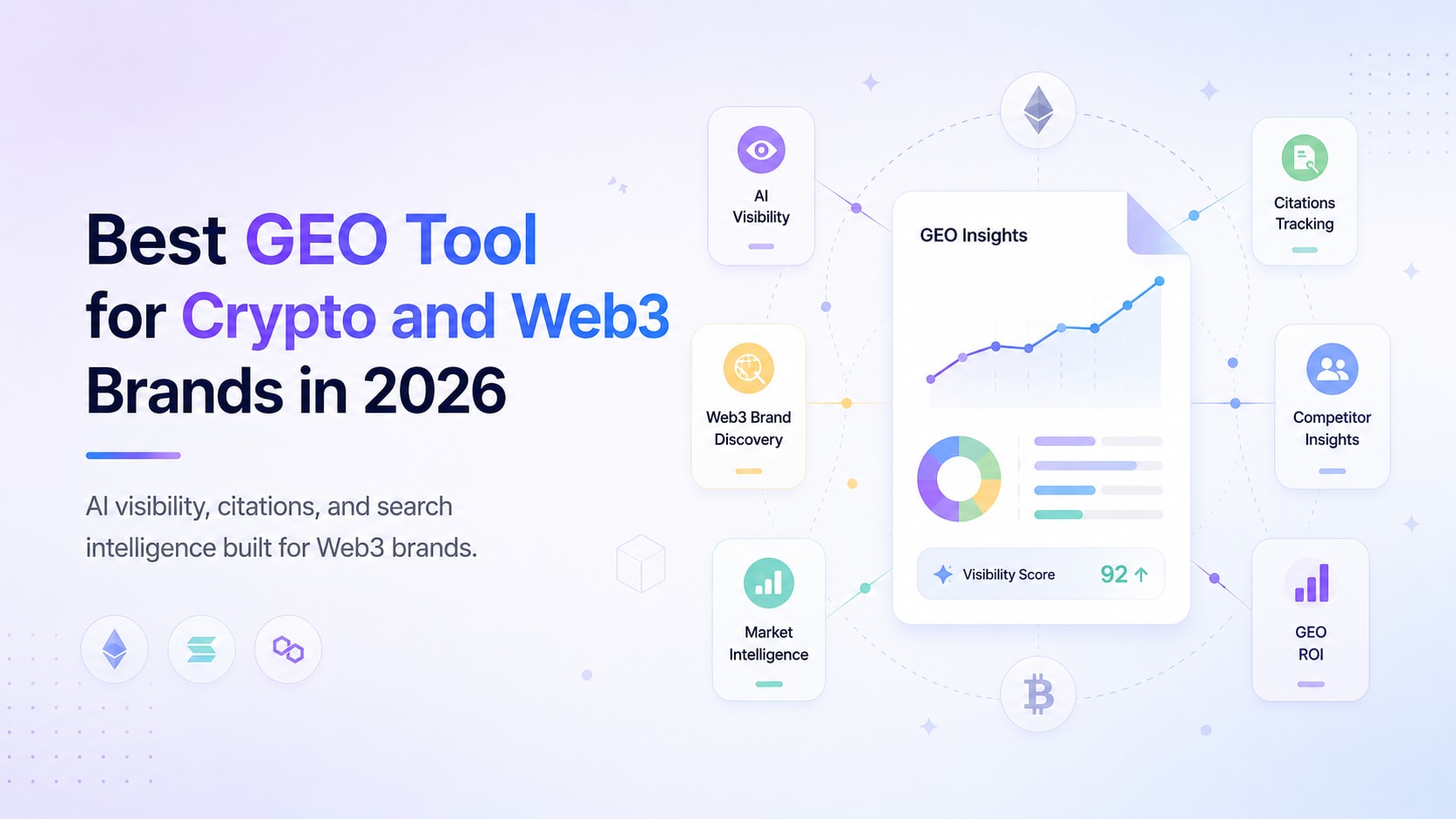
The GEO tool that works for a B2B SaaS company is not necessarily the right tool for a DeFi protocol or a DEX aggregator. Crypto and Web3 brands face a specific combination of challenges that most GEO platforms were not built to address: JavaScript-heavy dApps that AI bots cannot crawl, regulatory sensitivity that makes AI models extra cautious with recommendations, training data that lags fast-moving on-chain developments by months, and an audience that has shifted away from Google almost entirely.
Research shows the share of users who first encounter a crypto product through an AI query doubled during 2025, and for users aged 18 to 35, neural networks have overtaken traditional Google search as the primary source of financial information. The consequence is direct: Coinbase and Kraken together own 22% of all U.S. crypto AI citations across 65 or more tracked queries. The concentration at the top is not an accident. It reflects years of consistent, structured, third-party corroboration that AI models now treat as category authority.
This guide covers the tools and approaches that actually address the crypto and Web3 GEO problem, with an honest accounting of what each does well and where it falls short.
Why Crypto and Web3 Is a Harder GEO Problem Than Most Verticals
Before evaluating tools, it is worth understanding why this category requires different thinking.
AI models are structurally cautious about crypto. Because of the regulatory risk, market volatility, and fraud history associated with crypto, AI systems apply additional scrutiny to recommendations in this category. To get recommended by AI in the crypto space, a project must earn trust through transparency: security audits, aggregator listings, and verifiable on-chain data. A new protocol without CoinGecko listing, DeFiLlama inclusion, or public audit reports is functionally invisible to AI systems regardless of how good the product is.
LLM training data lags fast-moving crypto categories. A protocol that launched in Q3 2025 may not appear in AI training data until well into 2026. Models answer "best liquid staking protocol" using information that is months old by the time a user asks the question. This makes real-time citation building through creator content and earned media more important for crypto than in most other verticals, because that content enters model retrieval layers faster than training cycles update.
JavaScript-heavy Web3 sites are often uncrawlable. Most dApps are built on JavaScript frameworks that AI bots cannot render. LLM training data lags fast-moving crypto categories by months, and JavaScript-heavy Web3 sites are often uncrawlable by AI bots. A protocol can have excellent documentation and a strong product without any of it being readable by the systems that determine AI visibility.
Ad restrictions force organic and AI dependence. Google and Meta limit crypto advertising, making organic search and AI visibility the primary discovery channels for blockchain projects in 2026. Unlike SaaS companies that can supplement organic visibility with paid acquisition, most crypto projects have no paid channel fallback. AI search is not a supplementary channel for Web3 brands. It is often the only scalable one.
The queries are specific and high-stakes. The average crypto prompt in AI search contains 20 to 40 words, because users describe their specific scenario, experience level, and requirements. "What's the best DEX aggregator for large cross-chain swaps with MEV protection" is the query that drives real capital allocation decisions. A monitoring tool that only tracks broad brand mentions misses the queries that actually matter.
Understanding GEO as a discipline before evaluating tools for it is useful. The Complete Guide to GEO for Marketers covers the full framework, including how AI citation signals differ from traditional SEO signals and what content structure drives citation across ChatGPT, Perplexity, and Grok.
What a Crypto GEO Tool Actually Needs to Do
Generic GEO tools measure whether your brand appears in AI answers. That is necessary but not sufficient for crypto projects. A tool that actually addresses the Web3 GEO problem needs to do four things:
Capability | Why it matters for crypto specifically |
|---|---|
Track Grok specifically | Grok indexes X/Twitter content faster than any other platform, which is where crypto community discussion lives. A tool that skips Grok misses the citation signal most native to crypto culture. |
Monitor competitor-specific prompts | "Best DEX aggregator," "safest crypto wallet 2026," "which L2 has lowest fees" are the queries that drive shortlist formation. Broad brand monitoring does not capture these. |
Surface which aggregator sources are being cited | CoinGecko, DeFiLlama, CoinMarketCap, and crypto subreddits are the third-party sources AI models weight most in this category. Knowing which ones cite your brand is as important as knowing whether AI mentions you at all. |
Connect content gaps to citation gaps | The action layer. A monitoring tool that tells you your Perplexity citations are low without showing which specific content would close the gap is a reporting tool, not an optimization tool. |
The Tools
Gauge - Best General AEO Platform With Crypto Coverage
Gauge is a general AI visibility and optimization platform whose customers include PostHog, Supabase, and Braintrust alongside crypto-native clients like Eco and Sanctum. It is not a crypto-only tool, but it has the deepest crypto-relevant coverage of any general AEO platform: documented case studies in the DeFi and exchange categories, a prompt library that covers liquid staking comparisons, cross-chain swap evaluations, and crypto wallet queries, and the ability to surface how AI frames a protocol specifically rather than just whether it appears.
Gauge combines GA4, GSC, Semrush, and GEO data in a single interface, so a crypto marketing lead can ask "which queries are we losing to competitors on Perplexity?" and get a specific answer rather than exporting data from three separate tools. Sentiment analysis shows how AI frames your protocol specifically, not just whether your name appears. For DeFi protocols, the framing distinction matters directly: "well-audited DeFi protocol" versus "experimental yield farming platform" in the same AI response produces different conversion outcomes, and Gauge surfaces that framing data.
On pricing: the Starter plan at $99 per month covers ChatGPT only. Multi-platform coverage, including ChatGPT, Google AI Overviews, AI Mode, Gemini, Perplexity, and Copilot, requires the Growth plan at $599 per month. Grok tracking is available on Growth plans by connecting your own xAI API key, with the provider billing you directly. Native Grok monitoring without a separate API key requires Enterprise.
Honest limitation: The jump from $99 (ChatGPT only) to $599 (multi-platform) is steep for early-stage crypto projects. Grok access requires either bringing your own API key or an Enterprise contract, which is a meaningful friction point for Web3 teams where Grok is the highest-priority citation platform. Gauge is a newer platform and independent review coverage is thinner than Profound or Otterly, so verify current feature coverage directly before committing.
Best for: DeFi protocols, DEX aggregators, L1 and L2 projects, and crypto wallets with active marketing budgets that need prompt-level AI monitoring with content execution built in, and that are already tracking across the major AEO platforms rather than starting with Grok specifically.
Scribble Network - Best for Citation Gap Execution
Scribble addresses the part of the crypto GEO problem that monitoring tools cannot: building the third-party citation signal that makes AI models confident enough to recommend a brand.
The mechanism maps directly to how AI systems actually decide whether to cite a crypto project. AI models answer "which DEX aggregator should I use" by drawing on sources it can corroborate across Reddit threads, Substack essays, Medium walkthroughs, and community forums. A brand that exists only in its own website and social media is citing itself. That carries roughly the same weight as a reference letter you wrote for your own job application.
Scribble deploys independent creators to write about a protocol in their own voice, on platforms they already have credibility on, in formats structured for AI extraction. The RocketX campaign, a cross-chain DEX aggregator in exactly this position, moved from near-zero AI Share of Voice to 9% across 1,661 tracked queries in 15 days through 358 pieces of creator content from 162 independent creators, without improving domain rating, backlinks, or on-page SEO. Grok drove 68% of those citations, consistent with Grok's pattern of indexing Reddit and Medium content fastest in the crypto and Web3 category.
The crypto-specific advantage is community credibility. The content formats that generate the highest citation yield in Web3 are the same formats that require authentic community voice: comparison threads on r/defi and r/CryptoMarkets, first-person swap walkthroughs on Medium, technical breakdowns on Substack. These are content formats that a brand's own team cannot produce credibly, because the model discounts self-promotion. Scribble's creator scoring is based on citation history, not follower count, which matters specifically in crypto because a creator with verified subreddit history in DeFi is worth more to AI citation than an influencer with 100,000 followers who has never been sourced.
Creators receive payment immediately when their content is cited, not at the end of a campaign. That incentive structure rewards quality and speed rather than volume.
Honest limitation: Scribble is an execution layer, not a monitoring layer. It does not replace a tool like Gauge or Otterly that shows you current AI visibility and prompt-level gaps. The right workflow is to use a monitoring tool to establish your baseline, deploy Scribble to close the citation gap, and track the lift in your monitoring tool over the following weeks. The GEO Checker is the fastest way to establish your baseline for free.
Best for: Crypto and Web3 brands with a documented AI visibility gap, particularly where competitors have stronger citation footprints despite similar or weaker on-chain track records. Projects targeting Grok and ChatGPT specifically for consideration-stage queries in DEX, DeFi, wallet, and infrastructure categories.
Pricing: Campaign-based with per-citation creator payments. Active bounties at scribble.network/bounties.
Otterly AI - Best Entry-Level Monitoring for Crypto Teams
Otterly AI is the most accessible GEO monitoring platform and the most practical starting point for crypto teams that are not yet ready to commit to a crypto-specific tool like Gauge. It serves over 20,000 marketing professionals, starts at $29 per month, and tracks brand visibility across ChatGPT, Google AI Overviews, Perplexity, and Grok with a 25-plus on-page factor GEO Audit.
Otterly converts traditional keywords into conversational prompts and tracks which URLs are actually being cited versus which brands are only mentioned. In crypto, where a competitor might be named in an answer while your documentation page is the linked citation source, that distinction matters.
Honest limitation: Otterly does not currently track Grok, which is a meaningful gap for crypto and Web3 teams. Grok indexes X/Twitter content faster than any other platform and is where crypto community discussion generates citation signal. If Grok coverage is a priority for your category, Otterly is not the right primary monitoring tool. Gemini and Google AI Mode also cost extra as add-ons, and the data refresh is weekly at base tier. The GEO Audit recommends content changes but does not generate the third-party citation signal that crypto brands specifically need to build trust with AI models.
Best for: Early-stage crypto projects and DAO teams that need basic monitoring across ChatGPT, Perplexity, and Grok before committing to a full platform.
Pricing: Lite $29/month (15 prompts), Standard $189/month (100 prompts), Pro $989/month (1,000 prompts).
Profound - Enterprise Crypto Brands Only
Profound is the category leader in GEO monitoring overall, with $155 million in total funding, a $1 billion valuation, and Fortune 500 clients including Ramp, DocuSign, Figma, Target, and Walmart. For most crypto projects, it is overkill. For the handful of crypto-adjacent brands operating at enterprise scale, it is the deepest monitoring available.
The specific relevance to crypto: Profound's Prompt Volumes feature shows AI search demand at the query level, which means you can identify whether "best crypto wallet" or "most secure hardware wallet 2026" is driving more AI search volume before deciding which query cluster to target. No other tool shows this data at the same depth. The platform also tracks up to 10 AI engines on Enterprise, including Grok, which matters for crypto.
The $99 Starter plan covers ChatGPT only. Real multi-engine GEO starts at $399 per month on Growth, covering 3 engines and 100 prompts. Full coverage including Grok requires a custom Enterprise contract, with third-party estimates placing Enterprise between $2,000 and $5,000 per month.
Best for: Exchanges and crypto-adjacent fintech companies operating at enterprise scale that need SOC 2 compliant AI visibility reporting and the depth of Profound's competitive benchmarking.
Not for: DeFi protocols, early-stage projects, DAOs, or any crypto brand that does not have a dedicated GEO analyst and a budget north of $400 per month for monitoring alone.
Ahrefs Brand Radar - Best for Connecting Citations to Backlinks
Ahrefs Brand Radar tracks AI citations across ChatGPT, Google AI Overviews, and Perplexity and lets you correlate citation performance with the underlying backlink and content data Ahrefs already collects. For crypto projects, this correlation is specifically useful for understanding whether a citation gap traces to a content crawlability issue, a backlink signal issue, or a third-party coverage issue. Those require different fixes.
The free tier makes it the easiest place to start for any crypto project that already uses Ahrefs for traditional SEO and wants an AI citation baseline without a new vendor relationship.
Honest limitation: Three engines is a narrow coverage set for crypto, where Grok and Gemini carry significant citation weight with the Web3 audience. And like all monitoring tools, Ahrefs Brand Radar shows you where you stand but does not build the third-party corroboration that actually moves the needle.
Which Tool for Which Crypto Use Case
Use Case | Recommended Approach |
|---|---|
DEX aggregator or DeFi protocol with near-zero AI visibility | Scribble for citation building, paired with Otterly or Gauge for monitoring |
Crypto wallet or exchange competing against established players | Gauge for prompt-level monitoring with crypto case study coverage, Scribble for Grok and Reddit citation campaigns |
Early-stage token launch or NFT project | Otterly AI at $29/month to establish a baseline; Scribble if citation gap is documented |
L1 or L2 network targeting developer audience | Gauge for developer query tracking; Scribble for technical community content on Medium and Reddit |
Enterprise exchange or crypto-adjacent fintech | Profound for deep competitive intelligence; Scribble for citation execution |
Any crypto project using Ahrefs already | Ahrefs Brand Radar as a free starting point before committing to a dedicated GEO tool |
The Sources AI Models Actually Cite for Crypto
Knowing which sources matter in the crypto category shapes both your content strategy and your tool selection. The platforms AI models reach for when generating crypto recommendations are distinct from those it reaches for in B2B SaaS or consumer retail.
CoinGecko, DeFiLlama, CoinMarketCap, and Reddit are the highest-weighted sources for crypto queries across Perplexity and ChatGPT. Not your blog. Not your documentation. Those sources exist to answer specific factual queries ("what is RocketX's 24-hour trading volume") but they do not win the consideration-stage citations ("which DEX aggregator should I use for large cross-chain swaps"). The consideration-stage citations come from community content: Reddit comparison threads, Medium walkthroughs, Substack analysis pieces, and YouTube reviews written by people who have actually used the product.
A project that lacks CoinGecko listing, DeFiLlama inclusion, or public audit reports is functionally invisible to AI systems for transactional queries. Getting listed in these aggregators is foundational infrastructure for crypto GEO, before any monitoring tool or content campaign can meaningfully move the needle.
Research shows that traditional SEO metrics like backlinks and domain authority do not strongly predict LLM citations in crypto. What AI models prioritize instead is content depth, readability, brand popularity in community signals, and presence across independent sources. A DeFi protocol with 50 authentic Reddit mentions across r/defi and r/ethfinance outperforms a competitor with a domain rating 20 points higher but no community discussion, on the specific queries that drive capital allocation.
What Most Crypto Projects Get Wrong About GEO
Two patterns show up repeatedly across crypto projects that have invested in GEO without results.
The first is treating GEO as a content production problem. Publishing more on the company blog, rewriting existing documentation for AI extraction, and adding FAQ schema to the website are all useful hygiene tasks. They are not sufficient for AI visibility in a category where AI models specifically weight third-party corroboration over brand-owned content. A project can publish thousands of words of excellent technical documentation and remain invisible in AI answers if no independent sources discuss it, because the model treats brand-owned content as a reference letter the brand wrote for itself.
The second is monitoring brand mentions instead of query coverage. A monitoring tool that shows your brand is mentioned in 12% of responses does not tell you whether you appear on the consideration-stage queries that drive conversion. "Is mentioned in 12% of AI responses" is not a useful number if those responses are navigational queries from users who already know you exist. The useful number is how many of the 20 to 30 high-intent queries in your specific category you appear in, and in what position.
The crypto projects building durable AI visibility in 2026 are doing three things simultaneously: ensuring foundational aggregator presence (CoinGecko, DeFiLlama), monitoring prompt-level performance across ChatGPT, Perplexity, and Grok, and building the authentic community content that gives AI models the independent corroboration they need to recommend with confidence.
FAQ
Why does Grok matter more for crypto than for other verticals? Grok is trained extensively on X/Twitter content, which is where crypto community discussion has always lived. Token launches, protocol comparisons, DeFi debates, and security disclosures all happen on X before they appear anywhere else. Grok indexes that content faster than any other AI platform, which makes it both the most responsive to creator-driven citation campaigns and the most reflective of actual community sentiment about a crypto project. A GEO strategy for crypto that does not track Grok is missing the most crypto-native citation signal in the category.
Does having a CoinGecko or DeFiLlama listing actually affect AI visibility? Yes, directly. These aggregators are among the most-cited sources when AI models answer factual questions about protocols, their TVL, trading volumes, token prices, and safety profiles. AI models reach for CoinGecko and DeFiLlama as verification sources the same way they reach for Wikipedia or G2. A protocol that is not listed cannot be factually verified by the model, which suppresses both mentions and citations on queries where accuracy matters most.
How long does it take to see AI visibility improvements for a crypto project? Faster than traditional SEO, but variable. Creator content campaigns on Reddit and Medium can generate Grok citations within 24 to 48 hours of publication. Gemini and ChatGPT take longer, typically days to a couple of weeks for newly published content to surface in responses. Training data updates for base model knowledge are much slower. This is why retrieval-augmented generation content, the fresh third-party content that tools like Perplexity and Grok pull in real time, matters more for crypto than for categories where AI training data is more current and stable.
Should I use a general GEO monitoring tool or a crypto-specific one? Depends on your budget and stage. Otterly AI at $29 per month is a practical starting point for any early-stage project that needs a baseline before committing to more. Gauge is the purpose-built option for crypto teams with active marketing budgets that need prompt-level monitoring in their specific category. General tools like Profound are designed for enterprise brands and are often overkill for DeFi protocols and early-stage Web3 projects. The monitoring tool you use matters less than whether you are also building the third-party citation signal that monitoring tools report on.
What is the best way to improve AI visibility on a limited budget? Start with aggregator listings if you are not already on CoinGecko and DeFiLlama. Then fix any technical crawlability issues on your site. Then focus on building authentic community content, which means getting real users and independent creators to write about your protocol on Reddit and Medium, not just publishing more on your company blog. That sequence addresses the three layers of crypto GEO in order of leverage.
Check where you stand. Run your GEO Check to see where you stand outside Google.
Written by

I’m Ramaa, a writer and creator at Scribble. I’ve written two books, and writing is something I always find my way back to, whether that’s articles, scripts, captions, or overly long notes app rambles I swear will “be useful later.” I enjoy thinking about why people create, how ideas spread online, and what makes content feel genuinely human. When I’m not writing, I look after regulatory compliance and legal admin at Scribble, and I’m a graduate of the School of Policy, New Delhi. Outside of work, I’m a musician and an avid reader.