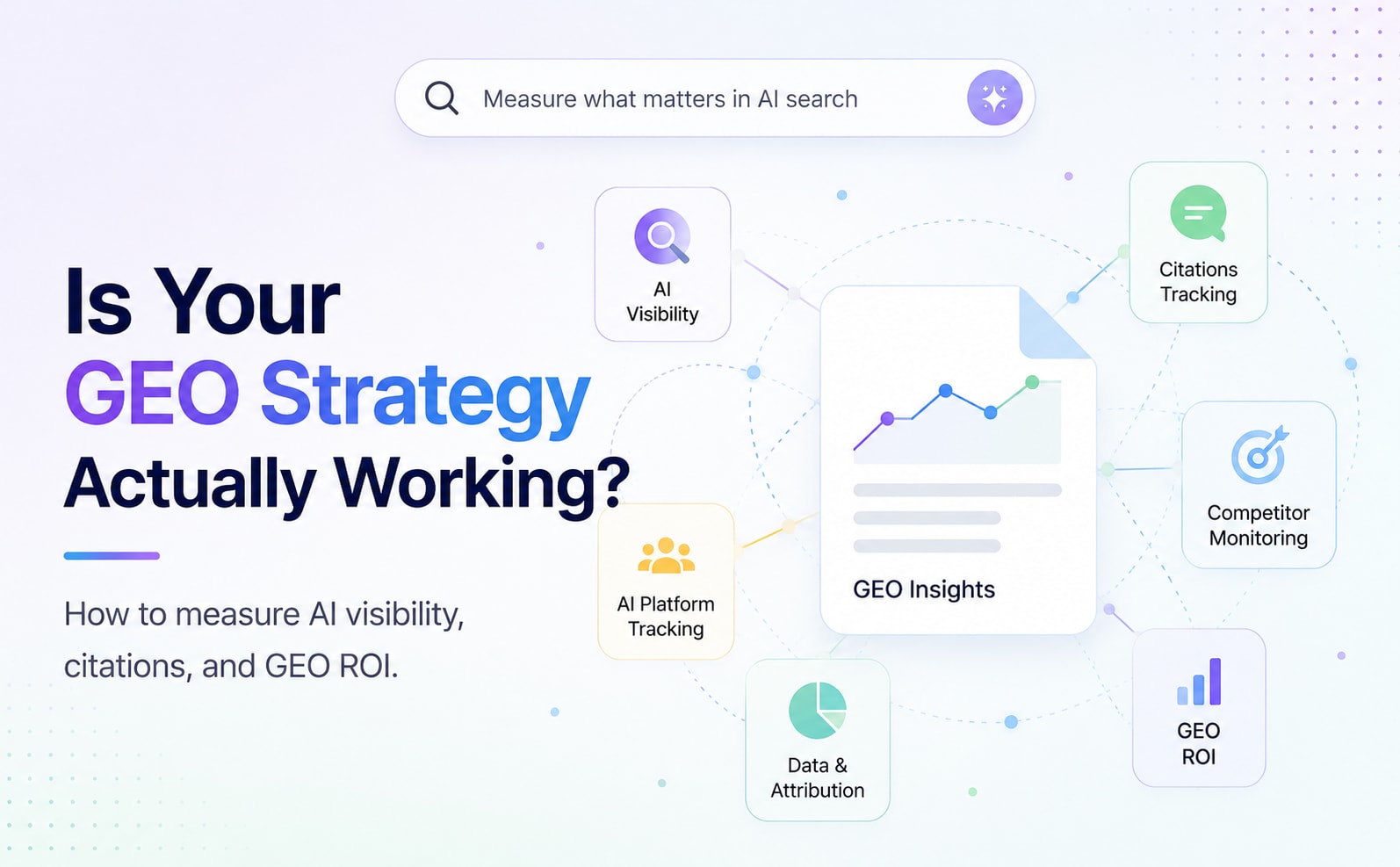
You have started optimising for AI search. Structured content, FAQ sections, third-party mentions, crawlability checks. All the right moves. But a week later your dashboard looks exactly the same. The question every brand eventually asks is: how do I know if any of this is working?
Tracking AI search attribution is the answer. It means identifying when a visitor arrives because ChatGPT, Perplexity, or Google AI Overviews cited you, and connecting that citation to a real business outcome. Right now, most brands cannot do this because their analytics were not built for AI traffic. This article walks through how to fix that, what to measure, and how Scribble approaches GEO measurement.
What is AI search attribution?
AI search attribution means tracing a conversion back to the moment an AI tool recommended your brand in a response.
It involves two parallel problems. First, AI search generates traffic your existing channels do not label correctly. Second, a large portion of AI influence never produces a click at all. Someone asks Perplexity a question, your brand appears in the answer, they close the tab and Google your name. That conversion lands as direct or organic, with no trace of what triggered it.
GEO measurement needs to cover both: the traffic you can see, and the influence you cannot.
Why your current analytics miss it
GA4 has no native AI channel. A visitor who clicks a ChatGPT citation lands under Referral or, if the referrer header gets stripped, under Direct.
This matters because AI-referred traffic converts far above standard organic benchmarks. Seer Interactive's published case study found ChatGPT referral traffic converting at 15.9% and Perplexity at 10.5%, compared to 1.76% for Google organic on the same B2B client property (October 2024 to April 2025). That is a single-client result, not an industry-wide average, but it reflects a pattern seen consistently across studies: AI-referred visitors arrive with higher intent because they have already been pre-qualified by the AI conversation before clicking.
According to Conductor's 2026 AEO/GEO Benchmarks Report, which analysed 3.3 billion sessions across 13,770 enterprise domains, AI referral traffic currently sits at around 1.08% of all website traffic, with ChatGPT driving 87.4% of that share. Small in volume today. But it is growing roughly 1% month over month, and it converts like high-intent paid traffic. Brands that instrument it now build a compounding data advantage.
Step 1: Set up an AI channel in GA4
This takes about 15 minutes. Go to Admin, then Data Display, then Channel Groups. Create a channel called "AI Search" with Session Source matching this regex:
chatgpt\.com|chat\.openai\.com|openai\.com|perplexity\.ai|claude\.ai|gemini\.google\.com|copilot\.microsoft\.com|deepseek\.com|grok\.com|meta\.ai|you\.com
Drag it above Referral and save. GA4 applies this retroactively. How each platform passes attribution differs:
Platform | Attribution behaviour |
ChatGPT | Appends utm_source=chatgpt.com to desktop links (from June 2025). Mobile app strips referrers; some traffic lands as Direct. |
Perplexity | Consistently passes perplexity.ai on desktop and mobile. Easiest to track. |
Google AI Overviews | Often appears as google/organic. Hard to isolate cleanly. |
Claude | Passes claude.ai from the web interface. App traffic can strip headers. |
Gemini | Uses standard HTTP referrer from gemini.google.com. No UTM available. |
Source: authoritytech.io, GA4 AI attribution guide, 2026
One honest limitation: GA4 tells you a session came from chatgpt.com. It cannot tell you what the user asked or which query surfaced your link. No standard analytics tool recovers prompt-level data from AI referrals today.
Step 2: Track brand mentions across AI platforms
GA4 tracks clicks. Most GEO impact never produces one. A buyer reads a ChatGPT answer naming your brand, gets their question answered, and leaves. That influence is real but invisible in acquisition reports.
To measure it, you query AI platforms directly. Build a list of 20 to 30 prompts your target customer would type into ChatGPT or Perplexity. Run them weekly. Record whether your brand appears, where in the response, and which competitors appear instead.
At scale, the key metrics from this layer are:
Metric | What it tells you |
AI share of voice | How often your brand appears vs named competitors across a defined prompt set |
Citation accuracy | Whether AI tools describe your product correctly |
Prompt coverage | The share of relevant queries where your brand appears at all |
Source attribution | Which pages or third-party mentions AI tools cite most often |
Step 3: The four metrics that actually matter
GEO measurement sits across four pillars. The first three tell you what is happening inside AI answers. The fourth is the one that justifies the budget. This framework comes from Scribble's own metric stack, covered in full in How to Measure GEO ROI: What Metrics to Actually Track.
Visibility: query presence rate and AI share of voice. Query presence rate is the percentage of your defined prompt set where your brand is mentioned at all. Run 50 to 100 buying-stage prompts across ChatGPT, Claude, Gemini, and Perplexity and log whether you appear. AI share of voice goes further: for each prompt, count mentions of your brand and all named competitors, then divide your mentions by the total. This is the metric that gives leadership something concrete. Moving from 12% AI share of voice to 19% in a quarter, while a named competitor drops from 31% to 24%, is a result you can report with confidence.
Citation: citation rate and source map. Visibility says you exist. Citation says AI engines trust you enough to reference. Track how often your domain appears as a cited source in answers that mention your category. Then build a citation source map: log every third-party URL AI engines cite when answering questions in your space and tag each one by type (review site, Reddit thread, industry publication, analyst report). If a specific publication appears repeatedly in citations and your content has never been featured there, that is a concrete PR and seeding target.
Sentiment: how AI engines describe you. Being present and cited is still not enough if the description does not help you win deals. Track whether AI engines frame you as "trusted by enterprise teams" or "simple but limited." Check whether that framing matches your current positioning and how it compares to how the same engines describe your closest competitors. Most mentions will be neutral. The flag to watch is outdated or misaligned framing being repeated at scale, because every user who asks the question gets that version of you.
Business impact: AI-attributed revenue. To get to ROI, combine three inputs: self-reported attribution from discovery forms (with ChatGPT, Perplexity, and "AI search" as explicit options), CRM notes from sales conversations where AI tools came up as the discovery source, and lift in branded search volume in Google Search Console following citation wins. Ahrefs' internal analysis found AI-referred visitors accounted for just 0.5% of total sessions but drove 12.1% of all sign-ups, a 23x conversion advantage. Once you have AI-attributed leads and an average close rate, the formula is straightforward:
GEO ROI = (AI-Attributed Revenue minus Total GEO Investment) divided by Total GEO Investment, multiplied by 100
You will rarely get this perfect. A conservative, consistently measured model is enough to prove whether GEO is a meaningful revenue driver and defend the budget for it.
How Scribble tracks it for you
Scribble's AI dashboard combines measurement and execution for brands running full-scale GEO campaigns.
The tracking layer monitors across five AI engines: ChatGPT, Perplexity, Google Gemini, Microsoft Copilot, and Grok. Unlimited prompts, that are tracked daily for your brand’s presence in the answers, and top competitor tracking.
The execution layer is where measurement connects to work that actually improves citations. Scribble also provides up to 50 creator-sourced LLM pages per month: real creators publish on their own accounts, and Scribble's engine transforms each post into an LLM-ready page hosted on your domain.
UGC distribution goes to X, Medium, Substack, and Paragraph. Forum seeding places content on Reddit and Quora, which AI retrieval bots consistently pull from.
Custom PR delivers three articles per month, building the third-party editorial presence that drives AI citations more than any on-site fix.
Explore the plans: Scribble pricing page
Frequently Asked Questions
Can GA4 track all AI referral traffic?+
No. With a custom channel group you capture most measurable AI traffic, but ChatGPT's mobile app strips referrer headers and Google AI Overviews traffic appears as google/organic. What you see in GA4 is a floor, not a ceiling.
How long before GEO shows up in attribution data?+
Scribble typically sees citation frequency rise within six to eight weeks of consistent GEO work. GA4 referral traffic usually follows four to six weeks after. Most GEO agencies report meaningful citation growth takes three to six months.
Do I need a dedicated GEO tool, or is GA4 enough?+
GA4 tracks clicks. To track citation frequency and share of voice in answers where no click happens, you need platform monitoring. Start with a manual weekly prompt audit. Scale to a platform like Scribble when manual tracking no longer keeps up. Measure your AI presence, uncover citation gaps, and execute campaigns that help your brand become the answer with Scribble’s dashboard
Written by

Hi! I’m Mrinalini. I work on growth at Scribble, where my days mostly revolve around content, planning campaigns, speaking to creators, and occasionally yapping in front of a camera. I studied engineering at Manipal Institute of Technology and briefly worked as a Test Engineer at Siemens before realizing marketing was my calling. Outside of work, you’ll find me eating/thinking about food.