A teardown of Rapido's zero commission entry into food delivery: the pricing mechanism, the CAC tell, the regulatory window, and the preconditions that decide whether you can run the same play. Bengaluru, August 2026.
The receipt
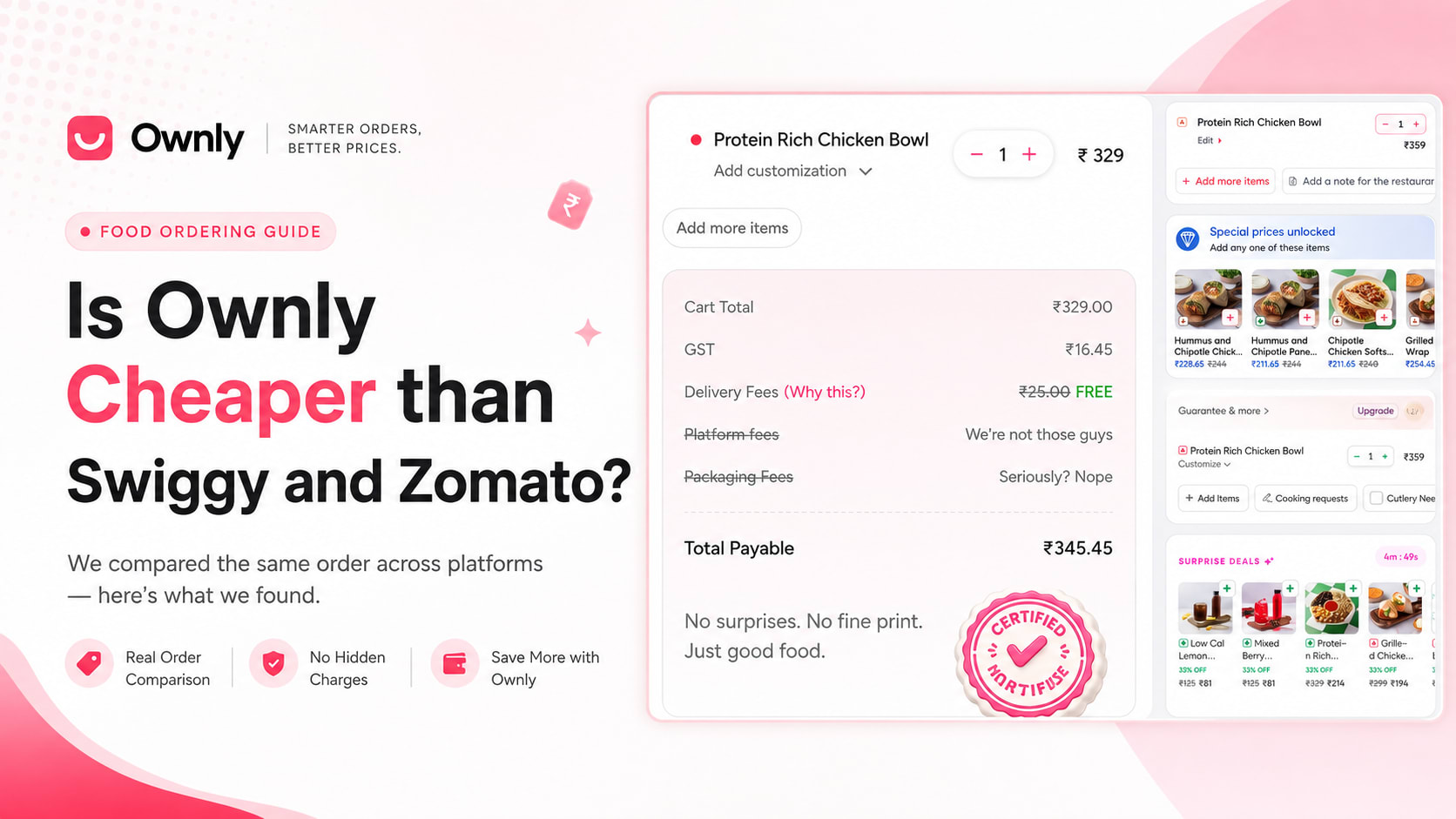
One dish (Protein Rich Chicken Bowl), one restaurant (Harvest Salad Co), one Bengaluru address, three checkout screens captured at 11:25 AM on the same morning.
Ownly (Rapido) | Swiggy | Zomato | |
|---|---|---|---|
Menu price | ₹329 | ₹359 | ₹359 |
Fees + GST | ₹16.45, delivery waived | bundled | bundled |
Discount applied | none | ₹100 (Swiggy One) | ₹125 movie voucher, post order |
Total | ₹345.45 | ₹395.00 | ₹466.53 |
Zomato: 35% more. Swiggy: 14% more, and only that close because ₹100 of subscription benefit was already applied. Strip the membership and that cart sits near ₹495, above Zomato.
Useful as a consumer datapoint. More useful as a diagram of two different cost structures.
The advantage lives in the menu, not the fees
The instinct is to blame the fee stack. Wrong layer.
Of the ₹121 gap, only ₹30 is the food. That ₹30 is the part that matters, because it is not a fee at all. It is the restaurant pricing in a commission before you ever see the cart.
Swiggy and Zomato take roughly 15 to 30% of order value depending on city, cuisine, volume and contract, with effective take rates reaching 25 to 35% once collection fees, subscription surcharges and GST stack. No kitchen absorbs that on food cost margins, so restaurants run a second menu. Marking aggregator prices 17 to 22% above dine in is standard practice in 2026.
Ownly charges 0% commission. There is no markup to apply. Harvest Salad Co's gap was 9.1%, below the industry norm, so on a restaurant pricing at the full spread the menu level difference alone would be ₹60 to ₹80 before a single fee line.
Pattern: in any marketplace, the incumbent's take rate does not appear as a fee. It appears as a higher base price one layer up, hidden inside supplier behaviour. The visible fee is the decoy. The embedded cost is two to three times larger.
Play 1: distribution arbitrage
Rapido runs 400+ cities and over 5 million rides a day. Food demand peaks at lunch and dinner. Ride demand does not peak at the same hours.
So Ownly did not buy a fleet. It bought utilisation of a fleet Rapido already pays for. A fixed cost became incremental, and the delivery economics that kill new entrants stopped applying.
This is the most copied lesson and the most often copied badly. It works because of one condition: the second use has to be genuinely counter cyclical to the first. If both curves peak together you are not reusing spare capacity, you are bidding against yourself for it.
Four questions for your own company:
What asset do I pay for at full cost regardless of usage? Fleet, audience, support team, sales floor, footprint, content library.
When is it idle?
Is there a demand curve that peaks inside that idle window?
Does serving it need a new capability, or only a new interface?
If the answer to (4) is a new capability, it is not arbitrage. It is a new company wearing your logo.
Play 2: wedge on the supply side
The obvious way into Indian food delivery is consumer discounts. Ownly's opening move went somewhere else.
The "Food Promise" launch film, a courtroom satire putting the existing delivery model on trial, plays as consumer advertising. It is not. Its most fervent audience was restaurant owners, and it landed inside a live grievance: the NRAI's antitrust fight, and over a thousand Bengaluru restaurants publicly agitating against aggregator terms this year.
That grievance bought supply at speed. An arrangement with the NRAI and its 50,000 plus member outlets. A Magicpin tie up reported to bring 80,000 more within reach. Roughly 20,000 restaurant partners live at citywide launch on 3 March 2026, for a platform that had piloted in three neighbourhoods since August 2025.
Pattern: in a two sided market, the side that is unhappy with the incumbent will do your distribution for free. Aim the launch narrative at their grievance. Consumer discounts buy volume that leaves when the discount does. Supply side coalitions buy inventory that stays.
Play 3: the clause, not the product
Aggregator contracts carried price parity clauses. A restaurant could not list a dish cheaper on its own site, on WhatsApp, or on a rival platform than it did on the aggregator. Under an enforced parity clause, the ₹329 versus ₹359 gap above could not legally exist.
The NRAI has fought those clauses since a 2021 CCI complaint. The CCI ordered an investigation in 2022 and found a prima facie case on cloud kitchens, exclusivity and price parity, with a final order still pending. In July 2026 the NRAI sought interim relief against Zomato specifically on parity, while a source at the company said the requirement had already been dropped earlier in 2026.
Pattern: some market openings are not product openings, they are a clause dying. If a contract term holds a category's pricing structure in place, the regulatory calendar is a roadmap input. The uncomfortable corollary: Ownly's price gap sits in a window that a single CCI order could close.
Play 4: the app integration is a CAC confession
In July 2026 Rapido folded Ownly into its main app, with 50% off up to ₹100 for first time users.
Read the sequencing. The plan reported at launch put Ownly in ten cities by July 2026. It is August 2026 and Ownly is in one city, inside a different app. That quarter was not spent buying geography. It was spent converting an audience Rapido already owned.
Pattern: when a company picks depth inside an owned surface over breadth in new markets, the honest reading is that paid acquisition was not working at the price they needed. Often the right call, but it should reset your estimate of how fast the thing scales.
What the incumbents did back
None of the defence on the other two screens is a price cut.
Zomato offered a ₹125 District movie voucher, claimable after the order is placed: high perceived value, zero effect on lunch, and it pushes you into a second product. Swiggy pre applied ₹100 of One membership benefit, ran Surprise Deals behind a 4m:49s countdown, and parked a ₹1 for three months Gold upsell in the cart. Both raised the platform fee to ₹17.58 including GST in March 2026, in the same period they were defending against a cheaper entrant.
That is the rational incumbent response. A price cut is permanent, symmetrical and instantly matchable. A voucher, a timer and a membership benefit are none of those, and they move attention from what this costs to what I am getting. It works right up until someone puts the two carts side by side.
Where the model is unproven
Ownly has removed all four lines incumbents monetise: commission, platform fee, packaging fee and ad inventory. What remains is a delivery fee of roughly ₹30, with reporting still inconsistent on whether restaurants pay a flat subscription on top.
No second revenue line disclosed. Either Ownly is a loss leader bought with Rapido's app engagement, or the P&L is unfinished.
Swiggy owns roughly 12% of Rapido and has told shareholders it would reassess given the conflict.
Zero commission is an offer, not a contract. Indian platforms have a documented pattern of generous onboarding terms that tighten once partners depend on them.
Steal, do not steal
Steal: auditing owned assets for a counter cyclical second use before buying a new channel. Aiming the launch narrative at the aggrieved side of a two sided market. Attacking the embedded cost rather than the visible fee. Treating a contractual change as a go to market trigger.
Do not steal: removing every revenue line before you know what replaces them. Reusing capacity whose demand peaks alongside your core business. Assuming unhappy suppliers convert into consumer demand, since Ownly still needed a discount and a parent app to get users. Reading single restaurant price data as a category wide claim, including the receipt at the top of this page.
FAQ
How did Rapido enter food delivery without building a delivery fleet? By routing food orders to riders it already employed for ride hailing. Rapido operates in 400+ cities with over 5 million rides a day, and food demand peaks at hours when ride demand does not, so deliveries fill otherwise idle capacity. Delivery cost becomes incremental rather than fixed, removing the largest barrier to entry in Indian food delivery.
What is distribution arbitrage? Using an asset you already pay for at full cost, such as a fleet, an audience or a sales team, to serve a second demand curve during its idle hours. It only produces margin when the second use is counter cyclical to the first. If both peak together, the second business consumes the first one's capacity instead of adding to it.
Why is zero commission a positioning strategy rather than a discount? Because it targets supply, not demand. It gave Ownly a grievance led narrative that recruited restaurants at speed, an NRAI arrangement, a Magicpin tie up and roughly 20,000 partners at citywide launch, solving the cold start problem that usually forces new entrants into consumer discounting.
Why is the same dish cheaper on Ownly than on Zomato? Because commission pushes restaurants to run a higher aggregator menu, with a 17 to 22% markup over dine in standard in 2026. With no commission to recover the markup disappears, so the difference shows up in the base menu price before any fee is added.
Can a non marketplace business run the same play? Yes, where four preconditions hold: a fixed cost asset, a defined idle window, a demand curve that peaks inside it, and a second use that needs a new interface rather than a new capability. A support team with quiet hours, a warehouse with a dead season, a content library nobody re cuts. If it needs a new competency, it is not arbitrage.
Related reading
From near zero to 9% AI share of voice in 15 days: the RocketX campaign
How much does AEO actually cost in 2026 (swap slug once live)
Run a citation check on your own brand with the GEO Checker
Start a campaign at brands.scribble.network
We run teardowns like this because these questions get asked to ChatGPT, Gemini and Perplexity before they get asked to Google, and the brands named in those answers are the ones publishing the receipts. See whether AI engines are citing yours at scribble.network.
Written by

I’m Tanmay Tarte, a community builder at Scribble and an engineering graduate from Priyadarshini College of Engineering. Over the years, I’ve worked across community management, content, hosting, and social media, mainly within the Web3 and creator ecosystem space. Outside of work, I’m a huge sports enthusiast and can genuinely play cricket all day, every day.