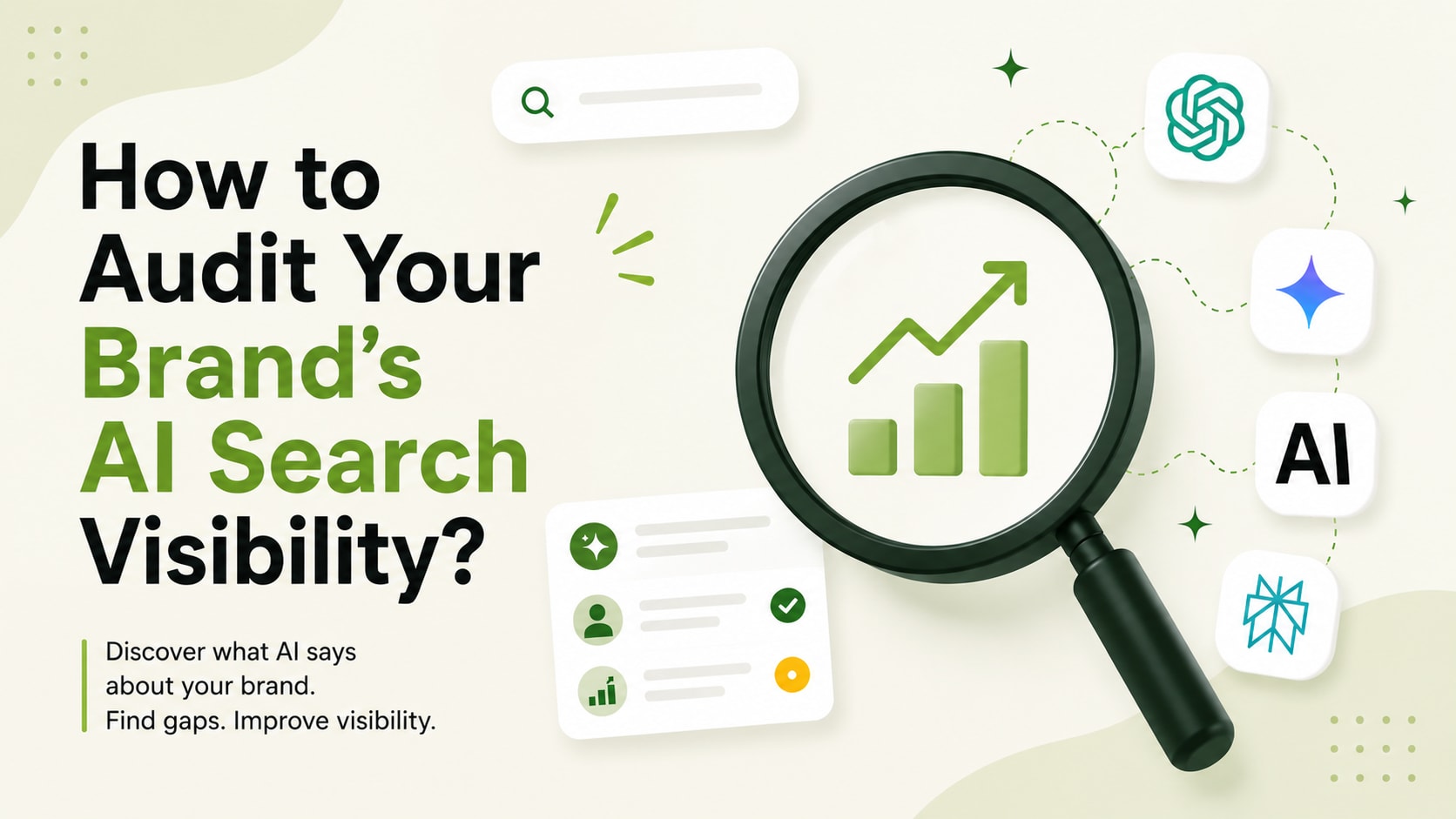
Here's the uncomfortable truth about AI search: 89% of brands are already appearing in AI-generated responses, but only 14% of marketers are tracking it. That gap, between appearing and knowing how you appear, is where brand narratives quietly go wrong.
An AI search visibility audit tells you whether you exist in the models your buyers use, how you're described when you do, and what's keeping you invisible when you don't. It's not the same as an SEO audit. It doesn't care about your keyword rankings or your domain authority score. It cares about whether ChatGPT, Perplexity, Gemini, and Google's AI Overviews reach for your brand when a relevant question is asked and what they say when they do.
This is that audit, step by step.
Step 1 — Establish Your Baseline: What Do the Models Actually Say About You?
Before you can fix anything, you need to know where you stand. The starting point is a structured prompt test: submit a set of category and comparison queries to the major AI platforms and log every response.
Start with these four platforms as a minimum:
Platform | Why It Matters |
ChatGPT (GPT-4o) | Drives 87.4% of AI referral traffic; the default interface for most users |
Perplexity | Cites sources explicitly; shows you exactly what it's pulling from |
Google AI Overviews | Now appears in 25% of all Google searches, up from 13% in early 2025 |
Gemini | Relevant for B2B audiences embedded in Google Workspace |
For your prompt set, write 20–40 queries the way a real buyer would ask them, not keyword phrases, but actual questions. Mix three intent types:
Category queries — "What are the best [product category] tools for [your audience]?"
Comparison queries — "How does [your brand] compare to [competitor]?"
Problem queries — "How do I solve [the problem your product addresses]?"
Run each query at least three times per platform. AI responses vary. A single run tells you nothing. Log every output in a spreadsheet with columns for: platform, query, brand mentioned (yes/no), position in response (primary / listed / absent), sentiment (positive / neutral / cautionary), and sources cited.
This spreadsheet is your baseline. Everything else in the audit builds on it.
Step 2 — Score What You Find
Raw responses aren't enough. You need a way to compare performance across platforms and track change over time. Use this scoring framework:
Metric | What to Measure | Why It Matters |
Mention rate | % of queries where your brand appears | Baseline visibility — are you in the room? |
Position | Primary recommendation vs. listed vs. absent | Primary mentions drive intent; list mentions build familiarity |
Sentiment | Positive / neutral / cautionary | Negative framing can suppress conversions even when you're visible |
Citation source | Which URLs the model cites when referencing you | Tells you which third-party coverage is doing the most work |
Competitor share | How often competitors appear vs. you | Your share of model within the category |
One thing that tends to surprise brands at this stage: 61.9% of brand mentions disagree across AI platforms. What ChatGPT says about your brand and what Perplexity says about it are often materially different. Treat each platform as a separate audience, not one homogenous channel.
Brands that appear in the top 3 AI responses receive 4.2x more brand searches within 30 days compared to brands that don't appear at all — so the position column in your log matters as much as the mention column.
Step 3 — Audit Your Source Footprint
When models mention your brand, they pull from somewhere. Identifying those sources is one of the most actionable parts of this audit because it shows you where your brand narrative is actually being built and it's usually not your website.
When a user asks an LLM about a brand, earned media accounts for 48% of citations versus only 23% from owned brand content. Your product pages and blog posts are not the primary inputs. Third-party coverage is.
Use Perplexity for this step. It shows its sources explicitly. Run your top 10 brand and category queries and note every URL cited. Then categorize what you find:
Source Type | Examples | What It Signals to Models |
Review platforms | G2, Capterra, Trustpilot | Social proof; used heavily for commercial queries |
Press coverage | Trade publications, industry blogs | Category authority and legitimacy |
Community discussion | Reddit, LinkedIn, Quora | Conversational context; Reddit is the #1 cited domain across most AI platforms |
Analyst/research mentions | Gartner, Forrester, industry reports | Enterprise trust signal |
Your own content | Blog posts, case studies, landing pages | Factual specifics — use cases, pricing, integrations |
Look for gaps. If your brand appears in AI responses but no review platform content is being cited, that's a signal. If competitor brands are being cited from analyst reports and you aren't, that's a signal. The goal of this step is to understand which distribution channels are feeding the models that your buyers use.
Step 4 — Test Your Content for Citability
Your website might be well-optimised for Google and still be nearly invisible to AI models. The two systems reward different things. Brand search volume — not backlinks — is the strongest predictor of LLM citations, and content structure matters in ways that traditional SEO doesn't fully capture.
Take your five most important pages, homepage, key product pages, your best-performing blog post, and run each through these checks:
Entity clarity check: Does the opening section define what your brand is, who it's for, and what specific problem it solves, without superlatives or vague claims? A model needs to be able to extract a confident, accurate summary from the first 200 words. Research shows models extract 44% of citations from the first 30% of a page.
Lift-out sentence check: Read each page and ask: which sentences could be quoted accurately out of context? If a model extracts one sentence from your pricing page to answer a buyer's question, does that sentence make sense and create the right impression on its own?
Claim specificity check: Are your claims quantifiable? Quantitative claims get 40% higher citation rates than qualitative statements. "Reduces onboarding time by 60% for teams under 50 people" is citable. "Streamlines your workflow" is not.
Source citation check: Does your content link out to primary sources? Original research, named studies, credited experts? External citations increase citation probability by 300% compared to self-published content without references.
Run these checks across your five pages and flag every failure. These are your highest-leverage content fixes.
Step 5 — Check Technical Accessibility for AI Crawlers
A piece of content can be perfectly written and still be invisible to AI systems if the technical configuration blocks them. This is a quick check but an important one.
AI platforms use their own crawlers to retrieve content for retrieval-augmented generation (RAG). The major ones are GPTBot (OpenAI), ClaudeBot (Anthropic), and PerplexityBot. If your robots.txt file blocks these bots, you're opted out of AI search for those platforms entirely sometimes accidentally.
Check your robots.txt file for any rules that disallow AI crawlers. Then check whether your key pages are JavaScript-rendered: AI bots generally do not execute JavaScript, which means content that only loads client-side may not be readable to them at all.
Also check for schema markup. Pages with FAQ schema are 30% more likely to appear in rich AI results, and Article schema lifts citations by 22%. If your key pages have no structured data at all, that's a straightforward fix with measurable upside.
Step 6 — Benchmark Against Competitors
An audit in isolation only tells you half the story. Run the same prompt set you used in Step 1, but this time log competitor mentions alongside your own. You want to answer three questions:
Which competitors appear more frequently than you, and in which query types?
What sources are being cited when competitors are mentioned — and are those sources accessible to you?
How are competitors described versus how you are described?
The last question is often the most revealing. If a competitor is consistently described as "the most user-friendly option" and you're described as "feature-rich but complex," that's a positioning problem surfaced by AI responses, one that exists regardless of what your marketing copy says.
Build a simple comparison table from your logs like this:
Query Type | Your Mention Rate | Competitor A | Competitor B | Gap |
Category queries | — | — | — | — |
Comparison queries | — | — | — | — |
Problem queries | — | — | — | — |
Fill it in from your data. The gaps in this table become your prioritised action list.
Step 7 — Build Your Monitoring Cadence
A one-time audit is a snapshot. AI models update, competitor coverage shifts, and new third-party sources enter the citation pool. To stay ahead of that, you need a repeatable monitoring routine.
The minimum viable cadence for most brands:
Frequency | Task |
Weekly | Spot-check 5–10 high-priority queries across ChatGPT and Perplexity |
Monthly | Run full prompt set; update mention rate, position, and sentiment scores |
Quarterly | Full source audit; check which third-party pages are being cited and whether new competitors have entered the top responses |
For the weekly and monthly layers, tools like Otterly.ai, Profound, or Superlines can automate query logging across platforms. For the source audit layer, Perplexity's manual citation output is still the most transparent option.
The goal isn't to track everything, it's to detect directional movement early enough to act on it. A sudden drop in mention rate on comparison queries is worth investigating. A new competitor appearing in primary recommendation position across multiple platforms is worth understanding.
What to Do With Your Audit Results
The audit will typically surface one of three situations:
Not appearing at all. The priority is entity building, earning third-party mentions, getting listed in review platforms and analyst reports, and publishing content that gives models something factual to reference. See the GEO content brief framework for how to structure that content work.
Appearing but with weak or inaccurate framing. The priority is source correction, identifying which third-party content is feeding the inaccurate framing and either updating it (for owned content cited externally) or generating better content that displaces it.
Appearing well in some platforms but not others. Citation rates can vary by 615x between platforms like Grok and Claude for the same brand. Platform-specific gaps usually trace back to source preferences: ChatGPT skews toward Wikipedia and authoritative editorial sources; Perplexity and Google AI Overviews pull heavily from Reddit, YouTube, and community platforms. Fix the gap by building presence in the source types each platform prefers.
Get a free GEO Audit from ScribbleAI here.
Frequently Asked Questions
How is an AI search visibility audit different from a regular SEO audit?+
A traditional SEO audit looks at rankings, backlinks, page speed, and on-page optimisation, signals that Google's crawler weighs. An AI visibility audit looks at something different: whether large language models mention your brand in generated responses, how accurately they describe you, and which third-party sources they're drawing from when they do. A page can rank on page one of Google and still never appear in an AI-generated answer. The two systems overlap but they are not the same, and they reward different things.
Do I need special tools to run this audit?+
Not for the manual version. A spreadsheet, access to ChatGPT, Perplexity, Google AI Overviews, and Gemini, and a defined set of prompts is enough to get a meaningful baseline. Where tools help is in the monitoring layer, running large query sets repeatedly across platforms is tedious manually. Tools like Otterly.ai, Profound, and Superlines automate the logging. For most brands, the right starting point is a manual audit first to understand what you're tracking, then tooling once you know what cadence and query set makes sense.
How many prompts do I actually need?+
Twenty to forty is enough for a first audit in most categories. The goal at this stage isn't statistical precision, it's identifying whether you're appearing, in what framing, and from which sources. You can always expand the query set once you know which intent clusters matter most to your buyers. For ongoing monitoring, a tighter set of 15–20 high-priority queries run consistently is more useful than a sprawling set run once.
What if I don't appear at all in any AI responses?+
It's more common than most brands expect, and it's fixable. The most likely causes are insufficient third-party coverage (models have little to draw on), weak entity definition (your brand isn't clearly associated with a specific category in the sources that exist), or technical blocks (AI crawlers can't access your content). Start with the source footprint audit in Step 3: understanding where your brand does and doesn't appear across third-party platforms is usually the fastest diagnostic.
How long does it take to see improvement after making changes?+
Faster than most people expect for some things, slower for others. Technical fixes, unblocking AI crawlers, adding schema markup can affect citability within weeks as bots re-crawl your content. Content changes take longer: new or updated pages need to be indexed, crawled by AI bots, and incorporated into model retrieval layers. Third-party coverage takes longest of all, because building review platform presence, earned media, and community mentions is a compounding process. A realistic window for seeing meaningful movement in your audit scores is two to four months from the start of active optimisation.
Should I be worried if AI models are describing my brand inaccurately?+
Yes, and it's worth addressing quickly. Inaccurate AI descriptions, wrong pricing tiers, outdated product scope, incorrect positioning, can create friction at exactly the point where a buyer is forming their consideration set. The fix starts with identifying which source the inaccurate description is coming from (Step 3 of this audit) and then either correcting that source directly or publishing clearer, more authoritative content that displaces it in model retrieval. Your own pages can be updated immediately; third-party sources require outreach or the slower process of generating better content that models prefer.
Is this audit a one-time project or an ongoing programme?+
Both, in sequence. The first audit is a project: establish your baseline, identify gaps, prioritise fixes. After that it becomes a programme, the monitoring cadence in Step 7 is what turns a one-time snapshot into a continuous improvement loop. The brands that will compound AI visibility over the next two years are the ones that treat this as infrastructure, not a campaign.
Written by

I’m Ramaa, a writer and creator at Scribble. I’ve written two books, and writing is something I always find my way back to, whether that’s articles, scripts, captions, or overly long notes app rambles I swear will “be useful later.” I enjoy thinking about why people create, how ideas spread online, and what makes content feel genuinely human. When I’m not writing, I look after regulatory compliance and legal admin at Scribble, and I’m a graduate of the School of Policy, New Delhi. Outside of work, I’m a musician and an avid reader.