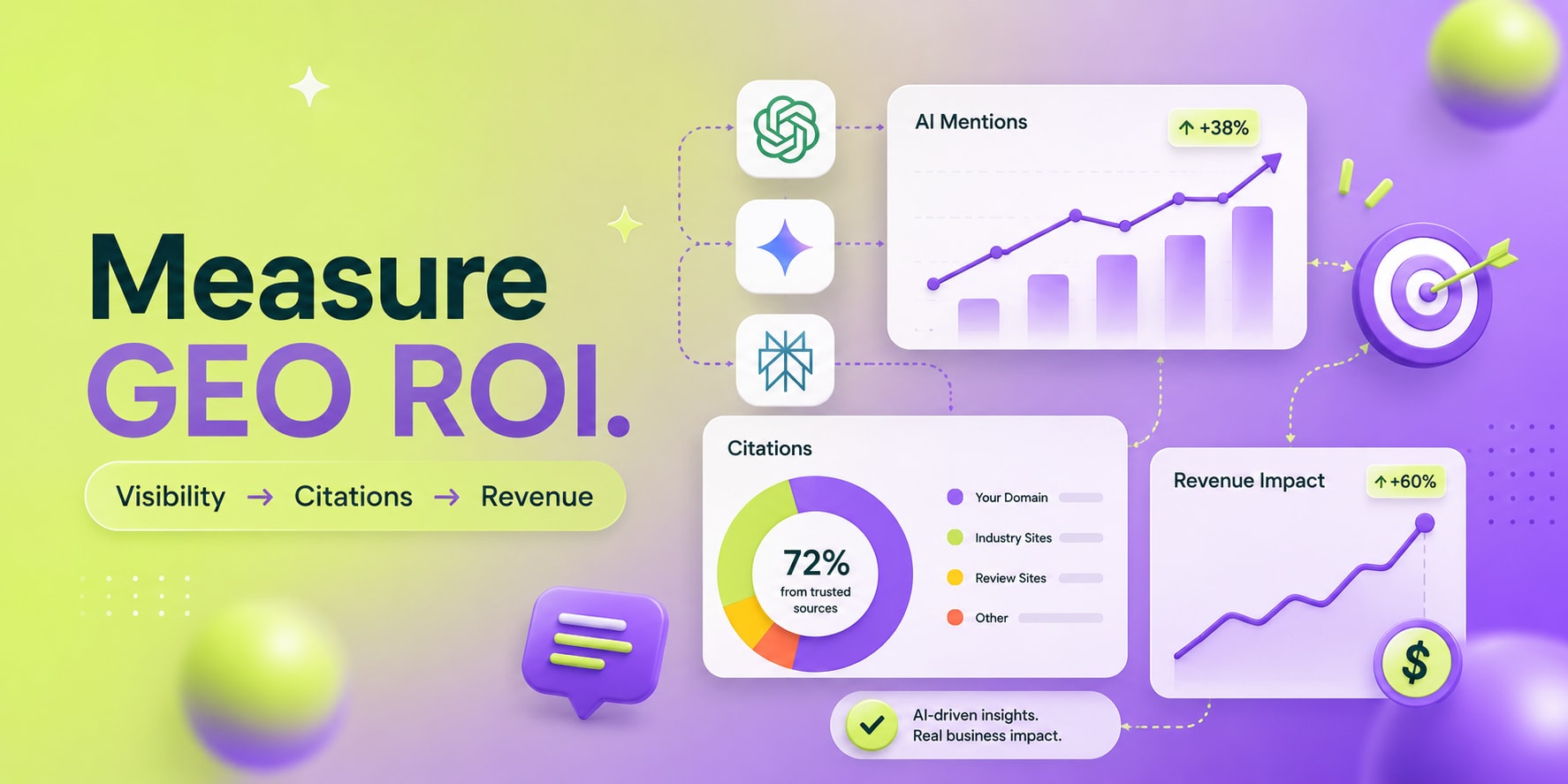
Most brands running GEO campaigns can tell you whether their content got published. Very few can tell you whether it got cited by an AI engine, how it was described when it was, or whether that citation drove a single qualified lead.
That gap is the measurement problem. Unlike SEO, there is no native AI Search Console handing you impressions, rankings, and click-through rates from ChatGPT, Claude, Gemini, or Perplexity. GEO measurement has to be built deliberately, from a structured query-simulation layer through to revenue attribution.
The urgency is not abstract. Roughly 60% of searches now end without the user clicking through to another site, according to Bain & Company, and SparkToro and Datos found that only about 360 of every 1,000 US Google searches reach the open web at all. As discovery shifts inside AI answers, the brands that can measure their presence there are the ones that will be able to defend a budget for it.
This guide gives you the metric stack to do that. Think of your GEO audit as the diagnostic that tells you what is broken. This is the instrumentation that tells you whether you are fixing it.
Start Here: Is Your Brand Visible to AI at All?
Before measuring ROI, you need to answer a prior question: do AI engines know you exist for the queries that matter?
Run a baseline audit across ChatGPT, Claude, Gemini, and Perplexity using buying-stage prompts for your category:
"Best [your category] tools or platforms"
"[Your brand] vs [top competitor]"
"[Your brand] alternatives"
"Which [category] tools are best for [key use case]?"
For each engine, record four things: are you mentioned at all, how are you described in two to three key phrases, who is mentioned when you are not, and which sources are being cited in those answers.
If you are consistently missing from high-intent prompts, or only showing up via third-party comparison sites rather than your own properties, you are effectively invisible to AI for commercial queries. That is your starting point. Everything below measures how far you move from it.
The Four Pillars of GEO Measurement
GEO measurement sits across four pillars. The first three are qualitative. The fourth is the one that justifies the budget.
Pillar | What it measures | The metric that matters |
|---|---|---|
Visibility | Whether AI engines surface you at all for the queries that matter | Query presence rate and AI share of voice |
Citation | Whether engines treat you as a credible source worth referencing or linking to | Citation rate and citation share of voice |
Sentiment and positioning | Whether engines describe you in a way that actually helps you win deals | Sentiment distribution and subtopic coverage |
Business impact | Whether AI-driven discovery produces measurable lift in branded search, qualified traffic, and revenue | AI-attributed revenue (GEO ROI) |
What follows are the specific metrics inside each pillar, and how to track them.
Visibility Metrics
Query Presence Rate
Query presence rate is the percentage of your defined prompt set where your brand is mentioned at all. It is your GEO visibility baseline.
Define a fixed set of 50 to 100 prompts that reflect how your buyers actually research: problem queries, solution queries, and vendor-evaluation queries. Run those prompts across your target engines and log whether you are mentioned.
Formula: presence rate equals prompts where you are mentioned divided by total prompts, multiplied by 100.
The number itself matters less than the trend. You want to see it move upward as you ship GEO-focused content. If it stays flat after three months of content investment, the content is not reaching the sources AI engines are pulling from.
AI Share of Voice
AI share of voice tells you how often you appear versus competitors for that same prompt set.
For each prompt, count mentions of your brand and all named competitors. Your AI share of voice equals your mentions divided by total brand mentions across all vendors.
This is the metric that tells leadership something concrete: you went from 12% AI share of voice to 19% in Q2, while Competitor A dropped from 31% to 24%. That is a directional win you can report with confidence.
Recommendation Rate
There is a meaningful difference between being visible and being chosen. Recommendation rate captures the second thing.
Focus on vendor-evaluation queries: "best [category] platform," "[your brand] vs [competitor]: which is better for [use case]?" For each of these prompts, record whether your brand is explicitly recommended or merely listed.
Formula: recommendation rate equals evaluation prompts where you are explicitly recommended divided by total evaluation prompts.
You can be mentioned in 70% of prompts and recommended in only 20% of them. That gap is a positioning problem worth surfacing distinctly, because it tells you the AI engine sees you but does not prefer you.
Citation Metrics
Visibility says you exist. Citation says you are trusted enough to reference. These are different signals and require separate tracking.
Citation Rate
Citation rate tracks how often AI engines cite your domain as a source in answers that mention your category or brand.
For each prompt where your brand or category appears, check which URLs the engine cites or references. Count how many times your domain appears versus third-party domains.
Track two numbers: domain citation rate, which is the percentage of relevant answers that include your domain, and citation share of voice, which is your share of all cited domains across your prompt set.
Higher citation rates on high-intent prompts mean AI engines see your content as authoritative, not just your brand name as a label to apply to a category.
Citation Source Map
A citation source map shows you which third-party URLs AI engines retrieve when answering questions in your category: comparison sites, YouTube reviews, Reddit threads, industry blogs, analyst reports.
Map all cited domains for your prompts and tag them by type: review site, marketplace, community, analyst, your own properties.
Two questions this answers: are competitors heavily represented on the pages AI engines love while you are missing entirely, and are your strongest case studies, documentation, and explainers actually present in the content pool that AI pulls from?
This metric does double duty. It measures GEO performance and it generates a distribution roadmap. If the AI engines are consistently citing a specific industry publication and your content has never been picked up there, that is a clear PR and seeding target.
Position in Cited Sources
Many AI interfaces list sources in an implicit ranking. Appearing first carries more perceived authority than appearing fourth. Track average citation position for your domain across prompts, and the distribution of positions over time.
If your average position improves quarter over quarter as you ship better GEO-aligned content, that is a strong signal that engines are increasingly prioritizing your explanations over competitors and third-party aggregators.
Sentiment and Positioning Metrics
Being present and cited is still not enough if AI engines describe you in ways that do not help you win deals.
Sentiment Distribution
Track the tone of AI descriptions of your brand: positive, neutral, or negative. More specifically, track the framing. Are you described as "simple but limited," "flexible but complex," "trusted by enterprise teams," or "expensive compared to alternatives"?
How does that framing compare to how the same engines describe your closest competitors?
Most mentions will be neutral or mildly positive. The flag to watch for is outdated or misaligned framing that does not reflect your current product or positioning, because that framing is being repeated at scale to every user who asks the question.
Subtopic Coverage Gaps
AI engines respond to the questions behind the question. Subprompts like "best for creators," "pricing," "integrations," and "[your brand] vs [competitor]" each trigger different answer sets.
Map which subtopics you appear in and where you are absent. If you consistently show up in generic category lists but disappear when users ask "best for [your core use case]," that is a content gap with a direct fix. You need content that specifically and credibly answers that subprompt.
Those gaps also tell you exactly which prompts competitors are winning, and why.
Business Impact: Closing the Loop to Revenue
The visibility, citation, and sentiment metrics above are worthless in a board deck unless they connect to pipeline and revenue. Here is how to build that connection.
AI Referral Traffic
Perplexity and some other AI engines send trackable referral traffic that appears in GA4 and standard analytics. Track AI-labeled referrals as a separate channel. Monitor trends in sessions, engagement rate, and conversions from this traffic as your visibility and citation metrics improve.
This traffic tends to punch above its volume. In a 12-month GA4 analysis of 94 ecommerce sites, ChatGPT referrals converted 31% higher than non-branded organic search (1.81% versus 1.39%), per Visibility Labs data reported by Search Engine Land. Semrush research has put the average AI-search conversion advantage even higher, around 4.4x organic for research-heavy queries. The mechanism is intent compression: by the time a user clicks through from an AI answer, the engine has already done the comparison and pre-qualified them.
A consistent uptick in AI referral traffic is one of the cleanest hard-number signals that GEO work is translating into real user behavior.
Branded Search Lift
Even when AI engines do not send a direct click, they influence what users search next. Users who discover your brand through an AI answer often search your brand name directly before visiting your site.
Monitor branded search volume trends in Google Search Console. A rising trend in navigational queries following GEO content investment is a second-order signal that AI visibility is driving awareness at the top of the funnel.
AI-Attributed Leads and Revenue
To get to ROI, you need to estimate AI-attributed revenue. Combine three inputs:
Self-reported attribution in discovery forms, with explicit options for ChatGPT, Perplexity, or AI search.
CRM notes from sales conversations where AI tools came up as the research or discovery source.
Delayed attribution patterns, specifically lift in branded search and direct traffic following major citation wins.
Once you have a reasonable estimate of AI-discovered leads and their average close rate, you can apply the GEO ROI formula.
GEO ROI = (AI-Attributed Revenue minus Total GEO Investment) divided by Total GEO Investment, multiplied by 100
Where AI-Attributed Revenue is revenue from deals where AI search played a material role in discovery or consideration, and Total GEO Investment is content, distribution, PR, tools, and internal time.
You will rarely get this perfect. A conservative, consistently measured model is enough to prove whether GEO is a meaningful revenue driver.
The Metric Stack at a Glance
Pillar | Metric | What it tells you | How to track it |
|---|---|---|---|
Visibility | Query presence rate | Baseline visibility | Mentions ÷ total prompts × 100 |
Visibility | AI share of voice | Visibility versus competitors | Your mentions ÷ all brand mentions |
Visibility | Recommendation rate | Chosen versus merely listed | Recommended ÷ total evaluation prompts |
Citation | Citation rate | Trusted as a source | Answers citing your domain ÷ relevant answers |
Citation | Citation source map | Where AI pulls from | Tag every cited domain by type |
Citation | Position in cited sources | Perceived authority | Average citation position over time |
Sentiment | Sentiment distribution | How you are framed | Tone and framing tags versus competitors |
Sentiment | Subtopic coverage gaps | Where you are absent | Subtopics present ÷ subtopics tracked |
Business impact | AI referral traffic | Real user behavior | GA4 AI-labeled channel trend |
Business impact | Branded search lift | Top-funnel awareness | Google Search Console branded-query trend |
Business impact | AI-attributed leads and revenue | ROI | GEO ROI formula |
Tracking Cadence
GEO measurement has to be operationalized or it dies as a one-off audit.
Weekly: Run a slim prompt set of 20 to 30 queries to catch shifts in visibility, citations, and sentiment across engines. Flag anything that moves significantly.
Monthly: Aggregate into trendlines for AI visibility score, share of voice, citation rate, and AI referral traffic. Include branded search movement and a summary of any new third-party citations acquired.
Quarterly: Connect the trends to pipeline and revenue. AI-attributed leads, win and loss patterns where AI came up in sales conversations, and shifts in how the engines describe you versus the quarter before.
Start With the Diagnostic
The goal is a GEO program that feels less like experimental content theater and more like a measurable, revenue-connected acquisition channel. That shift starts with a metric stack you actually trust.
But you cannot instrument what you have not diagnosed. Before you build any of the tracking above, you need a clear read on where you stand today: which high-intent prompts you are missing, how AI engines describe you right now, and which third-party sources are winning the citations you should own.
That is what a GEO audit gives you. Run your content through Scribble's GEO Checker to score how citable your pages actually are to AI engines, then use the metric stack in this guide to track every point of improvement from there. The audit tells you which gaps exist. The metrics tell you whether you are closing them.
Written by

I’m Tanmay Tarte, a community builder at Scribble and an engineering graduate from Priyadarshini College of Engineering. Over the years, I’ve worked across community management, content, hosting, and social media, mainly within the Web3 and creator ecosystem space. Outside of work, I’m a huge sports enthusiast and can genuinely play cricket all day, every day.