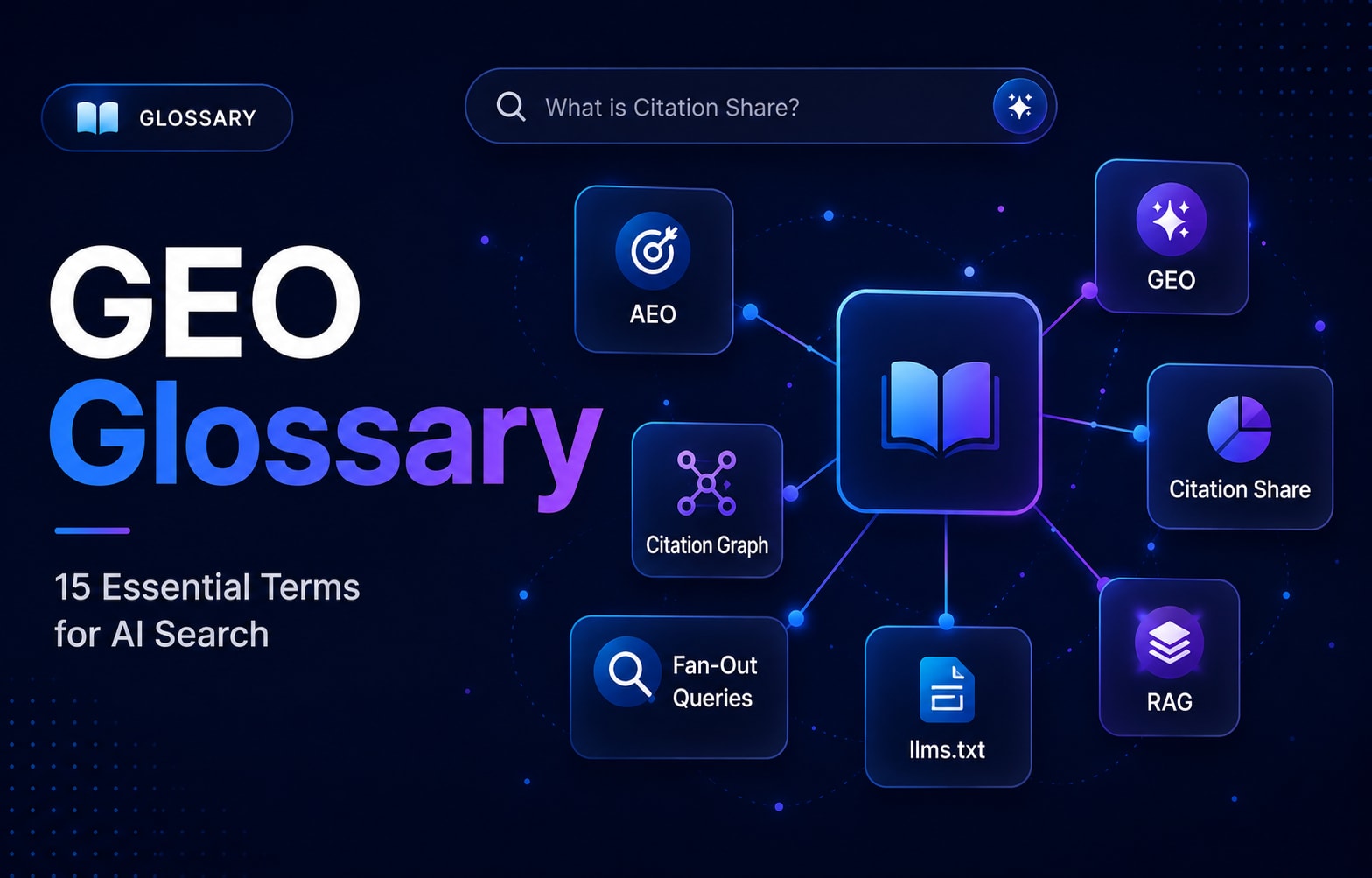
GEO has produced its own vocabulary faster than most marketers can keep up with. AEO, fan-out queries, citation graphs, llms.txt: these terms show up in client decks and Slack threads long before anyone agrees on what they mean. This glossary defines the 15 terms that come up most often, in plain language, so you can use them correctly the first time.
If you're new to the discipline itself, start with What is GEO? The complete guide for marketers, which covers the broader framework these terms sit inside.
AEO (Answer Engine Optimization)
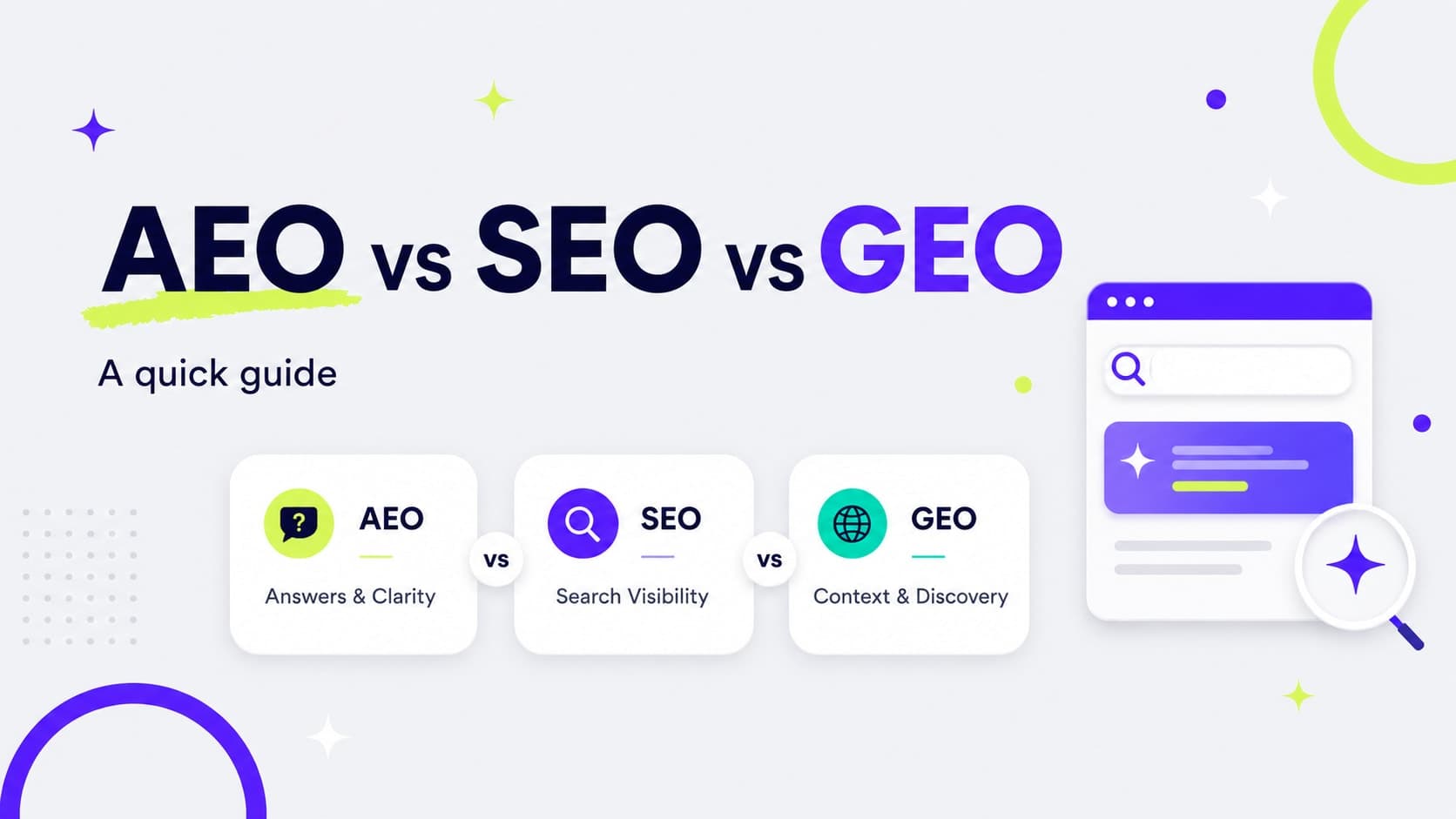
AEO is the practice of getting a specific piece of content selected as the direct answer in an AI-generated response. The target is narrower than GEO: AEO optimizes for individual answer moments on platforms like ChatGPT, Perplexity, and Google AI Overviews, while GEO covers visibility across the entire universe of AI search surfaces and query types.
Google's own developer documentation now uses both terms side by side without picking a winner, describing AEO and GEO as terms used to describe work focused on improving visibility in AI search experiences. In practice, most teams treat AEO as a subset of GEO: every AEO win is a GEO win, but not every GEO investment (building topical authority, earning third-party citations) is aimed at a single answer slot.
GEO (Generative Engine Optimization)
GEO is the practice of structuring content, brand presence, and citation sources so that AI models reference your brand when answering relevant queries. It shares 70 to 80 percent of its foundation with traditional SEO (technical crawlability, site structure, content quality) but adds a layer specific to how LLMs select and synthesize sources: quotable self-contained prose, named entities over vague references, and a citation footprint spread across third-party platforms rather than concentrated on owned domains.
For the full framework, see What is GEO? The complete guide for marketers.
Fan-out queries
Fan-out queries (also called query fan-out) are the sub-queries an AI model generates internally when answering a single user question. Instead of matching one query to one set of results the way traditional search does, the model breaks the original question into several related searches, retrieves results for each, and synthesizes them into one answer.
Google's Search Central documentation defines it directly: a set of concurrent, related queries generated by the model to request more information and fetch additional relevant search results to address the user's query. The example Google gives is a query about fixing a weedy lawn, which fans out into searches for herbicides, chemical-free removal methods, and prevention.
The practical implication for content teams: ranking for your primary target query is no longer the finish line. If your content doesn't also cover the three or four sub-queries a model is likely to generate around that topic, a competitor's content fills that gap and gets cited instead.
Citation graph
A citation graph is the network of sources an AI model treats as connected when answering questions about a topic, brand, or entity. It's built from co-citation patterns: when multiple AI-generated answers consistently cite the same cluster of sources together, those sources form a graph the model treats as a coherent, trustworthy reference set for that topic.
This is why interlinking and third-party citation diversity matter more in GEO than they did in traditional SEO. A single authoritative article rarely earns consistent citations on its own. A cluster of mutually reinforcing sources, spanning owned content, creator-published posts, and independent mentions, builds the kind of citation graph that shows up repeatedly across model responses.
Citation share
Citation share is the percentage of relevant AI-generated answers, across a defined set of target queries, in which a brand is cited as a source. It's the GEO equivalent of share of voice, and the metric to optimize for over raw "visibility."
The distinction between visibility and citation share matters more than it sounds. Visibility just means a brand shows up somewhere in an AI answer, even as an unlinked mention pulled from a model's training data. Citation share means the model is actually attributing a claim to your domain as a retrieved source. A brand can have high visibility and low citation share if models recognize the name but never pull from its content. Citation share is the harder number to move, and the one that actually correlates with referral traffic and perceived authority.
llms.txt
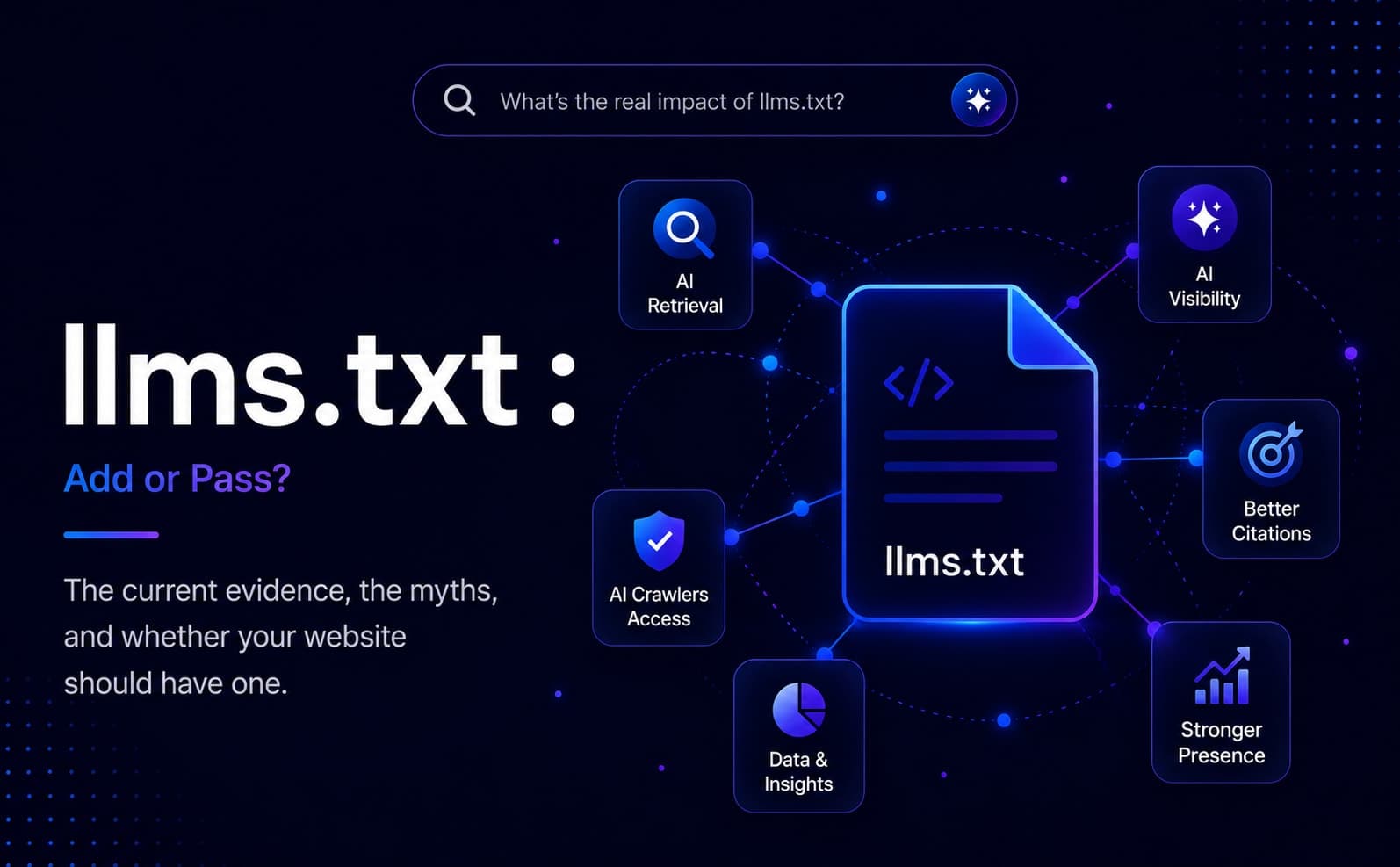
llms.txt is a proposed convention, not a ratified standard, that lets a website publish a Markdown file at its root domain listing the pages it considers most important, with one-line descriptions of each. It's modeled loosely on robots.txt but serves a different function: robots.txt controls crawler access, while llms.txt is meant to add editorial curation on top of that access.
Adoption data as of 2026 tells a mixed story. An SE Ranking study analyzing nearly 300,000 domains found adoption sitting around 10 percent, flat across low-, mid-, and high-traffic sites alike. More notably, Limy.AI's monitoring of over 500 million AI bot visits over a 90-day window found major AI search crawlers, including GPTBot, ClaudeBot, and PerplexityBot, overwhelmingly skip the file and crawl HTML directly.
Where llms.txt does show real traction is the coding-agent ecosystem. IDE agents fetch llms.txt routinely, with tools like Cursor, Windsurf, Claude Code, and GitHub Copilot checking for it when pointed at a documentation site. Some in the industry have started framing this as a "business-to-agent" surface rather than an SEO lever: a way for a brand's documentation to be legible to coding agents, distinct from whether it influences AI search citations. The takeaway for most brands: shipping an llms.txt file costs little and carries optionality if adoption grows, but it should not be mistaken for a citation strategy on its own.
AGENTS.md
AGENTS.md is a separate, more firmly established convention from llms.txt, and the two are easy to confuse since both are plain Markdown files sitting at a project root. AGENTS.md gives AI coding agents project-specific operating instructions: build commands, coding conventions, testing rules, and constraints the agent can't infer from the code alone. It functions as a README written for agents instead of humans.
The format is now stewarded by the Agentic AI Foundation under the Linux Foundation, with broad tool support across Cursor, GitHub Copilot, Claude Code, Aider, and Windsurf. OpenAI, which released the format in August 2025, reports adoption past 60,000 open-source repositories and agent frameworks as of its handoff to the foundation. For a content or marketing team, AGENTS.md is mostly out of scope: it governs how agents write code in a repository, not how AI search engines cite a brand's content. It's worth knowing the term exists mainly so it doesn't get conflated with llms.txt in a client conversation.
Schema markup (JSON-LD)
Schema markup is structured data embedded in a page's HTML, typically in JSON-LD format, that explicitly labels what a piece of content is: an article with a named author and publish date, an organization with a specific founding date and logo, a product with a price and availability. It's the clearest non-content signal a page can send to both traditional search crawlers and AI retrieval systems.
For GEO specifically, schema markup matters most for entity recognition. A model deciding whether to cite a page as the source for "who founded this company" or "when was this article published" relies on structured data to resolve that confidently, rather than having to infer it from unstructured prose. Article schema and Organization schema are the two types most relevant to a content program; FAQ schema can still function as a content signal for AI search even though Google scaled back its rich-result display.
RAG (Retrieval-Augmented Generation)
RAG is the technique most AI search tools use to ground their answers in current, retrievable information rather than relying solely on what the model learned during training. When a model uses RAG, it searches the live web (or a specific document set) for relevant content, pulls excerpts into its context window, and generates an answer based on those excerpts alongside its own training.
This matters for GEO because RAG is the mechanism that makes citation possible at all. A page can only be cited if it's retrievable, parseable, and specific enough to be selected during the retrieval step ahead of competing pages.
Parametric memory
Parametric memory is the knowledge a model has baked into its weights from training data, as opposed to information it retrieves live via RAG. A model answering from parametric memory alone won't cite a source because there's no retrieval step involved; it's recalling, not looking up.
The distinction matters for diagnosing why a brand isn't showing up in AI answers. If a model already "knows" general facts about a category from training, it may not bother retrieving live sources for related queries, which means no amount of fresh content production will move that specific query until the model's training data updates.
AI Overview vs. AI Mode
These two get used interchangeably, but they're distinct Google surfaces with different citation patterns. An AI Overview is the generative summary embedded above traditional organic results on eligible search queries, drawing from a panel of roughly three to eight cited sources. AI Mode is a separate, fully conversational destination, more like a dedicated chat interface than a snippet sitting on top of search results.
The practical difference for a content team: AIO is the surface most queries will trigger, since it's embedded directly into existing search behavior, while AI Mode is opt-in and conversational. Citation patterns and the kinds of pages that get pulled into each differ enough that teams tracking AI search performance need to treat them as separate surfaces, not one combined metric.
Zero-click rate
Zero-click rate is the percentage of search queries that end without the user clicking through to any source, because the AI-generated answer already satisfied the query. It's a long-running SEO concern that AI Overviews have made considerably more visible: a June 2026 SparkToro and Similarweb study found 68 percent of US Google searches ended without a click in the first four months of the year, up from roughly 60 percent in 2024.
This is the uncomfortable backdrop GEO work happens against. Even a brand winning citation share on a query may not see a proportional lift in click-through traffic, since the model's answer often resolves the user's need without a click. It's part of why citation share, brand mention frequency, and direct traffic increasingly matter as success metrics alongside (or instead of) raw click volume.
Citation pyramid
A citation pyramid is a content structure where a small number of high-authority "cornerstone" pieces sit at the top, each supported by a wider base of "spoke" content that links up to the cornerstone and reinforces the same core claims with different angles, formats, and external validation. The pyramid shape reflects how AI models tend to weight authority: a cornerstone surrounded by a dozen corroborating spokes builds a stronger citation graph than a dozen disconnected pieces with no anchor.
Entity clarity
Entity clarity refers to how unambiguously a piece of content identifies the specific people, products, companies, or concepts it discusses. Writing "the platform" when you mean a named product, or "experts say" instead of naming the expert, weakens entity clarity and makes content harder for a model to confidently attribute or cite. AI models favor content where every claim is anchored to a specific, named entity, since that specificity is what allows the model to connect a claim back to a verifiable source.
Quotable prose
Quotable prose is writing structured so individual sentences or short passages can stand alone as a complete, accurate answer if lifted out of context. AI models extract and cite at the sentence or short-passage level, not the full-article level, so content written in long, dependent clauses that only make sense in sequence performs worse than content with self-contained, fact-anchored sentences.
Frequently Asked Questions
Should every brand implement llms.txt?+
It's low-cost and worth shipping, but current data shows major AI search crawlers mostly skip it. Treat it as a hygiene item, not a substitute for the content and citation work that actually drives AI search visibility. Don't confuse it with AGENTS.md, which is a separate convention for coding agents working in a code repository, not a content visibility signal.
Why does fan-out matter more now than a year ago?+
Because ranking for one target query no longer guarantees visibility. If your content doesn't also address the sub-queries a model generates around that topic, a competitor's content fills the gap and gets cited in your place. Now that you know the vocabulary, see where your brand actually stands. Run a free GEO audit at scribble.network and find out how often AI search engines are citing you, and where the gaps are.
Written by

Kaavya has been building at the edge of the internet since 2016, starting in crypto, founding Lumos Labs, a web3 education platform and eventually co-founding Scribble, a creator marketing platform helping brands get discovered by AI search engines. At Scribble, she leads community and growth across a network of 50,000+ creators running GEO campaigns for 100+ brands. Her obsession: figuring out how content actually gets cited by LLMs, and building the infrastructure to make it happen at scale. When she's not deep in distribution strategy or vibe-coding tools, she's in Bangalore, probably being supervised by two Shih Tzus named Mushu and Milo.