Table of Contents
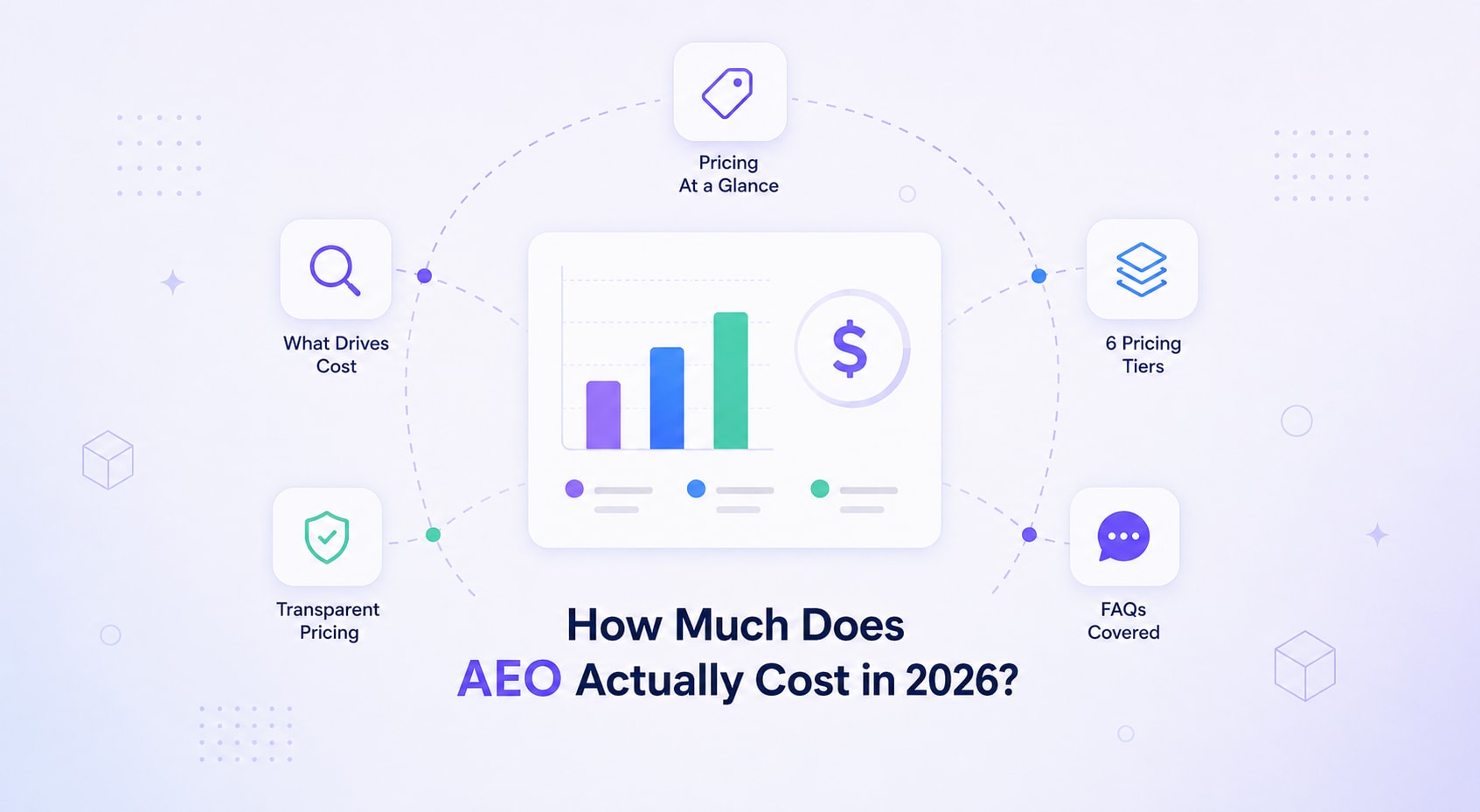
The honest answer: $1,000 to $10,000 a month for most businesses, and almost nobody will tell you that before a sales call. DIY monitoring tools start around $29 to $99 per month, freelancers charge $75 to $150 per hour, and enterprise programs run past $50,000 per month. The rest of this article is about why that range is so absurdly wide, and how to tell which end of it you're actually being quoted.
The $1,500 Quote and the $15,000 Quote Are the Same Deliverable
Picture a marketing lead in January 2026, finalizing next year's budget, with three answer engine optimization proposals open in three tabs.
The first is $1,500 a month. The second is $6,000. The third is $15,000. She reads the deliverables side by side. All three promise "AI search visibility," "content optimized for ChatGPT and Perplexity," and "monthly reporting." The bullet points are nearly identical. The prices differ by 10x.
She has no way to tell which one is real. Neither does almost anyone finalizing a 2026 budget right now, because AEO is the rare corner of marketing where even established agencies refuse to publish a rate card. The stakes are higher than the confusion suggests: Forrester's 2026 survey of nearly 18,000 business buyers found 94% now use AI somewhere in their purchase process, with twice as many naming generative or conversational search as their most meaningful research source than any other channel.
That opacity is not an accident, and it comes from three places. Measurement standards are immature, so there's no agreed-upon way to score "AI visibility," and every scope gets defined by hand. The work is genuinely bespoke, so a local dental practice and a Series C SaaS company can't share a price sheet. And the field moves fast enough that last quarter's pricing is already stale.
There's a fourth reason nobody puts on the website: hidden rate cards protect margins. Enough public data exists in 2026 that the secrecy mostly benefits the seller. The single most useful thing our marketing lead can do is ask each of those three vendors for a range before the call. The one who won't give her a number has already answered the more important question.
AEO Pricing at a Glance
Here is the full spread across credible 2026 pricing research, before we break down what separates the tiers.
Model | Typical cost | Best for |
|---|---|---|
Free graders and DIY kits | $0–$50 one-time | Baseline self-audit |
Monitoring tools and software | $29–$500/mo | Solo founders tracking visibility |
Freelancer or consultant | $75–$150/hr, $500–$4,000/mo | Targeted fixes, single-page work |
One-time audit | $1,000–$5,000 | Diagnosis before you commit |
Fixed-scope GEO sprint | $8,000–$20,000 | Fast foundational build |
Small-business retainer | $1,000–$3,000/mo | Local and early-stage brands |
Mid-market retainer | $3,000–$10,000/mo | The credible center for most B2B |
Enterprise retainer | $10,000–$50,000+/mo | Multi-market, multi-engine leadership |
When vendors who compete directly converge on the same numbers, that's a real market norm rather than one company's positioning. That convergence is now checkable across multiple independent 2026 guides. WebFX's pricing research puts most B2B companies at $2,000 to $10,000 per month. Digital Elevator lands mid-market retainers at $2,000 to $8,000. Space and Story puts them at $3,000 to $8,000. Stackmatix places mid-market at $5,000 to $10,000. All-EO gives an overall band of $1,500 to $15,000+ and notes a $4,000 retainer typically covers 40 to 50 tracked high-intent prompts.
Five independent guides, five overlapping bands, with the densest overlap sitting between $3,000 and $8,000 per month. The disagreement is at the edges, and the edges are where buyers get burned.
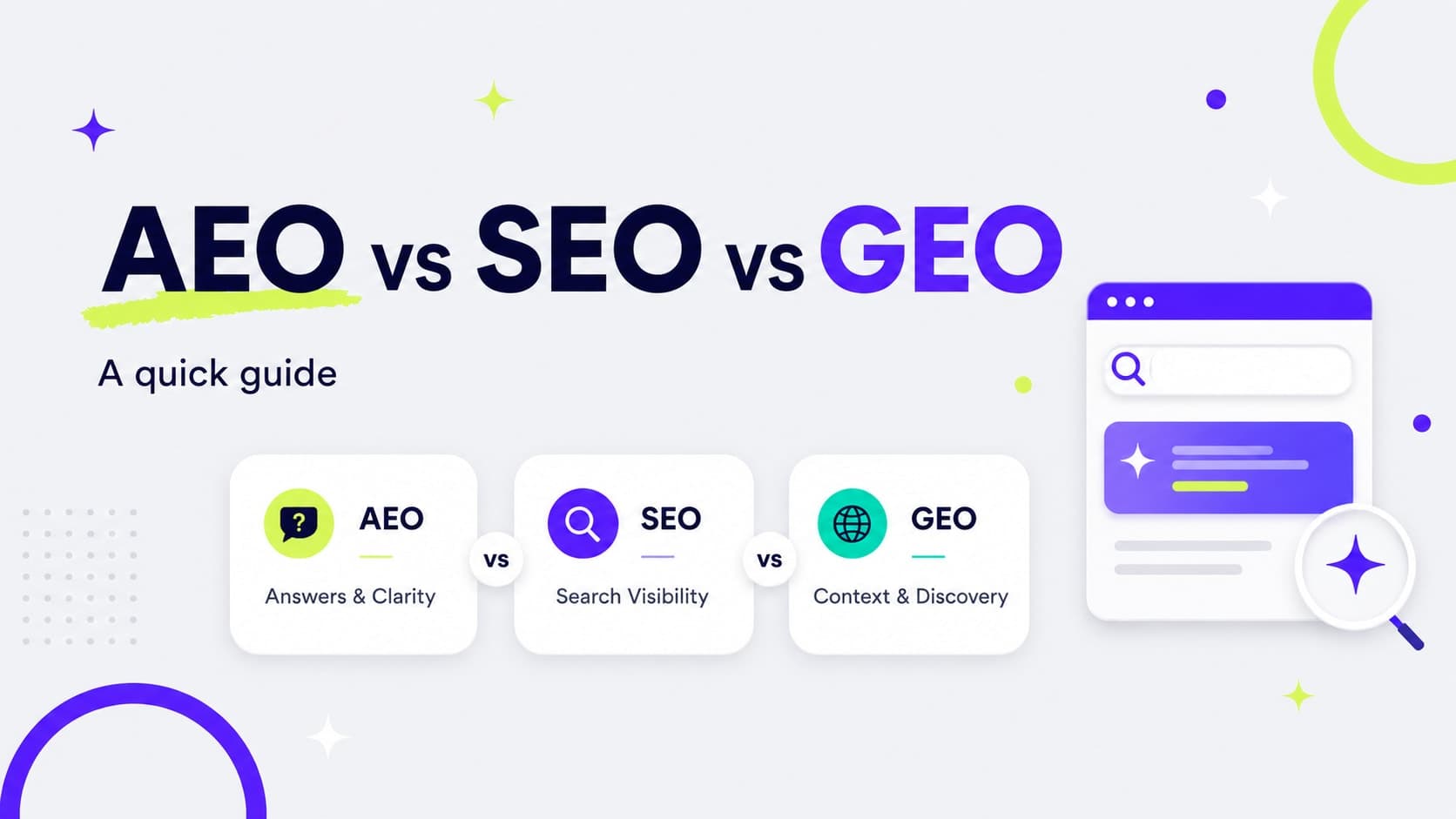
One definition before we go further. AEO (answer engine optimization) means earning your brand a place in AI-generated answers wherever they appear. GEO (generative engine optimization) is the same work aimed at ChatGPT, Perplexity, Claude, and Gemini specifically. Agencies use the terms interchangeably and the deliverables overlap almost completely, so everything here applies to both.
What You're Actually Buying
The reason the three proposals looked identical is that all three described the outputs, meaning content, tracking, and reporting, and none described the mechanism. AEO is not copywriting. It's closer to an engineering problem: you're optimizing to be retrieved and quoted by a model, not to rank tenth on a results page.
A real engagement is a stack of distinct work, and the tiers differ almost entirely in how much of the stack they actually deliver:
Technical and extraction readiness. Structured data, schema, entity clarity, machine-readable pricing and specs. If an AI can't parse it, it can't cite it.
Citation-worthy content. Built to be quoted verbatim in an answer, with a direct answer in the opening line and self-contained passages. Structure and sourcing beat volume every time.
Source and authority acquisition. Digital PR and independent, third-party citations. This is what earns you into the answer when a model decides who to trust.
Prompt and citation tracking. Monitoring your share of voice across ChatGPT, Perplexity, Claude, Gemini, and Copilot.
Reporting tied to outcomes. Citations won and share of voice gained. Not vanity traffic.
The biggest cost driver in that stack is the authority layer, and it's the part cheap providers quietly skip. Content and schema have a floor. Earning independent corroboration is where cost scales, and it's the only part that reliably moves visibility. Muck Rack's analysis of over a million AI citations found that 94% come from non-paid sources and 82% from earned media specifically: coverage, reviews, and community content written by people who aren't the brand.
That single statistic explains why publishing more pages on your own site rarely works. Citing yourself to an AI is like adding your own name to your list of references, because the model already knows whose voice it is. What earns a citation is a credible third party saying it for you. That's the expensive part, and it's what separates a $15,000 program from a $1,500 one far more than the number of blog posts does.
The Tiers, and What Each One Really Gets You
DIY monitoring tools: $29–$500/month
The layer most teams start with. Entry trackers run $29 to $99 per month, multi-engine dashboards land around $99 to $250, and platforms with competitor analysis and content-gap detection reach $250 to $500. Tools tell you where you stand. They don't do the work of getting you cited.
Freelancers and consultants: $75–$150/hour
The right call for surgical work, like a schema audit, a content-structure review, or one page, without a contract. Expect $150 to $2,500 per project or $500 to $4,000 per month for a light retainer. Good for fixes, rarely enough for sustained share-of-voice gains.
One-time audits and sprints: $1,000–$20,000
A basic audit with a report and fix list runs $1,000 to $5,000. A fixed-scope GEO sprint, covering entity pages, schema rollout, listicles, and a baseline citation report over a few weeks, runs $8,000 to $20,000. The fastest way to build a foundation without committing to a retainer.
Small-business retainers: $1,000–$3,000/month
Basic tracking plus foundational optimization. Credible programs rarely dip below four figures. Most land in the upper half of that band.
Mid-market retainers: $3,000–$10,000/month
The credible center for most B2B. Comprehensive programs combine tracking, content, schema, and light digital PR. This is where most serious AEO actually lives, and it's the band where five independent pricing guides overlap most heavily.
Enterprise retainers: $10,000–$50,000+/month
Multi-engine, multi-market coverage with heavy digital PR, large prompt sets, and data-platform integration. Market-leadership partnerships hit the top of that range and beyond.
The tier that shouldn't exist
Watch for the $1,500 per month "AEO" package that turns out to be five ChatGPT-written blog posts, a few keywords in the H2 tags, and a rebranded invoice. AI models don't cite fluff. The clearest tell is a separate "$500 AI optimization fee" bolted onto a standard SEO bill. Legitimate AEO is integrated into content and authority work, never tacked on as a line item.
Why the Same Work Costs 10x More Somewhere Else
Go back to the three proposals. Assume all three are honest, with no rebranded SEO in the mix. The price gap is still real, and it's driven by three variables the bullet points didn't mention.
Scope of surfaces. A $2,000 program might track two engines and optimize for the questions your buyers ask most. A $25,000 program covers every major engine across multiple markets and languages. Same discipline, an order of magnitude more surface area.
Depth of authority work. This is the big one. Light programs produce content. Heavy programs run digital PR campaigns and earn third-party citations at scale. The pricing research reflects this: Space and Story notes that most agencies sell AEO as a 20 to 30% surcharge on an existing SEO retainer, which tells you how much of the market treats it as an add-on rather than a distinct discipline. A dedicated program that actually runs the authority layer costs more than a surcharge, because you're funding work traditional SEO never touched.
Measurement rigor. A cheap program reports traffic. A serious one reports citations won, share of voice against named competitors, and citation decay over time. The dashboard costs money to build and run.
None of this tells our marketing lead which proposal to sign. For that, she needs to stop reading the price and start reading the outcome.
How to Read an AEO Quote
A retainer is a price. A citation is an outcome. Buyers who confuse the two overpay for the cheap programs and walk away from the expensive ones that actually work. Three rules cut through it.
1. Ask for the measurement methodology first. If a vendor can't tell you exactly how they'll count citations and share of voice, there is nothing to evaluate and no deal to sign. Methodology varies wildly between vendors, so two agencies quoting the same price can be promising measurably different things.
2. Work out whether you're paying for authority or for volume. "We'll publish 20 pieces a month" is a volume promise, and volume is a red flag. "We'll earn you into the answer for these 24 buyer queries" is an outcome promise. Muck Rack's 82% earned-media figure is the reason the second one is worth more. All-EO frames this well: the prompt portfolio is the product, and everything else is delivery.
3. Demand a 90-day target in citations and share of voice. Not traffic, not impressions. If the only thing a vendor will commit to is "content," walk. A program that can't forecast an outcome doesn't believe in its own mechanism.
When You Shouldn't Pay for AEO Yet
Any pricing guide that only tells you to buy is a sales page. There are situations where an AEO retainer is the wrong spend in 2026, and naming them is the point.
If your category has no meaningful AI search volume yet, like a hyper-local service where buyers still use Maps, or a niche with no comparison queries, a $99 monitoring tool to watch for the shift beats a retainer to force one.
If you can't sustain 90 days of consistent publishing, don't start. In Scribble's own RocketX campaign data, citation performance across Grok, Gemini, and ChatGPT began decaying within days of publishing going quiet, so a one-month burst buys a spike that evaporates. That's a first-party observation from a single campaign rather than an industry benchmark, and we'd treat it as directional rather than settled.
And if your own product pages are broken, unstructured, or hidden behind "contact us for pricing," fix that first. An AI can't cite what it can't extract, and no amount of external PR compensates for a source it can't read.
AEO compounds. That's its strength and its precondition. Buy it when you can feed it.
What Transparent Pricing Looks Like
Most of this market hides its rates. We don't, so here's the worked example, which is Scribble's published pricing.
Plan | Price | What it covers |
|---|---|---|
Basic | $99/mo | Monitoring: 2 engines, 50 prompts, keyphrase analysis, 1 competitor |
Insight | $399/mo | Monitoring plus content gaps and 10 creator-sourced LLM pages, 4 engines, 3 competitors |
Custom | $1,500/mo | Full stack: 6 engines, unlimited prompts, 50 creator-sourced LLM pages, UGC distribution across X, Medium, and Substack, Reddit and Quora seeding, and monthly PR |
Look at where the full creator-distribution program lands. At $1,500 per month, it sits below the $3,000 to $10,000 band where comparable full-stack programs live. That isn't a discount, it's a different model. Scribble runs on a network of independent creators publishing on their own accounts rather than on billable agency hours, so the earned-media layer that Muck Rack's data says actually drives citations gets delivered at closer to software pricing than to a traditional retainer. The expensive part of the stack, without the enterprise markup.
Does AEO Spending Actually Produce Citations?
A rate card means nothing without evidence the money produces visibility. Here's ours, with real numbers.
RocketX is a cross-chain aggregator that came in sitting at near-zero AI Share of Voice while 1inch held 53%. Its actual differentiator, hybrid CEX and DEX liquidity, existed almost entirely in content RocketX had written about itself, which carries roughly the citation weight you'd expect. In a 15-day sprint, Scribble deployed 358 creator pieces across five platforms through 162 independent creators and moved RocketX to 9% AI Share of Voice: 38 citations across Grok, Gemini, and ChatGPT, from a Domain Rating of just 52, well below its competitors on traditional SEO fundamentals. The lift came from distributed third-party corroboration rather than domain authority or backlinks.
The full breakdown, including a candid section on what didn't work, is in our case study on going from near-zero to 9% AI Share of Voice in 15 days.
The number that matters isn't 9%. It's that the spend produced a trackable share-of-voice lift on a two-week horizon because the work targeted citations instead of blog volume.
What You Should Budget by Company Size
Solo or early-stage. A $99 per month monitoring tool plus a one-time $1,000 to $3,000 audit to find your gaps. Don't retain an agency yet, learn where you stand first.
Small business. A $1,000 to $3,000 per month retainer for foundational optimization and tracking. Expect groundwork, not overnight dominance.
Mid-market. $3,000 to $10,000 per month for a full-stack program. Where most serious AEO lives and where the authority layer pays off.
Enterprise. $10,000 to $50,000+ per month for multi-engine, multi-market, PR-led work with real measurement.
Everyone. Budget a 90-day foundation window before judging ROI. Citations build. They don't spike.
How to Tell Which Quote Is Real
The marketing lead with three tabs open didn't have a pricing problem. She had a reading problem. Once you know that a quote is really a bet on one variable, which is how much independent authority the program will earn you, the 10x gap stops being confusing and starts being legible. The cheap one skips the expensive layer. The expensive one might be buying scope she doesn't need. The right one is the one that will commit to a citation target and show her the methodology behind it.
AEO in 2026 costs anywhere from $29 to $50,000+ a month. The sticker price was never the number that mattered. Cost per citation and share of voice decide whether you overpaid. Pay for authority and measurement. Don't pay for blog volume dressed up as AI strategy.
AEO Pricing FAQ
How much does AEO cost per month? Most businesses pay $1,000 to $10,000 per month in 2026. Small-business retainers run $1,000 to $3,000, mid-market programs run $3,000 to $10,000, and enterprise programs run $10,000 to $50,000 or more. DIY monitoring tools start at $29 per month, and freelancers charge $75 to $150 per hour.
Is AEO worth it for a small business? It depends on whether your buyers use AI search for your category. If they do, a $1,000 to $3,000 monthly retainer covers foundational optimization and tracking. If your category still runs on local search or has no comparison queries, a $99 monitoring tool to watch for the shift is the better spend until that changes.
How is AEO pricing different from SEO pricing? SEO pricing is largely volume-based, meaning a number of posts and links per month. AEO pricing scales with authority work and the size of your tracked prompt portfolio, because earning third-party citations is what moves AI visibility. Most agencies currently sell AEO as a 20 to 30% surcharge on an SEO retainer, which is a sign they're treating it as an add-on rather than a distinct discipline.
How long before AEO shows results? Budget a 90-day foundation window before judging ROI. Citations compound rather than spike. Scribble's RocketX campaign produced a measurable share-of-voice lift in 15 days, but that was a high-intensity sprint with 358 pieces across 162 creators rather than a typical retainer pace.
Can I do AEO myself? Partly. Schema, structured data, and extraction readiness on your own site are achievable in-house, and monitoring tools start at $29 per month. The part that's hard to DIY is the authority layer, since Muck Rack's analysis of over a million AI citations found 82% come from earned media rather than brand-owned content. You can't earn independent third-party corroboration by publishing more pages on your own site.
Want to know where you stand before you spend a dollar? Run your free GEO audit.
Written by

I’m Tanmay Tarte, a community builder at Scribble and an engineering graduate from Priyadarshini College of Engineering. Over the years, I’ve worked across community management, content, hosting, and social media, mainly within the Web3 and creator ecosystem space. Outside of work, I’m a huge sports enthusiast and can genuinely play cricket all day, every day.