You built the Discord. You ran the airdrop. You got the KOLs. You announced the partnership. And now you are trying to raise, and the VCs are not returning your calls at the terms you expected. The playbook that worked in 2021 is not just underperforming. It is actively working against you.
Where the Liquidity Went
Between 2020 and 2022, venture capital flooded into crypto at a scale the industry had never seen. Global blockchain and crypto VC investment peaked at over $30 billion in 2022 before contracting sharply through 2023 and 2024. That capital funded aggressive growth strategies, KOL networks, airdrop campaigns, and community-building operations targeting a self-selecting audience that was already inside the tent: people who held wallets, followed crypto Twitter, and knew what a liquidity pool was.
Then the cycle turned hard. Terra/Luna wiped out $40 billion in May 2022. FTX collapsed with $32 billion in valuation gone and billions in customer funds missing. Celsius went bankrupt. Three Arrows Capital defaulted. Retail confidence cratered. And the VC dry powder that used to flow into crypto started flowing into AI, fintech, and consumer tech with demonstrable retention metrics.
The projects that had built their entire identity around token hype and crypto-native channels discovered they had nothing underneath. No brand recognition outside the bubble. No users who would stay without an incentive. No content that existed anywhere an outsider might look.
Now, as a new cycle builds, those same projects are finding they cannot raise at the terms they expect. The VCs writing cheques in 2025 and 2026 want something the 2021 playbook never required: a brand that means something to people who do not already own the token, and an audience that exists outside the bubble.
The liquidity has moved. The question is whether Web3 marketing has moved with it.
What the Old Playbook Was Actually Built For
The 2021 Web3 marketing stack was not poorly designed. It was well-designed for a specific context that no longer exists.
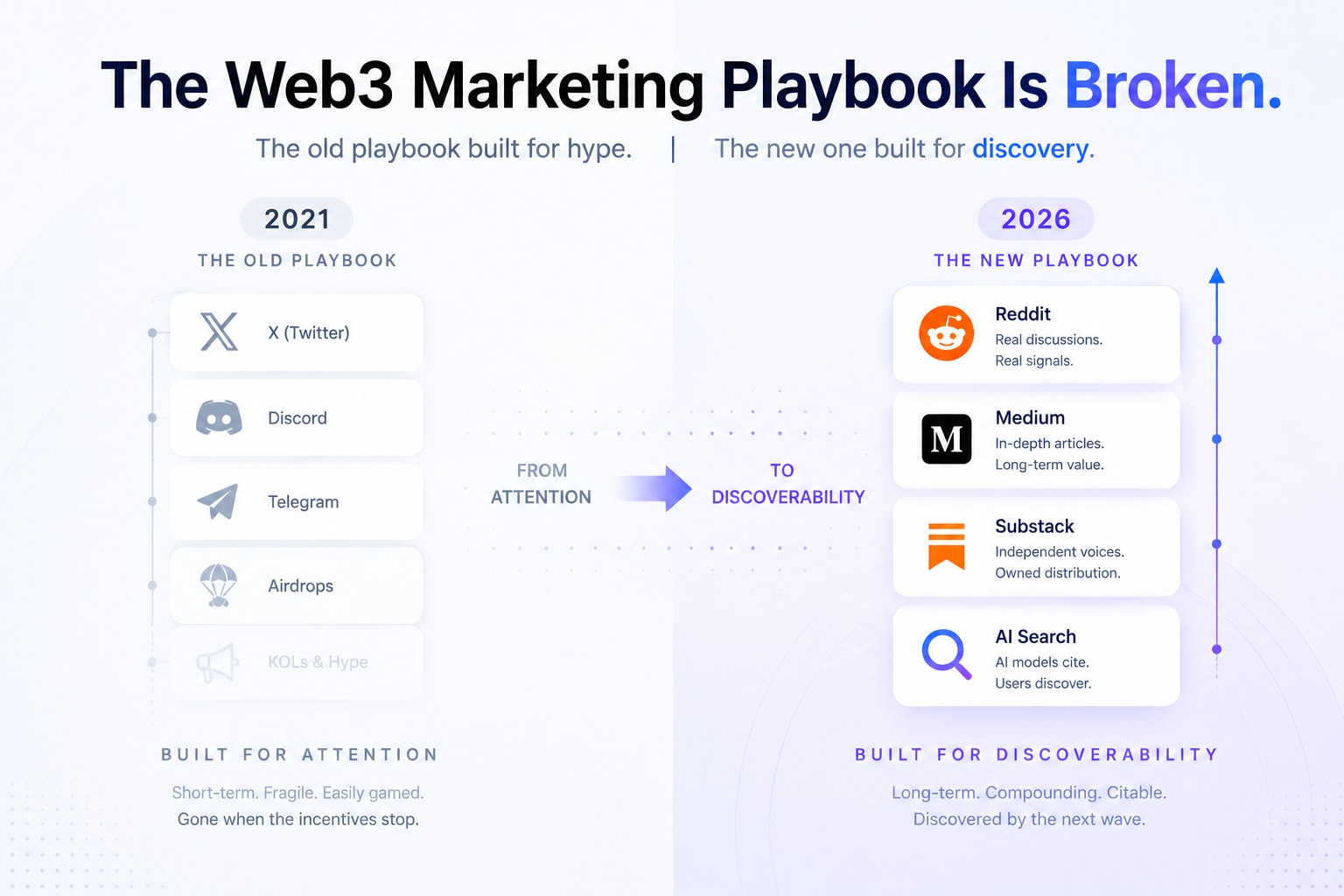
That context was: abundant VC capital, a growing pool of crypto-native retail users, token price as the primary growth lever, and an audience concentrated on X, Discord, and Telegram. In that environment, KOL deals drove awareness, airdrop campaigns drove wallet connections, Discord servers created the appearance of community, and token announcements drove press coverage. The loop worked because everyone involved already spoke the language and was already looking for the next opportunity.
The problems with this stack are not bugs. They are features that only make sense in a bull market with an inside audience.
When community growth is token-incentivised, every metric is manipulable. When press coverage is tied to token announcements, the narrative is hostage to price. When retention strategy is staking rewards, users leave the moment a better yield appears elsewhere. When your Discord has 50,000 members and three active conversations, any serious user who visits understands immediately what that silence means.
The Sandbox and Decentraland both had Discord memberships in the hundreds of thousands while reporting daily active users in the low hundreds at the bottom of the 2022 cycle. The gap between vanity metrics and real activity was visible to anyone who looked, and the investors who mattered were looking.
The deeper problem is structural. The entire stack is built for retention of an audience already inside crypto. It has almost no surface area for discoverability by people who are starting from scratch.
Why It Fails Now
Three things have changed simultaneously, and together they make the old playbook not just ineffective but actively damaging.
The audience has shifted. Wharton researchers studying Web3 adoption found that the technology is genuinely difficult to use and that the language used to describe it makes the barrier significantly worse. The next wave of users is not on Crypto Twitter. They are people who use Revolut, not Uniswap. People who discovered AI tools in the past two years and are now open to what else has changed. People who will never join a Discord but will ask ChatGPT which protocol to use. Marketing that assumes a crypto-native audience screens out everyone else before they reach the product.
The investor bar has risen. VCs doing due diligence in 2025 and 2026 have seen token-inflated community metrics enough times to discount them entirely. Bought Twitter followers show up in engagement ratio analysis. LOIs dressed as partnerships take one email to disprove. Forbes Contributor pieces and Cointelegraph sponsored content are paid placements, and institutional media teams know the difference. Some projects raised $10 million and spent over $4 million on marketing before launching a beta, distributing a thin story to an audience that had no reason yet to believe it. What moves institutional conviction now is evidence of users who would stay even if the token went to zero, and content that exists somewhere beyond X.
Discovery has moved to AI. This is the change that most Web3 marketing teams have not yet absorbed. ChatGPT reached 800 million weekly active users in October 2025. Perplexity hit 153 million monthly visits. Over half of B2B buyers now consult ChatGPT, Perplexity, or Gemini for vendor shortlists before visiting a single search result. When someone who has never heard of your protocol asks an AI which DeFi protocol to use, the answer depends entirely on whether there is enough structured, citeable, third-party content about your product for the model to include you. X posts, Discord updates, and Telegram announcements are ephemeral, platform-locked, and produce almost none of what AI models need to make a recommendation. If your brand story lives entirely inside the crypto content loop, it does not exist for the audience that is now the actual growth opportunity.
The brands that stayed quiet in the bear and came back loud in the bull discovered their audience had no memory of them and no reason to trust them. Solana recovered from a 95% price drop after the FTX collapse because the team kept shipping and communicating when the narrative was against them. The bear market is not a waiting room. It is the window in which brand trust is actually built. For a deeper breakdown of what AI search visibility means for your brand specifically, read Is Your Brand Invisible to AI?
What the New Playbook Looks Like
The new playbook is not a replacement for everything that came before. Strong product documentation, consistent founder communication, and genuine community engagement still matter. What has changed is where the growth surface area needs to be, and what kind of content actually drives discovery in 2026.
The shift has three components.
From token-led to product-led narrative. The story is not the token. The story is the problem your product solves for a user who has never heard of your token. BOB is the infrastructure layer that lets Ethereum developers access Bitcoin's $2 trillion liquidity base without rewriting their code. That framing works for a developer who has never held BOB tokens and is trying to solve a real problem.
Imagine a developer building a DeFi lending protocol on Ethereum. They want to let users collateralise Bitcoin, but bridging BTC to their smart contract is a three-step process involving a custodial bridge, a wrapped token, and significant slippage risk. They type "how to access Bitcoin liquidity from an Ethereum smart contract" into Perplexity. If BOB's documentation, third-party tutorials, and creator-written explainers have done their job, BOB appears in that answer. If BOB's marketing has only ever lived on X and Discord, it does not. That developer signs up for a competitor they found through AI search, and BOB never knew the query existed.
From crypto-native channels to distributed, citable content. The content that drives AI search visibility is not X threads. It is long-form, named-entity-rich, externally corroborated writing on platforms with editorial credibility: Reddit, Medium, Substack, Paragraph. Research from Princeton, Georgia Tech, and the Allen Institute (arXiv:2311.09735) found that content with specific statistical claims, external citations, and named entities is significantly more likely to appear in AI-generated responses than generic content, even on the same topic. Creator-led UGC campaigns targeting specific query clusters, distributed across these platforms, are how brands build the citation surface area that AI models draw from.
Old Stack Content | GEO-Optimised Content |
X threads and Telegram announcements | Long-form articles on Medium, Substack, Reddit |
Token launch press releases | Query-targeted editorial pieces with named entities |
KOL tweets citing KOL tweets | Third-party creator content with external citations |
Discord updates visible only to members | Indexed, crawlable content on open platforms |
Engagement measured in likes and retweets | Visibility measured in AI citations and mentions |
From launch sprints to always-on visibility. The old playbook optimised for launch day. The new one optimises for the queries people are typing into ChatGPT six months after launch, when they are making a real decision about which protocol to use. That requires a content infrastructure that keeps producing, keeps distributing, and keeps tracking which queries are generating citations and which are not.
What This Looks Like in Practice
RocketX Exchange
RocketX Exchange came to Scribble with near-zero AI search visibility. Users searching for cross-chain swap comparisons across ChatGPT, Perplexity, Claude, Gemini, and Grok were not finding RocketX in the results, regardless of how established the product was within crypto-native channels.
Scribble ran a creator campaign targeting specific query clusters around cross-chain swaps, DEX aggregator comparisons, and Bitcoin bridge alternatives. Creators published across Medium, Substack, and Reddit with named entity references, real performance data, and external citations. Within 15 days, RocketX was appearing in citations across all five major LLMs. The content that drove visibility was not token announcements or Discord activity. It was structured, third-party editorial content targeting the exact phrases new users were typing into AI search. Read about it in more detail here.
BOB
BOB is building the infrastructure layer that connects Bitcoin's $2 trillion liquidity base to Ethereum's DeFi ecosystem. The challenge was discoverability: developers and DeFi users searching for hybrid Bitcoin-Ethereum L2 solutions were not finding BOB in AI-generated responses, even though the product was technically among the most advanced in its category.
Scribble deployed 129 creators across Medium, Substack, Reddit, and Paragraph, producing 309 long-form editorial pieces targeting BOB's core query clusters: hybrid Bitcoin-Ethereum Layer 2 architecture, EVM compatibility for Bitcoin developers, cross-chain swap comparisons, and BTCfi infrastructure. The queries those pieces targeted are now showing measurable citation movement across all five major AI engines. The primary query around hybrid Bitcoin-Ethereum Layer 2 architecture is appearing in 78.5% of AI responses tracked, with 50 cites and 378 mentions recorded across ChatGPT, Gemini, Perplexity, Copilot, and Grok. Scribble's creator campaign is one of the content layers driving that visibility, specifically on the query clusters the campaign was briefed to target.
The correlation is direct: content created for specific queries, citation movement on those specific queries.
The Shift That Changes Everything
The Web3 marketing stack is not going away. X, Discord, and Telegram still matter for the audience already inside crypto. KOL relationships still move sentiment within the community. Token launches still generate attention.
What the stack cannot do is reach the audience that represents the actual growth opportunity in 2026: users who are not crypto-native, investors who have seen every cycle trick before, and AI systems that are now the first point of discovery for a growing share of the market.
What the Old Stack Does Well | What It Cannot Do |
Retain existing crypto users | Reach users who have never held a wallet |
Drive token trading volume | Build brand trust that survives a bear market |
Coordinate community around launches | Generate citations in AI search results |
Produce short-term engagement spikes | Establish topical authority over time |
Speak to crypto-native audiences | Attract VC interest from outside the crypto bubble |
Gartner predicts a 25% decline in traditional search volume by 2026, with that volume migrating to generative engines. The projects building for the next cycle need to be building for this channel now.
The brands that will compound through the next cycle are the ones treating the missing layer as urgent infrastructure, not a future experiment: structured, citable content distributed across high-authority platforms, targeting the specific queries their next users are already typing into ChatGPT and Perplexity today.
For a detailed breakdown of how to build this for your brand, read Is Your Brand Invisible to AI?
Frequently Asked Questions
How do you brief creators for AI search visibility? Assign specific query clusters: the exact phrases your target users type into ChatGPT or Perplexity. Require named entities (your protocol name, real metrics, specific features) rather than generic descriptions. Distribute across Reddit, Medium, and Substack. For the full creator briefing framework, read Is Your Brand Invisible to AI?+
What is GEO and how does it differ from SEO? Generative Engine Optimization (GEO) is the practice of structuring content to increase the probability of being cited in AI-generated responses. SEO optimises for search engine ranking algorithms. GEO optimises for the citation behaviour of AI models. The two overlap significantly at the fundamentals (clear writing, named entities, external citations) but GEO is less deterministic: models weight sources differently, citation behaviour varies by query phrasing, and AI favours quotable, self-contained prose over keyword-dense content.
Written by

Kaavya has been building at the edge of the internet since 2016, starting in crypto, founding Lumos Labs, a web3 education platform and eventually co-founding Scribble, a creator marketing platform helping brands get discovered by AI search engines. At Scribble, she leads community and growth across a network of 50,000+ creators running GEO campaigns for 100+ brands. Her obsession: figuring out how content actually gets cited by LLMs, and building the infrastructure to make it happen at scale. When she's not deep in distribution strategy or vibe-coding tools, she's in Bangalore, probably being supervised by two Shih Tzus named Mushu and Milo.