Most content is written to be read. AI-quotable content is written to be extracted. Those are different goals, and the gap between them is where most brands lose their citation potential. A paragraph that flows beautifully inside an article can still be completely invisible to ChatGPT, Perplexity, or Google's AI Mode, because AI systems do not read for pleasure. They scan for the clearest, most self-contained answer to a specific query, and they stop at the first one they find.
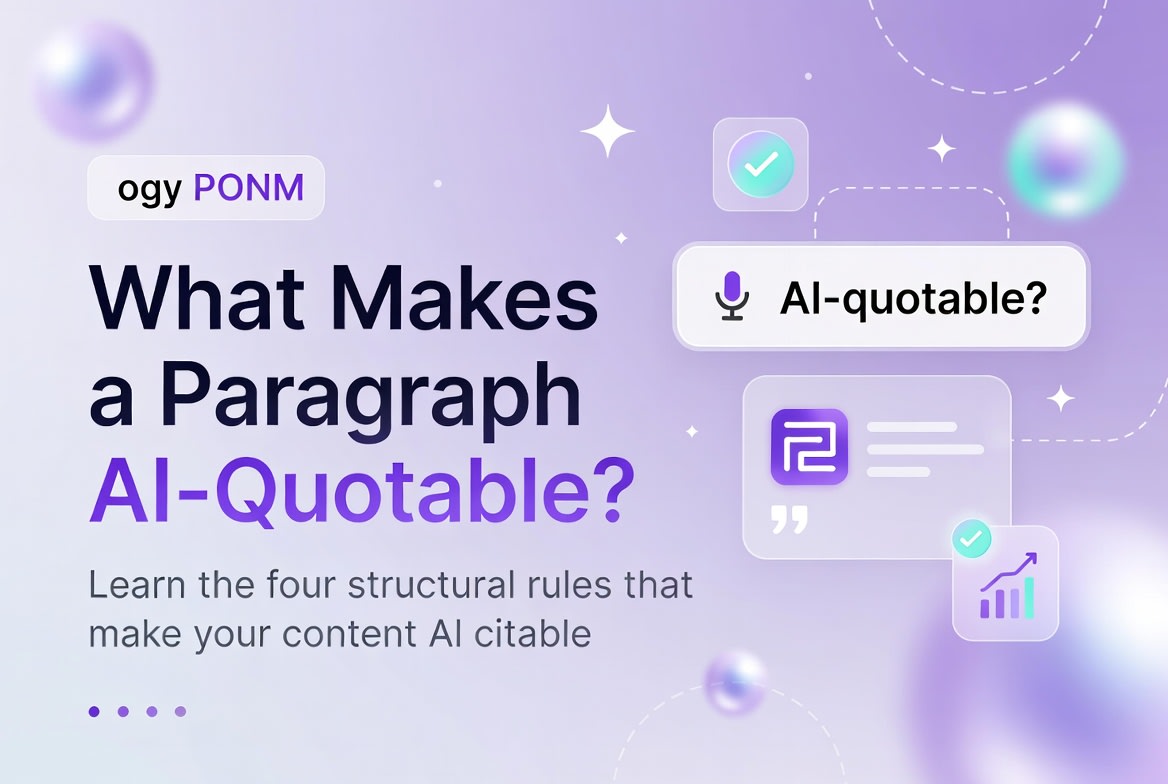
Here is the short answer: a paragraph becomes AI-quotable when it answers a specific query in the first sentence, contains at least one attributed statistic, stands alone without needing surrounding context, and uses the exact language of the query it targets. Four rules. Every quotable paragraph follows them.
Why Most Content Gets Skipped, Not Cited
Researchers at Princeton University tested nine content optimisation techniques across 10,000 queries in their 2024 GEO study, published at the KDD conference. Two techniques produced the largest citation lifts: adding statistics increased AI citation probability by 37%, and adding authoritative quotations from credible sources increased AI visibility by 40%. Keyword stuffing had a negative effect. Writing simply and directly had a positive one.
The pattern that emerges from that data is consistent with what Scribble's 100+ branded campaigns observes across campaigns: the paragraphs that get cited are the ones that could be lifted out of the article and dropped into an AI answer without any editing. The ones that do not get cited require context, build gradually toward a point, or use vague language where a named fact would do.
AI systems do not reward writing quality. They reward extractability. A paragraph that a human finds beautifully written is not automatically one that an AI system can quote.
The four rules below are the structural characteristics that make the difference.
Rule 1: Answer Before You Explain
Most paragraphs bury the answer. They open with context, then background, then qualifications, and finally the point. That structure works for human readers who follow a narrative. It fails for AI systems that extract the first clear answer they find and move on.
A quotable paragraph answers the query in sentence one. Everything after that sentence is supporting evidence.
Unquotable | Quotable |
"Content marketing has evolved significantly over the past decade, and with the rise of AI-powered search tools, brands are starting to think differently about how they structure their writing..." | "AI systems cite content that answers the query in the first sentence. Context, background, and qualifications belong after the answer, not before it." |
"There are several factors that researchers have studied when it comes to understanding how generative AI selects its sources..." | "Generative AI selects sources based on four signals: answer placement, factual density, paragraph independence, and query-phrase matching." |
The second column answers immediately. The first column makes the AI wait. Which it doesn’t.
Rule 2: Attach a Number and a Name to Every Claim
Vague claims do not get cited. Specific, attributed ones do.
Princeton's KDD 2024 research found that adding statistics to content increased AI citation probability by 37%. That finding holds across platform types because all major AI systems: ChatGPT, Perplexity, Google AI Mode, treat named, verifiable data as a credibility signal. A claim with a number and a source attached to it is easier to extract, easier to attribute, and more trustworthy to a system that is assembling a cited answer.
The attribution format matters too. "Studies show..." is a passive construction that no AI system can trace. "According to Ahrefs' May 2025 study of 75,000 brands..." is a citable statement. One gives the AI something to work with. The other does not.
"The market is growing" is an opinion. "The market grew 34% year-over-year, according to Forrester's Q1 2026 report" is a citation candidate.
If you are writing for Scribble bounties, include at least one sourced, quantified data point per section. Not per article, per section. That standard is not editorial preference. It is a structural requirement for AI citation eligibility.
Notice how this writer packs their content with as many data points as possible, all linked to source: https://towardsdev.com/bitcoin-l2s-how-bitcoin-is-becoming-more-than-digital-gold-in-2026-8f896a0d018a
Rule 3: Write Paragraphs That Stand Alone
AI systems extract individual passages, not whole articles. Perplexity averages 21.87 citations per response, each pulled from a different source and assembled into a single synthesised answer. (Qwairy, Q3 2025 analysis of 118,101 AI-generated answers.) What that means in practice: any paragraph in your article might be extracted independently, placed next to content from three other sources, and presented to a user who has never read your article at all.
If that paragraph only makes sense in the context of what came before it, AI cannot use it cleanly. If it uses pronouns that refer to earlier content, "this approach," "the method described above," "as we noted", it becomes unquotable the moment it leaves its original context.
A standalone paragraph:
Opens by naming its subject explicitly, not by reference
Contains the claim, the evidence, and the implication in one passage
Does not require the reader to know what section precedes it
Every paragraph in a GEO-optimised article should be able to answer its target query without the article around it. That is the extractability standard.
Rule 4: Use the Exact Query Phrase
AI systems match language precisely. A user who asks "what makes content AI quotable" triggers a retrieval process that scans for content using that exact phrase or close semantic equivalents. A paragraph that answers the question using different language: "AI-friendly writing", "LLM-optimised content", "generative search readiness", reduces its own match probability.
This does not mean stuffing a keyword into every sentence. It means that the paragraph targeting a specific query should contain that query phrase, used naturally, in the first two sentences. The rest of the paragraph can use related language freely.
Scribble's network of 50,000+ creators applies this at the brief level. Each piece of content identifies the primary query it targets, and writers include that phrase in the opening sentence of the section built around it. The brief labels this the "anchor phrase." Its placement is treated as a structural requirement, not a stylistic choice.
Walk-through: Rewriting a Paragraph From Invisible to Quotable
A creator is writing a blog section for a B2B SaaS client on the query "how do AI systems select sources." Her first draft reads:
"With the rise of AI-powered search, it has become increasingly important for brands to think about how their content is structured. There are many factors at play, and researchers are still working to understand them fully."
That paragraph fails all four rules. It does not answer the query. It contains no data. It cannot stand alone. It does not use the query phrase.
She rewrites it using the four-rule framework:
"AI systems select sources based on four signals: how directly the content answers the query, whether it contains attributed statistics, whether the paragraph stands alone without surrounding context, and whether it uses the exact query phrase. Researchers at Princeton University found that adding statistics to content increased AI citation probability by 37%, and adding authoritative quotations increased AI visibility by 40%. (Princeton, KDD 2024)"
The second version answers in sentence one. It contains two attributed data points. It stands alone. It uses the query phrase. It is a citation candidate. The first version is not.
The brands appearing in AI answers are not producing more content. They are producing content that follows these four rules.
Scribble's creator network writes to this standard on every brief. If you want to write AI-quotable content for brands and get paid for it, start here.
Start writing for brands today →
Frequently Asked Questions
Does every paragraph in an article need to follow these rules?+
No. Apply the four rules to the paragraphs that target a specific query. Typically the opening paragraph of each section. Background, narrative, and transitional paragraphs serve human readers. The quotable paragraphs serve AI systems. Both have a role.
Does formatting affect whether a paragraph gets cited?+
Yes. FAQ schema markup alone correlates with a 3x citation lift across GEO studies. Tables, numbered lists, and structured headings make content easier for AI systems to segment and extract. Plain prose paragraphs following the four rules still get cited, but structured formatting compounds the effect.
Can these rules be applied to existing content?+
Yes, and that is often the highest-leverage move. Auditing existing high-traffic pages and rewriting the opening paragraph of each major section to follow Rule 1 (answer before you explain), is the single fastest path to improving AI citation eligibility without producing new content.
How do I know if a paragraph is AI-quotable before publishing?+
Read it in isolation. Cover the rest of the article and ask: does this paragraph answer a specific query, contain verifiable data, and make sense without surrounding context? If yes to all three, it is structurally quotable. If not, identify which rule it fails and revise that element first. Also check the liklihood of your content being cited using this tool we built: https://scribble.network/geo-checker
Written by

Hi! I’m Mrinalini. I work on growth at Scribble, where my days mostly revolve around content, planning campaigns, speaking to creators, and occasionally yapping in front of a camera. I studied engineering at Manipal Institute of Technology and briefly worked as a Test Engineer at Siemens before realizing marketing was my calling. Outside of work, you’ll find me eating/thinking about food.