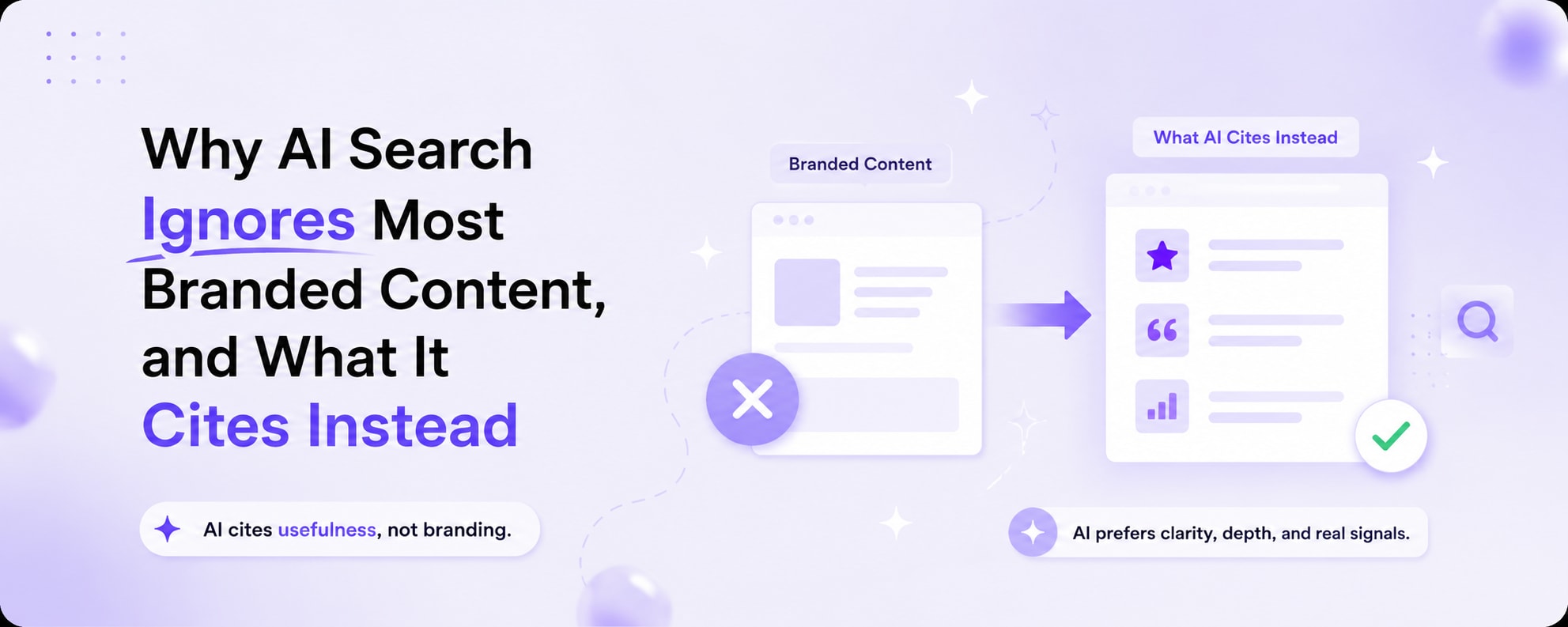
AI search engines cite earned, third party sources over brand owned content at dramatically higher rates, and the gap is not a minor statistical quirk. A September 2025 arXiv study found AI engines favor earned sources at 57 to 92 percent depending on query type, while Google's traditional results maintain a far more balanced 41 to 45 percent earned share. That is not a ranking problem your SEO team can patch with better keywords. It is a structural feature of how generative engines decide what to trust, and it means a huge amount of brand content, no matter how well written, is functionally invisible to the systems increasingly mediating purchase decisions.
This article explains why that bias exists, what the research says AI engines cite instead, and what a brand can actually do about it.
The Citation Gap Is Real, Measured, and Getting Wider
The pattern is not anecdotal. Multiple independent, large scale studies have now confirmed the same basic finding using different methodologies and different query sets.
https://authoritytech.io/blog/why-ai-search-ignores-your-website
Category | Google (earned sources) | AI search (earned sources) |
Software products | 45.4% | 72.7% |
Consumer electronics | 54.1% | 77.6–92.1% |
Automotive | 40.6% | 69.1–81.9% |
The gap narrows for purely transactional queries, where a brand's own product page naturally dominates, but for the informational and consideration stage queries that drive most B2B research and vendor evaluation, earned media is consistently what the model reaches for first.
A Muck Rack analysis of over one million AI prompts found that 85.5 percent of non paid AI citations come from earned media sources rather than brand owned content. A separate Fullintel and University of Connecticut study, presented at the 2026 Institute for Public Relations Research Conference, found that 47 percent of all AI citations in brand queries came from journalistic sources specifically, with more than 89 percent of cited links coming from unpaid earned media. For branded queries, an Omniscient Digital 2026 analysis found 57 percent of citations go to product and company reviews, listicles, forums, social media, and case studies, none of which are content the brand itself produced.
These are not small variations across a handful of studies. They are a consistent, cross verified pattern: when an AI model is deciding what to cite, it overwhelmingly reaches past the brand's own website.
Why This Happens: The Mechanics Behind the Bias
Understanding why requires understanding what an AI search system is actually trying to do when it answers a question, because the bias is not arbitrary. It follows directly from the engineering goals of retrieval and synthesis.
AI is built to minimize hallucination by anchoring claims externally
AI platforms are designed to synthesize information from multiple independent sources rather than surface a single brand's perspective, and that design choice exists for a specific reason. A model answering a factual question carries real risk of generating something false or unverifiable. Each platform has a different tolerance for how many sources it will draw on, but they all share the same underlying goal: minimizing the risk of hallucination by anchoring generated text to external, independently verifiable data. A brand's own claim about its own product is, structurally, the least independently verifiable source available to the model. A third party review, a comparison published by an unaffiliated outlet, or a forum thread written by an actual user carries a different evidentiary weight, simply because the author has no obvious incentive to overstate the product's value.
Retrieved passages are scored against consensus, not just relevance
Retrieved passages are scored across several signals, and authority is one of the most heavily weighted. AI is, in the language used by researchers studying this, overwhelmingly biased toward earned media and authoritative third party sources, with mentions in news sites, research papers, and industry blogs consistently outweighing owned content. A second factor compounds this: consensus. AI compares sources and trusts repetition. If ten independent sites say the same thing about a topic, the model's confidence in that claim is high. If only one source, especially the brand itself, makes the claim, it may simply be ignored. Being correct is not sufficient on its own. The claim needs to be echoed across the wider information ecosystem before a model treats it as trustworthy enough to cite.
The unit being competed for is the passage, not the page
AI breaks content into semantic chunks and retrieves the most relevant passage, not the most relevant page. The unit of competition is no longer the article as a whole, it is the single best paragraph on the internet for that specific question. This matters enormously for branded content, because most brand pages are written to build a narrative around a product rather than to isolate one extractable, self contained answer to a specific question. A Reddit comment that directly and concisely answers "does this tool integrate with Salesforce" frequently beats a beautifully designed product page that buries the same fact in the fourth paragraph under three sentences of marketing framing.
Even after retrieval, most sources never make it into the final citation
ChatGPT retrieves far more than it ultimately cites. Only about 15 percent of retrieved pages actually make it into the final response. The model reads broadly but cites narrowly, filtering sources based on title alignment, content specificity, and clarity. This is a critical distinction for brands to internalize. Being indexed, being read, and even being considered by the model are not the same as being cited. A brand's content can be fully crawled and genuinely informative to the model's underlying understanding of a topic while still losing the final citation slot to a source the model judged more specific, more clearly structured, or more independently corroborated.
What AI Cites Instead
The research converges on a fairly consistent answer to this question, though the exact mix shifts by platform and query type.
Reviews, listicles, and forums
Review platforms like G2, Capterra, and TrustRadius were among the few third party categories that grew their citation share during a recent measurement period, climbing from roughly 5 percent to about 7 percent of brand query citations. An analysis of 30 million sources found Reddit is the single most cited domain in AI search overall, followed by YouTube, LinkedIn, and Wikipedia, with the exact mix varying significantly by platform. Reddit specifically functions as the largest repository of authentic human opinion on the internet, something a corporate landing page structurally cannot replicate, which is why it performs so well for opinion seeking queries like "what's the best X" or "should I use Y".
Journalistic and editorial coverage
Independent reporting and editorial comparison content consistently outperforms brand content for informational queries, for the same reason any single review outperforms a brand's self description. An outlet with no financial stake in the outcome is, structurally, a more trustworthy anchor for a factual claim than the company being written about.
Original research and proprietary data
AI systems heavily prefer content that contains original statistics, proprietary research, or unique data points that exist nowhere else. If a piece of content is essentially a synthesis of what others have already said, the model has no real reason to cite it specifically when it can go to the original sources directly. This is one of the few categories where brand published content can compete directly with third party sources, precisely because original data has no third party alternative to defer to. Benchmark reports and proprietary datasets create unique, citable assets that simply do not exist anywhere else, functioning as a genuine moat that derivative content cannot copy.
One important nuance: branded queries are shifting back toward owned domains
The picture is not static, and one recent dataset complicates the simple "AI always prefers third party" framing. A 16 week AirOps study tracking roughly 3,000 brands found that company and product websites went from 55 percent of all brand query citations in December 2025 to 63 percent at one measurement point, holding around 62 percent through late March 2026. The interpretation offered by the researchers is that ChatGPT is increasingly going direct to source for product specific questions, becoming more likely to cite a product's own website rather than third party content describing it. At the same time, educational content, the "what is a CRM" and "how does X work" style explainer pages that content teams have invested in for a decade, dropped from 14 percent to under 10 percent of brand query citations over the same window, because the model increasingly synthesizes that explanatory information itself rather than linking out to it.
The practical takeaway from this nuance: the bias against brand content is strongest for broad, educational, and comparison style queries, the exact territory most content marketing has historically targeted. It is comparatively weaker for narrow, specific, transactional queries directly about a named product, where the brand's own site remains a credible and increasingly favored source.
A Useful Distinction: Mentions Versus Citations
Before deciding what to fix, it helps to separate two things that get conflated constantly in this conversation.
A mention is any time a brand is referenced in an AI generated answer, whether or not there is a clickable link attached. A citation specifically means the AI links directly to a page as the evidence behind a claim. If you ask an AI for a list of top software in a category and it names your brand, that is a mention. If the AI explains a specific process and links to a competitor's guide to verify the instructions, that is a citation. Mentions build awareness. Citations build authority and drive the kind of high intent traffic that actually converts.
This distinction explains a confusing pattern some brands notice: being named constantly in AI answers while almost never being the clicked source. It is entirely possible to be mentioned a thousand times as a "top player" in a category while a competitor captures nearly all the citation links, because that competitor's content happens to be structured as the foundational source of truth the model reaches for when it needs to back up a specific claim.
There is also a recent shift worth flagging here: brand mentions per answer have actually been increasing even as citation links have decreased, meaning models are discussing brands more frequently in their text while attaching fewer clickable references, which translates to more awareness but fewer actual clicks. This makes citation specifically, not just mention frequency, the metric worth optimizing for if traffic and conversion are the goal.
What Brands Can Actually Do About It
Given the mechanics above, the fix is not a single trick but a combination of content structure, earned presence, and original data, applied with the understanding that no individual brand controls the consensus signal alone.
Build a distributed presence across third party platforms, not just your own domain. Brands with consistently corroborated third party mentions across multiple domains are cited more frequently by AI systems, in a pattern that closely mirrors how academic citation works: the more a claim is independently referenced elsewhere, the more credible it appears to a synthesizing model. This means actively pursuing coverage on review platforms, contributing to relevant community discussions, and earning mentions in independent publications, rather than treating the brand's own blog as the only content investment that matters.
Publish original research and proprietary data wherever possible. This remains the one content category where owned brand content genuinely competes on equal footing with third party sources, precisely because there is no third party alternative for data that only the brand possesses.
Restructure existing content to answer the core question immediately. Generative engines are optimized to find the most direct answer to a query, and content that leads with brand storytelling or context setting before actually answering the question is routinely skipped in favor of content that answers immediately. A practical audit step: check whether your top pages answer the core implied question within the first two paragraphs, and restructure any that bury the answer further down.
Back every major claim with a named, verifiable source. Content that earns citations tends to be content that itself cites others, participating in the broader information ecosystem rather than making unsupported assertions in isolation. Every significant claim should be attached to a named source, a specific date, or a verifiable data point, which increases both human trust in the content and the model's willingness to treat it as a reliable retrieval candidate.
Maintain entity consistency everywhere the brand appears. If a brand is described differently across its own website, its press releases, its LinkedIn presence, and third party mentions, AI systems struggle to build a single coherent understanding of who that brand actually is, and that confusion directly reduces citation frequency because the model cannot confidently attribute information to a fragmented entity. The same name, the same core value proposition, and the same key facts should appear identically wherever the brand shows up online.
Treat thought leadership as infrastructure, not a direct citation bet. Thought leadership content falls into a relatively low tier for earning direct link citations on its own, but it builds the authority and entity understanding that improves a brand's odds of winning citations through the formats that do get cited consistently, such as comparison tables, how to guides, and structured FAQs. The right way to think about a thought leadership piece is not "will this get cited," but "does this earn the brand the credibility that makes the next listicle entry or comparison mention more likely."
Want to know if your content is structured in a way AI models can actually extract and cite?
Run your GEO Check to see how readable, retrievable, and citation-ready your page is for ChatGPT, Perplexity, Gemini, and AI Overviews.
Frequently Asked Questions
Does this mean brand owned content is worthless for AI search?+
No. Original research, proprietary data, and increasingly the brand's own product pages for narrow, transactional queries all remain competitive or even favored sources. The bias specifically affects broad educational, comparison, and "best of" style queries, where third party corroboration carries far more weight than a brand's own description of itself.
Why does Reddit get cited so often if it has no editorial standards?+
Reddit functions as the largest available repository of authentic, first hand human opinion on the internet, which is exactly what AI models need to answer opinion seeking queries like "is this worth buying" or "what do real users think." A corporate landing page cannot replicate that kind of unfiltered, first person testimony, regardless of how well written it is.
Is it better to focus on getting mentioned or getting cited?+
Citations matter more if traffic and conversion are the goal, since a citation includes a clickable link while a mention does not. That said, mentions still build the underlying brand awareness and entity recognition that make future citations more likely, so the two should be pursued together rather than treated as substitutes for each other.
Has this bias gotten better or worse over time?+
The most recent data suggests it is becoming more nuanced rather than simply worsening. For narrow, product specific queries, some platforms are shifting toward citing brand owned domains directly. For broad educational and comparison queries, the bias toward third party and earned sources remains strong and, by some measures, is increasing as models get better at synthesizing explanatory content themselves rather than linking out to it.
How long does it take to see a measurable change after fixing this?+
There is no universally agreed timeline, since it depends heavily on how much existing third party presence and structural content debt a brand is starting from. Building earned media coverage and review platform presence is inherently slower than restructuring existing pages for answer first formatting, which can show measurable changes within weeks once a page has been recrawled and reindexed by the relevant AI systems.
Written by

I’m Ramaa, a writer and creator at Scribble. I’ve written two books, and writing is something I always find my way back to, whether that’s articles, scripts, captions, or overly long notes app rambles I swear will “be useful later.” I enjoy thinking about why people create, how ideas spread online, and what makes content feel genuinely human. When I’m not writing, I look after regulatory compliance and legal admin at Scribble, and I’m a graduate of the School of Policy, New Delhi. Outside of work, I’m a musician and an avid reader.