TL;DR
Scroll Instagram this week and every second brand has an Onam film, a Malayalam-first post, a pookalam-coded visual. Not just Kerala brands. Auto, BFSI, fintech, healthcare, quick commerce, consumer durables, categories that historically waited for Diwali, showed up early and in force. The reason isn't sentiment, it's strategy: Thiruvonam lands before Ganesh Chaturthi, Navratri, Durga Puja and Diwali, which makes Onam the first real read on whether the festive consumer is actually spending. And the tell that the shift is complete? KFC's AI-generated Colonel Sanders wearing a mundu. When a global mascot dresses for your regional festival, that festival isn't regional anymore.
The Hook: The Colonel Went Native
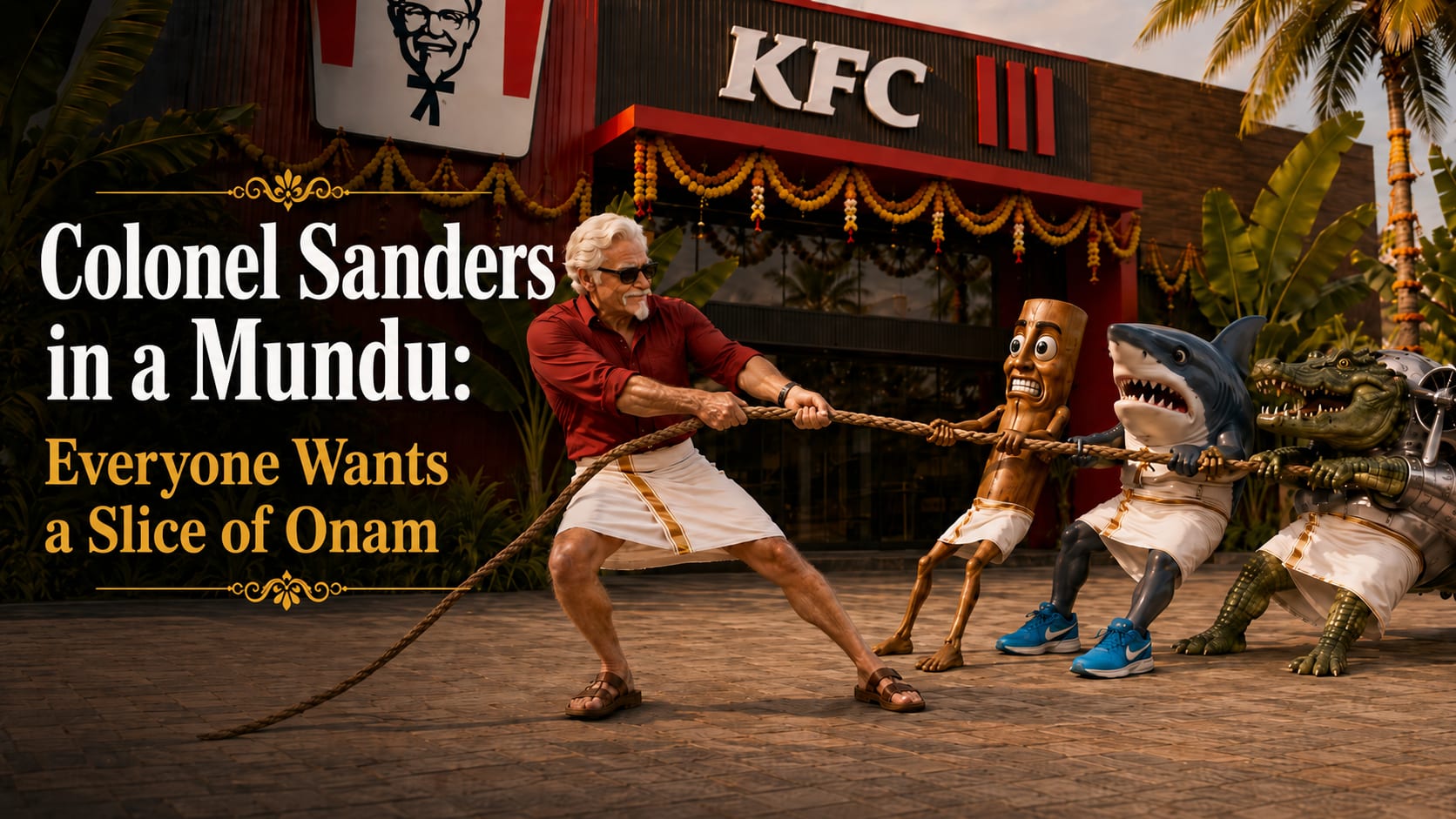
Let's start with the image that says everything. This Onam, KFC put its AI-generated Colonel Harland Sanders in a mundu.
Take a second with how strange that is. Colonel Sanders is one of the most globally standardised brand assets in existence, a fixed American icon, deployed nearly identically in a hundred markets. And this year he's dressed for a Kerala harvest festival celebrating a mythological king's annual homecoming.
That's not a small creative choice. Global brands protect mascot consistency obsessively, because the whole point of a mascot is that it looks the same everywhere. So when one gets localised for a specific regional festival, it means the commercial case was strong enough to override the brand-consistency instinct. The Colonel in a mundu isn't a cute one-off. It's a receipt.
The Real Story: Everyone Showed Up
Behind the joke is the actual shift, and the industry numbers back it.
According to media agencies, Onam now sees a 15 to 20% uplift in seasonal budgets for Kerala, and crucially, the advertiser base has widened well beyond the traditional Onam categories. Jewellery, textiles and local retail still dominate by volume, but this year auto, BFSI, fintech, healthcare, smartphones, consumer durables, e-commerce and quick commerce all committed early. Omnicom Media India's Ajay Varghese called Onam "the beginning of the Great Indian festive carnival." Mudra's Atrayee Chakraborty described it as "the opening bell of the festive season, particularly for national brands."
The scale explains the appetite. Kerala's Onam window moves an enormous amount of money in a very short period, and premium outdoor inventory across the state was, according to Laqshya's Yuvrraj Agarwaal, effectively sold out.
But volume alone doesn't explain why a fintech brand with no particular Kerala history suddenly cares.
Why National Brands Actually Care: The Opening Bell
Here's the strategic logic, and it's the part worth stealing.
Onam arrives before the big cluster: Ganesh Chaturthi, Navratri, Durga Puja, Diwali. That timing turns it into something more valuable than a regional sales opportunity. It becomes a live test. Agarwaal put it precisely: Onam is "the earliest real-world read on consumer sentiment" before the larger festive budgets get locked, and "the same rupee is doing two jobs: winning Kerala, and pressure-testing the national plan."
Think about what that means. A national brand entering Onam isn't only chasing Malayali consumers. It's buying an early data point on whether the Indian consumer has genuinely turned the corner this year, weeks before it has to commit its Diwali money. Onam is simultaneously a market and a dress rehearsal.
That's a genuinely smart reason to show up, and it's why the participation isn't a fluke that reverses next year.
The Catch: Translation Isn't Localisation
Here's where most brands still get it wrong, and where the good ones separated themselves.
The briefs have changed. As Agarwaal describes it, clients now understand that you cannot dub a national film into Malayalam and call it a campaign. What agencies are being asked for is Malayalam-first, Kerala-rooted work built on the actual grammar of the festival: the homecoming, the pookalam, the sadya, the Gulf diaspora returning with money and intent.
That distinction, translation versus localisation, is the whole difference between a brand that participates in a culture and one that photocopies itself into it. Chakraborty framed the planning question as no longer "how do we win Kerala," but "which Kerala are we speaking to, and at what moment." Kerala isn't one homogeneous audience, and treating it like one is exactly how you produce the generic festive ad everyone scrolls past.
Which brings the Colonel back into focus. Sticking a mundu on a mascot is, on its own, the shallowest possible version of localisation. It works as a joke and a signal, but it isn't the deep version. The brands doing this well built around rituals, not costumes.
The Uncomfortable Question
There's a real tension worth naming here, because a breakdown that only celebrates this misses the point.
When every category piles into a cultural moment at once, the moment gets crowded, and crowding flattens things. The risk is that Onam becomes what a lot of festivals have already become in marketing: a visual template. Pookalam, kasavu, sadya, generic warmth, a discount code, repeat. Agencies themselves have started questioning the reliance on familiar festive visuals, and the exchange4media piece notes AI-generated Onam imagery quietly filling feeds.
So there are two possible futures. In one, national attention pushes brands to understand Kerala genuinely, and the work gets better and more specific. In the other, Onam gets absorbed into a generic festive content calendar, produced cheaply, at scale, by brands that couldn't tell you what Thiruvonam actually commemorates. This year's work suggests the first is winning. But the Colonel is a reminder of how easily it tips into the second.
Tips to Steal
Look for the "opening bell" in your calendar. The most valuable cultural moment isn't always the biggest one. Sometimes it's the earliest one that tells you what the big one will do.
Translation is not localisation. Dubbing a national film into a regional language is a photocopy. Building around a specific ritual is participation. Audiences can tell instantly.
Segment inside the region. "Win Kerala" is not a strategy. Which Kerala, at which moment, for which purchase, is a strategy.
A moment can be a market and a test at once. Make your regional spend earn a second job: an early read that de-risks the bigger bet coming later.
A costume is not a culture. If your entire localisation is a traditional outfit on an existing asset, you've made a joke, not a campaign. Fine as a signal. Not enough as a strategy.
Onam kazhinju, ini festive season. Onam is over, now the festive season begins.
Except that's not quite true anymore. For a growing number of brands, Onam isn't the warm-up before the festive season.
It's the moment they find out what kind of festive season they're about to have.
Frequently Asked Questions
Why are national brands advertising during Onam now?+
Because Onam falls before Ganesh Chaturthi, Navratri, Durga Puja and Diwali, making it the first major festive moment of the year. Brands use it both to capture Kerala's substantial festive spending and to get an early read on consumer sentiment before committing larger national festive budgets.
Which categories entered Onam advertising in 2026?+
Beyond traditional Onam categories like jewellery, textiles and local retail, agencies reported participation from auto, BFSI, fintech, healthcare, smartphones, consumer durables, FMCG, e-commerce and quick commerce.
What does "Malayalam-first" mean in Onam advertising?+
It means creating campaigns rooted in Kerala's culture and language from the start, built around the festival's actual rituals like the pookalam, sadya and homecoming, rather than dubbing an existing national campaign into Malayalam.
Did KFC really put Colonel Sanders in a mundu for Onam?+
According to exchange4media's coverage of Onam 2026 advertising, KFC used an AI-generated Colonel Sanders wearing a mundu as part of its Onam creative, which the publication cited as a sign of how far the festival's commercial reach now extends.
Is Onam becoming a national festival for marketers?+
In commercial terms, largely yes. While it remains culturally specific to Kerala, brands across India now treat it as the opening moment of the national festive calendar rather than a purely regional event.
What's the risk of so many brands entering Onam?+
That the festival gets reduced to a visual template, pookalam, kasavu, sadya, generic warmth, produced at scale by brands with no real understanding of it, which is exactly what has happened to several other Indian festivals in advertising.
Written by

I’m Ramaa, a writer and creator at Scribble. I’ve written two books, and writing is something I always find my way back to, whether that’s articles, scripts, captions, or overly long notes app rambles I swear will “be useful later.” I enjoy thinking about why people create, how ideas spread online, and what makes content feel genuinely human. When I’m not writing, I look after regulatory compliance and legal admin at Scribble, and I’m a graduate of the School of Policy, New Delhi. Outside of work, I’m a musician and an avid reader.