A café holds up a notebook that says "We will not be using any AI posters to promote ourselves," then sells pancakes with it. A burger bar does its own version. A library does it on cardboard. Here's the cheapest ad format in the world, and why it's working.
TL;DR
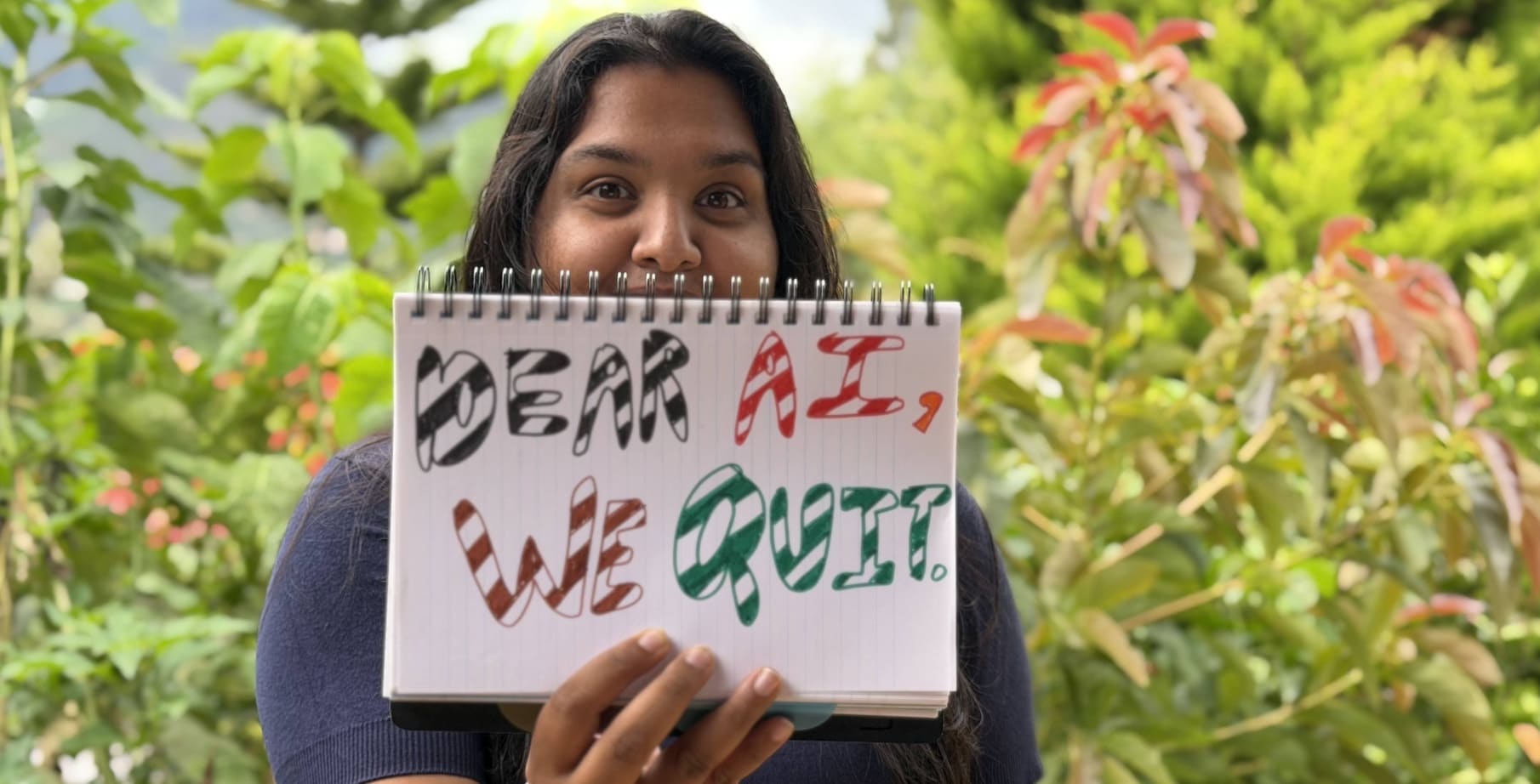
Across cafes, burger bars, libraries and salons, a small but genuinely spreading format has emerged: someone writes a refusal, "we will not use AI posters," "no AI here," in Sharpie on notebook paper or cardboard, holds it up to camera, and posts it. Then they use that exact clip to promote whatever they actually needed to promote, a job opening, an event, pancakes, a burger deal, a haircut. Several of these posts have pulled tens of thousands of likes on the strength of nothing but the bit itself. It's a direct answer to something 404 Media has nicknamed the "ChatGPT flyer pandemic," the flood of AI-generated business flyers that all started looking identical. And it's the small-business, five-minute version of a much bigger shift happening at the very top of marketing: brands from Polaroid to Aerie to Apple TV racing to prove a human made the thing you're looking at. Here's why a notebook and a marker just became a legitimate marketing format.
The Trend
Here's what's actually happening. A small set of businesses, bars, cafes, libraries, a hair stylist, are making an anti-AI pledge part of the ad itself. The format is deliberately unpolished, paper, cardboard, pencil, marker, handwriting that isn't trying to look neat. One bar filmed people holding clipboards, pairing the anti-AI message with a hiring call. A library wrote its pledge on cardboard. A café said it would use paper and marker instead of AI-generated posters, then went straight into promoting its pancakes. A hair stylist paired a handwritten criticism of AI flyers with a simple drawing of one person doing another's hair.
None of this is expensive. None of it required a designer, a shoot, or a brief. It's someone with five minutes, a notebook, and something to say.
What It's Actually Responding To
This didn't appear out of nowhere. It's a direct reaction to a specific, named problem: 404 Media has called the flood of AI-generated business flyers the "ChatGPT flyer pandemic," pointing out that flyers from surf-lesson coaches, guitar stores, bars and takeout places have started looking visibly, unmistakably alike, the same glossy gradients, the same over-designed fonts, the same slightly-off AI sheen.
So the handwritten notebook sign isn't just a cute gimmick. It's a pointed rebuttal to a specific, visible thing people had started noticing and getting tired of. When your entire feed starts to look like it was generated by the same template, the fastest way to stand out isn't better design. It's proof that nobody generated yours at all.
Why It Actually Works
A few things are doing real work here, and they're worth separating out.
It costs nothing and looks like it costs nothing, on purpose. In a feed full of AI flyers with identical gradients and fonts, a wobbly Sharpie scrawl on a notebook page is instantly, visually different. You don't need to read the words to register that a human made this. The imperfection is the proof.
It turns a refusal into the ad itself. These businesses aren't announcing a policy and then running separate marketing. The refusal is the content. "We will not use AI posters" gets the same reach and engagement as any promotional post, sometimes more, because it's a small, sharp point of view rather than an offer.
It borrows credibility from a value nobody can argue with. Nobody's going to defend AI slop. "We made this ourselves, badly, but ourselves" is a value people already agree with before you finish the sentence, which is exactly the kind of unarguable premise that travels fast.
The Bigger Trend It's Actually Part Of
Here's what makes this worth more than a passing meme: it's the small-business mirror of something already happening at the top of the market.
Polaroid ran posters near Apple and Google reading "AI can't generate sand between your toes." Aerie promised no AI in its ads and it became one of its most-liked posts of the year. Apple TV's Pluribus added five words to its own end credits: "this show was made by humans." iHeartMedia found that 90% of its listeners, including people who use AI every day, actively want media made by a person.
The notebook-and-Sharpie trend is the exact same instinct, running on zero budget instead of a global campaign. A café owner with a notebook and a global streaming platform adding a credits line are doing the same thing: reaching for visible, provable humanness as the one asset AI genuinely cannot manufacture. The scale is different. The mechanism is identical.
The Honest Caveat
Worth being straight about this: the format's own early coverage flags that it's measured post by post, not established as a broad market trend, and expects the novelty to fade quickly once people get used to seeing it. That's probably right. A handwritten refusal is inherently a first-mover format, it works because it's rare, and the tenth version of the same joke in your feed won't land the way the first one did.
But that doesn't make it a dead end. It makes it a signal. The specific format, a notebook page held up to camera, will fade the way every meme format fades. The underlying instinct it's built on, that visible, provable human effort is now worth advertising in its own right, is exactly what the biggest brands in the world are spending real budgets to prove. Small businesses just found the free version first.
Tips to Steal
Make the refusal the content, not the disclaimer. "We won't use AI" doesn't need to be a footnote before your real post. It can be the whole post.
Let imperfection do the proving. A polished statement about being human-made undercuts itself. A wobbly handwritten sign proves the point before anyone reads a word.
Borrow an unarguable value. Nobody defends AI slop publicly. Anchoring to a premise people already agree with is one of the fastest ways to travel.
Know this format has a shelf life. The novelty is the engine. Plan to evolve the bit before your audience gets used to it, not after.
Notice which scale you're playing at, and use it. A small business can post a notebook page in five minutes. A global brand needs a bigger, more deliberate gesture to prove the same thing. Match the effort to your actual size, don't over-produce a small-business idea or under-commit a big-brand one.
A small business owner holding up a notebook page got more genuine trust in five seconds than most AI-generated flyers get in a month of impressions.
That's not a fluke. That's the whole market quietly telling you what it actually wants proof of right now.
When everyone can generate a poster, the only thing left to advertise is the fact that you didn't.
Frequently Asked Questions
What is the "no AI posters" notebook trend?+
A social media format where small businesses, bars, cafes, libraries, salons, write a handwritten refusal to use AI-generated marketing on paper or cardboard, hold it up to camera, and use that clip to promote something else, a job, an event, a product.
Why did this trend start?+
It's a direct response to what 404 Media nicknamed the "ChatGPT flyer pandemic," a wave of AI-generated business flyers that had become so common they started looking visibly identical across unrelated businesses.
Is this actually a widespread marketing trend?+
Early coverage is cautious about that. Engagement has been measured post by post rather than across the market, and commentators expect the novelty to fade as the format becomes familiar. It's better understood as an early, small-scale signal than an established strategy.
How does this connect to bigger anti-AI marketing moves?+
It mirrors the same instinct behind larger campaigns like Polaroid's "AI can't generate sand between your toes," Aerie's no-AI ad pledge, and Apple TV's Pluribus crediting itself as "made by humans." All of them treat visible, provable human effort as something worth advertising, just at very different budgets and scales.
Will this trend last?+
Probably not in its exact current form, since its power comes from novelty and that fades fast. But the underlying instinct it's built on, using proof of human effort as a trust signal, is likely to keep showing up in new formats as AI-generated content keeps flooding feeds.
Written by

I’m Ramaa, a writer and creator at Scribble. I’ve written two books, and writing is something I always find my way back to, whether that’s articles, scripts, captions, or overly long notes app rambles I swear will “be useful later.” I enjoy thinking about why people create, how ideas spread online, and what makes content feel genuinely human. When I’m not writing, I look after regulatory compliance and legal admin at Scribble, and I’m a graduate of the School of Policy, New Delhi. Outside of work, I’m a musician and an avid reader.