Answer Engine Optimization (AEO) is the practice of structuring your content so that AI-powered platforms, ChatGPT, Perplexity, Google AI Overviews, and voice assistants, can extract it and deliver it as a direct answer to a user query, without requiring a click.
Where SEO asks: how do I rank? AEO asks: how do I become the answer?
That distinction matters more every month. Around 60% of all Google searches now end without a single click, and 83% of searches that trigger an AI Overview end without a click compared to 60% for searches without one. In this environment, being on page one is no longer the same as being seen. AEO is the discipline that addresses what comes after rankings.
SEO, AEO, GEO: What Each One Actually Means
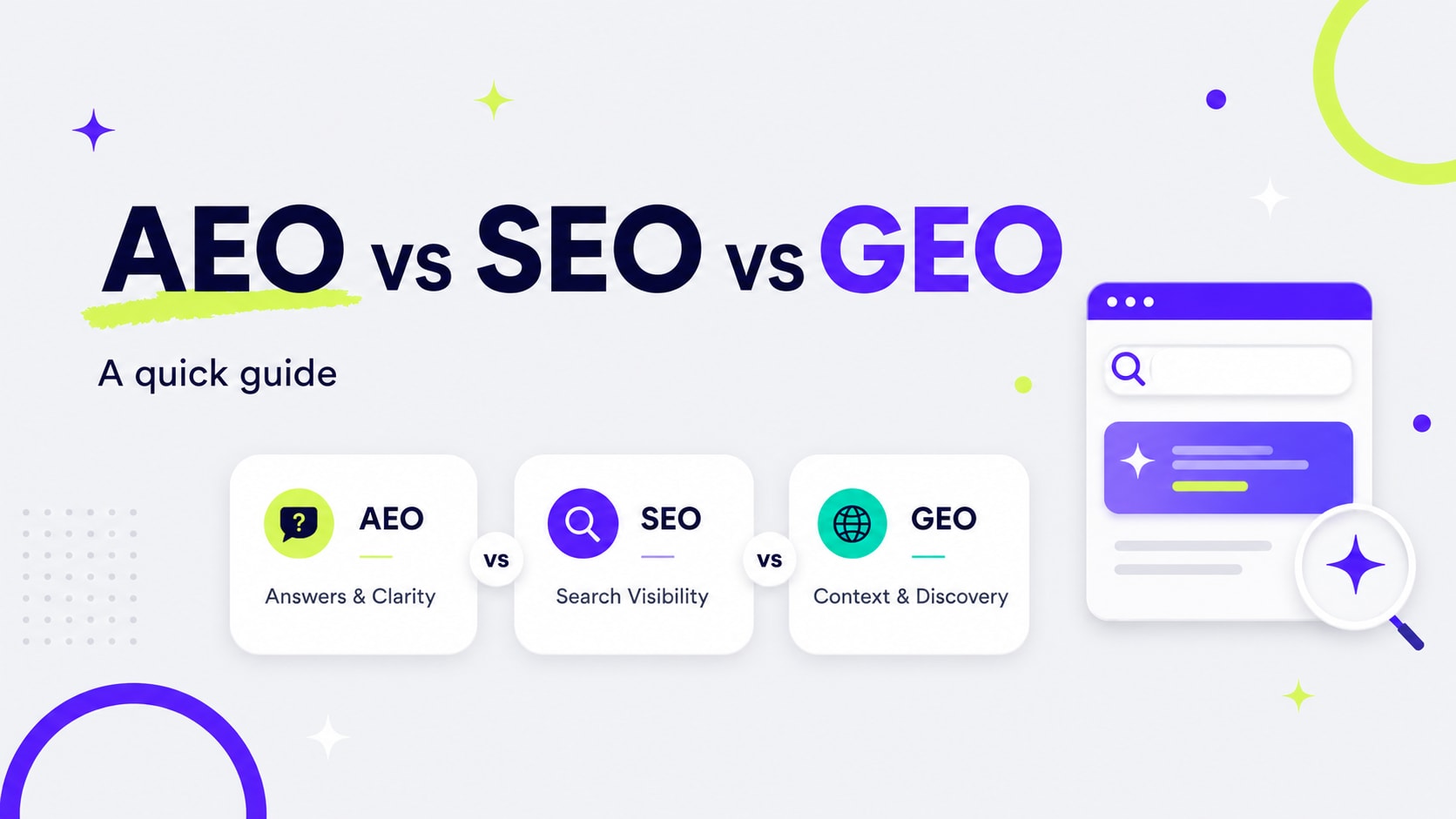
These three terms are increasingly used in the same breath, sometimes interchangeably, often imprecisely. Here's the clean distinction:
Discipline | Full Name | Core Question | Primary Output |
SEO | Search Engine Optimization | How do I rank in Google? | Traffic from organic search results |
AEO | Answer Engine Optimization | How do I become the direct answer? | Visibility in featured snippets, AI Overviews, voice responses |
GEO | Generative Engine Optimization | How do I get cited and recommended by AI models? | Brand citations in LLM-generated responses |
The simplest way to think about the difference: SEO drives clicks. AEO wins the answer box. GEO earns the citation.
They're not competing strategies, they're layered. SEO remains foundational; AEO ensures your content is surfaced in answers; GEO ensures your brand is consistently understood and represented across AI systems. A brand that does only one of the three will have gaps that the other two would close.
What AEO Actually Involves
AEO emerged from a specific behavioural shift: people started asking full-sentence questions instead of typing keyword strings. "Best project management tool for remote teams" became "What's the best project management tool for a fully remote team of 15?" The intent is the same; the format changed. And that format change required a different optimization response.
At its core, AEO is about making your content extractable. That means:
Answering the question immediately. AI systems and featured snippet algorithms both favour content that puts the answer in the first sentence or paragraph, not at the end of a long build-up. The reader-first convention of "context, then answer" works for essays. It fails for AEO.
Using question-and-answer structure. Pages that explicitly name the question in a heading and answer it in the paragraph below are structured precisely how answer engines scan for response material. FAQ sections, H2s phrased as questions, and definition-first formatting all help.
Implementing schema markup. Pages with FAQ schema are 30% more likely to appear in rich AI results. FAQPage, HowTo, Article, and Product schema types give AI systems explicit signals about what your content contains and how to categorize it.
Optimising for voice. Voice search is inherently zero-click and conversational. Voice search is growing at 24% per year, and 92% of voice answers come from position zero or the knowledge panel. AEO content needs to work when read aloud, short, clear, jargon-free.
How AEO Differs from GEO? And Why the Distinction Matters
AEO and GEO are frequently confused because they both involve AI systems. The difference is in the type of AI and the type of visibility each one addresses.
AEO targets answer-layer visibility: featured snippets, AI Overviews embedded in search results, voice assistant responses. These are AI systems sitting inside traditional search infrastructure, extracting and surfacing your content in near-real time from indexed pages.
GEO targets generative-layer visibility: the responses produced by large language models like ChatGPT, Claude, and Gemini when users ask open-ended questions in a chat interface. These models don't retrieve live web pages in the way a search engine does. They draw on training data, retrieval-augmented sources, and pattern-matching across vast amounts of text. Getting cited by them requires a different approach: authoritative third-party coverage, claim specificity, entity clarity, and a presence across multiple independent sources.
Put practically: AEO helps you appear in the answer box when someone Googles a question. GEO helps you get recommended when someone asks an AI chatbot the same question a week later. The user intent is often identical; the system delivering the response is different; the optimization required is different.
For a full breakdown of GEO and how to build a content strategy around it, see The Complete Guide to GEO for Marketers.
Why You Need Both and Where to Start
The mistake most marketing teams make is treating AEO and GEO as an either/or choice or assuming that strong SEO covers both. It doesn't. The channels are converging, AI Overviews now appear in 25% of all Google searches, but the content signals each one rewards are distinct enough that you need to address them separately.
That said, there's meaningful overlap, and you don't have to build two separate content programmes from scratch. Content that is specific, well-structured, and genuinely useful tends to perform across all three disciplines. The table below shows where the overlap is and where each discipline requires something the others don't:
What Good Content Looks Like | SEO | AEO | GEO |
Keyword-targeted headings | ✓ | ✓ | — |
Answer-first paragraph structure | — | ✓ | ✓ |
FAQ and HowTo schema | — | ✓ | — |
Specific, quantifiable claims | — | ✓ | ✓ |
External citations to primary sources | ✓ | — | ✓ |
Third-party coverage and review platform presence | — | — | ✓ |
Conversational, question-driven phrasing | — | ✓ | ✓ |
If you're starting from zero and need to prioritise: build your SEO foundation first (it feeds everything), then layer AEO by restructuring your highest-traffic informational pages for direct answers, then address GEO by building out your third-party footprint and content citability.
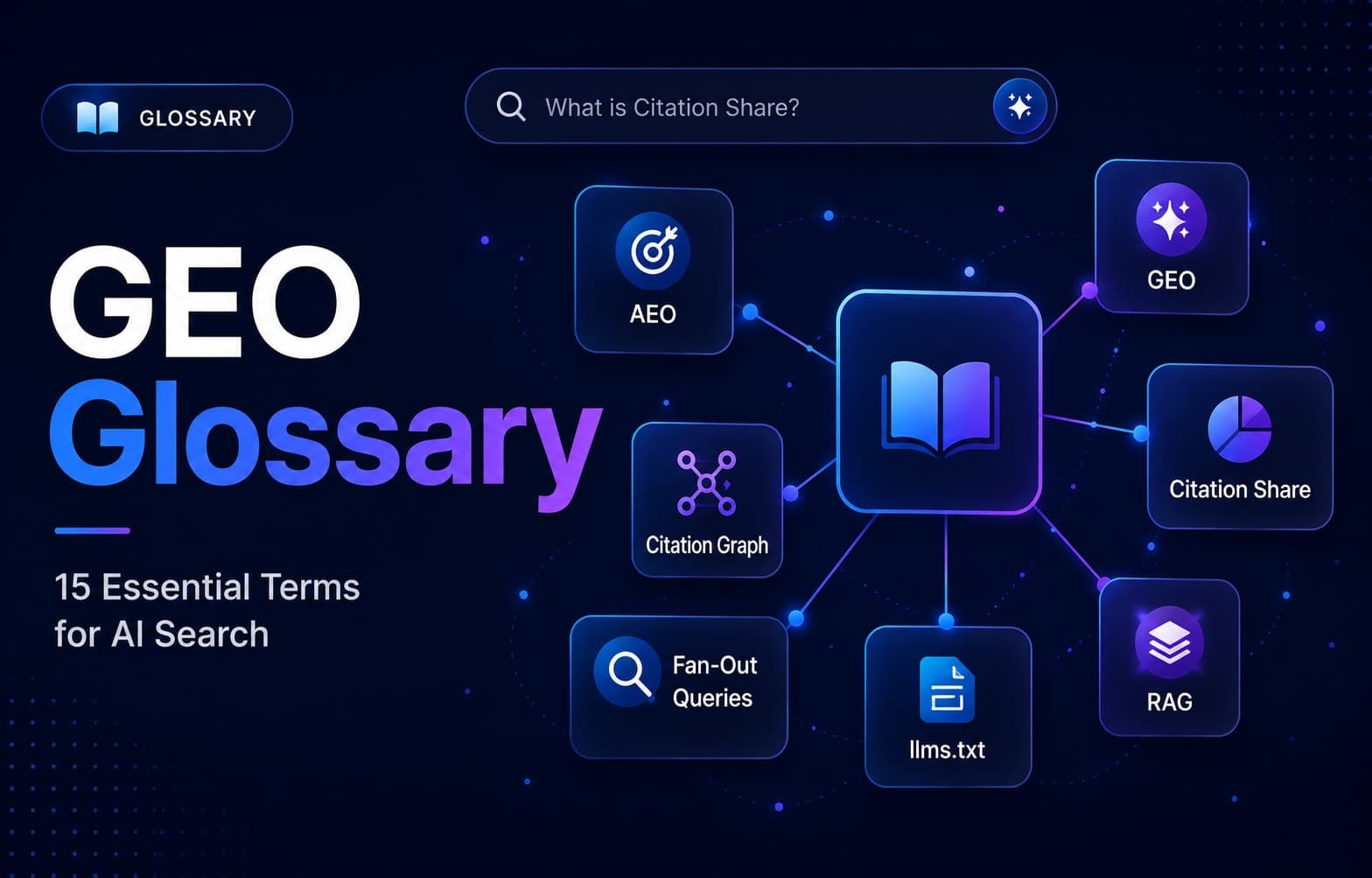
GEO Glossary: Key Terms in This Space
This discipline is still forming its vocabulary. The terms below are the ones you'll encounter most often and they're not always used consistently across the industry.
AEO (Answer Engine Optimization) — Optimizing content to be surfaced as a direct answer in AI-powered search features, including Google AI Overviews, featured snippets, and voice assistants. Focuses on extractability and structure within search infrastructure.
GEO (Generative Engine Optimization) — Optimizing for citation and recommendation within large language model responses. Addresses how AI models like ChatGPT and Perplexity understand, trust, and reference your brand across generative outputs.
SEO (Search Engine Optimization) — Optimizing content and technical infrastructure to rank in traditional search engine results and drive organic traffic. The foundation that both AEO and GEO build on.
Share of Model — The percentage of AI-generated responses in a defined query set that mention your brand, measured as a proportion of all brand mentions. The AI-era equivalent of share of voice.
LLM (Large Language Model) — The underlying AI architecture powering tools like ChatGPT, Claude, and Gemini. LLMs generate text by predicting likely continuations based on training data and, increasingly, retrieved sources.
RAG (Retrieval-Augmented Generation) — A technique where an LLM retrieves current web content to supplement its training data before generating a response. RAG is how tools like Perplexity cite live sources in real time.
Zero-click search — A search query that is resolved on the results page itself, without the user clicking through to any external website. Around 60% of all Google searches are now zero-click.
AI Overview (AIO) — Google's AI-generated summary that appears at the top of some search results pages. Previously called the Search Generative Experience (SGE). Now appears on approximately 25% of all Google queries.
Entity — In the context of AI and search, an entity is a clearly defined, named thing: a brand, person, product, place, or concept. Models cite entities with more confidence when they're clearly defined across multiple sources.
Citability — The degree to which a piece of content is likely to be extracted and referenced by an AI model in a generated response. Driven by claim specificity, source citation, answer-first structure, and entity clarity.
Lift-out sentence — A sentence that is accurate and useful in isolation, without requiring surrounding context. High-citability content is built around lift-out sentences that AI systems can extract and include in responses without distortion.
llms.txt — A proposed standard (analogous to robots.txt) that allows website owners to give AI systems structured guidance on how to interpret and use their content. Increasingly relevant for technical GEO.
Want to know if your content is ready to show up in AI answers?
Run your GEO Check and see how likely your page is to be discovered, cited, and understood by ChatGPT, Perplexity, Gemini, and other AI search tools.
Frequently Asked Questions
Is AEO just a rebrand of SEO?+
No, though the two share underlying content quality principles. SEO optimizes for rankings and clicks in traditional search engines. AEO specifically targets the answer layer: featured snippets, AI Overviews, and voice responses. The output metrics are different (visibility and citation vs. rank and click-through), and the content structure required is different. You can rank well in SEO and still never appear in an AI Overview.
Do I need to choose between AEO and GEO?+
No. They address different channels and different AI systems. AEO is about answer-layer visibility inside search infrastructure. GEO is about citation and recommendation inside generative AI chat interfaces. A complete AI visibility strategy needs both.
Will AEO hurt my organic traffic?+
AEO doesn't cause traffic loss, zero-click behaviour does, and that's driven by broader platform trends, not by your optimization choices. The brands that ignore AEO don't get their traffic back; they just lose the answer-layer visibility as well. The better question is: if a user gets a direct answer from your content in an AI Overview, has your brand still benefited? Usually, yes, through brand exposure, downstream branded search, and the authority signal that being cited creates.
What's the fastest AEO win for most websites?+
Adding FAQ schema to your most-trafficked informational pages, restructuring their opening paragraphs to answer the primary question immediately, and phrasing H2 headings as questions. These three changes collectively cover most of the structural signals that answer engines scan for.
How does GEO differ from traditional PR?+
Earned media and PR have always mattered for brand authority. GEO makes the mechanism explicit: the third-party sources that LLMs draw from when answering questions about your brand are the same sources that PR has always targeted. Press coverage, analyst reports, community discussion, review platforms. The difference is that GEO treats those sources as citation infrastructure with measurable impact on AI visibility, not just brand awareness. Run your GEO Check.
Written by

I’m Ramaa, a writer and creator at Scribble. I’ve written two books, and writing is something I always find my way back to, whether that’s articles, scripts, captions, or overly long notes app rambles I swear will “be useful later.” I enjoy thinking about why people create, how ideas spread online, and what makes content feel genuinely human. When I’m not writing, I look after regulatory compliance and legal admin at Scribble, and I’m a graduate of the School of Policy, New Delhi. Outside of work, I’m a musician and an avid reader.