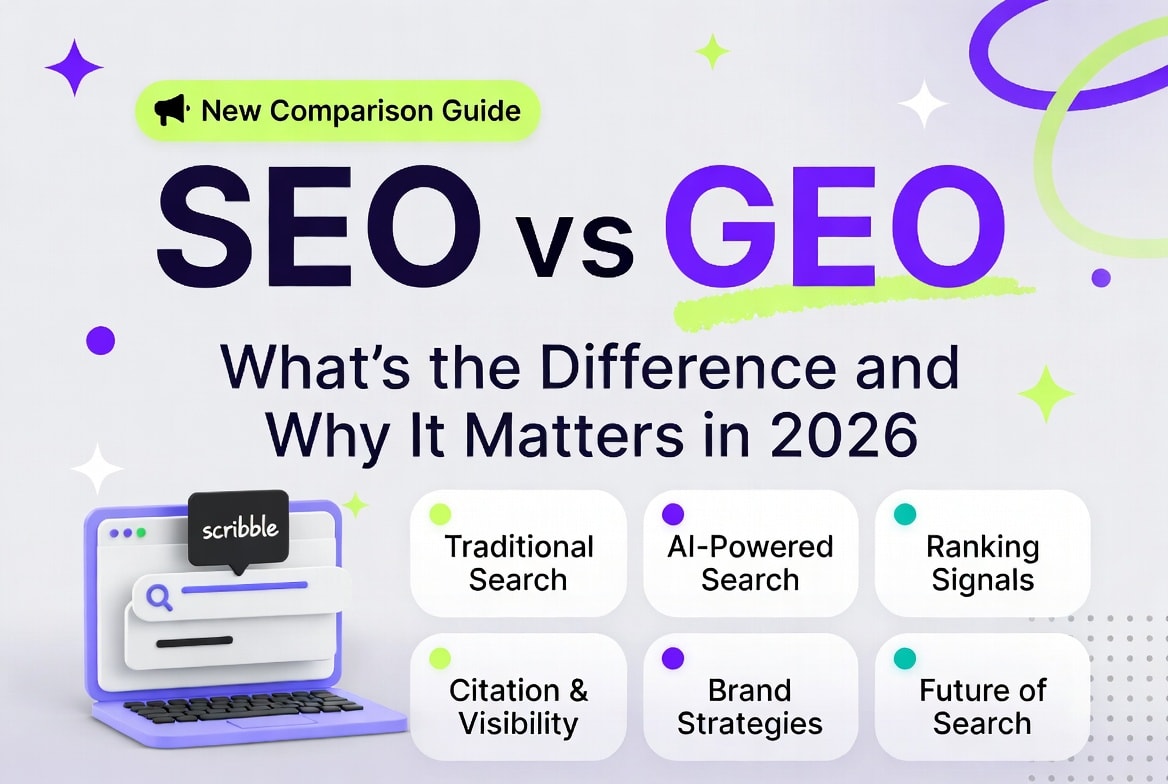
If you're looking for the short answer: SEO (Search Engine Optimization) helps your website rank in search results. GEO (Generative Engine Optimization) helps your brand get cited in AI-generated answers.
The distinction matters because buyers are increasingly discovering products through ChatGPT, Gemini, Claude, Perplexity, and Google's AI experiences before they ever click a website. SEO is still important. But ranking on Google and being recommended by AI are no longer the same thing.
In fact, some of the brands appearing most often in AI answers aren't necessarily the ones dominating traditional search rankings. AI systems evaluate different signals, cite different sources, and optimize for different outcomes.
GEO vs SEO: What's Actually Different?
At a high level, SEO optimizes for visibility in search engine results pages. GEO optimizes for visibility inside AI-generated answers.
The difference sounds subtle until you see how each system works.
Dimension | SEO | GEO |
Primary goal | Rank webpages in search engine results | Get cited or recommended in AI-generated answers |
Success metric | Rankings, clicks, and organic traffic | Citations, mentions, and AI share of voice |
Platforms | Google, Bing, traditional search engines | ChatGPT, Gemini, Claude, Perplexity, AI Overviews |
Content focus | Owned content on your website | Owned content plus third-party validation |
Trust signal | Backlinks and domain authority | Corroboration across multiple independent sources |
Optimization target | Search engine algorithms | Large language models and answer engines |
Best-performing content | Keyword-targeted pages and topic clusters | Answer-focused, citation-friendly, educational content |
User journey | Search → Click → Website | Question → AI Answer → Brand Consideration |
Measurement | Traffic, rankings, conversions | Citation frequency, recommendation rate, AI visibility |
According to Muck Rack's May 2026 analysis of more than 25 million AI citations, earned media accounts for 84% of citations across major AI systems, while paid and advertorial content contributes almost nothing.
In other words, AI systems trust what others say about you more than what you say about yourself.
The biggest difference between SEO and GEO is that SEO rewards publication. GEO rewards corroboration.
Why GEO Exists At All
For years, marketers operated on a relatively simple model:
Search → Click → Website → Conversion
AI has inserted itself directly into the middle of that journey.
Forrester's 2026 research found that generative AI is now becoming the starting point for business buyer research, fundamentally changing how products are discovered and evaluated.
A buyer who asks:
"What are the best customer support platforms for SaaS companies?"
may receive a complete answer without visiting a single website.
AI assembles:
recommendations
comparisons
pros and cons
citations
summaries
all before the traditional SEO journey even begins. This is why GEO emerged as a distinct discipline. Not because SEO stopped mattering. Because buyers changed their behaviour and way of asking.
And when buyers change behaviour, marketing eventually follows.
If you're new to the concept of GEO, start with our cornerstone guide: What is GEO? The Complete Guide for Marketers.
A slightly uncomfortable observation: many marketing teams are still reporting traffic growth while quietly disappearing from AI recommendations.
The dashboard looks healthy. The consideration set does not.
Visibility is no longer just about appearing on the page. It's about appearing in the answer.
How AI Systems Evaluate Brands Differently
One reason marketers struggle with GEO is that they assume AI works like Google.
It doesn't. Search engines primarily evaluate documents. AI systems evaluate relationships between documents.
Imagine two cybersecurity companies:
Company A
Strong website
Excellent SEO
Hundreds of optimized landing pages
Company B
Decent website
Frequently discussed on Reddit
Reviewed on Substack
Mentioned in industry newsletters
Covered in earned media
For some AI queries, Company B often has the advantage.
Why?
Because AI systems are looking for consensus. According to Scribble's creator campaigns with over 100 brands, the brands that appear most consistently across AI answers tend to have strong third-party discussion footprints across multiple independent platforms.
Not because AI "likes creators."
Because creators produce corroboration. And corroboration creates confidence.
Signal | SEO Weight | GEO Weight |
Keyword optimization | High | Medium |
Backlinks | High | Medium |
Brand mentions | Medium | High |
Earned media | Medium | Very High |
Reddit discussions | Low | High |
Expert commentary | Medium | High |
Structured answers | High | Very High |
What Still Matters From SEO
Here's the good news.
Most GEO advice that tells you to throw away SEO is wrong.
Many SEO fundamentals remain incredibly valuable.
AI systems still need:
crawlable content
clear site structure
strong topical authority
helpful information
schema and metadata
accessible pages
If your site is impossible to crawl, GEO becomes difficult.
If your content is shallow, GEO becomes difficult.
If your brand lacks authority, GEO becomes difficult.
The difference is that these elements are now table stakes rather than the finish line.
For example:
Traditional SEO Activity | GEO Impact |
Topic clusters | Helps AI understand expertise |
Schema markup | Improves machine readability |
FAQ sections | Increases extractability |
Internal linking | Strengthens topic relationships |
Helpful content | Increases citation potential |
This is why GEO should not be viewed as "SEO replacement." It's better understood as:
SEO + Citability + Third-Party Validation + AI Accessibility
How Marketers Should Think About GEO In 2026
The biggest mindset shift is moving from traffic thinking to visibility thinking.
Historically:
rankings mattered
clicks mattered
sessions mattered
Now another metric has entered the room:
citation share
Questions marketers increasingly need to ask:
Does ChatGPT mention us?
Does Gemini cite us?
Does Perplexity recommend us?
Which competitors appear more often?
Which questions are we missing entirely?
Zero-click behaviour continues to rise, with a growing percentage of searches ending without website visits.
This doesn't mean traffic disappears. It means recommendation increasingly happens before traffic.
The brands winning today are investing in:
Strong educational content
Creator-driven coverage
Earned media visibility
AI-accessible websites
Consistent brand positioning
Citation monitoring
Not because they're abandoning SEO. Because they're expanding beyond it.
A useful rule:
If SEO helped you win the click, GEO helps you earn the recommendation.
The future of discoverability isn't rankings versus citations. It's understanding how the two work together.
You might also want to read Is Your Brand Invisible to AI? How Buyers Research Products in 2026, which explores in more detail how AI is changing the vendor evaluation process long before buyers reach a company's website.
Frequently Asked Questions
Is GEO replacing SEO?+
No. GEO builds on SEO. Strong SEO fundamentals make GEO easier, but SEO alone no longer guarantees visibility inside AI-generated answers.
What does GEO stand for?+
GEO stands for Generative Engine Optimization. It focuses on increasing a brand's visibility in AI-generated responses from platforms like ChatGPT, Gemini, Claude, Perplexity, and AI-powered search experiences.
Can I rank on Google but still be invisible in AI search?+
Yes. Many brands rank highly for traditional search queries but rarely appear in AI-generated answers because they lack third-party citations, strong consensus signals, or AI-accessible content.
What is the biggest ranking factor in GEO?+
There isn't a single factor, but third-party corroboration, earned media, clear brand positioning, and answer-focused content consistently appear among the strongest signals.
Should marketers measure traffic or AI visibility?+
Both. Traffic remains important, but AI visibility and citation share are increasingly becoming leading indicators of future consideration and demand generation. Want to see how your brand currently stacks up across both? Run your free GEO audit at https://scribble.network/geo-checker
Written by

Hi! I’m Mrinalini. I work on growth at Scribble, where my days mostly revolve around content, planning campaigns, speaking to creators, and occasionally yapping in front of a camera. I studied engineering at Manipal Institute of Technology and briefly worked as a Test Engineer at Siemens before realizing marketing was my calling. Outside of work, you’ll find me eating/thinking about food.