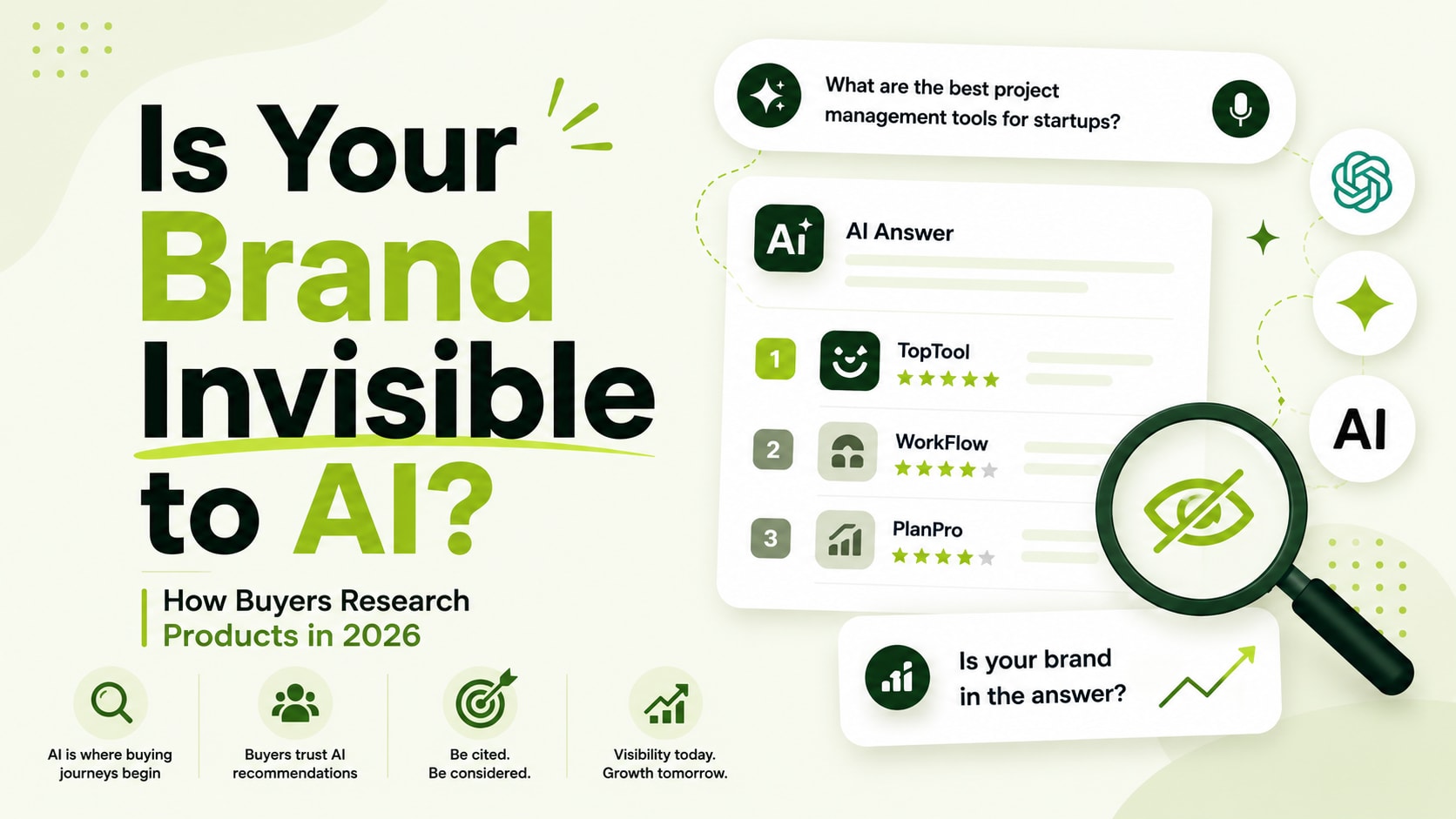
If you type your category into ChatGPT right now and your brand doesn't appear, you're not dealing with a content problem or an SEO problem. You're dealing with a citability problem — and the two are not the same thing. Google rewards what you publish on your own site. AI rewards what other people have written about you, on platforms you don't control. Most brands have spent years optimising for the first. Almost none have built for the second. This piece is about why that gap exists, how buyers are actually researching products in 2026, and what it takes to close it.
How buyers actually research products now
The scale of what's changed is worth sitting with for a moment.
Forrester's 2026 Buyers' Journey Survey polled nearly 18,000 global business buyers. It found that twice as many named generative AI or conversational search as their most meaningful research source compared to anything else in the study — more than vendor websites, more than product experts, more than sales representatives. The proportion of buyers using AI in their purchase process grew from 89% in 2025 to 94% in 2026. That's not adoption. That's saturation.
On the consumer side: among shoppers already using AI, 72% use it as their primary tool to research products and brands. 51% use it during early discovery. 57% use it to narrow down a shortlist.
Here's what that sequence actually means in practice. A buyer decides whether your product makes their shortlist before they've visited your website. Before your retargeting pixel has fired. Before your SDR has sent a single email. The shortlist gets assembled in a system you have no direct access to, using signals most marketing teams have never thought to build. Bain puts it plainly: buyers use AI to construct the consideration set, then turn to websites and review platforms to validate what the model already suggested.
The validation step still happens. But only for brands the AI named first.
The vendor evaluation process now begins in a system that operates entirely without the vendor's website, sales funnel, or retargeting infrastructure. — Forrester, January 2026
And 64% of customers say they're ready to purchase products recommended by AI. Not willing to consider — ready to purchase. The trust transfer from AI recommendation to purchase intent is faster than almost any other channel we've seen measured.
Why isn't my brand showing up in AI search?
The answer is mechanical, not mysterious.
Large language models don't crawl your site for keyword density. They look for corroboration — agreement across multiple independent sources that tells the model your brand is credible and relevant to a given query. Reddit threads, Substack essays, YouTube explainers, industry newsletters, review platforms, podcast transcripts. When those surfaces consistently mention your brand in context, AI systems gain confidence in recommending you. When they don't, the model defaults to brands that do have that external footprint.
Brands that rank on page one of Google and appear nowhere in AI search are not losing a traffic channel. They are losing the room where their next customer is making their shortlist.
This is what we call the consensus signal — and most brands have never built it. They've invested heavily in their own domain: case studies, whitepapers, thought leadership, a blog that publishes twice a week. From an AI's perspective, that's a brand talking about itself. It carries about as much weight as a reference letter you wrote for yourself.
The data confirms the gap. A Moz analysis of 40,000 queries found that 88% of Google AI Mode citations don't appear in the organic top 10 results. Muck Rack's analysis of over one million AI prompts found that more than 85% of non-paid citations come from earned media: coverage, reviews, creator content, forum discussions — written by people who aren't the brand, on platforms the brand doesn't own.
Google rankings and AI citations run on separate graphs. Building one doesn't build the other.
The top four reasons brands disappear from AI search
Based on our recent brand audits at Scribble Network, it comes down to some combination of these four.
Reason | What it looks like on your site | How to fix it |
Your brand identity is ambiguous or inconsistent | Your homepage says one thing, creator content says another, and media mentions describe you differently every time. You operate across multiple categories without a clear core positioning. | Standardise your messaging across your website, social profiles, creator partnerships, press coverage, and documentation. Make it immediately obvious what your brand does and which category it belongs to. |
You have almost no third-party mentions | Most mentions of your brand exist only on your own website. There are few Reddit discussions, independent reviews, creator breakdowns, or citations outside your owned channels. | Invest in distributed credibility. Encourage creators, users, analysts, and communities to talk about your category and product independently. One strong Reddit thread or Substack analysis can outperform multiple brand blog posts. |
You’re blocking AI crawlers without realising it | Your robots.txt blocks GPTBot, ClaudeBot, or PerplexityBot. Important content is hidden behind logins, rendered entirely in JavaScript, or inaccessible to crawlers. | Audit your robots.txt file and explicitly allow AI crawlers. Ensure key pages are crawlable, indexable, and server-rendered where possible. Remove unnecessary login walls around informational content. |
Your content makes claims rather than answering questions | Your site is filled with messaging like “We are the leading platform for X” instead of content that explains how X works, who it’s for, when to use it, or what tradeoffs exist. | Write for comprehension instead of conversion. Create content that answers real user questions, explains the category clearly, defines terminology, and acknowledges alternatives or tradeoffs. Useful content gets cited more than promotional content. |
Based on our recent brand audits at Scribble Network, most brands disappear from AI search because of some combination of these four issues. AI systems aren’t ranking websites the way traditional search engines did — they’re synthesising answers. That means they prioritise clarity, corroboration, accessibility, and usefulness. Brands that are easy to understand, widely referenced by third parties, accessible to crawlers, and genuinely educational are far more likely to appear in AI-generated answers over time.
The freshness problem
Citation performance typically begins declining after four to five days without content updates — a pattern that holds across all six major AI platforms. The most visible brands in competitive categories publish two or more structured content pieces per week. That's a significantly higher velocity than traditional SEO ever required.
Getting cited once isn't the goal. Staying cited is.
What zero-click search is doing to your business
In 2025, organic click-through rates dropped 61% on queries where AI Overviews appeared. Zero-click search hit record levels: 58.5% of U.S. searches and 59.7% of EU searches ended without a click to any external site. 93% of AI Mode search sessions end without a website visit.
The traffic-based model for measuring content performance is broken. The goal of AI citation isn't to drive clicks in the traditional sense — it's to be the brand the model names. That name travels with the buyer into the validation phase: the website visit, the G2 check, the demo request. The click happens, just later, and only after the AI has already made the introduction.
If AI never names you, the chain never starts. You're not losing a click. You're losing the consideration entirely.
How to start closing the citability gap
To understand GEO — Generative Engine Optimization — as a full discipline, this article is the right starting point. What follows here is the practical version: where to begin.
Run the manual test first. Open ChatGPT and Perplexity. Type the questions your buyers actually ask when evaluating your category. Note whether you appear — and which competitors do. Do this before doing anything else. 54% of US marketers plan to implement GEO within three to six months, but only 23% currently invest in measurement. You can't improve what you're not tracking.
For a structured view, this GEO Checker maps your content’s citation presence across ChatGPT, Perplexity, and Gemini against the queries your buyers are using, and surfaces exactly where the gaps are.
Fix your robots.txt. Allow GPTBot, ClaudeBot, and PerplexityBot explicitly. Make sure key content isn't JavaScript-rendered or login-gated. This is table stakes. It takes an afternoon.
Restructure content around direct answers. Identify your ten highest-intent queries. Write one piece per query that opens with a direct answer in the first paragraph. That's the format AI systems extract from most reliably.
Build a third-party footprint. Get your product and category discussed on the platforms AI indexes heavily: Reddit, Substack, Medium, YouTube, industry newsletters.
Use creators for corroboration, not just reach. An independent creator reviewing your product on Substack is doing something your own team can't: validating your claims from outside your ecosystem. AI weights that signal differently. One substantive independent piece is worth significantly more to your citability than ten posts from your own blog.
What this means for your brand right now
Brands that have been invisible to AI search for the past 18 months have been losing pipeline to competitors they may not have considered serious threats. Buyers who would have found them through Google and researched them through organic channels are now going to AI first — and if AI doesn't name you, the rest of the funnel doesn't start.
Forrester's data from 18,000 buyers makes it plain: the vendor evaluation process now begins in a system that operates entirely without your website, your sales funnel, or your retargeting infrastructure. That's not a future state. It's where things stand today.
The brands winning at AI visibility right now are not necessarily the biggest ones. They're the ones that understood the rules had changed and built deliberately for the new game — content that answers rather than claims, a third-party footprint that gives AI systems something to corroborate, and consistent enough positioning that the model knows exactly who they are and what they do.
That's a buildable position. But it requires starting.
Scribble AI to solve for your brand’s invisibilty
We use ScribbleAI to map exactly where a brand is and isn't showing up across AI engines, which queries are returning competitors, which are returning no one, and which represent real citability opportunities. That gap analysis becomes the brief.
From there, we match brands with independent creators from our network who already have credibility on the platforms AI indexes most heavily- writers publishing on Substack, voices with active Reddit presence, YouTubers covering the category.
These are real people, with real audiences, writing about brands in the natural way AI systems are built to trust. Brands running these campaigns across Medium, Substack, Reddit, and YouTube see measurably stronger citation rates within 90 days, because fresh, third-party corroboration from credible sources is exactly the signal AI is looking for.
Frequently Asked Questions
Why isn’t my brand showing up in ChatGPT or Perplexity?+
AI systems don’t rank brands the same way Google does. They look for corroboration across independent sources like Reddit, Substack, YouTube, review platforms, and media coverage. If your brand has weak third-party presence, inconsistent positioning, or inaccessible content, AI systems are less likely to recommend or cite you.
What is GEO and how is it different from SEO?+
GEO stands for Generative Engine Optimization. Traditional SEO focuses on ranking your website in search engine results. GEO focuses on increasing the likelihood that AI systems like ChatGPT, Gemini, Claude, and Perplexity mention or cite your brand when answering user questions. The goal shifts from winning clicks to becoming part of the AI-generated answer itself.
Do I need to allow AI crawlers on my website?+
Yes. AI crawlers like GPTBot, ClaudeBot, and PerplexityBot need explicit access to crawl and understand your content. Many websites unintentionally block them through robots.txt rules, JavaScript-heavy rendering, or login-gated pages. If AI systems can’t access your content, they can’t cite or reference it reliably.
How long does it take to start showing up in AI search?+
There’s no fixed timeline, but most brands begin seeing measurable improvements within a few months of consistently improving their citation footprint. Strong third-party mentions, fresh content, accessible site structure, and consistent positioning all compound over time. Brands publishing regularly and building external corroboration tend to improve visibility faster.
Does AI visibility affect my Google rankings?+
Not directly. Google rankings and AI citations operate on different systems and signals. A brand can rank highly on Google but still be absent from AI-generated answers. However, the activities that improve AI visibility — like clearer content, better authority signals, and stronger third-party discussion — can still indirectly strengthen your overall search presence. Run your free GEO audit
Written by

Hi! I’m Mrinalini. I work on growth at Scribble, where my days mostly revolve around content, planning campaigns, speaking to creators, and occasionally yapping in front of a camera. I studied engineering at Manipal Institute of Technology and briefly worked as a Test Engineer at Siemens before realizing marketing was my calling. Outside of work, you’ll find me eating/thinking about food.