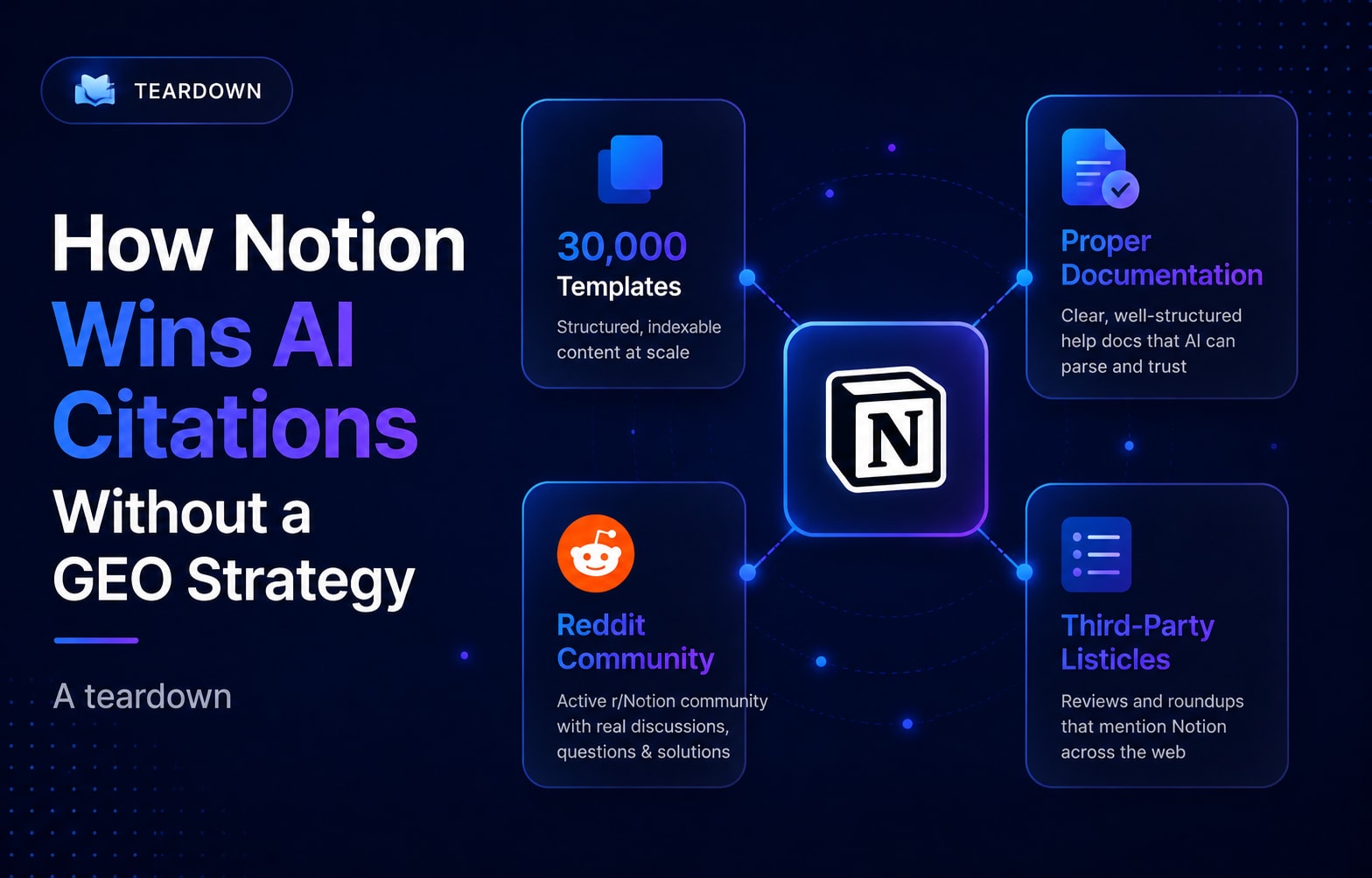
A public-data teardown of how Notion gets named by ChatGPT, Gemini, Perplexity and Claude in answers about note-taking, wikis and project management, despite never shipping a formal generative engine optimization program.
You can follow every GEO checklist this year and still watch ChatGPT or Perplexity recommend a competitor in your place. Notion does the opposite. It has never published a GEO program, yet it surfaces in AI answers about productivity tools almost every time someone asks.
Notion spent a decade building the exact assets large language models prefer to pull from. A vast library of templates and help pages, a deep third-party ecosystem of reviews and Reddit threads, and a brand referenced so widely that models treat it as a default. Notion did not chase AI citations. It earned them as a side effect of product-led and community-led growth. The rest of this teardown shows the receipts, using only public data.
The Scoreboard: Scale And SEO
Start with the size of the entity, because entity strength is what models reward. According to TapTwice Digital, Notion has more than 100 million users and more than half of Fortune 500 companies run teams inside it. According to Modern Meeting Standard, Notion crossed a roughly $11 billion valuation in a January 2026 tender offer, up from the $10 billion mark it set in 2021, which Notion VIP documented at the time.
By the numbers
100M+ users worldwide, according to TapTwice Digital
30,000+ public templates in the marketplace, according to Modern Meeting Standard
~0% of traffic from paid search, according to Similarweb
On traditional SEO, Notion sits near the top of its category. According to ahrefs, Notion has a Domain Authority of 87.
The channel mix is the tell. According to Similarweb, about 82 percent of notion.so visits come from Direct traffic and about 11 percent from Organic Search, with paid search close to zero. Notion wins through brand recall and earned content, not an ad budget. That same earned footprint is what feeds the models.
SEO metric | Value | Source |
Domain Authority | 87 | |
Monthly visits | ~130M to 170M | |
Direct traffic share | ~82% | |
Paid search share | ~0% |
Why AI Citations Are Worth The Fight
AI answers have become a real discovery channel, and the research points to one conclusion: they reward exactly what Notion already has. Ahrefs studied 75,000 brands and found that the strongest signals for showing up in AI answers are all off-site. AI visibility is not really about your own website. It is about how widely your brand appears across the rest of the web. In that data, branded web mentions ranked among the top predictors of an AI citation, and mentions on YouTube correlated even more strongly.
Link diversity tells the same story. SE Ranking found that sites with only a couple thousand referring domains averaged fewer than two ChatGPT citations, while citation rates roughly doubled once a site crossed about 32,000 referring domains, and the largest domains averaged more than eight. Notion clears that threshold many times over, with around 170,000 referring domains.
The same pattern shows up inside the tools. Ahrefs' own Brand Radar data shows that most AI citations for a brand come from third-party sites, not its own domain. For Ahrefs itself, the most-cited sources are Zapier, YouTube and Reddit, the very independent-source mix that works in Notion's favour.
The channel is growing fast and concentrating in a handful of engines. Ahrefs' AI-versus-search tracker recorded ChatGPT referral traffic jumping 59.4 percent in a single month in 2026, with AI platforms growing several times faster than Google. A brand that wants citations has to register across ChatGPT, Gemini, Perplexity and Claude at once, not bet on one.
One caveat keeps this honest. AI is expanding discovery, not replacing search outright, so the brands that win stay visible in both AI answers and traditional results. Notion shows up in both at the same time, which is exactly why it keeps getting named.
The Five Assets That Earn Notion Its Citations
LLM models cite sources they can retrieve, parse and trust. Notion happens to produce all three at scale. Here is the inventory, mapped to what each asset gives an AI engine.
Notion asset | What it feeds the model |
Template marketplace | 30,000+ structured, indexable pages that match long-tail prompts like "Notion CRM template," per Modern Meeting Standard |
Help and guide docs | Clean, question-shaped answers models can lift directly |
r/Notion community | A community-run subreddit that passed 118,000 members, the kind of forum signal models weight heavily |
Third-party listicles | Roundups from Lindy and get-alfred that name Notion in "best note-taking app" comparisons |
Brand ubiquity | Entity recognition strong enough that models reach for Notion as a default option |
None of this was built for AI. The templates existed to drive word-of-mouth growth. The subreddit existed for support. The listicles exist because reviewers cover popular tools. Notion satisfied the test for AI citations years before the term existed.
Anatomy Of A Notion Citation
When someone asks ChatGPT or Perplexity for the best note-taking app, the model does not invent an answer. It assembles one from sources it can retrieve and trust. Notion sits in every layer of that stack.
Layer one, the roundups. Comparison articles are the raw material for "best tool" answers. Lindy's guide to AI note-taking apps and get-alfred's 2026 roundup (amongst many others) both name Notion directly. When a model summarizes the category, it leans on exactly these lists.
Layer two, the community. Forum discussion gives models social proof. Notion's community-run subreddit passed 118k members in June 2026. That is a deep, searchable well of real user opinion.
Layer three, the first-party surface. Models need pages that answer the literal prompt. Notion's 30,000-plus templates, per Modern Meeting Standard, plus its help docs, produce structured pages that match long-tail queries like "Notion project tracker" almost word for word.
Layer four, the entity graph. Models build confidence in a brand when many independent sources describe it the same way. According to Similarweb's research on LLM seeding, consistent presence across independent sources is what makes an AI system trust an entity enough to cite it. Notion appears across Wikipedia, Crunchbase, news and reviews, so models can describe it confidently.
The layers reinforce each other. Notion is not cited because of one clever page. It is cited because it saturates every source type a model reaches for.
What The Teardown Proves
Strip away the detail and the causal chain is simple. Notion built a huge earned footprint, shown by the 82 percent Direct traffic share that Similarweb reports. That footprint produced ubiquity across the exact sources models retrieve. That ubiquity now produces AI citations.
Here is the honest counterpoint that keeps the case credible: Notion is rarely the single top pick. Models tend to name it as one default among several, alongside entities like Obsidian and NotebookLM. The lesson is not that Notion dominates every answer. It is that Notion never loses the consideration set, because it is impossible for a model to discuss the category without encountering Notion in every layer. For most brands, getting into that consideration set is the entire battle.
What You Can Copy This Quarter
You will not match 100 million users. You can match the mechanics. The brands that win AI citations, like Notion, treat presence across independent sources as the product, not the byproduct.
The play | What to do | What Notion did |
Build retrievable pages | Publish structured pages that answer real prompts head-on, so a model can lift the answer directly | Templates and help docs that match long-tail queries word for word |
Earn third-party mentions | Get named on the independent sources models already cite, like Reddit threads and category roundups, not just your own blog | A 180,000-member subreddit and a permanent spot in "best tool" listicles |
Keep your entity consistent | Describe your brand the same way across Wikipedia, Crunchbase, review sites and news, so engines read one clear story | Uniform presence across reference, data and news sources that lets models cite it with confidence |
Why AI Visibility Matters, And How Scribble Helps
AI visibility is no longer optional. Every month your brand stays invisible in ChatGPT, Gemini, Perplexity and Claude, a competitor takes the citation and the customer.
Scribble closes that gap. We track which sources each AI engine cites in your category, show you exactly where you are missing, and tell you which independent sources to earn next so the models start naming you. We turn AI visibility from guesswork into a measurable channel.
Run a free GEO audit here: https://scribble.network/ and see where you stand today.
Frequently Asked Questions
Why does ChatGPT recommend Notion so often?+
Because Notion shows up everywhere AI engines look before they answer. Its templates and help docs give models clean pages to pull from, its large Reddit community and constant spot in "best tool" lists add outside validation, and its consistent presence across the web lets models describe it with confidence. It is hard to leave Notion out of a productivity answer.
Does Notion have a GEO or AI strategy?+
Not a formal one that it has made public. Its AI visibility looks like a side effect of years of product-led growth, a huge template library, helpful docs, and a strong community, all of which existed long before "GEO" became a term.
Can a smaller brand get cited by AI the way Notion does?+
Yes, but you copy the mechanics, not the scale. Publish pages that answer real questions directly, earn mentions on independent sources like Reddit and category roundups, and keep your brand described consistently across the web. You build the footprint through earned coverage, not ad spend.
Is Notion always the top AI recommendation for note-taking?+
Models usually name it as one strong option among a few, alongside tools like Obsidian and NotebookLM. The win is that Notion almost never gets left out of the shortlist.
Does SEO still matter if AI search is growing?+
Yes. AI is adding to discovery, not replacing search. Most people still use Google alongside AI tools, and the same signals that earn strong search rankings, like wide third-party coverage and a consistent brand presence, also help you get cited by AI.
Which AI engines should a brand track?+
Ideally, ChatGPT, Gemini, Perplexity, CoPilot, Grok and Claude. Each one pulls from a different mix of sources and recommends brands differently, so checking only one gives you a misleading picture of where you actually stand.
Written by

Hi! I’m Mrinalini. I work on growth at Scribble, where my days mostly revolve around content, planning campaigns, speaking to creators, and occasionally yapping in front of a camera. I studied engineering at Manipal Institute of Technology and briefly worked as a Test Engineer at Siemens before realizing marketing was my calling. Outside of work, you’ll find me eating/thinking about food.