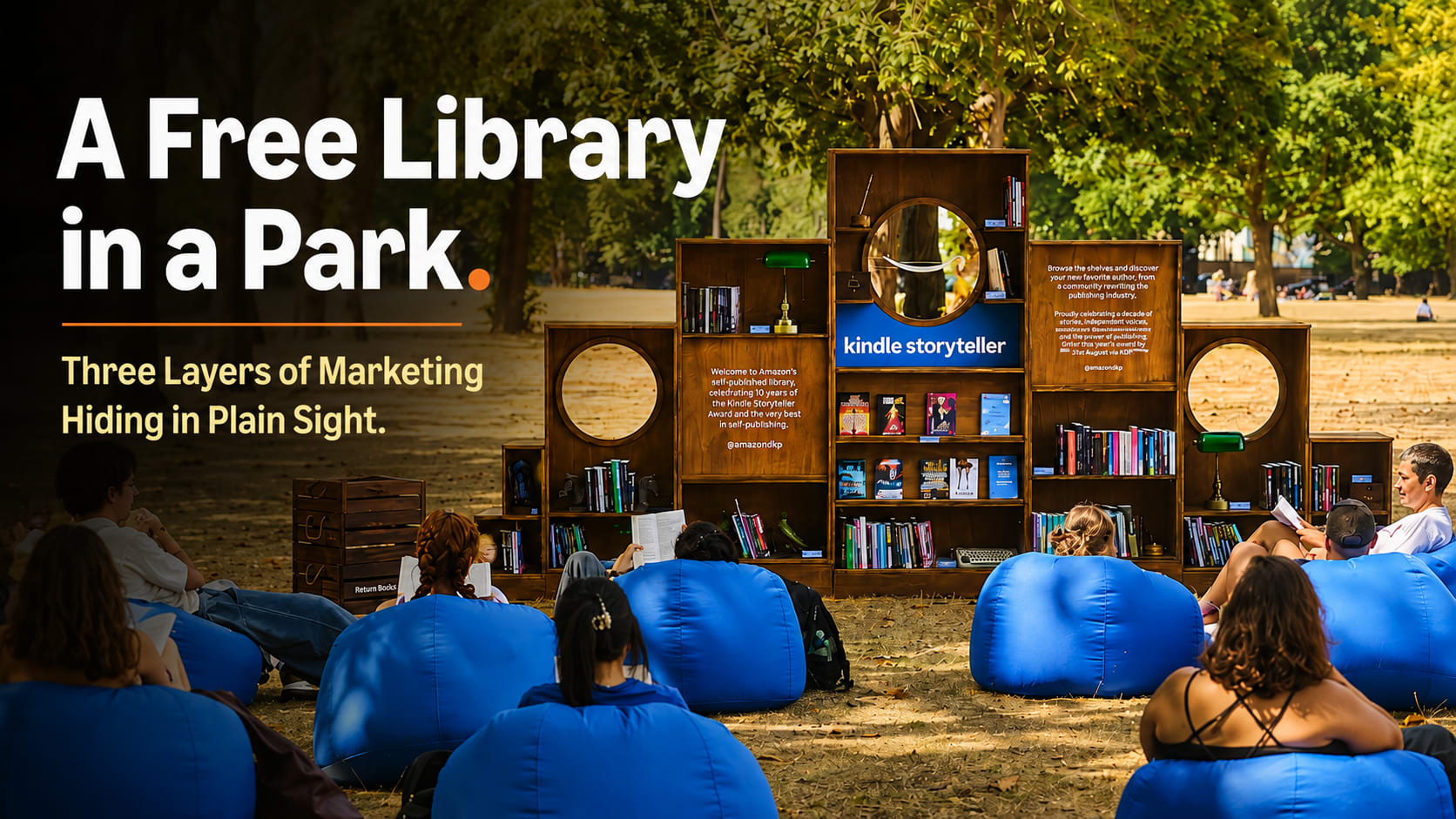
Last month, Amazon set up a pop-up library in Victoria Park, London. No Amazon branding plastered everywhere. No Prime upsell. Just shelves of self-published books, open to the public, free to browse and borrow for an afternoon.
It was charming. It was warm. And it was one of the most calculated brand moves of 2026.
Here is what actually happened, and what every marketer should take from it.
What the Campaign Was, on the Surface
The pop-up marked the 10th anniversary of Amazon's Kindle Storyteller Award. First launched in 2016, it is a £20,000 literary prize open to any self-published author in any genre. Every book on those shelves was self-published. Past award winners sat alongside breakout titles from Colleen Hoover and Frieda McFadden. Hoover built her entire readership through BookTok with no publisher behind her. McFadden spent years being rejected by traditional publishers, started self-publishing on KDP in 2013, and by 2024 had outsold James Patterson and John Grisham to become America's top thriller author.
Visitors could walk in, pick up a book, read for a while, and leave. No purchase required. Entries for this year's award were open until 31st August via Kindle Direct Publishing, mentioned once, quietly, at the bottom.
A lovely afternoon in the park celebrating indie authors. And underneath it: a four-layer PR operation.
Layer 1 : Reputation Management Disguised as a Cultural Event
Amazon is not having a quiet year legally. The FTC and 17 state Attorneys General are currently suing the company for monopolistic behaviour, arguing it controls prices for third-party sellers, punishes those who list products cheaper elsewhere, and uses platform dominance to squeeze the small businesses it publicly claims to support.
That is the Amazon that lives in courtrooms.
The Amazon in Victoria Park was handing out free books and celebrating first-time authors. Both versions are real. The latter generates warm press coverage.
This is reputation management at its most sophisticated self. Not a press release defending the company, but a physical event that creates a competing narrative. By the time a journalist writes "Amazon opens free pop-up library," the antitrust story is already sharing space with something more human.
The psychology here is called narrative displacement. When two stories compete for the same mental space, the more emotionally resonant one wins. A free library full of underdogs beats an FTC filing every time. Amazon knows this.
Layer 2 : The Underdog Borrowed
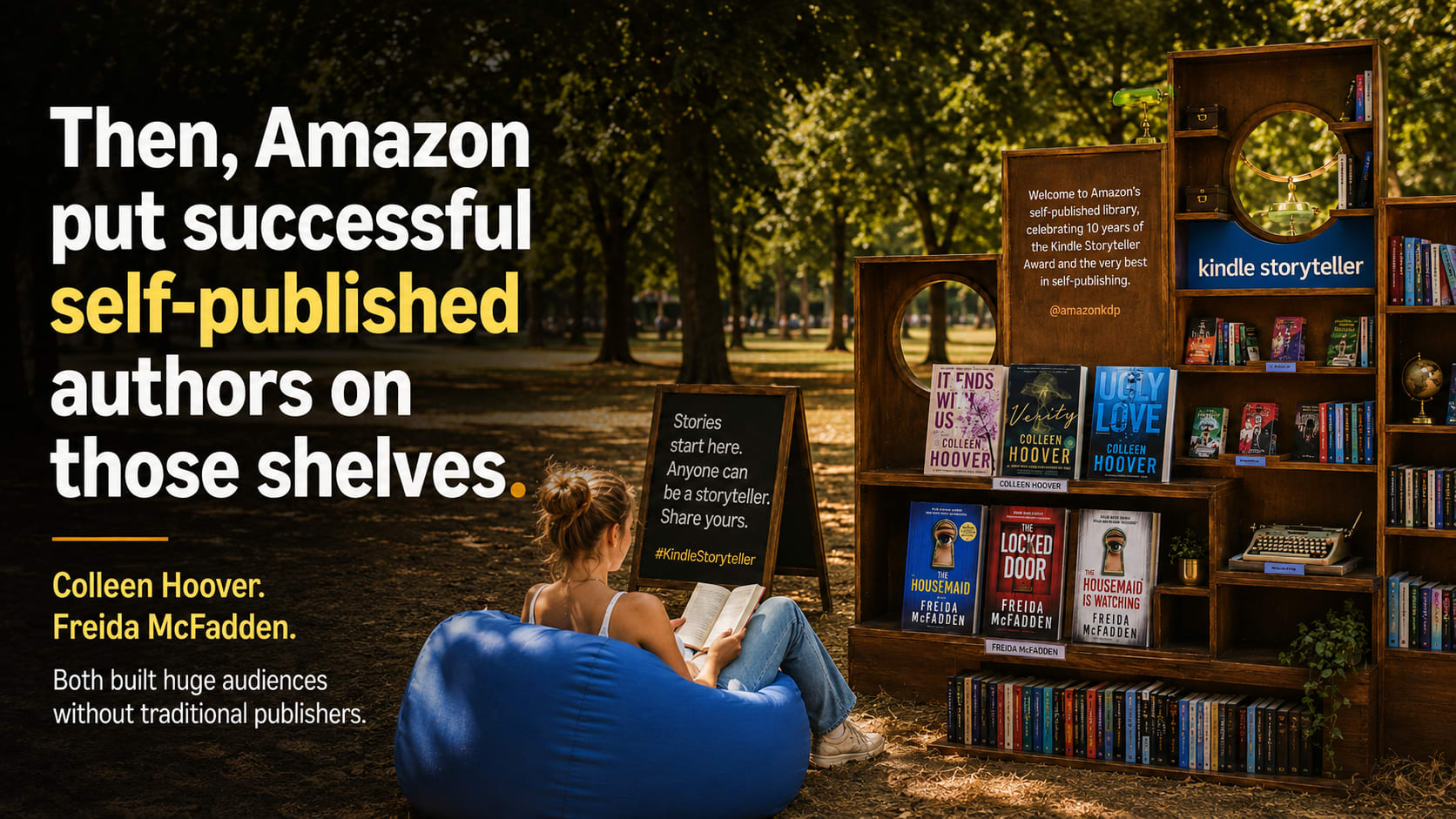
Putting Colleen Hoover and Frieda McFadden's books on those shelves is not a curatorial choice. It is an argument: our platform is the reason they made it.
This is association transfer, borrowing the emotional equity of something the audience already loves and attaching it to your brand. Their stories carry warmth, relatability, and triumph. Amazon stands next to them and absorbs that by proximity.
It works because there is truth in it. These authors genuinely built their careers through self-publishing. Amazon was the infrastructure. The brand is not lying, it is selecting which truth to tell loudly. And it is running the same playbook as every other platform under scrutiny. Google celebrates small businesses that "grew with Search." Meta publishes creator success stories. Shopify built its entire brand identity around the indie merchant, despite being worth over $100 billion.
The structure is always identical: platform faces scrutiny, surfaces the people who succeeded because of it, and lets the creator become the hero while the platform becomes the enabler.
Layer 3 : The Funnel Nobody Called a Funnel
The pop-up was a top-of-funnel acquisition event for Kindle Direct Publishing. Every aspiring writer who walked through Victoria Park, picked up a self-published novel, and thought I could do this, moved one step closer to becoming a KDP user. The mechanism was frictionless: feel inspired, go home, look up KDP.
Amazon converted a public park into a lead generation channel and made it feel like a gift to the community.
What This Means for Marketers
The smartest part of this campaign is that Amazon never had to ask anyone to think about Amazon.
People came for books. They left thinking about authors, discovery, opportunity, and self-publishing. Amazon simply positioned itself at the centre of that story.
1. Stop marketing the product. Market the world around it
Amazon could have promoted Kindle, KDP, or the Kindle Storyteller Award directly. Instead, it built a physical experience around the culture of reading and discovering new authors.
2. The best PR doesn't feel like PR
If your campaign is designed primarily to generate coverage, it will probably feel like a campaign. If it's designed to give people something worth talking about, the coverage becomes a consequence rather than the product.
The mechanics are replicable at any scale. Find the people your product genuinely helped, not polished testimonials, but real stories with friction. Surface them in the real world, not just online. Tie it to a moment that already has meaning. And let the funnel stay implicit.
The line between authentic advocacy and calculated PR is thinner than most brands admit. Amazon's pop-up sits right on it.
But as a piece of marketing craft, it is very good.
Written by

Hi! I’m Mrinalini. I work on growth at Scribble, where my days mostly revolve around content, planning campaigns, speaking to creators, and occasionally yapping in front of a camera. I studied engineering at Manipal Institute of Technology and briefly worked as a Test Engineer at Siemens before realizing marketing was my calling. Outside of work, you’ll find me eating/thinking about food.