Most people writing for AI visibility are thinking about it wrong. They're chasing the algorithm when the real question is much simpler: can an AI system read your content, understand what it's saying, and pull a clean answer from it without needing context from three paragraphs before?
If the answer is yes, you have a shot at being cited. If the answer is no, it doesn't matter how good the content actually is.
The fix is almost always structural not a knowledge problem, not an authority problem. This guide breaks down exactly what to change: the structure, the formats, the platform differences, and how to check if what you're publishing actually has a chance of being picked up.
Why content structure is the real unlock
When ChatGPT, Perplexity, Google AI Overviews, or any other AI system generates an answer, it isn't reading your full article and summarizing it. It's retrieving specific passages from across multiple sources and stitching them into a response. The unit of AI retrieval is the paragraph, not the page.
A paragraph that contains a complete idea a definition, a comparison, a specific fact, a direct answer can be extracted and cited cleanly. A paragraph that builds on what came before it, or saves the point for the end, loses almost all its value when pulled out of context.
Superlines' analysis of AI citation patterns across 34,000+ responses found that 44.2% of all LLM citations come from the first 30% of a piece of content. Your opening isn't a warm-up. It's prime real estate.
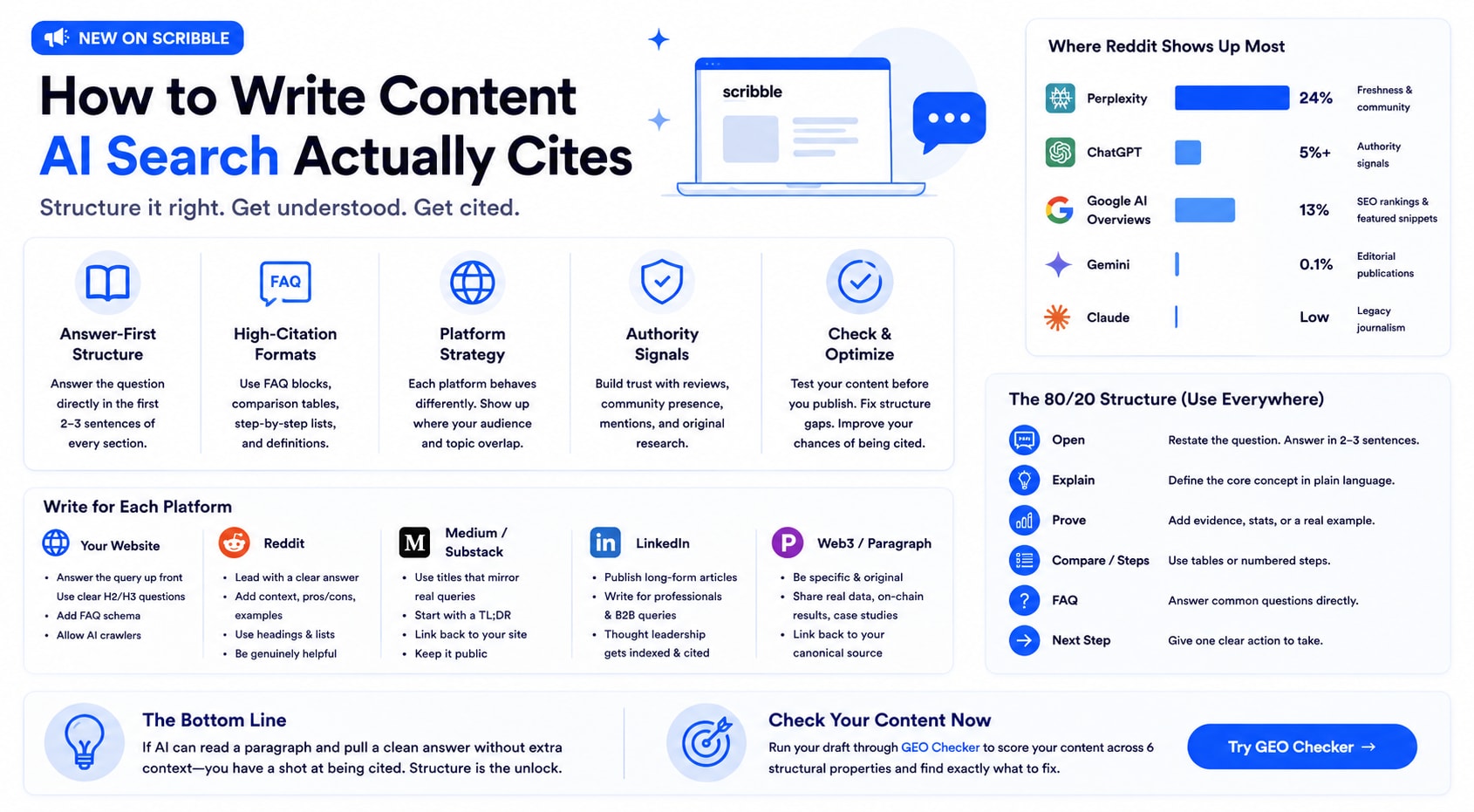
The structure that works isn't complicated. Answer the question directly in the first two to three sentences of every section. Define terms in self-contained blocks. Keep paragraphs to one idea. Use headings that read like the actual question someone would type into an AI tool. Every section should be able to stand alone if someone read only that section.
That's the structural game.
The formats AI cites most often
Some content formats get cited significantly more than others. This maps directly to how AI systems construct answers.
FAQ blocks are the highest-citability format right now. A question followed by a direct answer is exactly the format AI uses to respond to users. When your content mirrors that structure, extraction is trivial. AI can lift the Q&A pair directly. If you have a section that could be written as an FAQ, write it as an FAQ.
Comparison sections and tables get pulled constantly for "X vs Y" queries. A well-structured comparison table with clear criteria, honest tradeoffs, and specific claims will get cited for those queries repeatedly. Don't bury comparisons in prose if a table would make them clearer.
Step-by-step sections with numbered lists perform well for how-to queries. The numbered structure signals process to AI systems, and each step tends to be self-contained enough to extract cleanly.
Definition paragraphs where you explain what something is in one complete, self-contained block are highly citable. AI needs to define terms for users constantly. If your definition is clear and complete without requiring context from the rest of the article, it becomes a go-to reference.
What doesn't get cited: long narrative paragraphs that weave multiple ideas together, content that requires reading the section above to make sense, and anything that saves the main point for the end of the paragraph.
How to write an answer-first paragraph (with examples)
The single most impactful change most content needs is moving the answer to the front.
Hard to extract: "There are many factors that influence whether AI systems will cite your content. Some relate to technical setup, others to how the content is written. After considering all of these factors, the most important thing is probably how clearly you structure your information."
Easy to extract: "The most important factor in getting cited by AI systems is content structure specifically whether each paragraph can answer a question cleanly without surrounding context. Technical setup matters, but a well-structured paragraph on a basic site will outperform a poorly structured paragraph on a high-authority domain."
The second version leads with the answer, includes a specific claim, and makes sense on its own. That's what you're aiming for in every section of every piece you write for AI citation.
Platform differences that actually matter
The major AI systems don't all behave the same way when deciding what to cite. The 5WPR AI Platform Citation Source Index 2026 aggregated 680 million citations across ChatGPT, Google AI Overviews, Perplexity, Gemini, and Claude between August 2024 and April 2026 — and the platform differences are stark.
Reddit accounts for roughly 40% of all citations across every major model — making it the single most influential content source in AI search today. But the platform-level breakdown matters:
According to the Tinuiti Q1 2026 AI Citations Trends Report and the 5WPR Citation Source Index, here's how Reddit citation share breaks down by platform:
Platform | Reddit Citation Share (Jan 2026) | Key Trust Signals |
|---|---|---|
Perplexity | 24% of all citations | Freshness, community discussion, content < 12 months old |
ChatGPT | 5%+ of all citations | Authority signals, encyclopedic depth, Wikipedia-adjacent sources |
Google AI Overviews | 13% from social sources (Reddit dominant) | Traditional SEO rankings, featured snippet structure |
Gemini | 0.1% from Reddit | Editorial publications, brand-owned pages |
Claude | Low Reddit share | Legacy journalism (NYT, The Atlantic), well-sourced analysis |
The implication: which AI platform your buyers use determines whether your Reddit presence is a competitive advantage or irrelevant. A SaaS company monitoring Gemini and seeing no Reddit influence may be completely unaware that ChatGPT is assembling its product evaluations from subreddit threads.
Across all platforms, the content foundation is the same: answer-first structure, self-contained paragraphs, specific claims over vague generalities, genuine depth. What changes is where you need to be present.
Platform-by-platform writing approach
Your website
Your site is the canonical layer everything else should point back to. The pages that get cited most are built around a single specific question, open with a direct answer to that question, and use H2/H3 headings framed as explicit sub-questions underneath.
Build your key pages with this structure: a direct answer or TL;DR at the top, then sections for "What it is," "Why it matters," "How it works," "Step-by-step," and "FAQs." Add FAQPage schema to any page that has a Q&A section. Add Article schema to editorial content.
Also check your robots.txt. OAI-SearchBot, PerplexityBot, and Claude-SearchBot all need access. A lot of sites are blocking these without realizing it, which means the content never gets indexed for citation in the first place.
If you haven't already read our breakdown of what GEO actually is and how it works, What is GEO? The Complete Guide for Marketers covers the full framework — this article builds directly on it.
Reddit is the most cited source across AI platforms right now. According to ZipTie.dev's 2026 AI citation analysis, Reddit alone has 23.6 million pages cited in AI responses, appearing in 92.8% of all AI search opportunities. Most brands still treat it as an afterthought.
The posts and comments that get cited open with one clear, opinionated answer, then follow with context, pros and cons, and specific examples. First-person experience matters here more than anywhere else. "I tested this with three clients over six months and here's what actually happened" outperforms polished brand language every time.
Use structure even in long Reddit posts headings inside the body, bullets for lists. Write in the right subreddits for your topic rather than posting everywhere. And be genuinely useful. AI systems are getting better at detecting shill content, and Reddit communities will downvote it before AI ever gets a chance to cite it.
Medium and Substack
Both platforms get cited regularly for in-depth explainers and niche topics, especially when the content is well-structured. Treat important pieces on these platforms like blog guides, not casual newsletter dispatches.
Use titles that mirror real queries "How to Get Your Startup Cited by ChatGPT and Perplexity" rather than "Thoughts on the AI Search Shift." Start with a TL;DR. Use H2s framed as questions. Include concrete stats or mini case studies. Link back to your canonical website content so citation signals flow across platforms.
For Substack specifically, make your educational issues public. A paywalled piece is invisible to AI crawlers.
LinkedIn was among the top cited domains across major LLMs in late 2025 and into 2026. Long-form LinkedIn articles — not posts, actual articles — get indexed and cited by AI platforms for professional and B2B queries. If your thought leadership currently lives only in posts, republishing as articles gets it into the citation pool.
Paragraph and Web3 platforms
These behave like regular indexable blog pages for AI purposes. Apply the same principles — answer-first, self-contained paragraphs, clear headings, link back to your canonical source. The angle that makes Paragraph content citation-worthy is specificity: first-hand experience with Web3 tools, actual on-chain data, real campaign results. That's what differentiates it from generic SEO content and gives AI a reason to cite it over anything else.
The authority signals that matter outside your content
Structure gets you extractable. Authority signals get you trusted. These are different problems.
AI systems cross-reference claims against third-party sources before deciding how much to trust a domain. A brand that only exists on its own website looks thin compared to one that shows up consistently across Reddit, YouTube, LinkedIn, review platforms, and industry publications.
Forrester's 2026 B2B buyer research found that 94% of B2B buyers now use AI search engines during vendor research yet most companies with strong traditional SEO never appear in AI platforms. The gap is almost always off-site presence, not content quality.
The most accessible versions of this for most businesses: active G2 or Capterra reviews (both cited consistently across all major AI platforms), genuine Reddit participation, and a few industry publication mentions. Original research and data are particularly valuable if you publish a finding no one else has, AI systems have no choice but to cite you as the primary source.
How to check if your content is actually citation-ready
The honest way: go to ChatGPT, Perplexity, and Google AI Overviews, type in the query your content is trying to answer, and see what comes up. See who's being cited. See how their content is structured compared to yours. That gap is your roadmap.
The faster way: use GEO Checker paste your content, enter the query you want to get cited for, and it scores your content out of 100 across six structural properties that correlate with AI citation. It also shows what's actually surfacing for similar queries right now, the specific gaps between those pieces and yours, and the questions people are really asking around your topic.
The fixes it surfaces are almost always structural: move the answer earlier, rewrite this paragraph so it stands alone, add a FAQ block, use a heading that mirrors the actual query. These are cheap to fix once you can see them.
A reusable structure for any piece of content
Regardless of platform, this template works for any piece you want to optimize for AI citation:
Opening (first 100–200 words): Restate the question the reader came with. Answer it directly in two to three sentences. Add one specific nuance that shows you understand the topic beyond the surface level.
Explanation section: Define the core concept in plain language. One idea per paragraph. Each paragraph self-contained.
Evidence or example: A concrete number, a before/after, or a specific mini case study. Connect it back to the original question so it reads clearly in isolation.
Comparison or step-by-step section: Use a table for comparisons, numbered lists for steps.
FAQ block: Five to eight questions framed exactly how someone would type them into an AI tool. Direct answers of two to three sentences each. This section alone can drive significant citation volume for the queries covered.
Closing with a next step: Not a summary - a specific action. "Run your existing content through GEO Checker before you publish your next piece" is more useful than "in conclusion, content structure matters."
Frequently Asked Questions
What makes content get cited by AI search engines? Content gets cited by AI systems when it directly answers a specific question in a self-contained way meaning each key paragraph makes sense without requiring context from the surrounding article. Answer-first structure, FAQ blocks, comparison tables, and specific factual claims consistently outperform narrative prose in AI citation frequency.
Does my website need high domain authority to get cited? No. Frase's March 2026 GEO research found that 90% of ChatGPT citations come from outside Google's top 20 results, meaning AI visibility and traditional search authority are largely independent. What matters more is content structure, entity clarity, and consistent presence across the platforms AI systems actually pull from.
Which AI platform is easiest to get cited by first? Perplexity is generally the most accessible starting point because it favors freshness and community-validated content over established domain authority. Well-structured Reddit posts and recent, specific articles on Medium or Substack can get picked up relatively quickly. Google AI Overviews take longer because they're more closely tied to traditional search rankings.
How do I know if my content is structured for AI citation? The simplest test: read a single paragraph in isolation without the paragraph before or after and ask whether it still makes sense and answers a real question. If it does, it's likely extractable. Tools like GEO Checker score your content across six structural properties and show you specifically what to fix.
Does schema markup actually help with AI citations? Schema markup helps by confirming to AI systems that what they're reading matches what the page says it contains. FAQPage schema in particular is high-value because it labels Q&A content explicitly. It's not a magic signal the underlying content structure still has to be solid but it reduces uncertainty in the citation decision. Google's own May 2026 guidance confirms structured data remains a useful part of overall SEO strategy even if not strictly required for AI citation.
How is writing for Perplexity different from writing for ChatGPT? The Tinuiti Q1 2026 AI Citations Trends Report found that Perplexity draws 24% of its citations from Reddit alone. ChatGPT still weights traditional authority signals more domain reputation, backlinks, established publications. For Perplexity, recent Reddit participation and fresh articles with specific data matter most. For ChatGPT, comprehensive, encyclopedic guides on credible domains perform better.
Can Reddit comments actually get cited by AI? Yes, more often than most people realize. ZipTie.dev's analysis found Reddit alone has 23.6 million pages cited in AI responses across platforms. Comments that open with a clear, direct answer and include specific first-person experience are exactly what AI systems are looking for. Structure and authenticity matter more than whether it's a post or a reply.
The gap between content that gets cited and content that doesn't is almost always structural, not substantive. The knowledge is there. The insight is there. The content just isn't formatted in a way that lets AI extract it cleanly.
Fix the structure, build presence across the platforms AI trusts, and check your work before you publish. Run your content through GEO Checker before your next piece goes live.
Written by

I’m Tanmay Tarte, a community builder at Scribble and an engineering graduate from Priyadarshini College of Engineering. Over the years, I’ve worked across community management, content, hosting, and social media, mainly within the Web3 and creator ecosystem space. Outside of work, I’m a huge sports enthusiast and can genuinely play cricket all day, every day.