HubSpot’s buyers stopped Googling before HubSpot’s marketing team noticed. By late 2024, a growing share of purchase-stage buyers were opening ChatGPT or Perplexity, typing a category question, reading the AI’s answer, and acting on it, without clicking a link.
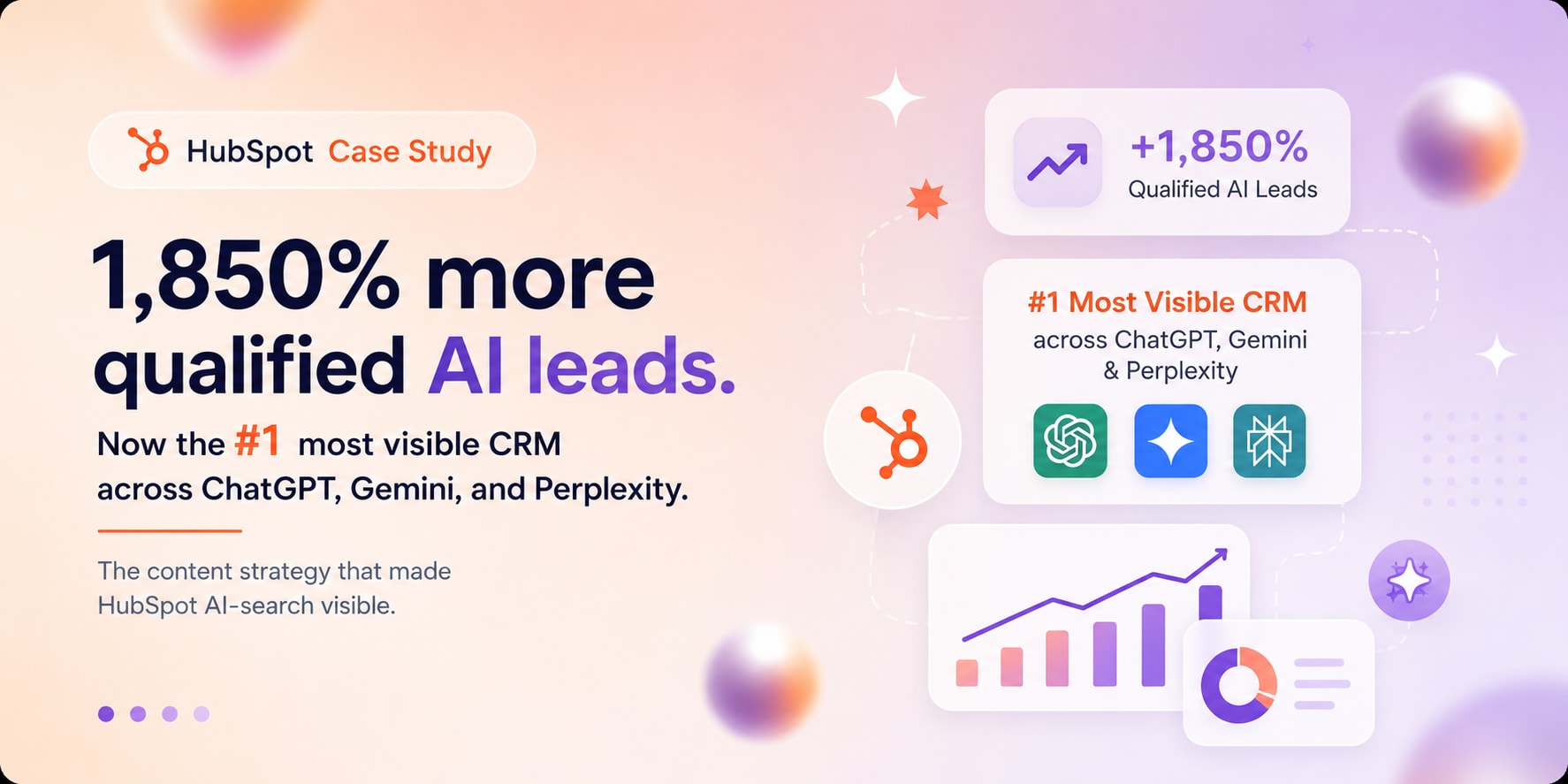
In June 2025, HubSpot decided to measure that problem before solving it. What followed was a six-month campaign that made HubSpot the number-one most visible CRM across ChatGPT, Gemini, and Perplexity, with 1,850% more qualified leads from AI search, citations up 433%, and AEO-sourced leads converting at three times the rate of every other acquisition channel.
New to GEO? Start with Scribble’s complete guide to Generative Engine Optimization. Not sure whether your brand already shows up in AI responses? Is your brand invisible to AI? walks through the diagnostic before you build a strategy.
The measurement system HubSpot built first
HubSpot started with a question most brands haven’t thought to ask: when a buyer types a CRM question into ChatGPT or Perplexity, does HubSpot appear in the answer?
Google Search Console couldn’t answer this. Traffic dashboards couldn’t either. So in June 2025, HubSpot partnered with XFunnel (an AEO measurement platform) and built a tracking system across eight product lines: CRM, Marketing Hub, Sales Hub, Service Hub, Content Hub, Commerce Hub, Data Hub, and Breeze.
For each product line, they tracked three signals: brand mentions (how often HubSpot appeared in AI responses to category queries), citations (when a specific HubSpot URL was attributed as a source), and sentiment (positive, neutral, or negative framing within the response).
The sequencing was the strategy. HubSpot didn’t publish a single piece of GEO-optimised content before they had a prompt-level baseline across all three engines. Without that baseline, any content effort would have been directionally untestable.
This measurement blind spot is where most brands currently sit. If you’re running content without knowing whether ChatGPT or Perplexity actually surfaces your brand, Is your brand invisible to AI? is a useful read before going further.
How HubSpot mapped the AI buyer journey
With measurement running, HubSpot mapped which prompts buyers were actually sending AI tools, not keyword variations but full conversational queries across every stage of the funnel.
Stage | What the buyer is doing | Example AI prompt |
Awareness | Identifying a challenge; learning which solutions exist | “How do I improve my email marketing campaign performance?” / “What are the best platforms for small business marketing?” |
Consideration | Comparing vendors and shortlisting options | “Compare HubSpot vs Mailchimp vs ActiveCampaign for email marketing” |
Evaluation | Looking for reviews, sentiment, and social proof | “What do actual users say about HubSpot vs its competitors?” |
Source: HubSpot AEO case study, blog.hubspot.com/marketing/hubspot-aeo-case-study
Each of HubSpot’s eight product containers in XFunnel tracked all three layers. The output was a prompt coverage map: for every query a HubSpot buyer might send an answer engine, the team could see whether HubSpot appeared, and with what sentiment.
A keyword map tells you what people search. A prompt coverage map tells you what people ask when they’ve already moved past Google. For most brands, this planning layer doesn’t exist yet.
The three-pillar strategy that drove 433% more citations
HubSpot’s content shift came down to three structural moves. The table below is the summary; the prose below it explains each one.
Pillar | What HubSpot did | The outcome |
Content structure | Shifted pillar-and-spoke to knowledge clusters; answer-first openings; named entities throughout | |
Authority signals | Named contributors, practitioner bylines, and data from proprietary HubSpot research | Brand mentions correlated 0.664 vs backlinks at 0.218 with AI citation probability |
Distribution | Seeded structured answers on Reddit communities where buyers discuss the category | Reddit-driven citations grew from 178 to 146,000 in 7 months |
Sources: HubSpot AEO case study · Martech360, May 2026 · Ahrefs / Averi.ai, 2026
Pillar 1: Restructure existing content for answer extraction
HubSpot’s team found that many of their highest-ranking Google posts weren’t appearing in ChatGPT or Perplexity responses. The content existed; the structure didn’t work for AI extraction.
Martech360’s analysis found HubSpot shifted from a traditional pillar-and-spoke architecture toward knowledge clusters: tightly linked content groups where every piece answers a specific query at a specific funnel stage, and the relationships mirror how AI models build entity graphs. Three structural rules drove this: declarative opening sentences that state the answer before the argument; FAQ sections built around real buyer prompts; and named entities throughout: “ChatGPT,” “Perplexity,” “HubSpot CRM,” not “AI platforms” or “leading tools.”
Pillar 2: Expert-led content with visible E-E-A-T signals
AI models don’t just surface answers; they surface answerers. HubSpot invested in content with named contributors, practitioner bylines, and data from their own research including the 2025 AI Trends for Marketers Report.
Seer Interactive’s 2025 analysis found that traditional SEO signals (backlinks, domain authority, rankings) showed little correlation with AI brand mentions. Ahrefs confirmed this across 76 million AI Overviews: brand mentions correlated at 0.664 with AI citation probability, while backlinks correlated at just 0.218.
Pillar 3: Distribute content onto AI-trusted platforms
HubSpot didn’t rely on their own domain alone. They pushed structured answers onto the platforms ChatGPT, Perplexity, and Google AI Overviews actively pull from, and the biggest of these was Reddit.
The Reddit number that explains the whole strategy
In May 2025, Reddit-driven citations to HubSpot content numbered 178. By December 2025: 146,000.
Reddit saw a 450% increase in AI citations between March and June 2025, now accounting for 21% of Google AI Overview citations. Nearly half of all AI Overviews include Reddit content, and Reddit went from 68th to 5th among US domains for commercial queries in a single year.
Reddit content earns this preference because it’s upvoted by humans, timestamped, and indexed by AI crawlers as unsponsored, community-validated opinion. When ChatGPT encounters a comparison prompt (“which CRM is best for scaling B2B sales?”), it pulls from sources where real buyers gave real answers. HubSpot made sure it was consistently part of those conversations.
Any brand with a clear ICP can run the same play: identify the subreddits where your buyers discuss the category, post genuinely useful answers to questions already being asked, and do it consistently. The Reddit citation loop takes months to build but it compounds, and it’s the distribution layer most GEO strategies miss entirely.
Why this works, and what most brands are still doing instead
Most brands build content for Google’s ranking algorithm and assume AI visibility follows. It doesn’t, at least not reliably.
What HubSpot demonstrated is that AI visibility is a separate discipline with its own measurement layer, its own content requirements, and its own distribution logic. The same content that ranks on Google often fails to appear in ChatGPT or Perplexity responses, not because it’s low quality, but because it isn’t structured to be extracted.
The four moves HubSpot made that most brands still haven’t:
Measured prompt coverage before optimising anything
Mapped buyer questions at the conversational query level, not the keyword level
Restructured content architecture for AI extraction, not just Google ranking
Built citation presence on Reddit and community platforms in parallel with owned content
HubSpot ran this with dedicated AEO tooling and eight product lines. The underlying logic applies at any scale, and it’s the same infrastructure Scribble builds for brands running GEO campaigns today.
Start here
Want to see where your brand stands in AI search right now? Check your content against Scribble’s free GEO Checker, or talk to the team about building the citation infrastructure that makes AI visibility repeatable. |
Frequently Asked Questions
Does strong SEO performance predict AI search visibility?+
Seer Interactive’s 2025 analysis found that traditional SEO signals like backlinks and rankings showed little correlation with how often a brand appeared in AI-generated answers . What correlates more strongly is brand visibility: the frequency with which a name appears in trusted contexts across the web.
How quickly do GEO improvements surface in AI responses?+
Faster than traditional SEO timelines. One documented case found structured content updates appearing in AI responses within days, with tracked visibility moving from near-zero to over 35% within five weeks . AI systems index and update faster than Google’s ranking cycles.
Written by

Kaavya has been building at the edge of the internet since 2016, starting in crypto, founding Lumos Labs, a web3 education platform and eventually co-founding Scribble, a creator marketing platform helping brands get discovered by AI search engines. At Scribble, she leads community and growth across a network of 50,000+ creators running GEO campaigns for 100+ brands. Her obsession: figuring out how content actually gets cited by LLMs, and building the infrastructure to make it happen at scale. When she's not deep in distribution strategy or vibe-coding tools, she's in Bangalore, probably being supervised by two Shih Tzus named Mushu and Milo.