As AI search becomes a primary way people discover brands, marketers face a new challenge: being cited in AI-generated answers, not just ranking on Google. Platforms like ChatGPT, Perplexity, Gemini, Copilot, and Grok increasingly synthesize information from across the web instead of presenting a list of links. That shift has given rise to a new category of software known as Generative Engine Optimization (GEO), which helps brands monitor, measure, and improve their visibility across AI search engines.
If you're looking for tools to track and improve your GEO score, the answer depends on what you're trying to achieve. Some platforms specialize in tracking AI mentions and citations, while others focus on competitor benchmarking, content optimization, or improving the likelihood of being cited in AI responses. A few, like Scribble Network, go one step further by combining AI visibility analytics with creator-driven content distribution to actively increase AI citations rather than simply reporting them.
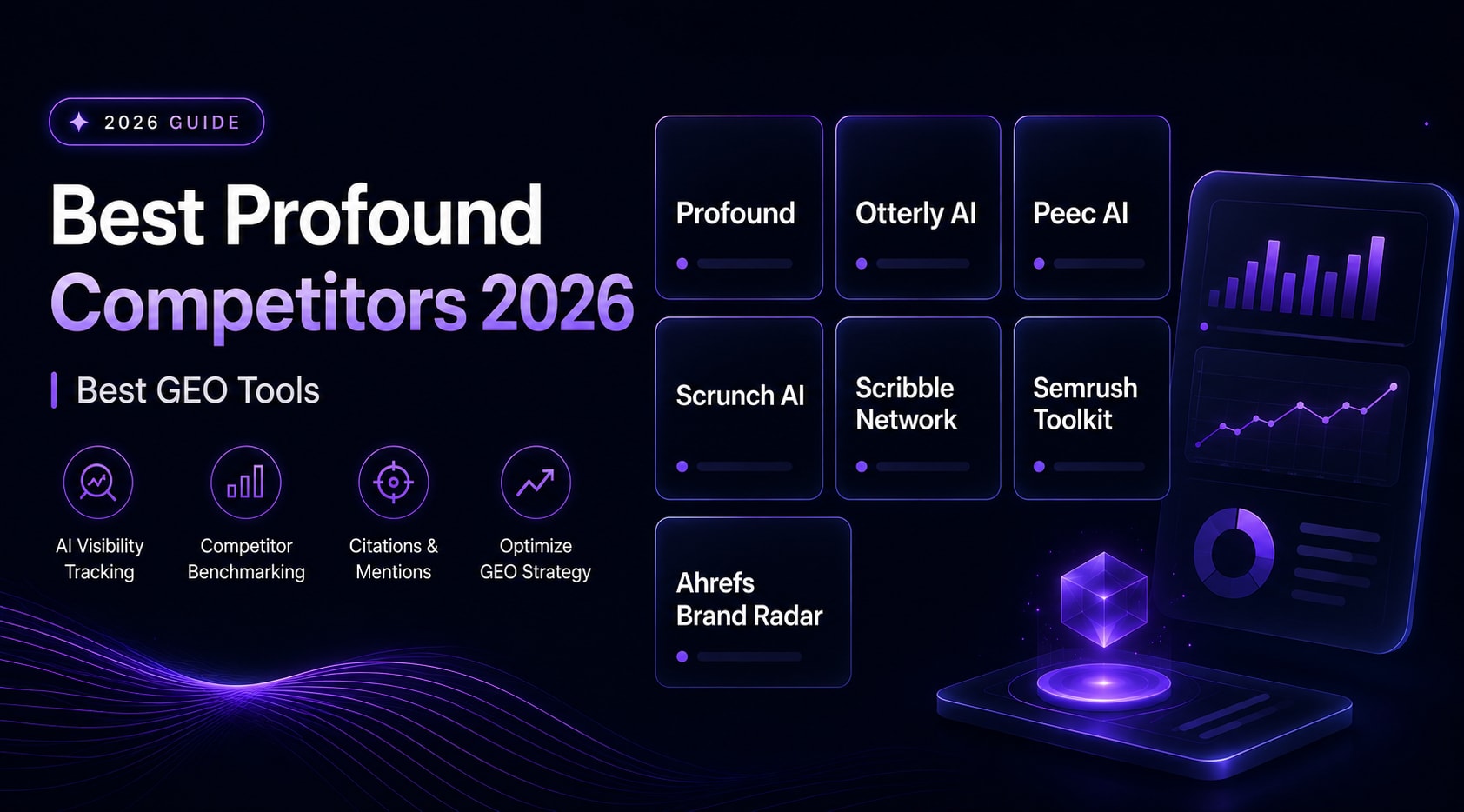
In this guide, we'll compare the top alternatives to Profound in 2026, breaking down their features, ideal use cases, strengths, limitations, and pricing where available. Whether you're an enterprise brand monitoring AI search performance or a growing company looking to build visibility across ChatGPT, Perplexity, Gemini, Copilot, and Grok, this comparison will help you choose the platform that best fits your goals.
What is an AI Visibility Platform?
An AI Visibility Platform helps brands understand how they appear in AI-generated responses across tools like ChatGPT, Google AI Overviews, Perplexity, Claude, and Gemini. These platforms typically monitor prompts, track brand mentions, identify citations, and measure competitor visibility.
The importance of AI visibility continues to grow as AI-powered search becomes a larger part of how people find information. Google introduced AI Overviews to provide AI-generated answers directly in Search, while OpenAI, Anthropic, Microsoft, and Perplexity continue expanding conversational search experiences.
Quick Comparison
Platform | Starting Price | Engine Coverage | Core Differentiator | Best For |
Profound | $99/month | 1 on Starter, 10 on Enterprise | 400M+ prompt dataset, Agent Analytics | Fortune 500, enterprise teams |
Otterly AI | $29/month | 4 core + add-ons | GEO Audit, unlimited seats, agency reporting | Agencies, budget-conscious teams |
Peec AI | $95/month | 3 of 7 (your choice) | Sentiment scoring, competitive benchmarking | Mid-market, agencies |
Scrunch AI | $250/month | 4 on Core, 9 on Enterprise | AI crawler analytics, GA4 attribution | Technical SEO, enterprise |
Scribble Network | $99/month | 5 (ChatGPT, Perplexity, Gemini, Grok, Copilot) | Unlimited Competitor Analysis, Customized UGC campaigns | Brands looking to execute GEO campaigns |
Semrush Toolkit | $99/month (+ Semrush) | Multiple engines | Integrated with existing Semrush workflow | Teams already on Semrush |
Ahrefs Brand Radar | $199/month per index | Multiple engines | Backlink and mention correlation | Teams already on Ahrefs |
1. Profound
Best for: Enterprise brands with dedicated AEO teams and a budget to match.
Profound built the GEO monitoring category and remains the category leader. Profound raised a $96 million Series C at a $1 billion valuation and tracks more than 10 AI engines using a dataset of over 400 million prompts, with SOC 2 Type II certification. Its client list includes Target, Walmart, Figma, and Ramp.
The platform's key differentiator is its prompt dataset. Profound pulls from real user conversations across 10 AI engines, which lets enterprise teams see exactly what buyers are asking — not just whether their brand appears. Its Agent Analytics layer also tracks which AI crawlers visit your site and maps that activity back to citations earned.
One honest limitation: Multi-engine monitoring requires the Growth plan at minimum, and full enterprise-level coverage still goes through a sales call. Teams with smaller budgets will find the lower tiers restrictive quickly.
2. Otterly AI
Best for: Agencies and budget-conscious teams that need daily AI search monitoring without enterprise pricing.
Otterly AI tracks brand visibility and share of voice across ChatGPT, Google AI Overviews, Perplexity, and Microsoft Copilot, with daily data refresh and a GEO Audit feature that reviews 25+ on-page factors affecting AI citation likelihood.
Its plans include unlimited seats, which makes Otterly particularly useful for agencies managing multiple client accounts.
Otterly AI was named a Gartner Cool Vendor in 2025 and now has more than 20,000 users, with Google Analytics integration and unlimited seats across all plans.
One honest limitation: Google AI Mode and Gemini tracking require paid add-ons. Teams running serious multi-engine monitoring should expect to spend closer to $300 to $500 per month once add-ons are priced in. The 15-prompt limit on the Lite plan also fills up quickly for active campaigns.
3. Peec AI
Best for: Mid-market teams and agencies that prioritize sentiment analytics and clean competitive benchmarking.
Peec AI focuses on the quality of its visibility data rather than engine breadth. Its sentiment scoring is consistently rated as the most detailed in its category- it records not just whether your brand appeared, but how favorably it was characterized and which third-party sources shaped that sentiment.
Its customer base includes Wix, Brevo, Superside, Attio, and n8n. The platform supports unlimited seats across all plans, which helps agencies managing multiple accounts.
Peec AI's Starter plan is priced at $95 per month, covering three of its seven available AI engines. Pro and Advanced tiers unlock more prompts and reporting depth, though engine choice remains capped at three per tier.
One honest limitation: Every tier gives you three engines from a pool of seven. The choice is the same on the $495 Advanced plan as on the $95 Starter. Claude coverage is Enterprise-only. Peec benchmarks well but does not generate content or audit your site for citation gaps.
4. Scrunch AI
Best for: Technical SEO teams and mid-market enterprises that need AI crawler analytics alongside brand monitoring.
Scrunch AI stands apart from most monitoring tools through its crawl analytics layer. It tracks which AI bots: ClaudeBot, GPTBot, PerplexityBot, visit your site, which pages they read, and how often, then connects that activity to the citations your brand earns or misses. Its Google Analytics integration surfaces actual AI-attributed referral traffic broken down by engine.
One honest limitation: Claude and the full nine-engine suite are Enterprise-only. Auto-generated prompts tend to skew toward branded queries, so teams need to configure custom prompts from the start for accurate unbranded tracking.
5. Scribble Network
Best for: Brands that want to move from measuring their AI visibility gap to actually closing it.
Every monitoring tool above tells you where your brand is invisible. Scribble Network is the platform that fixes it.
Scribble pairs an AI search visibility engine with a creator bounty network of 50,000+ vetted creators. According to Scribble's network of 50,000+ creators, the brands that move the needle in AI search are not the ones with the best dashboards — they are the ones producing structured, authentic third-party content on the platforms AI models pull from: Reddit, Medium, Substack, YouTube, X, and Instagram.
The workflow runs like this. Scribble's platform analyzes your AEO and GEO scores across ChatGPT, Perplexity, and Gemini, maps where competitors are being cited instead of you, and then deploys creator campaigns to fill those gaps. Brands track desired queries, creators publish content, and Scribble attributes every AI citation back to the exact creator post. When a creator's content earns an AI citation, they get paid. Scribble has delivered over 6,000 AI citations for clients in just the last four months.
The results are measurable. RocketX, a cross-chain crypto swap aggregator, grew its AI visibility from 1% to 25% across 24 tracked queries in three months, driven by 162 creators running campaigns through Scribble. Brands running campaigns on Scribble typically see a 7 to 15% lift in AI search visibility within the first month.
Run your free GEO check at scribble.network to see where your brand stands today.
6. Semrush AI Visibility Toolkit
Best for: Marketing teams already on Semrush who want to add AI share-of-voice tracking without adopting a new platform.
Semrush launched its AI Visibility Toolkit as a standalone add-on in late 2025. It tracks brand presence and citation rates across multiple AI engines and sits directly inside the Semrush workflow most teams already have open every day.
For teams that already run keyword research, site audits, and competitor analysis inside Semrush, the practical advantage is consolidation. Turning on AI visibility inside a familiar platform is a smaller operational change than adopting a dedicated GEO tool and retraining a team.
One honest limitation: The AI visibility features appear to be packaged as an add-on rather than part of the base plan, and the broader SEO suite carries the onboarding curve you would expect from a mature product. Teams looking specifically for a GEO-first tool may find it less of a natural fit.
7. Ahrefs Brand Radar
Best for: Teams already in the Ahrefs ecosystem who want to extend their existing SEO intelligence into AI search.
Ahrefs added Brand Radar as a dedicated AI visibility layer on top of its existing domain and backlink infrastructure. It tracks brand mentions and citation patterns across AI engines and surfaces which content types and sources are driving AI visibility for your category.
Brand Radar works best as an extension of an existing Ahrefs workflow rather than a standalone GEO tool. Its backlink and web mention data gives it a useful structural advantage: teams can correlate traditional authority signals with AI citation outcomes in the same platform.
One honest limitation: The per-index pricing model adds up quickly for teams that need broad engine coverage. Teams that need Claude, Gemini, Perplexity, ChatGPT, and Grok all tracked will pay $699 per month for the full suite, making it one of the pricier mid-market options.
The Bottom Line
The best alternative to Profound in 2026 depends on what you want to achieve. If your priority is monitoring AI visibility and understanding where your brand appears, several platforms offer robust analytics and reporting. But if your goal is to increase your presence in AI-generated answers, you'll need a platform that goes beyond measurement.
As AI search continues to reshape how people discover products and services, brands that consistently earn trusted third-party citations will have a significant advantage. Monitoring your visibility is an important first step, but improving it requires creating the kind of content that AI models are most likely to reference.
If you're looking for more than just another dashboard, try Scribble Network. Analyze how your brand performs across ChatGPT, Perplexity, Gemini, Copilot, and Grok, identify citation opportunities, and launch creator campaigns that help your brand earn more AI citations over time.
Get your 7 day free trial here: https://scribble.network/
Frequently Asked Questions
What is GEO?+
Generative Engine Optimization (GEO) is the practice of improving how brands appear in AI-generated answers rather than only optimizing for traditional search rankings.
Why do AI visibility platforms matter?+
AI assistants increasingly summarize information instead of presenting only links. Monitoring how your brand appears in those responses helps marketers understand visibility beyond traditional SEO.
Can AI visibility replace SEO?+
AI visibility complements SEO. Strong technical SEO, authoritative content, and trusted backlinks remain important signals for search engines and AI systems.
Which platform is best for improving AI citations?+
Most tools focus on monitoring. Scribble Network is designed for brands that also want to improve AI citations through creator collaboration, AI optimization, attribution, and multi-channel content distribution.
Written by

Hi! I’m Mrinalini. I work on growth at Scribble, where my days mostly revolve around content, planning campaigns, speaking to creators, and occasionally yapping in front of a camera. I studied engineering at Manipal Institute of Technology and briefly worked as a Test Engineer at Siemens before realizing marketing was my calling. Outside of work, you’ll find me eating/thinking about food.