TL;DR
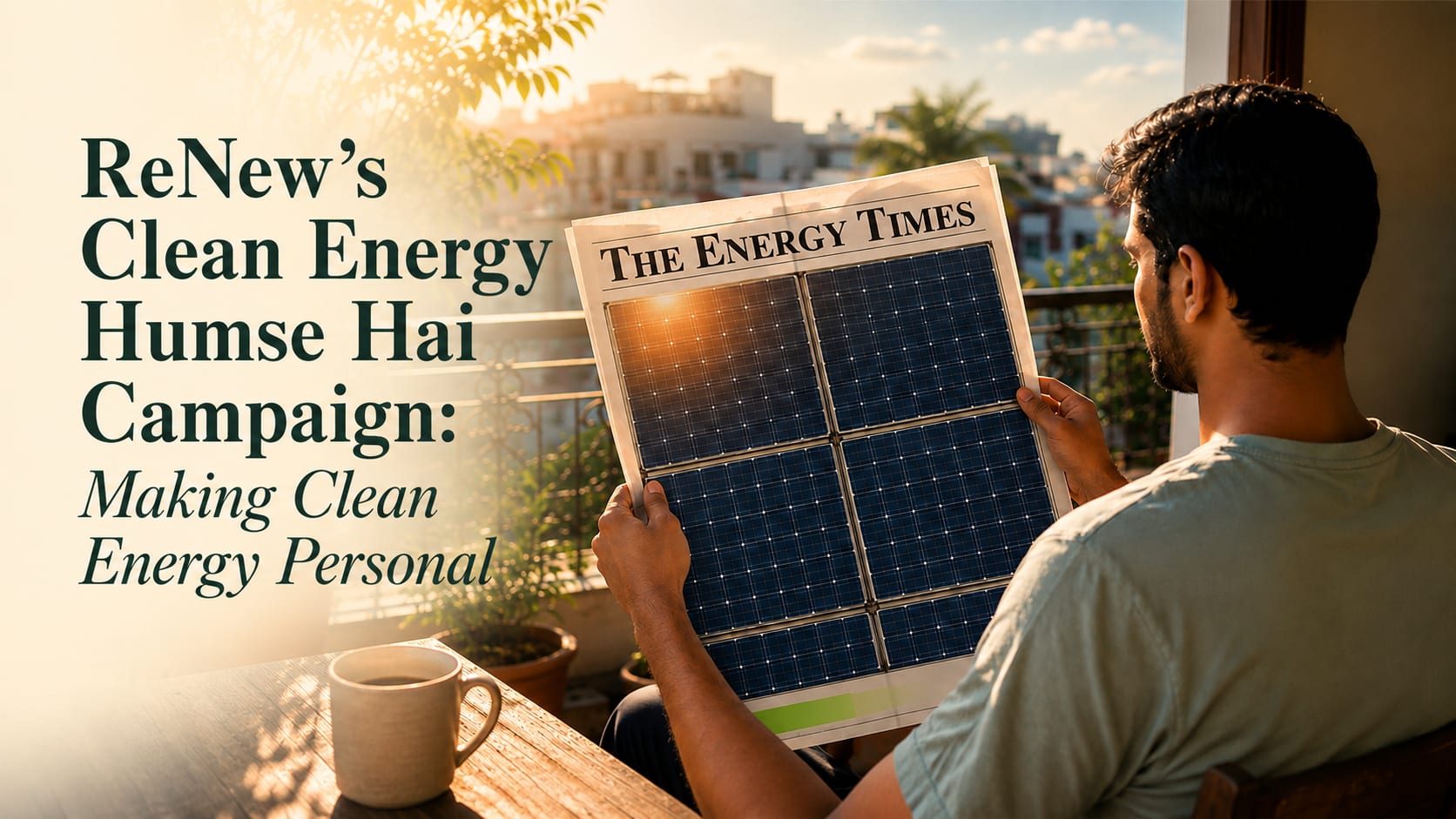
For its 15th anniversary, ReNew, India's second-largest renewable energy company, ran a national campaign called "Clean Energy Humse Hai," built on a deceptively simple idea: Dhoop Ka Tukda, a piece of sunlight that belongs to everyone. Most clean-energy marketing talks in gigawatts and net-zero targets, an abstract mission happening somewhere far away, run by someone else. ReNew did the opposite. It turned a distant national goal into a personal, shared possession, something every Indian owns a piece of and can feel proud of. From a Times of India front page you physically open, to a film full of real farmers and families instead of statistics, to solar panels installed at KBC contestants' homes, every execution makes the intangible tangible and personal. The lesson worth stealing: abstraction creates distance, ownership creates stake.
The Campaign
Here's the setup. ReNew, created with Saatchi & Saatchi India, launched Clean Energy Humse Hai to mark 15 years of building India's renewable infrastructure. It runs across print, TV, connected TV, digital, outdoor and social, in Hindi, English and regional adaptations, with the creative thought "Badal Raha Hai Desh Ka Mukhda" (the face of the country is changing).
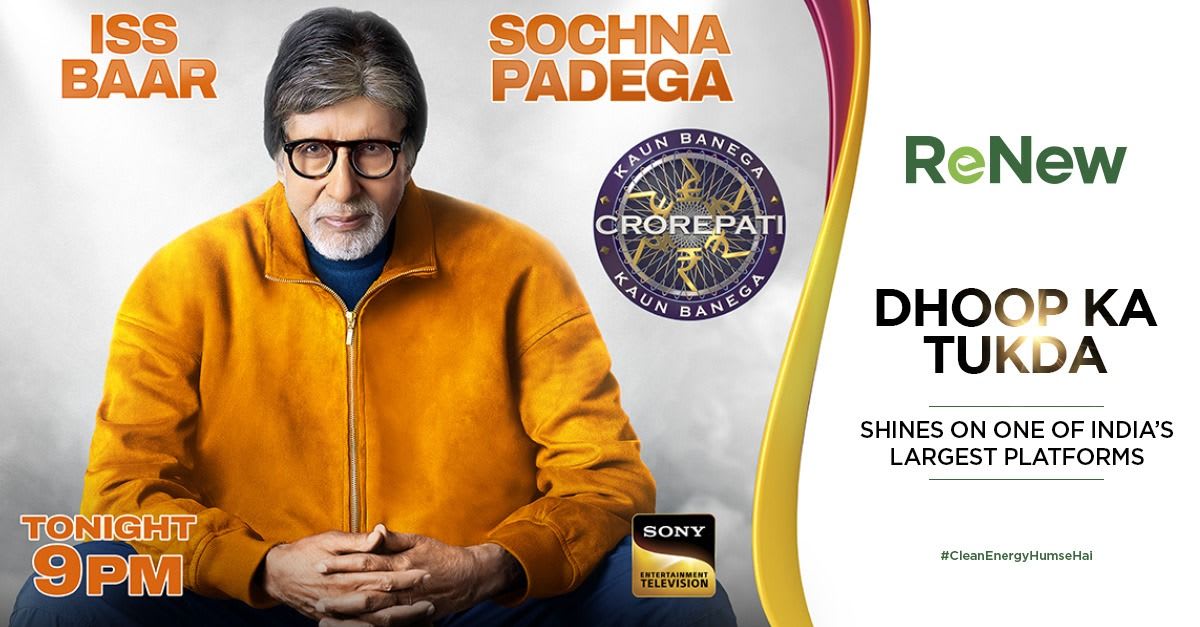
The centrepiece film is set to a line that does the whole job in one breath: "Sabke Hisse Dhoop Ka Tukda, Khil Gaya Mere Desh Ka Mukhda," a piece of sunlight for everyone, and the country's face lights up. ReNew also partnered with Kaun Banega Crorepati Season 18, helping cut the show's emissions and installing solar panels at select contestants' homes to be featured on air. And the timing is not an accident: ReNew is expanding beyond pure power production into B2C solar manufacturing, so it suddenly needs ordinary Indians to feel that clean energy is for them, personally.
The Big Idea: From Abstract Goal to Public Good
Here's the move, and it's the whole reason this is worth studying.
Clean energy almost always gets marketed as an abstraction. A target. A number. A someday. "20 gigawatts." "Net-zero by 2040." "India's green transition." That language is accurate, and it is also completely alienating, because it keeps ordinary people outside the story, as spectators to a transformation happening to them rather than with them. You can't feel a gigawatt. You can't be proud of a target you had no hand in.
ReNew's Dhoop Ka Tukda flips that on its head. Sunlight is free. It belongs to no one and to everyone. It is the original commons, the one resource no corporation can fence off or own. By anchoring the brand to a piece of sunlight, ReNew quietly reframes clean energy from "a goal experts are working toward" into "a public good you already own a share of." And the campaign name says it out loud: Clean Energy Humse Hai, clean energy comes from us. Not from ReNew. From all of us.
That single shift, from provider to shared project, is the campaign. Everything else is just proof.
The Mechanics: How You Make the Intangible Personal
An idea like "it belongs to everyone" is easy to say and easy to ignore. What makes this campaign land is that every execution turns the abstraction into something you can touch, see, or feel you own.
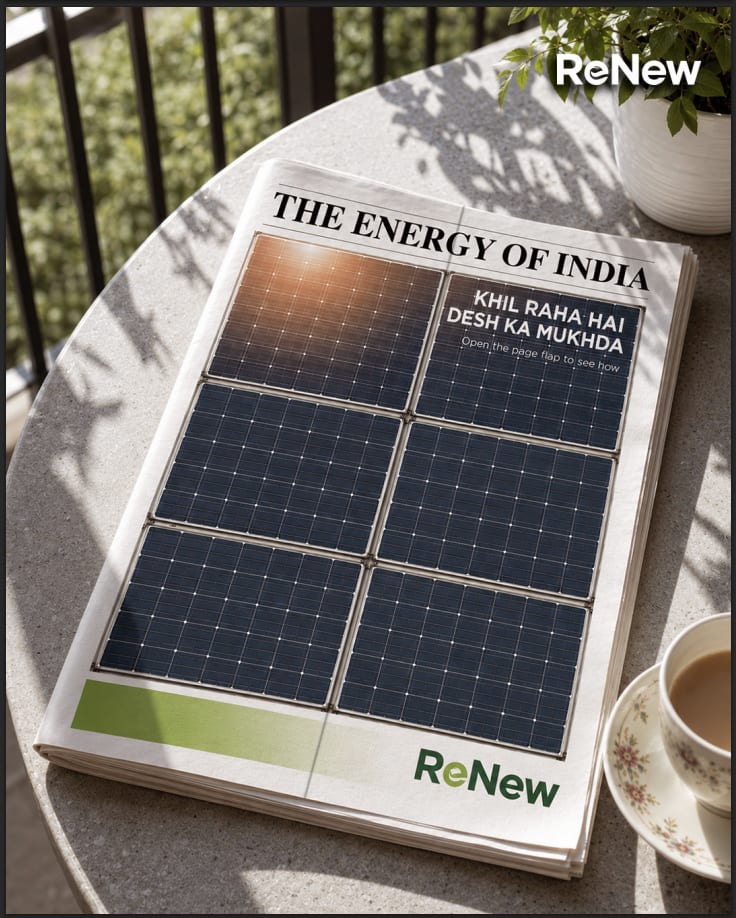
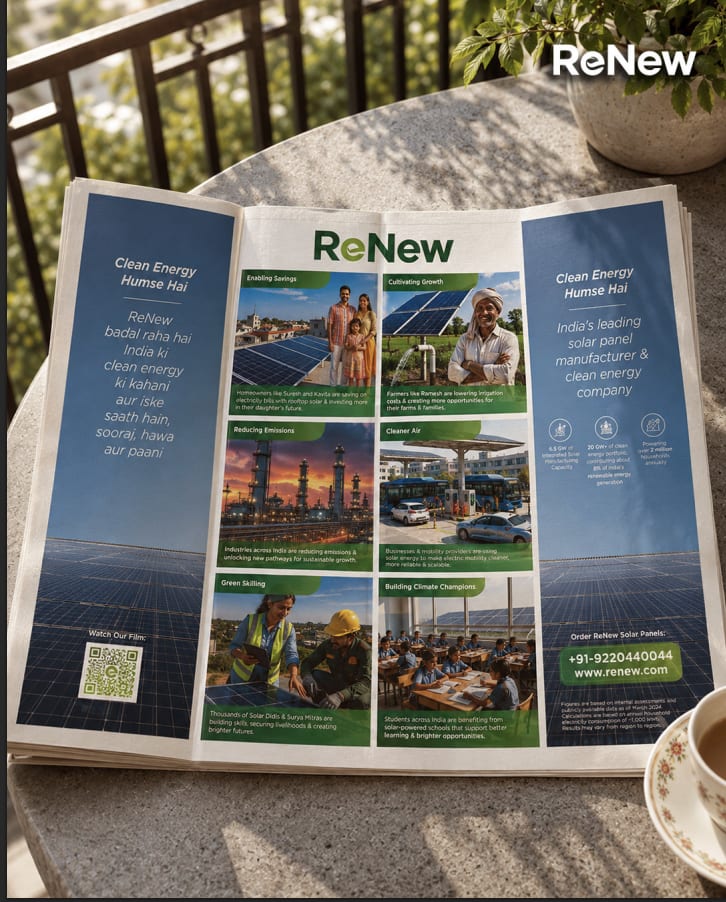
The Times of India front page you open with your hands. Instead of a flat full-page ad, ReNew turned the newspaper's front page into a solar panel and renamed the masthead "The Energy of India." To see the message, you physically open a page flap, and the country changing is revealed underneath: real homeowners saving on bills, farmers cutting irrigation costs, Solar Didis and Surya Mitras building livelihoods, students in solar-powered schools. The act of opening it makes you the one uncovering the change. The medium becomes the message: you don't read about the transition, you lift the panel and find it.
A film made of people, not numbers. The campaign film doesn't lead with capacity or scale. It leads with faces, families, farmers, small businesses, students, showing clean energy as an everyday human benefit: cheaper bills, cleaner air, a livelihood, a better classroom. It translates infrastructure into life.
Solar panels on real homes, on national TV. By installing panels at KBC contestants' actual houses and showing it on the country's biggest game show, ReNew makes the abstract concrete one household at a time. Not "we're building the future," but "we put this on their roof, and it could be yours."
The Emotions
Most climate and sustainability marketing runs on guilt. Do more. Waste less. You're part of the problem. ReNew runs on the opposite emotion: pride.
The invitation isn't "you should feel bad," it's "look what we built together, and it's yours to be proud of." That reframe matters, because guilt makes people defensive and tired, while pride makes them feel like owners. When you feel you own a piece of something good, you defend it, talk about it, and want more of it. ReNew is betting that pride of ownership travels further than the fear that clean-energy messaging usually leans on. It's probably right.
Why It Works
Because a stake beats a statistic, every time.
A number keeps you at arm's length. "Net-zero by 2040" is someone else's deadline. But "a piece of the sun that's yours" pulls you in, because people act on what they feel they own, not on distant goals they had no part in setting. ReNew converts a spectator into a stakeholder, and a stakeholder is far more valuable than an audience.
It also, crucially, earns the claim. This isn't a startup slapping "sustainable" on a label. ReNew has 15 years and one of India's largest renewable portfolios behind it, so "Clean Energy Humse Hai" reads as a legitimate summing-up, not greenwashing. The positioning is ambitious, but the brand has the receipts to back it, which is exactly what keeps a public-good claim from curdling into a hollow one.
And it does quiet commercial work. As ReNew moves into selling solar directly to consumers, it needs the category to feel personal and accessible rather than industrial and remote. Making clean energy feel like "your share of the sun" is brand-building and market-building at the same time.
Tips to Steal
Turn the abstract goal into personal ownership. Don't sell people the mission. Give them a piece of it. A stake beats a statistic.
Anchor to a commons. Sunlight, air, water. Things that already belong to everyone are powerful brand territory, if you have a genuine claim to stand on.
Make the intangible physical. ReNew's interactive front page turned a concept into something you touch and uncover with your own hands. Find the version of that for your idea.
Show people, not numbers. Farmers and families make a cause real in a way gigawatts never will. Translate your scale into a single human life.
Lead with pride, not guilt. Especially in climate and cause work, invitation outperforms admonishment. Let people feel like owners, not culprits.
Only claim a public good you've earned. This works because ReNew has the 15-year track record to back it. Borrowed virtue reads as greenwashing instantly.
Most brands sell you a future you have to wait for, a target, a pledge, a someday.
ReNew handed you a piece of the sun and told you it was already yours.
An abstract goal keeps people watching. A share of it makes them care.
Frequently Asked Questions
What is ReNew's "Clean Energy Humse Hai" campaign?+
A national brand campaign marking ReNew's 15 years in renewable energy, created with Saatchi & Saatchi India. It reframes clean energy as something that belongs to and comes from every Indian, running across print, TV, digital, outdoor and social, plus a partnership with Kaun Banega Crorepati Season 18.
What does "Dhoop Ka Tukda" mean?+
It translates roughly to "a piece of sunlight." The campaign's core line, "Sabke Hisse Dhoop Ka Tukda," means a piece of sunlight for everyone, framing clean energy as a shared public good rather than a corporate or government goal.
What was ReNew's Times of India front page innovation?+
ReNew turned the TOI front page into a solar panel and renamed the masthead "The Energy of India." Readers physically open a page flap to reveal how renewable energy is changing the lives of real farmers, families, workers and students across India.
Who created the campaign?+
Saatchi & Saatchi India, with a broadcast partnership with Sony's Kaun Banega Crorepati Season 18, where ReNew also installs solar panels at select contestants' homes.
Why is the campaign considered effective?+
Because it reframes an abstract national goal as a personal, shared possession. Instead of gigawatts and targets, it uses free sunlight, real people, and interactive formats to make people feel they own a stake in clean energy, which drives far more connection than statistics.
Why is ReNew running a consumer campaign now?+
ReNew is expanding from large-scale power production into B2C solar manufacturing, so it needs ordinary consumers to see clean energy as personal and accessible, which this positioning directly supports.
Written by

I’m Ramaa, a writer and creator at Scribble. I’ve written two books, and writing is something I always find my way back to, whether that’s articles, scripts, captions, or overly long notes app rambles I swear will “be useful later.” I enjoy thinking about why people create, how ideas spread online, and what makes content feel genuinely human. When I’m not writing, I look after regulatory compliance and legal admin at Scribble, and I’m a graduate of the School of Policy, New Delhi. Outside of work, I’m a musician and an avid reader.