If you are building or marketing a cross-chain aggregator like RocketX, Li.Fi, Houdini Swap, or Bungee, and are trying to get cited by AI, you need to first know where ChatGPT, Perplexity, Grok and such models get their information from.
Scribble tracked 25 queries across all three models to find out. We logged every citation each model produced, categorised each domain, and counted frequency. This sample covers 1,504 of the total citations, with between 56 (on perplexity) and 163 (on Grok) unique domains appearing per model.
Citation Volume by Model
The three models produce citations at very different rates.
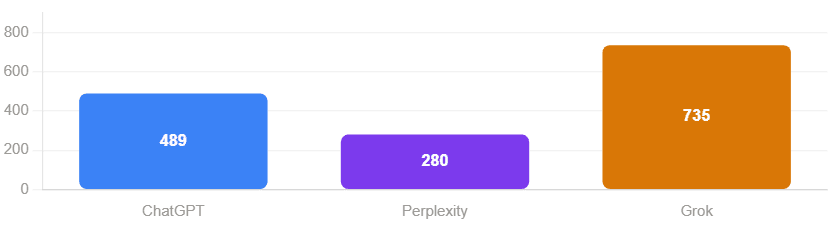
Grok generated almost three times as many citations as Perplexity across our 25 queries. Perplexity, on the other hand, drew from just 56 unique domains. Which suggests it applies stricter source selection for this query type.
A Note on How We Categorised Sources
One distinction matters before reading the data.
For this study, "Official / product sites" means only the domains belonging to the four brands we studied: rocketx.exchange and its subdomains, li.fi and its subdomains, houdiniswap.com, and bungee.exchange.
Sites like symbiosis.finance, debridge.com, foxwallet.com, and zerion.io are protocols, wallets, and exchanges that sit in the Blog / editorial category, because from the perspective of a study on RocketX, Li.Fi, Houdini Swap, and Bungee, they are third-party content.
Similarly, CoinGecko, CoinMarketCap, and DefiLlama are not blogs. They are third-party data platforms, live on-chain trackers and price aggregators, and we treat them as a separate category.
Category definitions used in this study:
Official / product sites: domains owned by the 4 studied brands only
Blog / editorial: comparison guides, how-to content, fintech editorial, and all other protocol, exchange, wallet, and aggregator sites not belonging to the 4 brands
Third-party data platforms: CoinGecko, CoinMarketCap, DefiLlama, DexTools, TokenTerminal
News: Coindesk, Cointelegraph, BeInCrypto, Cryptopolitan, and equivalents
Community / forum: Reddit, Bitcointalk, Trustpilot, Slashdot
Social media: YouTube, X/Twitter, LinkedIn, Instagram, Facebook
Medium / Substack: including brand-owned accounts on these platforms
Academic / research: Arxiv, research papers, regulatory filings
The Full Category Breakdown
Category | ChatGPT | Perplexity | Grok |
Official / product sites | ~12% | ~6% | 8% |
Blog / editorial | 35% | 42% | 55% |
Third-party data platforms | 8% | 6% | 12% |
News publications | 15% | 10% | 6% |
Community / forum | 2% | 11% | 4% |
Social media | 0% | 5% | 11% |
Medium / Substack | 0% | 0% | 3% |
Academic / research | ~0% | 0% | 1% |
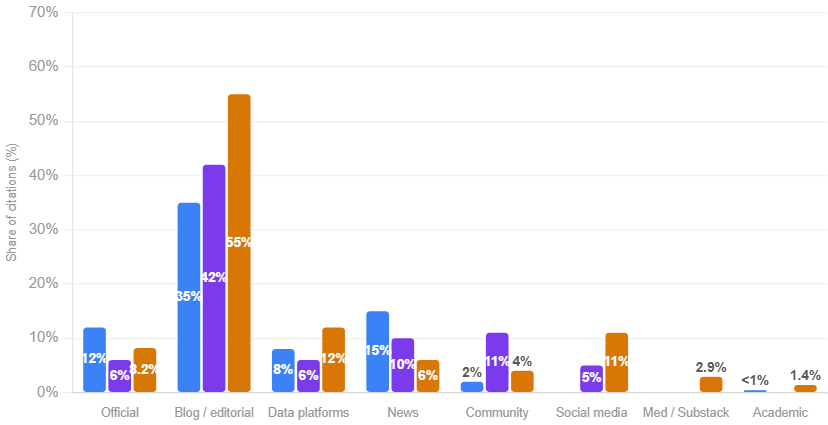
Blog and editorial content is the largest citation category across all three models. Data platforms, news, community, and social media split the remainder differently depending on the model.
What ChatGPT Pulls From
ChatGPT led on news citations at 15 percent, the highest of any model in this sample. It also concentrated heavily on a small number of editorial domains, with eco.com accounting for roughly 13 percent of all ChatGPT citations on its own.
ChatGPT's top cited domains
Domain | Category |
eco.com | Blog / editorial |
li.fi | Official |
coincodex.com | Blog / editorial |
coingecko.com | Data platform |
rocketx.exchange | Official |
debridge.com | Blog / editorial |
coinmarketcap.com | Data platform |
cryptopolitan.com | News |
datawallet.com | Blog / editorial |
spark.money | News |
Point to note: ChatGPT cites zero social media across 25 queries in this sample.
What Perplexity Pulls From
Perplexity's top domains skew heavily toward official protocol and product sites from across the DeFi space, and it leads all three models on community citations at 11 percent, pulling from Reddit, Bitcointalk, Trustpilot, and Slashdot.
Perplexity's top cited domains
Domain | Category |
foxwallet.com | Blog / editorial |
debridge.com | Blog / editorial |
symbiosis.finance | Blog / editorial |
reddit.com | Community |
datawallet.com | Blog / editorial |
zerion.io | Blog / editorial |
coincodex.com | Blog / editorial |
coingape.com | News |
coinmarketcap.com | Data platform |
beincrypto.com | News |
Perplexity is the only model to pull from Bitcointalk and Slashdot in this sample. User-generated content and community reviews carry more weight here than on either ChatGPT or Grok.
What Grok Pulls From
Grok produced the highest volume and widest domain spread in this sample, and its citation mix is the most distinctive of the three.
Grok's top cited domains (exact counts from sample)
Domain | Citations | Category |
defillama.com | 53 | Data platform |
eco.com | 43 | Blog / editorial |
youtube.com | 31 | Social media |
li.fi | 28 | Official |
reddit.com | 25 | Community |
alchemy.com | 24 | Blog / editorial |
stablecoininsider.org | 23 | Blog / editorial |
symbiosis.finance | 23 | Blog / editorial |
defiway.com | 22 | Blog / editorial |
binance.com | 19 | Blog / editorial |
DefiLlama is Grok's single most cited source in this sample at 53 citations, accounting for 60% of all data platform citations Grok produced. It does not appear in the top domains of ChatGPT or Perplexity at all. Grok treats it as a primary reference for on-chain data about cross-chain protocols.
Grok also cites social media at 11 percent of total citations: YouTube (31), X/Twitter (17), LinkedIn (17), Instagram (9), and Facebook (5). ChatGPT cites zero social media. For Grok, social platforms are a real part of the citation pool.
Another point to note is that Grok is also the only model to cite Medium, Substack, and Paragraph content, including brand-owned accounts. lifi.substack.com and rocketxexchange.medium.com both appear in this sample.
What Scribble Tracked and How
Scribble ran 25 structured queries across ChatGPT, Perplexity, and Grok targeting RocketX, Li.Fi, Houdini Swap, and Bungee. We logged every source each model cited, categorised each domain, and counted frequency. All percentages and domain counts reflect this sample of 1,504 citations.
Three Things to Take Away
1. Each model has a different citation volume and source concentration. Grok produced 735 citations across 163 domains. ChatGPT produced 489 across 118. Perplexity produced 280 across just 56. This tells us how easily each of these models trust domains.
2. Community and social citations split sharply by model. Perplexity leads on community content: forums, review platforms, and discussion boards at 11 percent. Grok leads on social media at 11 percent. ChatGPT cites neither category in any significant volume. The source types that reach one model do not reliably reach the others.
3. Third party mentions on blogs and editorials is the largest citation category across all three models. At 35 percent for ChatGPT, 42 percent for Perplexity, and 55 percent for Grok, it is the only category that ranks first in every model. News, data platforms, community, and social all vary significantly by model. Third party mentions from editorials do not.
Scribble helps brands with their AI visibility and tracks how AI models cite, surface, and recommend brands across categories. This study sampled 1,504 citations produced across 25 queries for cross-chain DEX aggregators on ChatGPT, Perplexity, and Grok. All percentages and domain counts reflect this sample.
Frequently Asked Questions
Which AI model cites the most sources for cross-chain aggregator queries?+
Grok produced the most citations in this sample at 735, followed by ChatGPT at 489 and Perplexity at 280. Grok also drew from the widest range of domains at 163, compared to 118 for ChatGPT and 56 for Perplexity.
Do all three models cite the same types of sources?+
Not consistently. Editorial content is the only category that leads across all three. Beyond that, each model diverges. ChatGPT leans on news, Perplexity on community forums, and Grok on social media and data platforms.
Does social media content get cited by AI for DeFi queries?+
It depends on the model. Grok cited social platforms at 11 percent of total citations, including YouTube, X/Twitter, LinkedIn, Instagram, and Facebook. Perplexity cited YouTube occasionally.
Do the official sites of the studied brands appear in AI citations?+
Yes, and they roughly take up 6 to 12 percent depending on the model. Li.Fi and RocketX carry most of the official brand citations across all three models. Houdini Swap and Bungee appear at low frequency in this sample.
Is this study relevant for DEX aggregators outside the four studied brands?+
The citation patterns like which source categories each model favours, are likely to apply broadly to cross-chain aggregator queries. The specific domain rankings would differ for other brands, but the category-level behaviour of ChatGPT, Perplexity, and Grok is consistent with the query type.
Can a newer or smaller aggregator enter these citation pools?+
Yes. The most accessible paths are getting listed and updated on DefiLlama, appearing in editorial comparison content on sites like coincodex.com or stablecoininsider.org, and building community presence on Reddit or Bitcointalk for Perplexity specifically.
How do I find out if my brand is being cited by AI?+
Run structured queries across ChatGPT, Perplexity, and Grok and log every citation. Or run a free GEO audit here on Scribble to see exactly where you stand.
Written by

Hi! I’m Mrinalini. I work on growth at Scribble, where my days mostly revolve around content, planning campaigns, speaking to creators, and occasionally yapping in front of a camera. I studied engineering at Manipal Institute of Technology and briefly worked as a Test Engineer at Siemens before realizing marketing was my calling. Outside of work, you’ll find me eating/thinking about food.