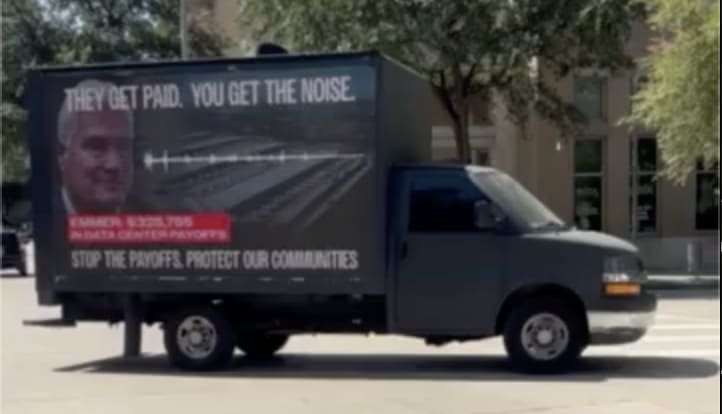
A truck circled the RNC in Texas, playing the recorded sound of a data center. The caption didn't need to argue anything. It just quoted the president.
TL;DR
Texas Democrats posted a video of a truck driving around the site of the Republican National Convention in Dallas, rigged to play the sound of a data center, the kind of persistent industrial hum residents near these facilities have complained about. The caption paired the stunt with a real quote from President Trump: that communities opposing data centers "want to end up being backwards and poor." As a standalone clip, it reads as a sharp partisan jab. In context, it's tapping into a genuinely large, cross-partisan backlash against data center construction that's currently splitting both parties, not a grievance invented for the bit. Here's the tactic, the real fight sitting underneath it, and how it lands depending on which side you're standing on.
What Actually Happened
The video is simple. A truck, marked to draw attention, drives past the RNC venue playing a recorded industrial drone, the kind of sound associated with data center cooling systems and generators. On-screen text reads "RNC Day Two: There's a truck driving around the RNC that emits the noise of a data center." The caption does the actual work: "Donald Trump said people who oppose Data Centers are 'backwards and poor.' Let's see how he likes having a Data Center right next door."
The quote is real. Trump posted on Truth Social that "the only reason that communities throughout the U.S.A. should not want Data Centers is if they want to end up being backwards and poor," part of a broader defense of the AI buildout he's called potentially "bigger than oil."
The Fight This Sits Inside
Here's the part worth understanding before judging the stunt either way: data centers have become a genuinely significant, bipartisan flashpoint in 2026, not a manufactured Democratic talking point.
A Gallup poll found more Americans said they'd rather live near a nuclear power plant than a data center. In Texas itself, Republican Governor Greg Abbott paused new data center approvals pending a regulatory audit, saying the facilities had "dug their own grave" by failing to engage with local communities on water use, power strain, and noise. Tennessee Republican Congressman Tim Burchett responded to Trump's "backwards and poor" line with open sarcasm: "I guess I'm backwards and poor." Other Republicans have pushed bills to protect local zoning authority and shift infrastructure costs onto tech companies rather than taxpayers or ratepayers.
On the ground, longtime Republican voters in towns near new data center construction have described their outdoor businesses struggling under nonstop truck traffic and noise, while still saying the issue alone wouldn't move them to vote Democrat this cycle. Some Democrats have used sharper rhetoric of their own, Alexandria Ocasio-Cortez suggested putting a data center at Mar-a-Lago.
So the underlying grievance, noise, water use, strain on local power grids, is documented and real, and it's dividing voters within both parties, not simply along party lines.
As a Communications Tactic
Set the politics aside for a moment and look at the craft. This is a well-built piece of political messaging, evaluated the same way you'd evaluate any attention-grabbing stunt.
It converts an abstract policy complaint into something physically encountered by its intended audience, RNC attendees hearing an unwanted sound outside their own convention, rather than reading about noise complaints in a press release. That's the same "make the abstract physical" mechanism behind plenty of non-political attention-grabbing work: give people something to experience rather than something to read.
It also uses the target's own words as the caption instead of the party's own framing. Letting a quote stand largely on its own is a common and effective rhetorical technique, a line condemning itself is often read as more persuasive than an opponent's accusation would be. The tradeoff is that quoting one line necessarily strips away whatever broader context or argument surrounded it.
The Fair Pushback
A few criticisms of this kind of tactic apply regardless of who's running it, and are worth naming plainly.
It's a symbolic gesture, not a policy proposal, so it demonstrates a grievance without offering a solution. It's aimed at a friendly audience, people already inclined to agree will enjoy it, and it's unclear whether it moves anyone undecided. And a single quote, however real, can flatten a more complicated position, Trump's broader argument has been that AI infrastructure is a major economic opportunity, a claim plenty of voters, in both parties, are still weighing against the local costs.
Supporters of the tactic would counter that symbolic, memorable actions have always been part of how political arguments get made and remembered, and that turning an abstract complaint into something felt, even briefly, is exactly the point of that kind of communication.
Tips to Steal (For Anyone Making an Argument, Political or Otherwise)
Let the opponent's own words do the arguing. A quote used as-is often lands harder than a paraphrase or an accusation.
Give people something to experience, not just read. An abstract complaint about noise is easy to dismiss. Hearing the actual sound, even for a few seconds, is harder to wave away.
Know what a symbolic stunt can't do. It can dramatize a grievance. It can't substitute for an actual policy argument, and audiences who want more than the bit will notice the gap.
Check whether the underlying claim is real before leaning on it. This stunt works partly because the noise and water-use complaints it references are documented, not invented. A stunt built on a shakier premise invites exactly the kind of fact-check that can undercut it.
The truck didn't argue anything. It just played a sound and let a real quote sit next to it.
Whether that reads as clever or cheap mostly depends on how much you already agreed with it going in, which is true of almost every stunt like this, on any side.
Frequently Asked Questions
What did the Texas Democrats' truck stunt actually do?+
A truck circled the Republican National Convention venue in Dallas playing a recorded industrial sound associated with data centers, paired with a caption quoting President Trump's statement that data center opponents "want to end up being backwards and poor."
Is the data center backlash a real, widespread issue?+
Yes. Polling shows broad public wariness of data centers, and the issue has drawn pushback from officials in both parties, including Texas's Republican governor pausing new approvals and Republican members of Congress publicly distancing themselves from Trump's framing.
Is this stunt likely to change anyone's mind?+
Symbolic political stunts like this one typically reinforce the views of an already-sympathetic audience more than they persuade undecided voters, though they can succeed at raising the visibility of an issue.
What's the strongest critique of this kind of tactic?+
That it's a memorable gesture rather than a policy proposal, and that quoting a single line can simplify a more complex underlying position.
Written by

I’m Ramaa, a writer and creator at Scribble. I’ve written two books, and writing is something I always find my way back to, whether that’s articles, scripts, captions, or overly long notes app rambles I swear will “be useful later.” I enjoy thinking about why people create, how ideas spread online, and what makes content feel genuinely human. When I’m not writing, I look after regulatory compliance and legal admin at Scribble, and I’m a graduate of the School of Policy, New Delhi. Outside of work, I’m a musician and an avid reader.