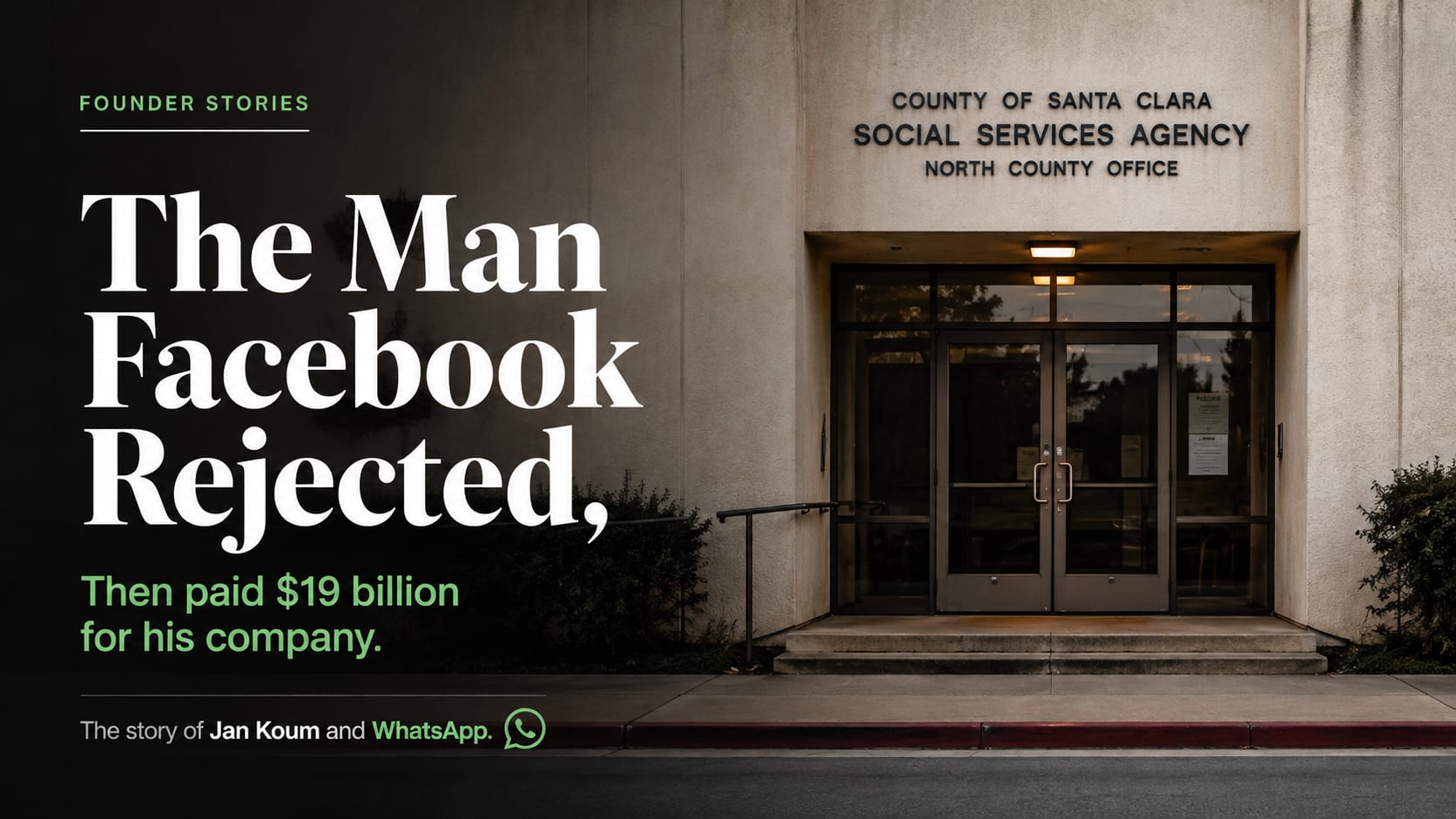
There is a building in Mountain View, California that most people would drive past without noticing. A disused former social services office, sitting across the railroad tracks from a stretch of Silicon Valley headquarters.
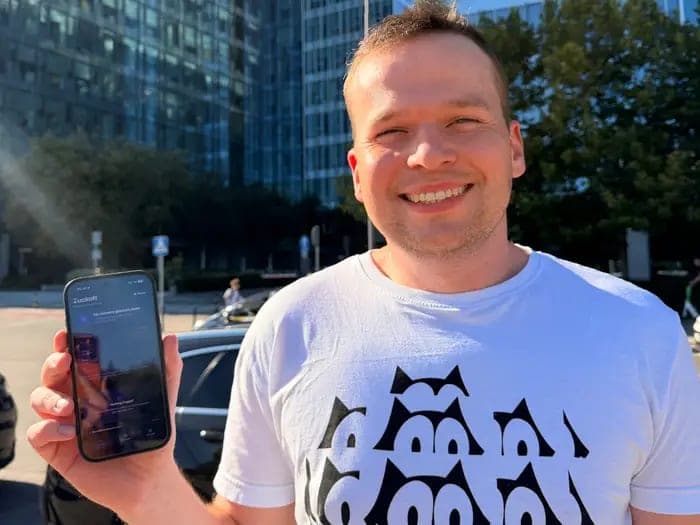
In 2014, Jan Koum drove there to sign one of the biggest technology acquisitions in history.
He chose the building because it was the same place where he had once stood in line with his mother to collect food stamps.
Here’s the story of a rejected Facebook application, a borrowed computer textbook, and a $19 billion comeback.
From Soviet Ukraine to Silicon Valley
Koum grew up outside Kyiv in Soviet Ukraine, in a village with no hot water and no phone. His family was Jewish, and they lived under a government where privacy and surveillance were very real parts of everyday life.
In 1992, when he was 16, Koum and his mother moved to Mountain View, California. His father had planned to join them but never did. Soon after arriving, his mother was diagnosed with cancer. The two lived on welfare, food stamps and government housing.
Koum couldn't afford computer textbooks, so he borrowed them from libraries and taught himself to code and eventually became a security engineer at Yahoo, where he spent almost nine years.
The Rejection That Came Before WhatsApp
In 2007, Koum and his Yahoo colleague Brian Acton left the company and took some time off. Two years later, they both applied for jobs at Facebook.
Both were rejected.
That same year, Koum bought an iPhone. The App Store was barely seven months old, and he saw something most people hadn't yet: a new world of software was about to be built around the phone.
He started working on an app that would let people put statuses next to their names: “at the gym”, “sleeping”, “available”, “busy”.
He called it WhatsApp. At first, almost nobody cared.
The Accidental Pivot
Then Apple introduced push notifications. Suddenly, WhatsApp users could be notified whenever someone changed their status. But instead of simply checking those updates, people started replying to them and using the app to send messages back and forth.
Koum noticed what was happening. People weren't really using WhatsApp for status updates anymore.
They were using it to talk.
So he changed the product.
WhatsApp became a messaging app, built around a remarkably simple philosophy: no ads, no games, no gimmicks.
There were no usernames to remember or complicated profiles to create. WhatsApp used something almost everyone already had: your phone number and your existing contacts.
That tiny product decision removed an enormous amount of friction. You didn't have to build your social network from scratch. Your network was already sitting in your phone.
And the product began spreading.
By April 2013, WhatsApp had reached 200 million active users.
The $19 Billion Door
Five years after Facebook rejected the duo, Facebook came back with a very different proposition.
In February 2014, Facebook announced it would acquire WhatsApp for approximately $16 billion in cash and stock, plus another $3 billion in restricted stock for founders and employees.
$19 billion.
There's something almost too perfect about that ending.
The teenager who once couldn't afford computer books had taught himself to code.
The engineer Facebook rejected had built a company Facebook desperately wanted.
And the messaging app built around privacy, simplicity and no advertising had become a $19 billion company.
The Product Was Personal
Koum's obsession with privacy wasn't just clever positioning.
Growing up in the Soviet Union, he had seen what surveillance could mean. His parents were cautious about what they said over the phone because they worried their conversations could be monitored. That experience stayed with him and shaped how he thought about communication.
That's why WhatsApp's early philosophy was so uncompromising: no ads, no games, no gimmicks. The product wasn't built around a marketing thesis. It was built around something Koum personally believed communication should be.
And perhaps that's the most interesting part of the story. WhatsApp wasn't just solving a market problem. It was solving a problem Koum understood personally.
This is part of our Founder Stories series.
Frequently Asked Questions
Who is Jan Koum?+
Jan Koum is the Ukrainian-American co-founder and former CEO of WhatsApp. Before founding WhatsApp, he worked as a security engineer at Yahoo. He later led WhatsApp through its acquisition by Facebook in 2014.
Why did Jan Koum create WhatsApp?+
Koum initially created WhatsApp as a simple status-sharing app after seeing the potential of Apple's new App Store. When users began using its push notifications to communicate with each other, he recognised that messaging was the real use case and pivoted WhatsApp toward messaging.
Was Jan Koum rejected by Facebook?+
Yes. After leaving Yahoo, Koum and WhatsApp co-founder Brian Acton both applied for jobs at Facebook and were rejected. A few years later, Facebook acquired the company they had built for a deal valued at approximately $19 billion.
How much did Facebook pay for WhatsApp?+
Facebook announced a deal worth approximately $19 billion: $4 billion in cash, about $12 billion in Facebook shares, and another $3 billion in restricted stock for WhatsApp's founders and employees.
How many people use WhatsApp today?+
Meta does not consistently publish a current global monthly-active-user figure for WhatsApp. Its 2025 announcements said the WhatsApp Updates tab alone was being used by 1.5 billion people per day globally, but that should not be treated as the total number of daily WhatsApp users.
Written by

Hi! I’m Mrinalini. I work on growth at Scribble, where my days mostly revolve around content, planning campaigns, speaking to creators, and occasionally yapping in front of a camera. I studied engineering at Manipal Institute of Technology and briefly worked as a Test Engineer at Siemens before realizing marketing was my calling. Outside of work, you’ll find me eating/thinking about food.