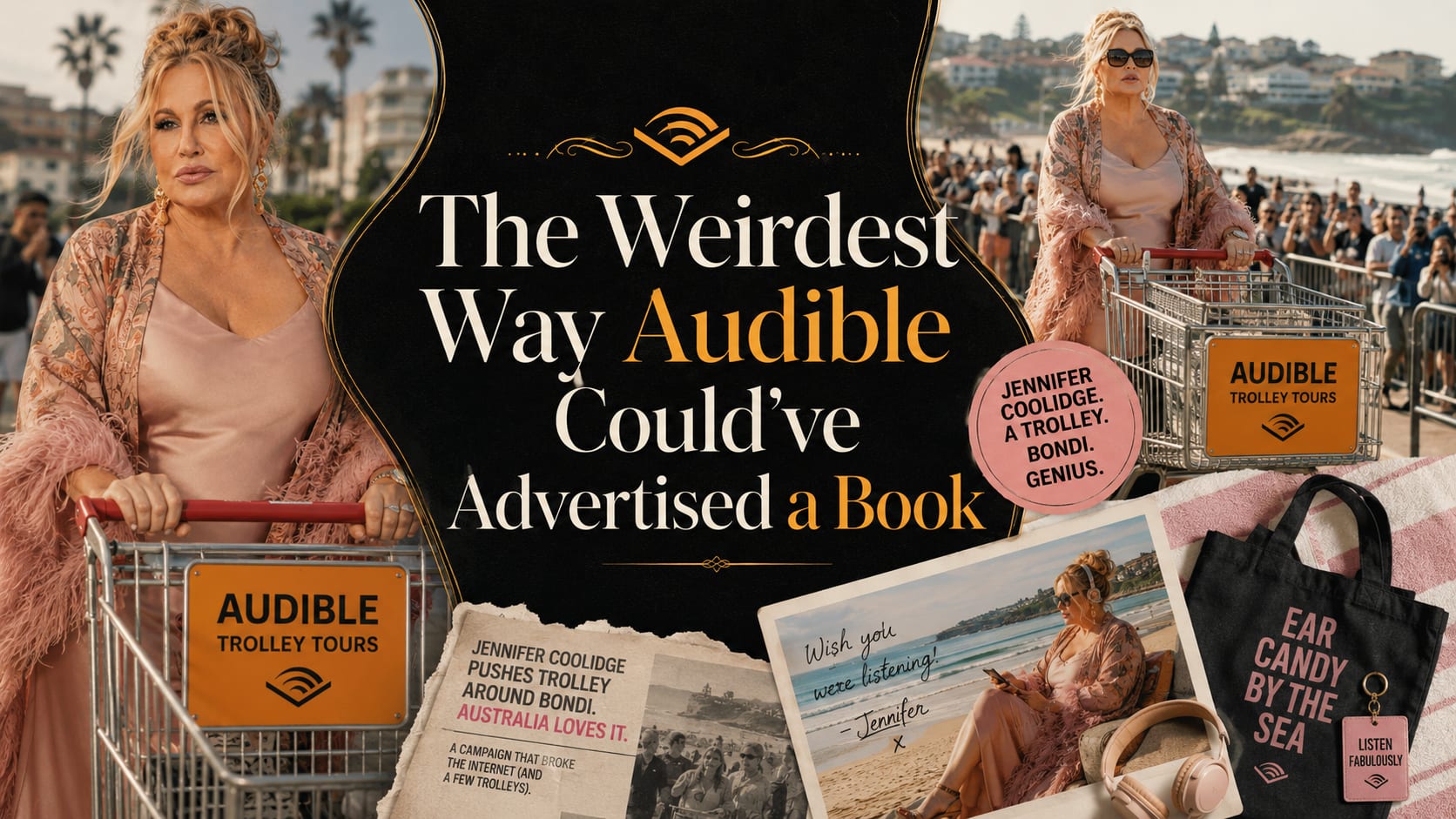
Audible spent late July letting Australia believe Jennifer Coolidge had wandered into a Bondi supermarket run with a bright orange shopping trolley and matching headphones, said nothing while the country tried to work out what it was watching, and only then revealed the campaign behind it. The idea being sold is "getting lost in an audiobook," and the stunt was a literal enactment of it: a Hollywood star, visibly absorbed, visibly elsewhere, pushing a trolley she could not entirely control up a hill in North Bondi.
The reveal landed on 20 August 2026, with a hero film showing Coolidge wandering off set mid-shoot because she is too deep in a story to notice, and a full rollout across TV, social, retail and out-of-home. The campaign was built by independent agency Hello, with Wavemaker on media, Somewhere Nowhere producing the hero film and Hello Create handling the wider rollout.
What makes this worth studying is not the celebrity. It is the sequencing. Audible earned attention first and bought reach second, which is the reverse of how most integrated campaigns are built, and it changes the risk profile of the entire media spend.
What Actually Happened
Coolidge appeared around Bondi doing something entirely unremarkable in a way that was completely remarkable: shopping. Orange trolley, orange headphones, no visible film crew explanation, no brand attached. Onlookers stopped. People took photos. The trolley got away from her on an incline, which is the kind of detail no brief could have written and every planner would have wanted.
The appearance was seeded through media and selected creators before Audible attached its name to anything. Coverage ran with the confusion rather than around it. The tone of the pickup was consistently some version of "why is this happening," which is the tone a brand cannot buy and can only engineer.
Then the retail piece landed. From 31 July to 3 August, shoppers at Harris Farm Bondi could listen to audiobooks through the trolleys themselves. The stunt was not a standalone photo opportunity. It was the trailer for a product experience sitting in the same suburb days later.
Three weeks after that, Audible revealed the film and the campaign.
Why the Stunt Worked Before Anyone Knew It Was an Ad
The mechanism here is a gap, and the gap is the product.
A famous person doing an ordinary thing is a pattern violation, and pattern violations generate attention because the brain has to resolve them. Coolidge with a trolley in North Bondi did not compute. That non-computation is what people shared, wrote about, and commented on. The confusion was not a side effect of the stunt. It was the entire distribution mechanism.
Had Audible branded the moment on day one, there would have been no gap to resolve, and therefore nothing to talk about. It would have been a celebrity endorsement, which is a category of thing people scroll past because they already know what it wants from them. Withholding the brand converted an ad into a question, and questions travel.
Audible's own framing of this was that the stunt earned fame first, and paid media amplified the momentum afterwards. That order matters more than it sounds, and it is the most transferable part of the whole exercise.
Why the Reveal Made the Stunt Better Instead of Killing It
Most teaser stunts have a structural problem: the reveal is a letdown. The mystery was more interesting than the answer, and the moment the brand appears, the audience feels slightly conned. Attention converts into mild resentment.
This one inverts that, and the reason is that the stunt was a literal performance of the product benefit rather than a metaphor for it.
Coolidge was not doing something random that Audible later claimed. She was doing exactly what the product does to you. She was lost in a story, to the point of losing track of where she was and what she was holding. When the film reveals her wandering off set because she is too absorbed to notice the shoot has moved on, the earlier footage does not get retroactively explained away. It gets retroactively completed.
That is the test for any teaser: does the reveal make the tease make more sense, or does it make the tease irrelevant? If the answer is the second one, the tease was decoration.
The Problem Audible Was Actually Solving
Audiobooks are an invisible product. Someone listening to one looks identical to someone doing nothing at all, which is a genuine creative constraint that this category has never fully solved. The default answers are to show a person in headphones looking contemplative, or to animate the story happening inside their head. Both are so established they have stopped registering.
The Bondi stunt is a third answer: do not depict the listening, depict the consequence. You cannot see someone being absorbed in a story. You can absolutely see someone lose control of a shopping trolley because they have stopped paying attention to the physical world.
This is the strategic move underneath the celebrity, and it is the part that would still work at a fraction of the budget. The insight is that the observable evidence of an invisible experience is more filmable than the experience itself.
Why the Casting Was Strategy Rather Than Star Power
Coolidge is not interchangeable here, and swapping in an equally famous name would have weakened the work.
Her established comic register is delightful absence. The characters she is best known for are frequently, charmingly, slightly elsewhere. So the behaviour the campaign needed her to perform, being visibly not present in her own surroundings, is a behaviour audiences already associate with her. The casting does not just borrow attention. It borrows a pre-loaded reading that makes the stunt legible before the brand explains anything.
That is the difference between casting for fame and casting for behaviour. Fame gets you noticed. Behaviour gets you understood without exposition, which is what a brandless stunt requires to work at all.
The Sequencing Argument, and Why It De-Risks Media Spend
The conventional order is to develop a campaign, buy media, launch, and hope earned coverage follows. Earned attention is treated as an upside case rather than a planning assumption.
Audible ran it backwards. The stunt generated the attention, the response proved the idea landed, and only then did significant paid investment go behind it. Hello's position was that this required integrated thinking from the start rather than a stunt with a campaign bolted on afterwards, along with internal alignment on vision, objectives and investment before anything went live.
That second part is the unglamorous condition that makes the first part possible. A brand cannot decide to amplify a stunt after the fact if the reveal film, the retail activation, the TV buy and the OOH were not already built and approved. The three-week gap between stunt and reveal only looks like patience from outside. From inside it looks like everything being finished and waiting.
The practical benefit is risk. By the time the media money was committed, Audible already had evidence the creative worked in the wild, on strangers, without a brand attached. Most campaigns find that out after the spend rather than before it.
Where This Model Does Not Transfer
Worth being direct about the limits, because the lesson gets misapplied constantly.
It needs a genuinely interesting mystery. A brandless stunt without a recognisable face is usually just a confusing thing that nobody photographs. The celebrity is doing structural work here, not decorative work, and removing it does not leave a cheaper version of the same idea.
It needs a literal link between stunt and product. The reason this survived the reveal is that the behaviour and the benefit were the same thing. A stunt that is merely attention-grabbing collapses when the brand appears, because the audience discovers the spectacle was unrelated to the pitch.
It needs the campaign finished before the tease runs. Brands that stunt first and plan second cannot amplify quickly enough, and the attention decays before the paid layer arrives.
Attention is not conversion. No public data ties this to subscription outcomes. The campaign demonstrably earned fame. Whether fame earned signups is a separate question that the visible evidence does not answer, and anyone presenting reach figures as effectiveness figures is skipping a step.
What Marketers Should Take From It
Engineer the gap deliberately. Attention comes from unresolved patterns. If you brand the moment immediately, there is nothing left to resolve and nothing to share.
Make the stunt the benefit, not a metaphor for it. The reveal should complete the tease rather than replace it. If your stunt would still make sense with a different brand's logo on it, the stunt is not doing strategic work.
Cast for behaviour before fame. The right person makes your idea legible without explanation. The wrong famous person makes it a celebrity endorsement with extra steps.
Finish the campaign before you run the tease. Amplification is only available to brands that were already ready.
Give people a way to do the thing. The trolley activation at Harris Farm turned a spectacle into a product trial in the same postcode, which is what converted a stunt into a campaign.
Plan earned as the mechanism, not the bonus. The order was earn first, then buy reach. Treating earned attention as a happy accident means you can never build a media plan that depends on it.
FAQ
What was the Audible Jennifer Coolidge campaign? An integrated Audible campaign built on the idea of getting lost in an audiobook, launched with an unbranded stunt in which Coolidge appeared around Bondi with an orange shopping trolley and headphones, followed by a reveal film and a national rollout across TV, social, retail and out-of-home.
Who made it? Independent agency Hello created the campaign, with Wavemaker on media, Somewhere Nowhere producing the hero film and Hello Create handling the wider rollout.
Why was the brand hidden at first? Because the confusion was the distribution mechanism. An unexplained famous person doing an ordinary thing generates coverage and conversation that a branded celebrity appearance does not. Audible revealed itself only after the moment had already earned attention on its own.
What was the shopping trolley activation? From 31 July to 3 August 2026, shoppers at Harris Farm Bondi could listen to audiobooks through the trolleys themselves, turning the stunt into a product experience in the same location days later.
The lesson is not that stunts work. It is that Audible knew what its stunt was for before it ran it, had the entire campaign built and waiting behind it, and only spent real media money on an idea that strangers had already proven worked without a logo attached.
Written by

I’m Tanmay Tarte, a community builder at Scribble and an engineering graduate from Priyadarshini College of Engineering. Over the years, I’ve worked across community management, content, hosting, and social media, mainly within the Web3 and creator ecosystem space. Outside of work, I’m a huge sports enthusiast and can genuinely play cricket all day, every day.