TL;DR
Mamaearth has become one of the first Indian consumer brands to start advertising on ChatGPT, after parent company Honasa Consumer partnered with Criteo to enter ChatGPT’s advertising ecosystem.
And this is much bigger than Mamaearth buying another ad placement.
For years, brands fought to appear when you searched something on Google or while you scrolled Instagram.
Now, more buying decisions are beginning with conversations like:
“I have dry skin and acne. What should I use?”
That gives AI something traditional advertising rarely gets in one place:
The problem, the context and the buying intent behind the search.
Mamaearth wants to be early to that shift.
The important clarification is that paying for an ad does not make ChatGPT recommend Mamaearth in its answer. Ads are separately labelled and do not influence the assistant’s response.
But it creates a much bigger question for marketers:
What happens when the place people ask for buying advice also becomes the place brands advertise?
What Actually Happened
Mamaearth’s parent company, Honasa Consumer, partnered with Criteo to advertise on ChatGPT.
Co-founder Ghazal Alagh described Honasa as the first Indian company to advertise on ChatGPT, as part of its attempt to understand how consumers are changing the way they discover products.
For years, people searched.
Then they scrolled.
Then they compared reviews.
Now, increasingly, they can simply ask.
Instead of searching:
“best face serum”
someone can say:
“I have oily skin but my cheeks get dry. I occasionally break out and I don’t want to spend more than ₹800. What should I use?”
That's a very different type of intent.
And that changing behaviour is one of the reasons Mamaearth says it wants to experiment early with ChatGPT advertising.
Google Knows What You Search. ChatGPT Can Understand Why.
This is where things get interesting.
Google Search Ads became incredibly powerful because somebody searching:
“buy running shoes”
is probably much closer to buying than somebody randomly watching television.
Instagram and Meta added another layer by understanding what people watch, follow and engage with.
But conversational AI can potentially sit even closer to the actual problem.
Imagine asking:
“I'm travelling to Goa next week. My skin gets oily in humid weather. I need sunscreen that doesn't feel sticky, I'm prone to acne and I don't want to spend more than ₹600.”
That conversation contains:
Your problem.
Your preferences.
Your budget.
Your destination.
Your use case.
And possibly the fact that you're actively looking to buy.
That isn't just a keyword.
That's intent with context.
And that could become incredibly valuable to advertisers.
But Will ChatGPT Start Secretly Recommending Mamaearth?
No.
This distinction is important.
Mamaearth paying to advertise around ChatGPT conversations doesn't mean the assistant suddenly starts saying:
“You should buy Mamaearth.”
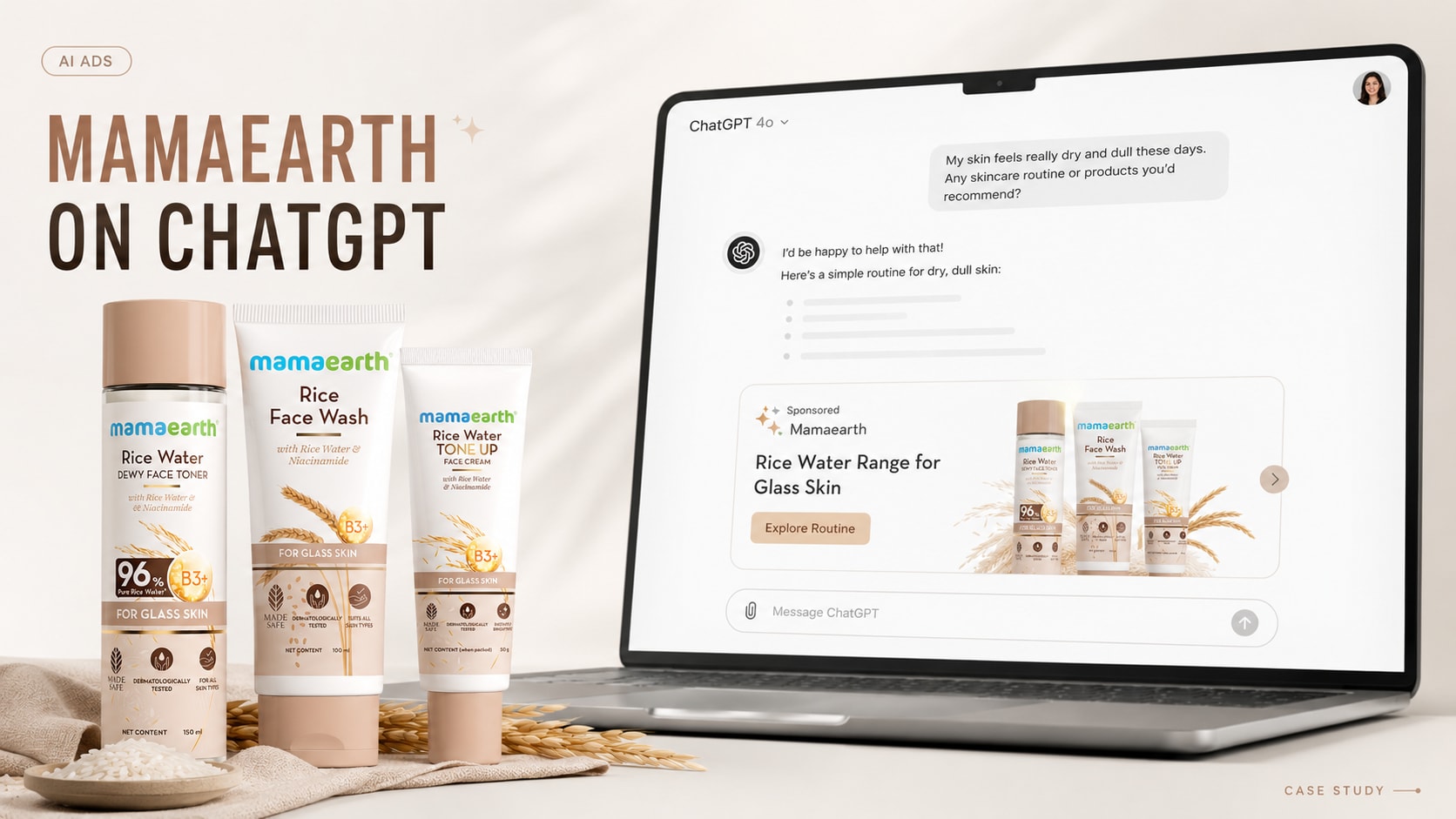
The sponsored placement and the AI-generated answer are separate.
So theoretically, you could have:
ChatGPT's answer:
Here are the ingredients and types of products worth considering.
And separately:
Sponsored:
A relevant Mamaearth product.
Those are two completely different ways of getting visibility.
And that creates an interesting new battle for brands.
Brands Could Now Have Two Ways to Win ChatGPT
The first is organic AI visibility.
Someone asks:
“What are the best sunscreens for oily skin in India?”
And ChatGPT independently mentions your brand because there is enough trusted information across the web to support it.
That's the world of AEO and GEO.
The second is paid visibility.
A brand pays for a clearly labelled sponsored placement around a relevant conversation.
We've already seen this exact relationship play out somewhere else.
Google has:
SEO + Search Ads.
AI could increasingly have:
Organic AI visibility + AI Ads.
And Mamaearth is getting an early look at the paid side.
Why Mamaearth Is Actually a Great Brand to Test This
Beauty products aren't always straightforward purchases.
People don't just want:
“face wash.”
They ask:
Which one works for oily skin?
Can I use niacinamide with vitamin C?
What should I use for pigmentation?
Is this good for sensitive skin?
What's best under ₹500?
Should I buy Product A or Product B?
These are naturally conversational buying decisions.
Criteo, which became OpenAI’s first advertising technology partner for its ChatGPT advertising pilot, has also said beauty is among the categories already participating in the ecosystem.
By June, Criteo said more than 2,000 brands were advertising through its ChatGPT integration.
So Mamaearth's move isn't random.
It's going where its customers may increasingly be asking questions.
This Could Change What an “Ad” Means
Most digital advertising interrupts something.
You're watching a Reel.
Ad.
Watching YouTube.
Ad.
Reading an article.
Ad.
Scrolling through a website.
Ad.
AI potentially creates something different.
The user is already trying to solve a problem.
The advertisement can therefore appear much closer to the actual buying decision.
It doesn't need to convince you that you have dry skin.
You just spent five minutes explaining to the AI that you do.
That's a very different starting point for an advertiser.
Mamaearth Isn't Really Betting on an Ad Platform
This is the part I find most interesting.
Mamaearth isn't necessarily betting that ChatGPT Ads will replace Google tomorrow.
It's betting on a behaviour:
People are beginning to ask AI what to buy.
And whenever consumer behaviour moves somewhere new, advertising eventually follows.
Google owned search intent.
Instagram and TikTok captured discovery.
Amazon captured people close to purchase.
AI could potentially sit across all three:
Discovery → Research → Comparison → Decision
inside the same conversation.
Mamaearth simply wants to understand that behaviour before everyone else does.
The Bigger Question
For marketers, the takeaway shouldn't immediately be:
“We need to run ChatGPT Ads.”
We're too early for that.
The more interesting question is:
Where will your customer's buying decision actually happen five years from now?
Because if people increasingly ask an AI:
“Which one should I buy?”
brands will care deeply about two things:
Does the AI recommend us?
And:
Can we advertise around that decision?
Mamaearth has started experimenting with the second.
The battle for the first has already begun.
What Do You Think?
Would seeing a sponsored product while you're asking AI what to buy make you more likely to consider it than seeing the exact same ad while scrolling Instagram?
And more importantly:
When ChatGPT recommends a product to you, do you treat that recommendation differently from a Google search?
Because if the answer is yes, advertising may have just found its next major surface.
Written by

I’m Tanmay Tarte, a community builder at Scribble and an engineering graduate from Priyadarshini College of Engineering. Over the years, I’ve worked across community management, content, hosting, and social media, mainly within the Web3 and creator ecosystem space. Outside of work, I’m a huge sports enthusiast and can genuinely play cricket all day, every day.