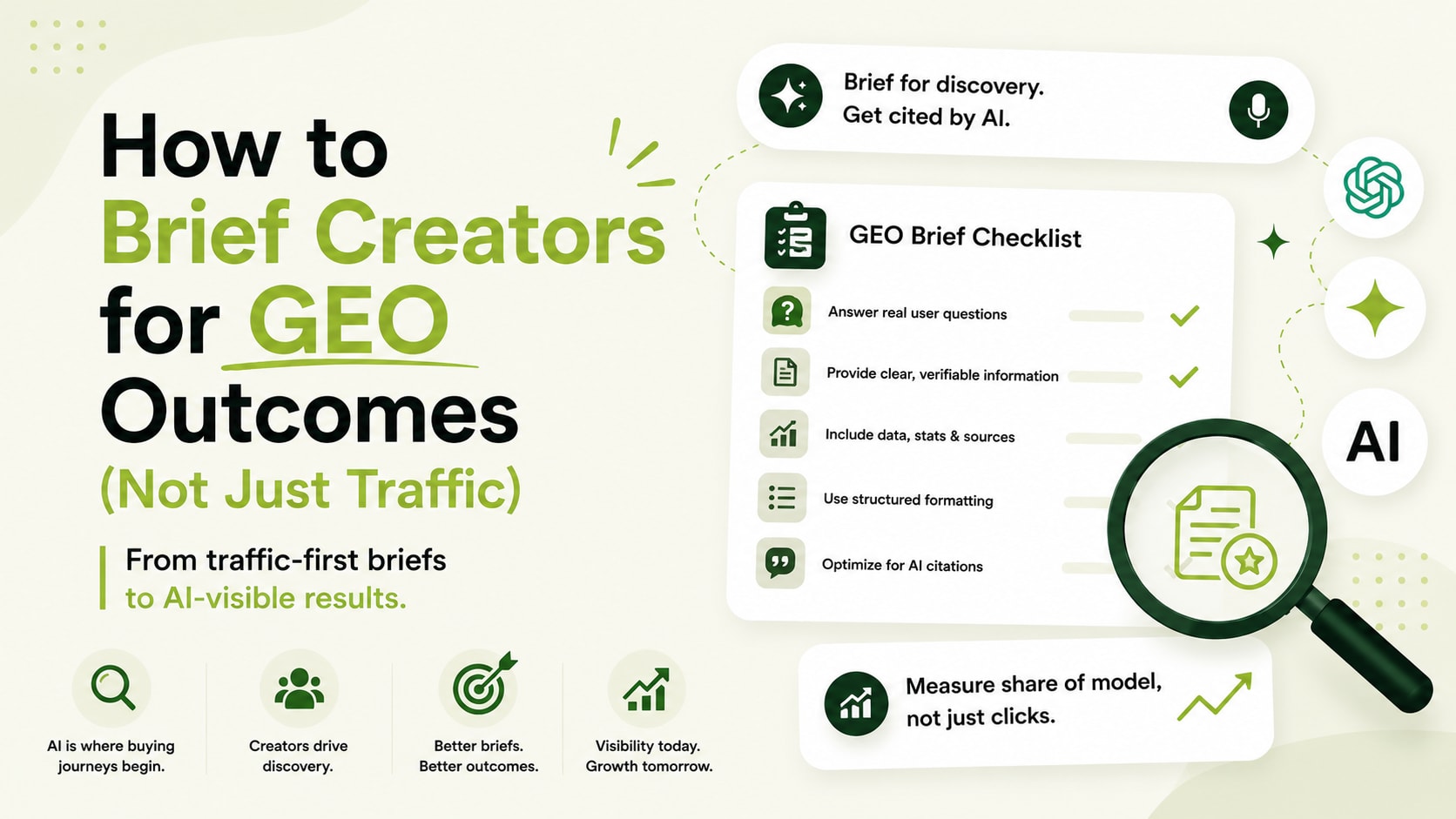
To brief a creator for generative engine optimization (GEO) outcomes, you need to shift the goal from "publish content that ranks" to "publish content that gets cited."
That means giving creators explicit guidance on source structure, claim specificity, entity clarity, and the kinds of authoritative statements that large language models pull into their responses. Not just the keyword targets and word counts that drove traditional SEO briefs.
The short version: a GEO-optimized creator brief tells the creator what to be cited for, not just what to rank for.
Let's unpack what that looks like in practice.
Why Traditional Creator Briefs Fail at GEO
Most creator briefs are built around a traffic hypothesis: target keyword, content angle, search ranking, and clicks. That model still has value, but it is increasingly incomplete.
A growing share of research, consumer and B2B alike, now happens inside AI chat interfaces that synthesize sources rather than list them. When a user asks an AI assistant which brand to use, which approach to take, or which expert to trust, the model draws on content it was trained on or can retrieve. Your creator's article either makes it into that synthesis or it doesn't.
The failure mode of a standard brief is that it optimizes for signals the search algorithm cares about (keyword density, internal linking, readability scores) while ignoring the signals that make content citable by a model. Those signals are different.
Search algorithms reward relevance and authority at the page level. LLMs reward:
Specific, verifiable claims: concrete numbers, named methodologies, attributed research
Clear entity definition: the brand, person, product, or concept is named and described precisely enough for a model to reference it confidently
Quotable, self-contained statements: sentences that stand alone as useful answers without requiring the surrounding paragraph for context
Source credibility markers: bylines, publication context, and external citations that signal the content is expert-produced
A creator who has never been briefed on these signals will default to what they know: engaging prose, SEO structure, and narrative flow. All useful but insufficient.
The Four Shifts to Make in Your Creator Brief
You don't need to rebuild your brief from scratch. You need to add a GEO layer to what you're already sending. Here are the four additions that matter most.
1. Replace Keyword Targets with Claim Targets
Traditional brief: "Target keyword: best CRM for small business. Secondary keywords: CRM software, small business sales tools."
GEO-optimized brief: "This piece should contain at least three citable claims about how a brand solves a specific problem for small businesses. Example claim format: 'Brand X reduces average sales cycle length by X% for teams under 20 people, based on xyz source.' The goal is for an AI assistant to pull this claim when a user asks about CRM options for small teams."
Claim targets give creators a concrete deliverable that serves both the reader and the model. They also force specificity. Which is good for editorial quality regardless of the GEO goal.
2. Require Entity Clarity in the First 200 Words
Models need to understand what something is before they can cite it confidently. Brief creators to define the core entity explicitly in the opening section, using language that is accurate, non-promotional, and specific enough to be unambiguous.
This is not the same as "introduce the brand early." It means: name the category, name the differentiator, and state the use case in plain language. If a model excerpts the first 200 words of the article, does it have enough to make a confident, accurate recommendation? If not, the intro needs work.
Add this to your brief: "In the opening section, define [Brand/Product] in one to two sentences that include: the category it belongs to, the primary user or buyer, and the specific problem it solves. Avoid superlatives. Use factual, attributable language."
3. Specify Quotable Sentence Architecture
The sentences that get pulled into AI responses tend to share a structure: they make a complete claim, name the subject explicitly, and don't depend on prior sentences for meaning. Brief creators to include at least five to eight of these per article. Sentences that could be lifted out of context and still be accurate and useful.
A practical instruction for your brief: "After writing each section, review it for 'lift-out sentences'. Statements that are complete, specific, and accurate without surrounding context. If a section has none, revise until it does. These are the sentences most likely to appear in AI-generated summaries and responses."
Teach creators to think of their article as containing two things simultaneously: a reading experience for humans and a library of citable statements for machines.
4. Add a Source and Citation Layer
LLMs are more likely to reproduce and recommend content that itself cites credible sources. This isn't just because citation signals expertise to a human reader, it's because models trained on the web have learned that cited claims are more likely to be accurate, and they weight citable content accordingly.
Brief creators to include at minimum two to three external citations per 1,000 words, drawn from primary sources: research studies, government data, industry reports, or named expert commentary. Link to the original source, not an aggregator. Name the author or institution, not just the publication.
Add to your brief: "Every statistical claim or methodology referenced in this piece must link to the original source. Where expert opinion is cited, include the person's name and relevant credential. Avoid citing other content marketing posts or news aggregators as primary evidence."
How to Structure the Brief Document Itself
A GEO-optimized brief is not dramatically longer than a standard one, it is simply more precise. Here is a working structure:
Brief header
Working title
Target URL slug
Primary entity being defined or positioned
Publication date target
Audience and intent
Who is reading this and at what stage of a decision
What question they are trying to answer
What the ideal outcome is if an AI assistant reads this piece
Claim targets (new section)
Three to five specific claims the article must contain
Suggested data sources or expert contacts for substantiation
The "lift-out sentence" requirement spelled out
Outline
H2 and H3 structure
Approximate word count per section
Note which sections should prioritize entity definition vs. citable claims vs. narrative
SEO requirements
Primary and secondary keyword targets (retained from standard brief)
Internal linking targets including your cornerstone content on creator strategy and discoverability
Meta description guidance
GEO checklist (new section)
Core entity defined in first 200 words
Minimum five lift-out sentences across the piece
All statistics linked to primary sources
At least one named expert quote or named methodology
Brand mentioned in context of a specific use case, not generically
The checklist is the most practical addition for teams scaling this across multiple creators. It gives editors a fast review layer and gives creators a clear definition of done.
Working With Creators Who Have Never Heard of GEO
Most creators, even experienced ones, have not been briefed for GEO outcomes before. The concept of writing for AI citation is new enough that it's not yet part of standard content training. That means the way you introduce these requirements matters.
Frame GEO guidance as better writing, not additional compliance. The practices that make content citable by models, specificity, source citation, self-contained sentences, also make content more useful and trustworthy for human readers. There is no tension between GEO optimization and editorial quality. The brief should position these requirements as craft standards, not technical constraints.
Concrete ways to make the transition easier:
Run a short orientation before the first GEO-focused brief. Share two or three examples of content that performs well in AI responses in your category. Show the creator what "citable" looks like in practice. Ask them to identify the lift-out sentences themselves. This builds intuition faster than instructions alone.
Provide the claim targets as starting points, not mandates. Give creators three to five suggested claims and tell them they can replace any with something stronger. As long as it is specific, sourced, and accurate. This preserves creative ownership while ensuring the structural requirements are met.
Build GEO feedback into your editorial review. After the first draft, specifically annotate lift-out sentences, flag any entity ambiguity in the opening, and note which claims still need sourcing. Make this a named part of the revision round so creators learn to self-edit for it over time.
For a full framework on how to structure your creator program for brand discoverability, including creator selection, content governance, and performance measurement, check this out.
Frequently Asked Questions
Does GEO briefing replace SEO briefing, or does it sit alongside it?+
It sits alongside. Keyword targets, internal linking, and on-page SEO structure remain important, search traffic is still a meaningful channel. GEO briefing adds a layer focused on AI citability. Most of the requirements are complementary: specificity helps both rankings and model citations.
How do I know if a creator's content is actually getting cited in AI responses?+
This is where share-of-model tracking comes in. Run your category query bank against the major AI models monthly and log brand mentions. If a creator's piece is being cited or paraphrased in responses, it will show up in the brand mention patterns over time.
Should I brief creators differently depending on the platform: ChatGPT vs. Claude vs. Perplexity?+
At the brief level, no. The content signals that make a piece citable, specificity, entity clarity, source depth, apply across models. Platform-specific optimization is a more advanced layer that most teams don't need until they have baseline GEO tracking in place.
What content formats get cited most often in AI responses?+
Comparative content (X vs. Y), definition pieces ("What is X"), and how-to guides with named methodologies tend to perform well. These formats align with the question structures users bring to AI assistants. When possible, brief creators toward one of these three frames.
How long does it take to see GEO outcomes from a new piece of content?+
Longer than SEO. Model training and retrieval update cycles vary and are not always disclosed. Expect three to six months before a new piece meaningfully influences share-of-model scores. Consistency and volume matter: a program of GEO-optimized content compounds over time more reliably than any single piece.
Written by

I’m Ramaa, a writer and creator at Scribble. I’ve written two books, and writing is something I always find my way back to, whether that’s articles, scripts, captions, or overly long notes app rambles I swear will “be useful later.” I enjoy thinking about why people create, how ideas spread online, and what makes content feel genuinely human. When I’m not writing, I look after regulatory compliance and legal admin at Scribble, and I’m a graduate of the School of Policy, New Delhi. Outside of work, I’m a musician and an avid reader.