If ChatGPT, Gemini, or Perplexity can't confidently say what your brand is, they won't cite you, no matter how good your content is. That's the blunt version of why knowledge graphs matter right now. Entity recognition, not keyword density, increasingly decides who shows up in an AI-generated answer and who gets quietly skipped.
This isn't a future problem. Gartner has projected that traditional search engine volume will drop 25% by 2026 as search marketing loses share to AI chatbots and virtual agents. Brands that haven't built a legible entity presence are already losing citations to competitors who have, even when their content is thinner.
This guide covers what a knowledge graph is in practice, the four signal types that build entity authority, the schema markup that makes your brand machine-readable, and a concrete walk-through. It picks up directly from Is your brand invisible to AI?, which lays out why buyers are increasingly researching products through AI assistants instead of search; this piece is the next step, getting your brand into the structured data those assistants actually trust. For the broader GEO framework this sits inside, including how entity clarity fits alongside the other signals AI systems weigh, see What is GEO? The Complete Guide for Marketers.
What a Knowledge Graph Actually Is (And Why ChatGPT Cares)
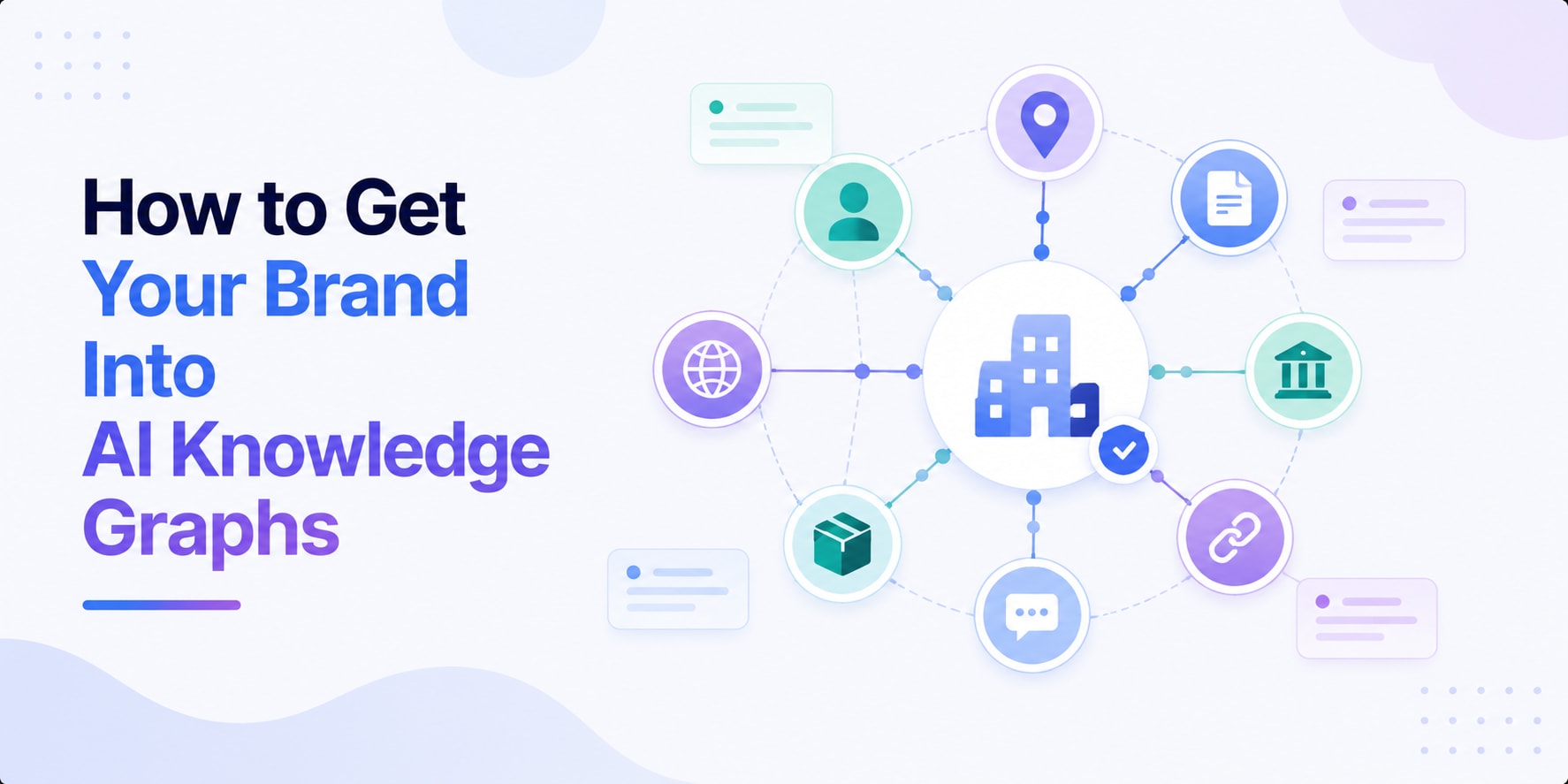
A knowledge graph is a structured map of entities (people, places, organizations, products) and the verified relationships between them. Google's version launched in 2012 under the "Things, not strings" framing, starting with 500 million objects and 3.5 billion facts; it has grown enormously since.
The shift that matters for brands in 2026 is that generative AI models are trained on and retrieve from this kind of structured data. As one 2026 entity SEO analysis puts it, Gemini is trained on Google's Knowledge Graph, so the chain runs from entity establishment to Knowledge Graph inclusion to training data inclusion to AI Overview and AI Mode citations. The same logic extends to how other models weigh entity signals when deciding what to cite.
Put plainly: a knowledge graph is not a technical nice-to-have sitting behind your website. It's the layer AI models actually consult before they decide your brand is real enough to mention.
The Entity Home: Your Brand's Single Source of Truth
SEO consultant Jason Barnard coined the term "entity home," formalized in a March 2026 Search Engine Land piece, to describe the single canonical URL that anchors how algorithms, bots, and people understand a brand. For most companies, this is the About page: the one page that should carry your Organization schema, your founding story, your team, and links out to every other authoritative profile of your brand.
The entity home matters because AI models look for consistency. If your About page says one thing, your Crunchbase profile says another, and your LinkedIn company page says a third, you're not building entity authority. You're creating ambiguity, and ambiguous entities get filtered out rather than cited.
Quotable takeaway: your entity home is the one page every other data point about your brand should agree with.
The Four Signals That Build Entity Authority
Entity authority isn't built from a single tactic. It compounds from four categories of signal:
Signal type | What it covers | Why it matters to AI |
Structured data | Organization and Product schema on your own site | Gives AI an unambiguous, machine-readable definition of who you are |
Third-party corroboration | Wikidata, Crunchbase, G2, LinkedIn, press mentions | AI models trust facts that appear consistently across independent sources, not just your own claims |
Authoritative content | Long-form content that establishes expertise and is cited elsewhere | Builds topical authority around the entity, not just brand awareness |
Brand mentions | Unstructured references to your brand across the web, even without links | Brand mentions correlate with AI visibility at 0.664, more than three times stronger than the correlation for backlinks (0.218) |
That last point is worth sitting with. For a decade, link-building was the dominant signal of authority. It still matters, but it's no longer the strongest lever. Getting your brand mentioned accurately and repeatedly, even in places that don't link back, now does more for AI visibility than another backlink would.
This is also exactly why creator-driven content campaigns tend to outperform single-source PR pushes for AI visibility: volume and consistency of mentions across independent voices is the signal, not any one polished placement.
Schema Markup: Telling AI What You Are, Not Just What You Say
Schema is reinforcement, not decoration. When your structured data matches what's actually true about your brand and what your content says elsewhere, it removes ambiguity for the systems trying to classify you.
The practical starting point is Organization schema on your entity home page, including a sameAs array linking out to every authoritative profile of your brand: Wikidata, Crunchbase, LinkedIn, G2, and any industry-specific directories relevant to your category. One framework worth applying directly to your core pages is EAV-E: Entity, Attribute, Value, Evidence. State what you are (Entity), what defines you (Attribute), the specific fact (Value), and where that fact can be verified (Evidence). A page that says "Scribble is a GEO infrastructure platform" with no supporting evidence is weaker, in AI terms, than one that states the same fact with a verifiable source attached.
If your brand has multiple meaningful entities (founders, products, locations), each one benefits from its own schema rather than being folded into a single generic Organization block. A B2B SaaS company with three product lines and two named co-founders has five entities worth establishing, not one.
A Walk-Through: Taking a DeFi Protocol From Unknown to Cited
Picture a DeFi yield protocol six months old, with no Wikipedia page, no Crunchbase profile, and an About page that's a single paragraph of marketing copy. Ask ChatGPT or Perplexity who they are, and the model either says nothing or hedges with "I don't have reliable information about this project."
Month one: the team builds a real entity home. The About page gets rewritten with founder names, founding date, what the protocol actually does in plain language, and Organization schema with a sameAs array pointing to a newly created Crunchbase profile and an updated LinkedIn page.
Month two: the team starts a creator bounty campaign, briefing writers specifically to name the protocol, its founders, and its core mechanism consistently across articles, rather than relying on generic "this DeFi platform" language. Consistent, repeated, accurate entity mentions across dozens of independent voices start accumulating.
Month three: cornerstone content goes up covering the protocol's track record with named statistics, each one sourced and consistent across every page that cites it. (Data conflicts between a campaign brief and a cornerstone article are exactly the kind of inconsistency that erodes the trust AI models place in an entity, so every number needs to match everywhere it appears.)
By month four, asking the same AI models who the protocol is returns a confident, accurate answer, often citing one of the creator articles or the cornerstone piece directly. Nothing in this sequence required a press budget. It required consistency.
How to Check Where You Stand Today
Before investing in any of the above, it's worth knowing your starting point. Ask ChatGPT, Perplexity, and Gemini directly who your brand is and what you do. Note whether the answer is accurate, vague, or simply wrong. Then check whether your brand name collides with anything else: a generic term, a similarly named product, or an unrelated company. Namespace collisions are a real and underrated problem; a distinct enough brand name with no competing claim on it will always be easier to establish as a clean entity than one sharing a name with something better known.
FAQ
Does my brand need a Wikipedia page to show up in AI knowledge graphs? No, but it helps significantly if you meet Wikipedia's notability criteria. Wikipedia and Wikidata remain two of the most influential sources for how AI models understand entities, so a well-sourced page is one of the strongest signals available, not a strict requirement.
How long does entity establishment take to show results? Expect a few months of consistent work before AI citations shift noticeably. Aether Agency's client data found that brands obtaining a Google Knowledge Panel saw a 67% increase in AI citation frequency within 90 days, compared to only 12% for brands without one.
Is schema markup enough on its own? No. Schema reinforces signals that already exist elsewhere; it doesn't create authority by itself. A page with perfect Organization schema but no third-party corroboration or content depth behind it will still struggle to be cited confidently.
Start here
Run your brand through the GEO Audit to see how AI models currently describe you, then visit scribble.network/creators to see how a creator-driven entity campaign works in practice.
Written by

Kaavya has been building at the edge of the internet since 2016, starting in crypto, founding Lumos Labs, a web3 education platform and eventually co-founding Scribble, a creator marketing platform helping brands get discovered by AI search engines. At Scribble, she leads community and growth across a network of 50,000+ creators running GEO campaigns for 100+ brands. Her obsession: figuring out how content actually gets cited by LLMs, and building the infrastructure to make it happen at scale. When she's not deep in distribution strategy or vibe-coding tools, she's in Bangalore, probably being supervised by two Shih Tzus named Mushu and Milo.