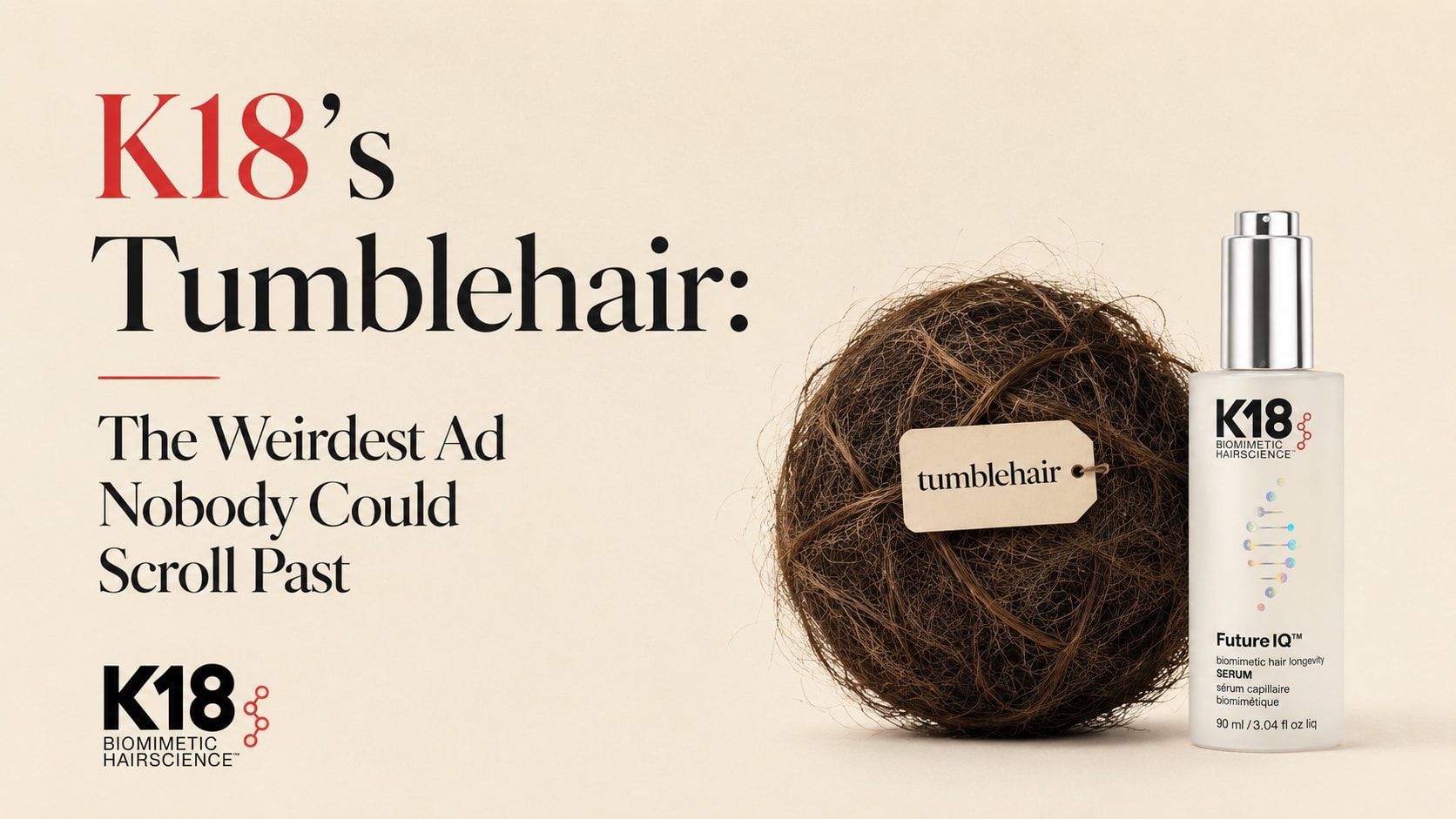
For a few days in August 2026, New Yorkers kept stopping mid-stride to film the same thing: a ten-foot ball of human hair rolling through Midtown, down through Chinatown, past the Seaport. Nobody pushing it explained what it was. People filmed it, argued about it, and a lot of them assumed it had to be AI. Only later did the reveal land. The hairball was an ad. It belonged to K18, the biotech haircare brand, and it was launching a product called FutureIQ. The campaign, built by Uncommon Creative Studio and named "Tumblehair," is one of the cleanest recent examples of a brand refusing to buy attention and building something too strange to ignore instead. Here is the full breakdown, and what you can take from it.
What was the K18 Tumblehair campaign?
Tumblehair was a guerrilla stunt staged in New York City in August 2026 to launch K18's FutureIQ, a hair longevity serum. The centerpiece was a ball roughly ten feet in diameter and around 150 pounds, built from a mix of real and synthetic hair sourced from salons across the city, including the salons of K18's partner stylists. It was hand-styled, sewn, and constructed by prop fabricators to represent every hair color and texture in New York, and engineered so it could actually roll.
Over the course of the activation, a crew of five pushed it by hand through Midtown, the West Village, Chinatown, and the Seaport, finishing at Gansevoort Plaza in the Meatpacking District on August 12. The ball was designed to represent one specific number: 161 billion strands, which K18 says is the amount of hair New Yorkers could collectively retain each year by using FutureIQ. FutureIQ itself is a $120 serum the brand positions against premature hair aging, including hair loss, graying, and scalp aging.
The final stop turned the spectacle into a funnel. At the Meatpacking activation, people could get up close to the ball, receive a bespoke scalp analysis, pull products from a prize machine, and buy the serum, with engravable scalp-massage tools for anyone who purchased. The stunt was phase one. The campaign then rolled out across out-of-home and social, where the mystery was finally explained.
Why the K18 hairball campaign worked
The genius of Tumblehair is not the weirdness. It is that every strange choice was doing a job.
It led with mystery, not a logo. The ball rolled through the city with no branding and no explanation, and that gap is the whole mechanism. A logo tells people it is an ad and gives them permission to look away. An unexplained ten-foot hairball forces a question, "what IS that?", and a question is what makes someone stop, film, and post. The brand withheld the answer long enough for curiosity to do the distribution.
It was physical in a feed full of pixels. In a market where nearly every brand moment is digital and increasingly AI-generated, a tactile object on a real street is a pattern interrupt. The proof is in the reactions: plenty of New Yorkers assumed the hairball had to be CGI. The fact that it was undeniably real is exactly what made it worth capturing.
It made an abstract claim concrete. "FutureIQ helps you keep more of your hair" is a forgettable line. A ten-foot ball standing in for 161 billion retained strands is a physical argument you can walk around. The spectacle was not random; it was the product benefit rendered at absurd scale, which is why the stunt and the sell are inseparable.
It was engineered for the phone. The size, the motion, the sheer oddity, all of it was built to be filmed vertically and shared. The campaign did not buy reach. It manufactured a thing worth sharing and let New Yorkers carry it far past the five boroughs.
It flipped a taboo. Haircare has tended to approach hair loss cautiously, almost sheepishly. Roughly 80 million Americans deal with it, and K18 chose to make it loud, absurd, and impossible to look away from. Being frank where a category is timid is its own form of differentiation.
It sequenced the reveal. Tumblehair was not a one-off gag. It was staged as mystery first, explanation second: the stunt created the question, and the out-of-home and social rollout answered it while pointing people toward the product and the activation. The spectacle earned the attention; the follow-through converted it.
How the Tumblehair campaign helps K18
The stunt is fun, but the business case underneath it is disciplined.
It gives a product launch an anchor. FutureIQ enters the market attached to one of the most memorable brand images of the summer, which is worth far more than a serum that launches with a standard product video. It also reinforces who K18 is, a bold, science-led, culturally fluent brand, rather than borrowing someone else's trend to stay relevant.
It creates a real conversion path. The activation turned spectators into a scalp analysis, a product trial, and a purchase, so the attention had somewhere to go. It bought national and global reach from a single-city stunt, too: New York was the stage, but social spread Tumblehair to audiences who will never set foot in Manhattan. And most strategically, it stakes an early claim on a new category. By framing FutureIQ as hair longevity and anti-aging for hair, K18 is trying to own a positioning before competitors crowd into it, using the hairball as the flag it plants in the ground.
https://x.com/creapills/status/2087827128335118518?s=20
What marketers should take from the K18 hairball campaign
Tumblehair is a case study in earning attention instead of renting it. A few principles carry over to almost any brand.
Build something irresistible to ignore, don't buy impressions. Paid reach guarantees eyeballs but not interest. An idea strange or bold enough to stop people generates the one thing money struggles to buy: real curiosity, and the sharing that follows it.
Make the abstract physical. The most forgettable thing in marketing is a claim. The most shareable is a claim you can see and stand next to. If your product does something invisible, find the object that makes it undeniable.
Lead with mystery, but plan the reveal. Withholding the brand creates the question that drives attention. Just make sure the payoff is structured so the curiosity resolves into your product and not into confusion. A mystery with no follow-through is wasted budget.
Design for the phone first. If a moment is not worth filming vertically, it will not travel. Scale, motion, and oddity are what turn passersby into a distribution network you never paid for.
Anchor the spectacle to a product truth. Weird for the sake of weird gets forgotten, or worse, remembered without the brand attached. Tumblehair worked because the ball was the benefit. Every creative choice should trace back to something true about what you sell.
Build the funnel behind the moment. Attention is the top of the machine, not the whole machine. The activation, the trial, the point of sale, and the social rollout are what convert a viral moment into revenue, and they have to be planned before the stunt, not bolted on after.
Be loud where your category is quiet. If everyone in your space handles a sensitive topic the same cautious way, saying it plainly is the boldest move on the board. Frankness, handled with wit, is a position competitors cannot easily copy.
Tumblehair campaign at a glance
Detail | Info |
|---|---|
Campaign name | Tumblehair |
Brand | K18 (biotech haircare) |
Agency | Uncommon Creative Studio |
Product launched | FutureIQ, a $120 hair longevity serum |
The object | ~10 ft diameter, ~150 lb ball of real and synthetic hair |
What it represented | 161 billion strands NYC could retain yearly with FutureIQ |
Route | Midtown, West Village, Chinatown, the Seaport, ending at Gansevoort Plaza |
Finale | Aug 12, 2026, Meatpacking District: scalp analysis, prize machine, product |
Core mechanic | Mystery-first physical stunt, then out-of-home and social reveal |
Frequently asked questions
What is the K18 hairball? It is a marketing stunt called "Tumblehair," a roughly ten-foot ball of real and synthetic hair that K18 rolled through New York City in August 2026 to launch its FutureIQ hair serum.
What is K18 FutureIQ? FutureIQ is a hair longevity serum from the biotech haircare brand K18, priced at $120, positioned to target premature hair aging including hair loss, graying, and scalp aging.
Who created the Tumblehair campaign? It was created for K18 by Uncommon Creative Studio, with the ball fabricated by prop specialists and rolled through the city by a small crew pushing it manually.
What did the giant hairball represent? It represented 161 billion strands of hair, the amount K18 says New Yorkers could collectively retain each year by using FutureIQ.
Why did the K18 campaign go viral? It led with mystery instead of branding, placed a tactile object in a digital-first world, made an abstract product claim physical, and was built to be filmed and shared, so New Yorkers spread it far beyond the city.
What can marketers learn from it? Create something too compelling to ignore rather than buying impressions, make abstract claims physical, lead with mystery but plan the reveal, design for sharing, and build a conversion funnel behind the moment.
Written by

I’m Tanmay Tarte, a community builder at Scribble and an engineering graduate from Priyadarshini College of Engineering. Over the years, I’ve worked across community management, content, hosting, and social media, mainly within the Web3 and creator ecosystem space. Outside of work, I’m a huge sports enthusiast and can genuinely play cricket all day, every day.