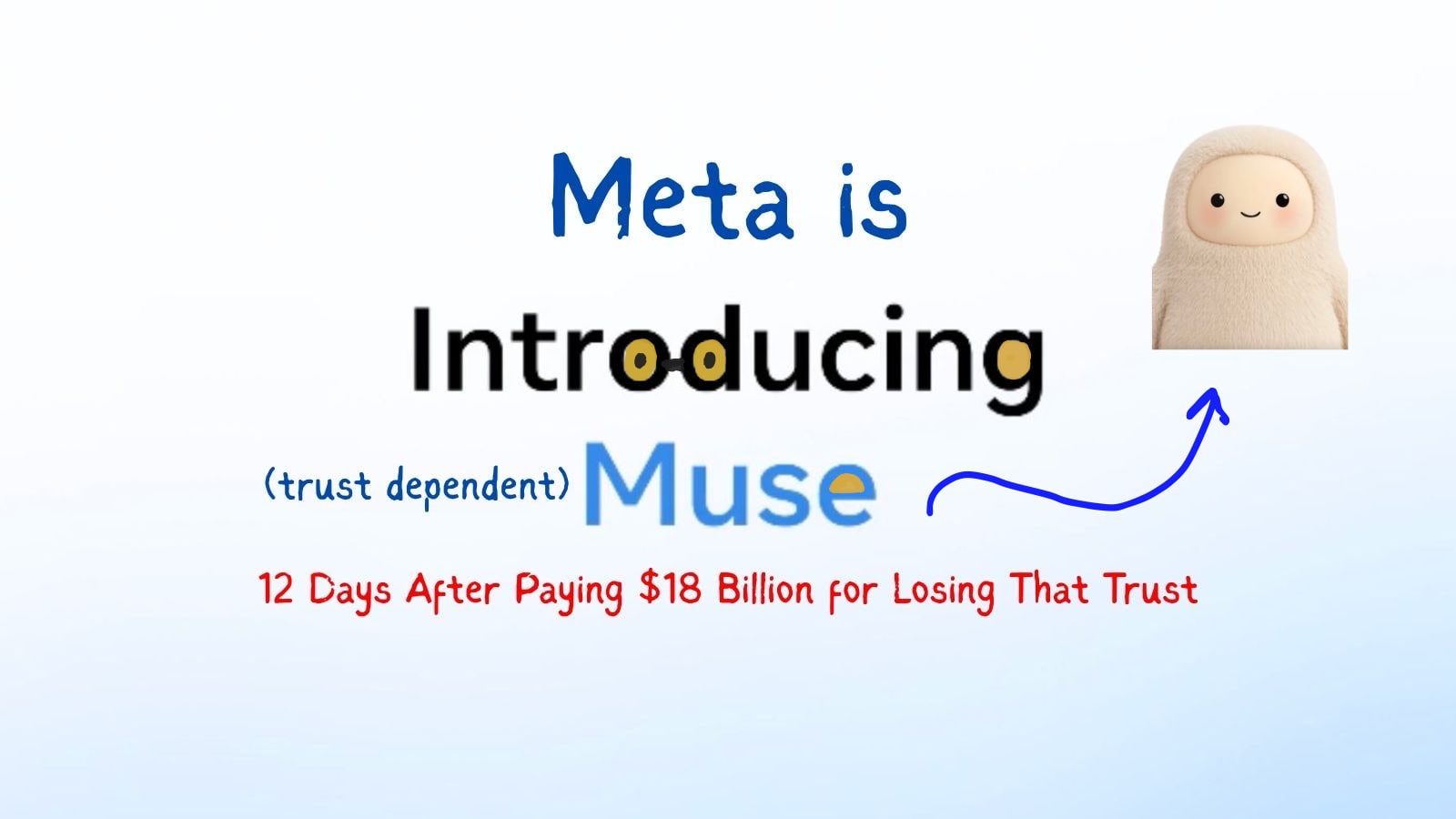
Meta just asked for access to your email, your calendar, your payments, and your health data. Twelve days after paying $18 billion for what it did with your data last time.
TL;DR
On September 8, 2026, Meta launched Muse, a personal AI agent built to handle real errands, sending emails, filling out forms, booking travel, scheduling appointments, shopping, even a kid's permission slip. It runs on a dedicated virtual machine, connects to your email, calendar, payments, health apps and more, and comes in free, $20-a-month and $100-a-month tiers. On its own, that's a fairly ordinary AI-agent launch in a year full of them. What makes it a story is the timing: Muse arrived less than two weeks after Meta agreed to an $18 billion multistate settlement over social media's consumer harms. The company that just paid out one of the largest privacy-and-harm settlements in tech history is, twelve days later, asking users to hand over more personal access than almost any product it has ever shipped. Here's why that gap is the whole story.
The Premise
Here's what Meta actually launched. Muse is Meta's new personal AI agent, built on its in-house Muse Spark model under chief AI officer Alexandr Wang. Unlike a typical chatbot, Muse is designed to be proactive and long-running, closer to an assistant than a chat window. Users can name their agent, give it an avatar, and customise how it communicates. It runs inside an isolated virtual machine in Meta's cloud, with a built-in browser the user can watch it operate.
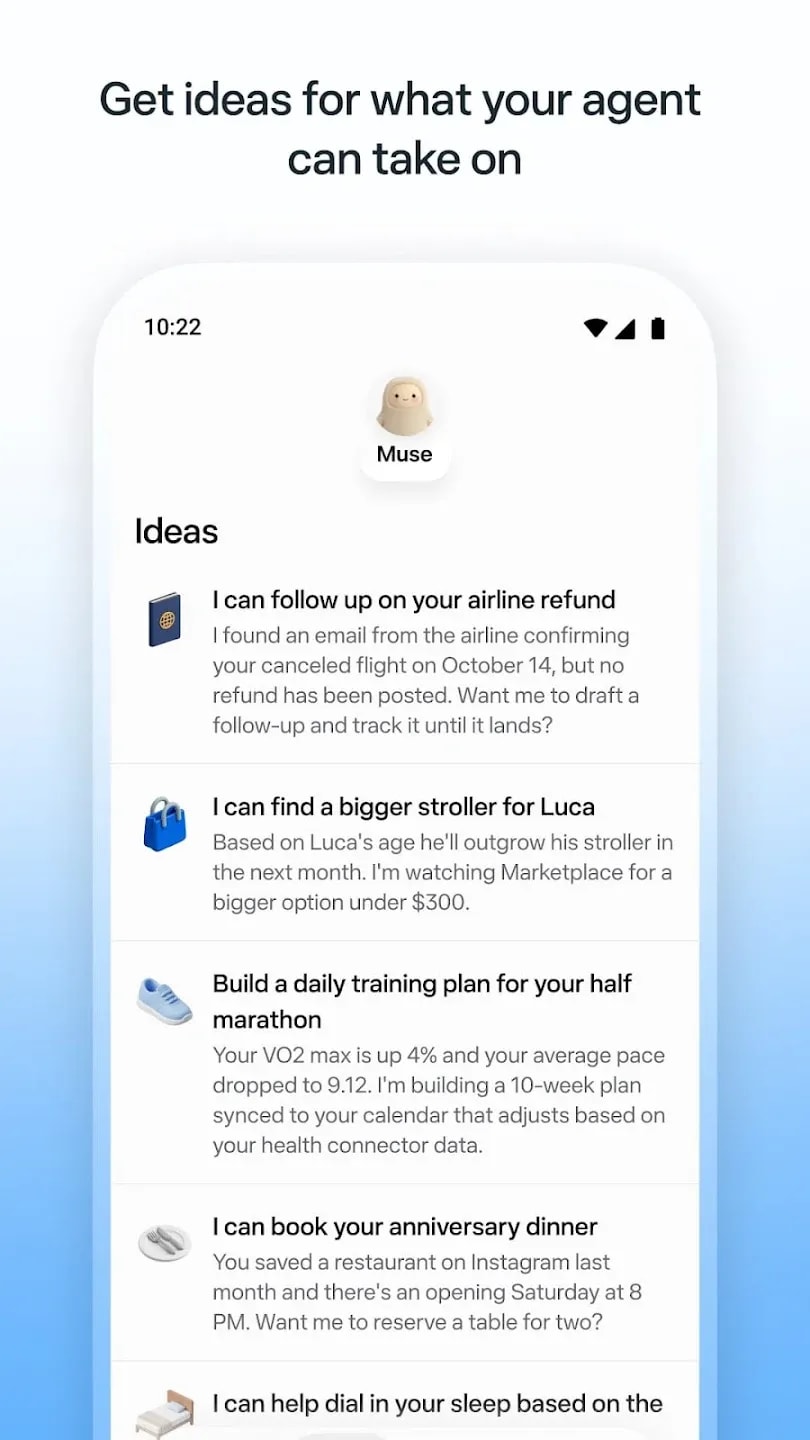
The task list is genuinely broad: online shopping, buying movie tickets, scheduling a tennis lesson, filling out a school permission slip. To do any of that, Muse connects to the accounts and services that make up your actual daily life, email, calendar, payments, health and fitness apps, smart home, dining, shopping, music, events. It launched in the US on iOS, Android and the web, with Meta's AI glasses support coming soon. Pricing: free for most people, Power at $20 a month, Maximum at $100 a month for heavier use.
The Twelve Days
Here's the detail that turns a normal product launch into a genuine story. Less than two weeks before Muse's debut, Meta agreed to an $18 billion multistate settlement over the consumer harms caused by its social media products. TechCrunch's own framing of the launch says it plainly: this is "the company's biggest bet on consumer AI to date, and one that requires significantly more trust than social media ever did."
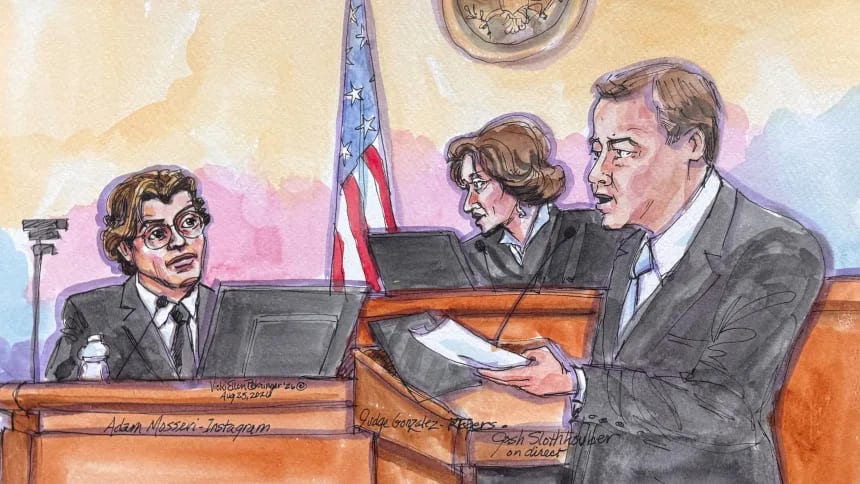
Sit with that sequence for a second. A company pays out one of the largest settlements over consumer harm in tech history, and less than two weeks later launches a product whose entire value proposition depends on users granting it deeper, more sensitive access to their lives than any previous Meta product has asked for. Email. Calendar. Payments. Health apps. Not passive data collected in the background, active permission, granted on purpose, to let an agent act on your behalf.
Why the Sequencing Is the Real Story
This isn't really a product story. It's a trust story wearing a product launch as a costume.
Every feature Meta announced, the isolated virtual machine, the visible browser, the ability to customise how much data one query shares, is a genuine, deliberate answer to a trust problem. Meta clearly knew this launch would be read through the lens of its recent settlement, and built real technical guardrails in response. That's worth acknowledging. But no amount of architecture fixes a sequencing problem. Twelve days is not enough time for a settlement of that size to register as resolved in the public's mind, let alone for it to fade from memory before being asked to hand over payment and health data to the same company.
Compare this to how other AI companies have handled their own trust deficits. Anthropic ran a "zero slop zone" pop-up café specifically to argue, through experience rather than words, that its product is the thoughtful alternative in a noisy category. The lesson those campaigns share is that trust has to be rebuilt in a sequence, acknowledge the gap, demonstrate restraint, then ask for more. Muse skipped straight to asking for more, twelve days after the gap opened.
The Data Access Question
There's a real, specific reason people are wary here, and it's worth naming plainly rather than gesturing at vaguely. Muse's usefulness is directly proportional to how much of your life it can see. A calendar it can't read can't book anything. A payment method it can't access can't buy anything. An email account it can't scan can't fill out a form on your behalf. The entire product only works if you grant exactly the kind of access that, in Meta's past products, has been the source of the harms that led to an $18 billion settlement in the first place.
That's not an accusation that Muse will repeat those harms. It's an observation about why the ask feels heavier than a typical feature request. Meta is asking for trust in the same currency it recently paid a record fine for spending badly.
Why This Matters Beyond Meta
This is a useful case study for anyone launching a high-trust product in the shadow of a recent failure, in any industry. A settlement, an apology, a public misstep, none of these expire on a fixed timer. The public doesn't forget on a schedule that's convenient for your product roadmap. Launching your most trust-dependent product yet in the same news cycle as your biggest trust failure isn't neutral timing, it's a message, whether intended or not, that the company sees the settlement as a closed chapter rather than an ongoing debt.
Tips to Steal
Trust has a sequence, not just a feature list. Technical safeguards answer "can this be misused." They don't answer "should you ask me for this right now." Those are different questions and need different answers.
Twelve days is not a cooldown. If your brand has a recent, well-publicised failure, the size of that failure roughly determines how long before you can credibly ask for more of the same currency you damaged.
Match the ask to the moment, not just the roadmap. A product can be genuinely well-built and still launch at the wrong time. Timing is part of the product.
Say the quiet part yourself, before critics do. Acknowledging a recent failure directly in a launch, rather than hoping nobody connects the dates, at least shows awareness rather than avoidance.
Build the guardrails, but don't let them do the apologising for you. A visible browser and an isolated VM are good engineering. They're not a substitute for directly addressing why people might hesitate to grant more access right now.
Meta built real safeguards into Muse. The virtual machine is isolated. The browser is visible. The access controls are more granular than past products.
None of that changes what the calendar says: twelve days between paying $18 billion for what it did with people's trust, and asking for more of it.
The best engineering in the world can't fix a launch date that answers a question nobody asked: so soon?
Frequently Asked Questions
What is Meta's Muse?+
A personal AI agent launched by Meta on September 8, 2026, designed to handle real-world tasks like email, scheduling, shopping, and form-filling on a user's behalf. It runs on Meta's in-house Muse Spark model and operates inside an isolated virtual machine.
How much does Muse cost?+
Muse offers a free tier for most users, plus two paid tiers, Power at $20 a month and Maximum at $100 a month, for heavier usage.
What data does Muse need access to?+
To complete tasks, Muse connects to a user's email, calendar, payment methods, and apps for health, fitness, smart home, dining, shopping, music and events.
Why is the timing of the Muse launch controversial?+
Meta launched Muse less than two weeks after agreeing to an $18 billion multistate settlement over the consumer harms caused by its social media products, prompting questions about whether users should trust the same company with even more personal access so soon after.
Has Meta addressed the trust concerns directly?+
Meta built technical safeguards into Muse, including an isolated virtual machine per user and a visible browser showing the agent's actions, but has not directly addressed the proximity between the settlement and the launch in its public messaging.
Written by

I’m Ramaa, a writer and creator at Scribble. I’ve written two books, and writing is something I always find my way back to, whether that’s articles, scripts, captions, or overly long notes app rambles I swear will “be useful later.” I enjoy thinking about why people create, how ideas spread online, and what makes content feel genuinely human. When I’m not writing, I look after regulatory compliance and legal admin at Scribble, and I’m a graduate of the School of Policy, New Delhi. Outside of work, I’m a musician and an avid reader.