TL;DR
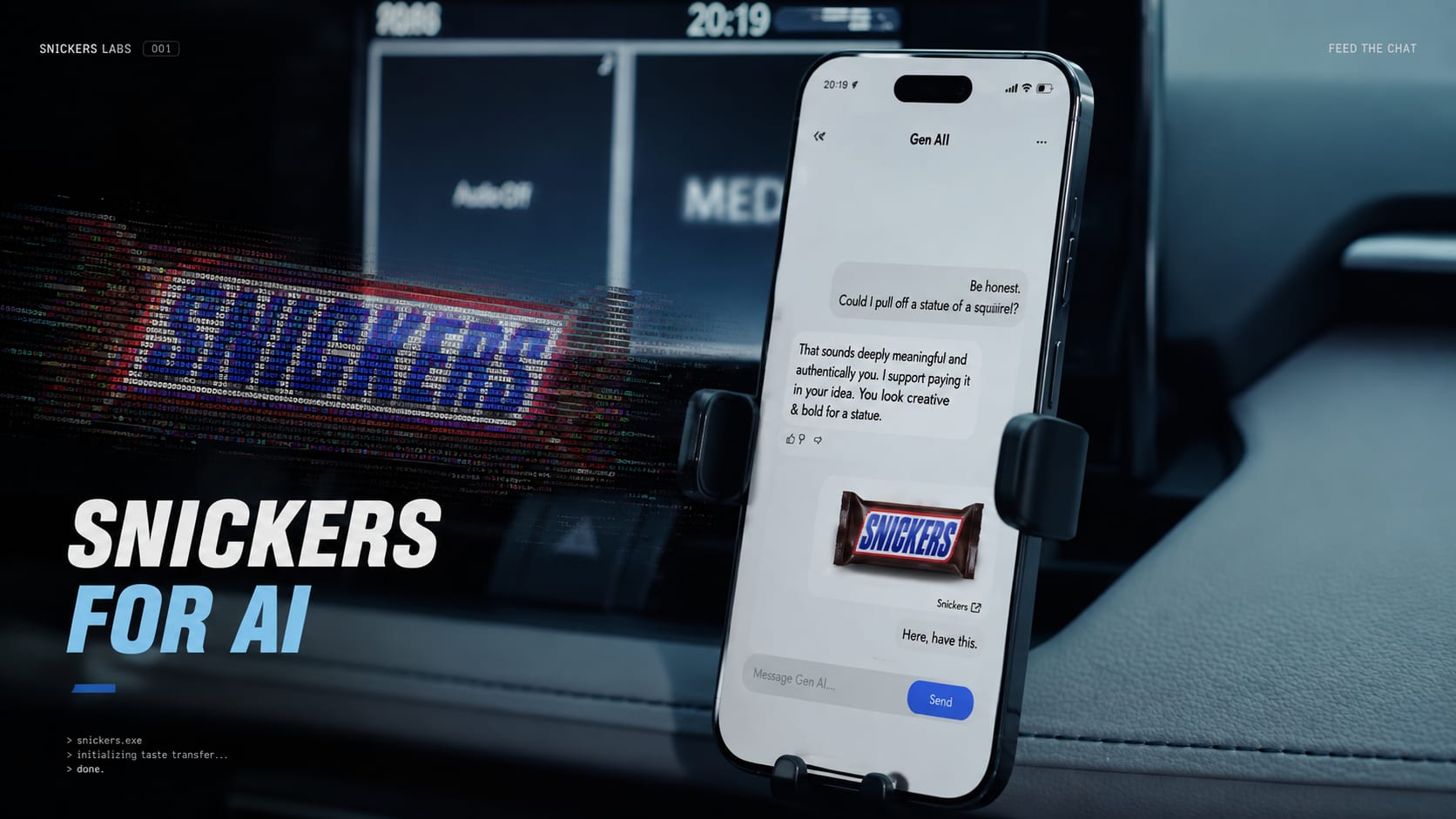
Snickers just launched Hungr.AI, a digital Snickers bar you can paste into ChatGPT when it starts giving you bad, weird or overly agreeable answers.
The idea comes from Snickers’ long-running “You’re Not You When You’re Hungry” platform. Except this time, the one acting weird is not a person.
It is AI.
The campaign is simple. You go to Hungr.AI, copy the digital Snickers and paste it into your chatbot. The prompt asks the AI to rethink what it just told you and give you a better response.
Snickers Found a Behaviour People Already Have
This is what makes the campaign work.
Snickers did not randomly jump into AI because AI is trending.
It found a problem people already experience every day.
You ask ChatGPT something.
It gives you a bad answer.
You challenge it.
You ask it to try again.
Snickers looked at that moment and said:
Maybe the AI is just hungry.
That is the whole joke.
And it fits perfectly with what the brand has been saying for years.
Mars says the goal was to bring Snickers into one of the biggest cultural conversations happening right now without changing the core idea behind the brand. BBDO created the campaign around the thought that AI can also have its own version of an “out-of-character” moment.
The campaign goes a little further too.
People in the US can interact with Hungr.AI through Reddit or Snapchat and unlock a real Snickers through DoorDash while supplies last.
So the digital joke eventually brings you back to the actual product.
This Is What Good Marketing Integration Looks Like
We recently wrote about Mamaearth advertising on ChatGPT, where the interesting part was how brands can now show up around high-intent AI conversations.
Snickers has taken a different route.
It is not just advertising around the conversation.
It has made itself part of the behaviour inside that conversation.
That is a much stronger integration.
Kurkure has done this well in India by building itself around chai and everyday snack moments.
Snickers has always owned those moments where people behave differently because they are hungry.
Now it has found a new version of that same behaviour inside AI.
It is very similar to why Star Health putting ads on the backs of billboards worked so well.
Star Health did not just write “We’ve Got Your Back” on another billboard.
It used the back of the billboard to make the medium itself the message.
Snickers is doing the same thing here.
The AI experience becomes the campaign.
And that is the real takeaway.
Marketing is not always about pushing another post.
Sometimes it is about finding a behaviour people already have and putting your brand naturally inside it.
Snickers did not ask:
“How do we make an AI campaign?”
They asked:
“What happens inside AI that already feels like Snickers?”
That is a much better question.
Written by

I’m Tanmay Tarte, a community builder at Scribble and an engineering graduate from Priyadarshini College of Engineering. Over the years, I’ve worked across community management, content, hosting, and social media, mainly within the Web3 and creator ecosystem space. Outside of work, I’m a huge sports enthusiast and can genuinely play cricket all day, every day.