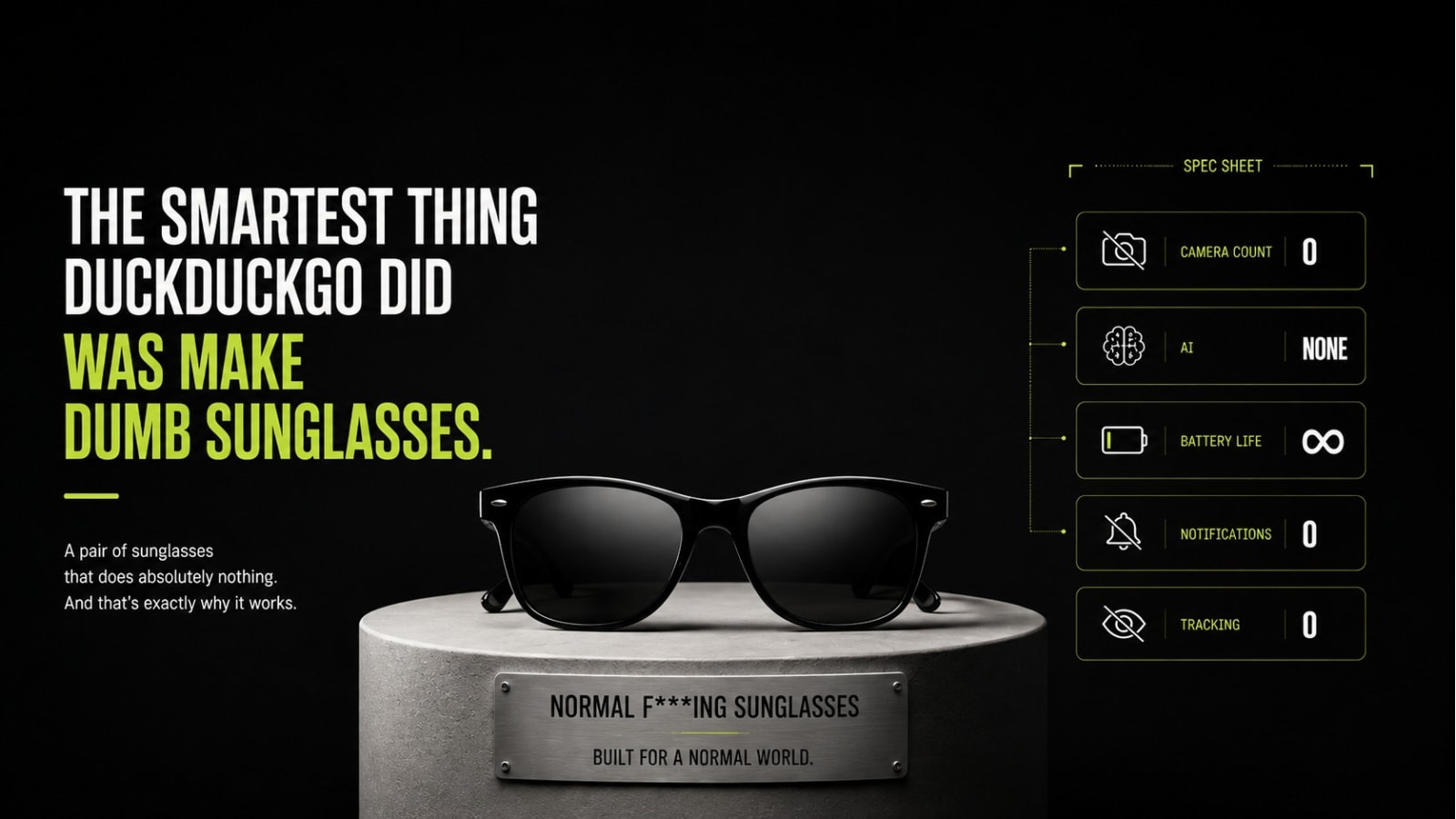
There is a pair of sunglasses on the market with no camera, no microphone, no battery, no AI and no app.
They cost $35 and they also sold out in under a week.
The company behind them is DuckDuckGo, a search engine that has spent 18 years building its brand around one idea: we don't track you. So when the internet started getting uncomfortable with AI glasses that could see, hear and record the world around them, DuckDuckGo didn't write a privacy manifesto.
It made Normal F***ing Sunglasses.
It was funny. It was timely. And, more importantly, it was probably the most literal expression of DuckDuckGo's brand positioning they could have made.
How We Got Here
Meta's Ray-Ban smart glasses launched in 2023. Camera in the frame, AI assistant on call, cosmetically identical to a regular pair of sunglasses. By 2026 they were on their second generation and sitting on millions of faces.
Then the story changed. Swedish investigative journalists revealed that Meta was routing footage captured through the glasses to human contractors overseas for AI model training. Footage that included people undressing, people in bathrooms, people who had absolutely no idea they were being recorded. A class-action lawsuit followed. The UK's Information Commissioner's Office opened an inquiry. Reports surfaced of the glasses being used by pickup artists to secretly film women. Police Scotland opened a criminal investigation into one of the users.
The backlash reached a fever pitch. Owners stopped wearing them in public to avoid the embarrassment of association. The internet settled on a name for them: pervert glasses.
Meta's response was a policy update and a small light that turns on when recording. The backlash did not slow down.
The Product
On July 30th, DuckDuckGo (a search engine) launched the "Normal F***ing Sunglasses" in partnership with San Diego eyewear brand Knockaround. Retail price: $35, against Meta's $299.
The spec sheet reads like a parody of every tech product launch of the last decade.
Camera count: zero. Battery life: infinite. Notifications: zero. Offline mode: always on.
The launch video is brilliantly done, taking a jab at Meta's privacy concerns and guarantees the glasses will never record nude videos of you and send them to random people.
While every tech company promises their product will change how you experience the world, DuckDuckGo's version offers one groundbreaking capability: you can run around in circles and see things for yourself. The glasses also block the sun. And apparently make you look good.
Why This Works as a Brand Move
DuckDuckGo does not manufacture glasses. What they manufacture, consistently and well, is a point of view.
The company has built its entire identity since 2008 around one idea: we do not track you, surveil you, or monetise your data. Every product decision, every campaign, every piece of communication points back to that. Launching anti-surveillance sunglasses is the most literal expression of brand identity possible: a physical object that makes the brand's values tangible.
This is the same mechanic as the best reactive marketing. Find the cultural moment your brand was born to respond to, show up with something specific and real, and get out of the way. No paid media budget required. The story writes itself.
What Marketers Should Take From This
The obvious lesson is about brand consistency. DuckDuckGo's campaign landed because it was completely coherent with everything the company had said for 18 years. A brand without that kind of established identity could have launched the same product and generated nothing.
The less obvious lesson is about timing and specificity. The "Normal F***ing Sunglasses" would not have worked in 2023 when the Ray-Ban glasses were still a novelty. It worked in July 2026 because the privacy backlash had reached a specific, documented, culturally visible peak. The campaign reads as a response to a real moment, not a manufactured one.
And the subtler thing still: DuckDuckGo did not position this as an attack on Meta. They positioned it as a solution to a problem anyone with eyes could see. That framing is harder to dismiss and more durable in the press cycle than a direct competitor takedown.
Frequently Asked Questions
Who made the actual glasses?+
Knockaround, a San Diego-based eyewear brand known for affordable, durable sunglasses. DuckDuckGo partnered with them for production and distribution. The glasses retail at $35.
Are Meta's Ray-Ban glasses actually dangerous?+
The documented issues are real: footage was routed to overseas contractors without adequate user disclosure, the glasses are cosmetically indistinguishable from regular eyewear making covert recording easy, and multiple incidents of misuse have resulted in lawsuits and police investigations. Whether that constitutes danger depends on context. The privacy concerns are legitimate and the legal proceedings are ongoing.
Written by

Hi! I’m Mrinalini. I work on growth at Scribble, where my days mostly revolve around content, planning campaigns, speaking to creators, and occasionally yapping in front of a camera. I studied engineering at Manipal Institute of Technology and briefly worked as a Test Engineer at Siemens before realizing marketing was my calling. Outside of work, you’ll find me eating/thinking about food.