TL;DR
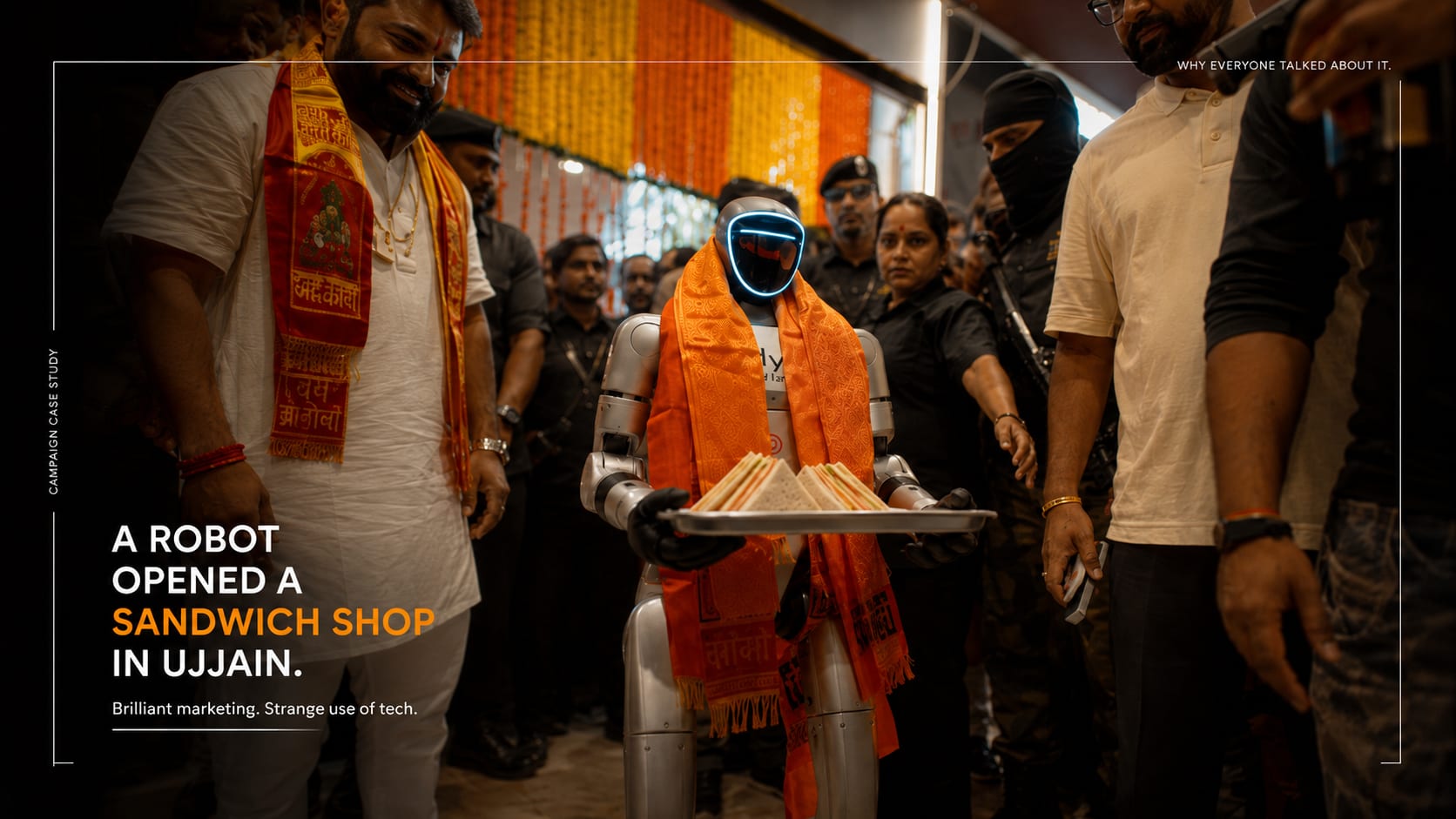
On August 23, 2026, a sandwich shop opening in Ujjain did something no normal local business launch would ever do: it invited a humanoid robot as the chief guest. The robot arrived with armed security, got a traditional welcome, took part in the puja and ribbon-cutting, was offered sandwiches, and eventually started dancing for the crowd. The clips spread quickly online, with industrialist Harsh Goenka even asking, “Does any of this make sense?” (NDTV Food)
From a robotics point of view, it was absurd. From a marketing point of view, it was brilliant. Nobody would normally care about the opening of a sandwich shop in Ujjain. But put a humanoid robot at the centre of it and suddenly people across India are watching, sharing, debating and writing about it. The real question is: was this a ridiculous waste of technology, or exactly the kind of strange idea that great marketing needs?
What Actually Happened
The inauguration happened on Sunday, August 23, in Ujjain, Madhya Pradesh.
Instead of inviting a celebrity, politician or local personality, the shop brought in a humanoid robot supplied by Indore-based Bidyut Innovation.
And they committed fully to the bit.
The robot arrived with armed security personnel, walked the red carpet, shook hands with guests and received a traditional welcome. It then joined the inauguration ceremony, took part in the puja and ribbon-cutting, and was even offered a plate of sandwiches. Later, it performed a series of dance moves as people gathered around filming it on their phones. (India Today)
The entire thing looked ridiculous enough that you almost had to keep watching.
And that was probably the point.
From a Tech Perspective, This Is Pretty Stupid
Humanoid robots are being built to eventually do genuinely useful work.
Factories.
Warehouses.
Dangerous environments.
Repetitive physical jobs.
Tasks where putting a human in the loop is expensive, risky or unnecessary.
So watching one get a tilak, wear a ceremonial scarf and dance outside a sandwich shop is not exactly the most inspiring demonstration of robotics.
That reaction was part of the online conversation too. Harsh Goenka shared the video and questioned whether the spectacle made any sense at all. (NDTV Food)
If this was meant to show India’s robotics capability, there are probably a hundred better ways to do it.
But it wasn’t really a robotics demonstration.
It was marketing.
And that changes everything.
As Marketing, It Was Kind of Genius
Ask yourself one simple question:
Would you normally know that a new sandwich shop opened in Ujjain?
Probably not.
Local restaurant openings happen every day.
Most of them look exactly the same.
Ribbon.
Flowers.
Family.
A few photos.
Maybe a local influencer.
Done.
This shop created something completely different.
A humanoid robot walking into a puja with security around it is so unexpected that it instantly becomes content.
People record it.
People send it to friends.
People argue about it.
News outlets pick it up.
Harsh Goenka shares it.
And suddenly the shop is being talked about far outside Ujjain. AajTak noted that the stunt succeeded in making the robot, and by extension the opening, the main topic of conversation. (AajTak)
The robot was not just the guest.
The robot was the distribution strategy.
The Weirdness Was the Media
Most businesses use technology to solve a problem.
This shop used technology to create one.
People looked at the video and thought:
Why is there a robot here?
That question is incredibly valuable in marketing.
Because curiosity buys attention before you ever need to explain the brand.
A robot at a robotics conference is expected.
A robot inside a factory is interesting, but logical.
A robot attending a puja at a sandwich shop in Ujjain?
That makes no sense.
And because it makes no sense, you keep watching.
That is exactly why the stunt worked.
Two Ways to Read It
There are really two completely different ways to look at this.
Read one: this is a terrible use of advanced technology.
India has enormous technical talent, and humanoid robotics could eventually help solve serious industrial and physical-work problems.
If the most visible thing we do with that technology is make robots dance for social media views, it is easy to feel like we're wasting the potential.
On this reading, the spectacle is funny, but also a little depressing.
Read two: this is exactly what good marketing is supposed to do.
The sandwich shop did not buy the robot to advance robotics.
It wanted attention.
And for one local opening, it created a spectacle unusual enough to generate national conversation.
It took something people already find fascinating, put it somewhere nobody expected to see it, and let curiosity do the distribution.
From that perspective, it worked incredibly well.
The Marketing Lesson Is Bigger Than the Robot
The important lesson here is not:
“Every brand should hire a robot.”
Please don't.
The lesson is that marketers often ask the wrong question.
We ask:
What ad should we make?
Sometimes the better question is:
What can we do that people will naturally want to talk about?
The strongest part of this campaign was not the copy.
There barely was any.
It was not media targeting.
It was not an elaborate funnel.
It was simply the collision of two things that felt like they should never exist together:
a humanoid robot and a traditional sandwich-shop inauguration in Ujjain.
That tension created the story.
And the story created the reach.
So Was It Stupid or Brilliant?
Probably both.
As a showcase of what robotics can achieve, making a humanoid dance at a shop opening feels incredibly underwhelming.
As a way of making thousands of strangers care about a business they had never heard of?
It is hard to argue with the result.
And that is what makes the story more interesting than another “brand uses AI” headline.
Sometimes marketing does not need to show people what technology is capable of.
It just needs to put that technology somewhere people cannot resist talking about.
We Want to Know What You Actually Think
Was bringing a humanoid robot to a sandwich-shop opening a ridiculous waste of technology, or a genuinely smart marketing stunt?
And separately:
Should brands use emerging technology mainly for practical value, or is creating spectacle and attention a perfectly valid use too?
There is a reasonable argument on both sides.
That is probably why everyone kept watching.
Frequently Asked Questions
Where did the robot sandwich-shop inauguration happen?+
It happened in Ujjain, Madhya Pradesh, on August 23, 2026. (NDTV Food)
Was the robot actually the chief guest?+
Yes. Multiple reports described the humanoid robot as the chief guest at the opening ceremony. (NDTV Food)
What did the robot do at the event?+
It received a traditional welcome, participated in the puja and ribbon-cutting, interacted with guests and later performed dance moves. (India Today)
Who supplied the robot?+
The robot was brought to the event by Indore-based Bidyut Innovation. (NDTV Food)
Why did the event go viral?+
The unusual combination of a humanoid robot, a traditional Indian inauguration and a local sandwich shop created a spectacle that people found surprising enough to record, share and debate online. (timesofindia.indiatimes.com)
Written by

I’m Tanmay Tarte, a community builder at Scribble and an engineering graduate from Priyadarshini College of Engineering. Over the years, I’ve worked across community management, content, hosting, and social media, mainly within the Web3 and creator ecosystem space. Outside of work, I’m a huge sports enthusiast and can genuinely play cricket all day, every day.