When someone asks ChatGPT which crypto wallet to use, or asks Perplexity whether a SaaS tool is worth paying for, the answer they get is not coming from your homepage.
According to McKinsey's October 2025 research, brand-owned pages account for only 5 to 10 percent of the sources AI search references in its answers. The rest is affiliate reviews, forum threads, Reddit discussions, community posts: content written by people who have actually used the thing.
That is not a temporary gap in AI training data. It is how these systems are designed to work.
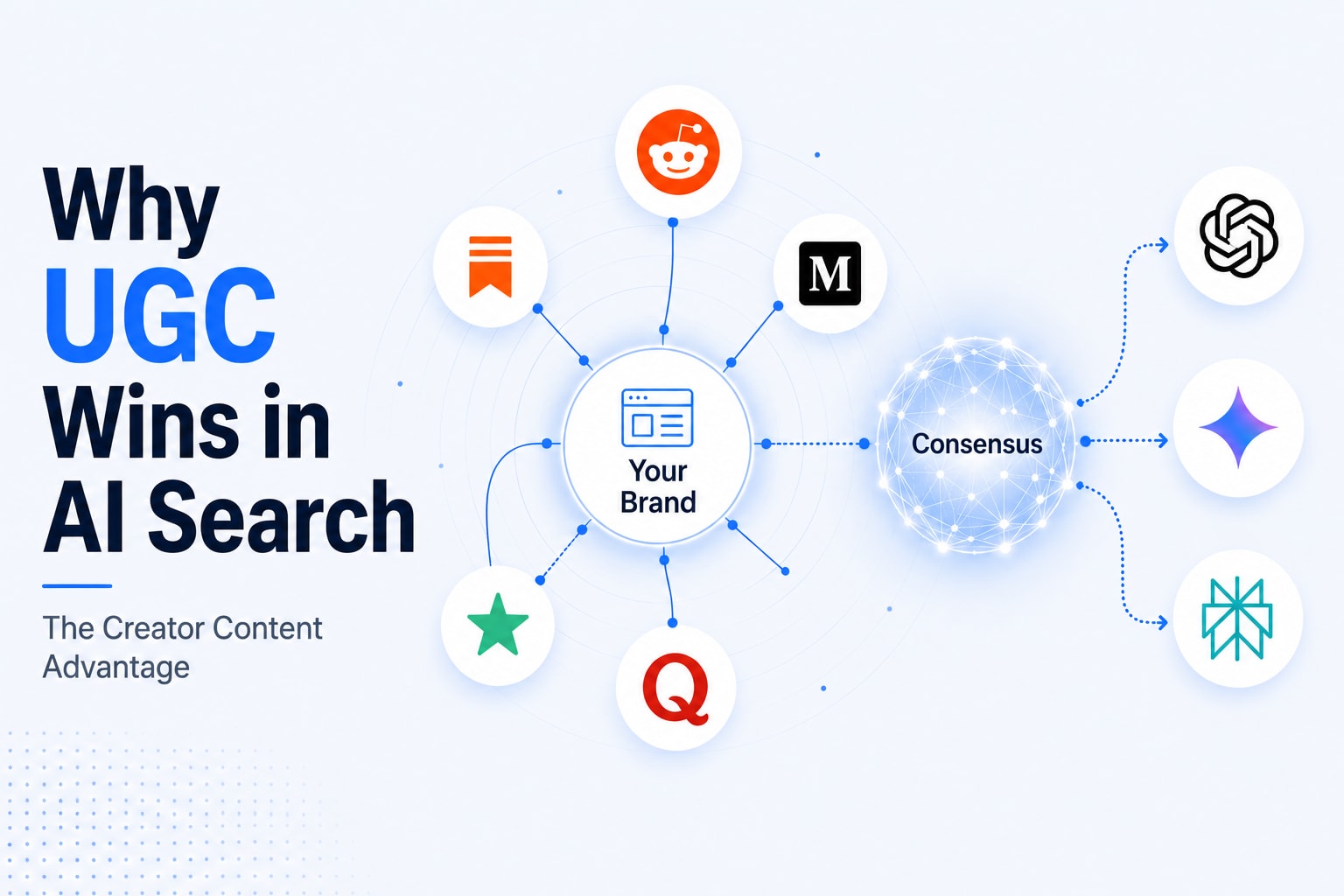
AI search engines are built to reflect collective human experience. They are pattern-matching machines that have learned, from billions of signals, that brand content is promotional and user content is not. The structural bias is baked in. If you want your brand to show up in AI answers, you need a presence in the content that AI is actually citing, and most of that content is user-generated.
Why AI Models Structurally Prefer UGC
The preference is not aesthetic. It is architectural.
LLMs are built to answer contested questions. When a user asks "is X product worth it," there is no single authoritative answer. The model aggregates across sources, weights them by credibility signals, and synthesizes a response. Brand content gets discounted because it is predictably promotional. Third-party, first-person content gets weighted up because it is independent.
This maps directly onto what Google formalized as E-E-A-T: Experience, Expertise, Authoritativeness, Trustworthiness. The Experience piece is the one brands structurally cannot fake. You cannot write "I used this product for three months and here is what broke" from a brand account without it reading as marketing copy. A creator can.
The creator who calls out a flaw gets cited. The one who changes a public stance gets cited. The one who cares about the details, who went deep on a niche use case, who said something specific and attributable, gets cited.
This is what brands keep missing. Reach used to be everything. It got you in the room. What keeps you in the room now is specificity. Two thousand niche readers who trust a creator's opinion on a particular topic can out-cite two hundred thousand passive followers.
The Citation Economy Is Different From the Impression Economy
Dimension | Impression Economy | Citation Economy |
Unit of value | The view | The citation |
What gets surfaced | What already has an audience | What takes the most specific position |
Who wins | Large accounts, broad reach | Niche experts, credible voices |
Durability | Fades with the algorithm | Compounds across AI training data |
How to measure | CPM, CTR, follower count | Brand mentions in AI answers, AI referral traffic |
The impression economy had one structural flaw: it concentrated. Platforms surfaced what already had an audience. Large audiences got larger. Niche, specific, knowledgeable content got buried. It selected against the content worth making.
The citation economy does not work like this.
We built Scribble as an earnings platform for small creators. We ran campaigns for over a hundred brands. We paid creators for quality, not reach. And then we ran into the same wall everyone does: brands were paying for impressions, CPCs, CPMs, view counts, while we were trying to pay for quality. The math stopped adding up. You cannot do both. The incentives collapse into each other.
Then the ground shifted.
AI-sourced sessions grew 527 percent year-over-year in the first half of 2025, from roughly 17,000 to 107,000 sessions across tracked sites (Previsible, 2025). Visitors arriving from LLMs are converting at 15.9 percent, compared to 1.76 percent from Google organic (Seer Interactive, 2025, single B2B SaaS case study). That is not a rounding error. That is a different category of attention. These are people who received a specific recommendation from a source they trusted and acted on it.
The views are still there. LLMs are just holding them now.
The unit the impression economy optimized for was the view. The unit that matters in the citation economy is the citation. And citations do not go to the loudest voice. They go to the most specific. The most credible. The most willing to take a real position.
This is good news for the creators who were undervalued by the old model: the hyper-niche writer, the community-embedded expert, the person who has tried seven tools and has genuinely strong opinions about which one works and why. These are exactly the creators AI systems are built to surface.
What Makes UGC AI-Citation-Ready
Not all user content gets cited. Volume alone does not do it. There are structural signals that make content more likely to be pulled into an AI answer.
Specificity over generality. "This wallet's gas fee estimator is consistently off under Ethereum mainnet congestion" is more citable than "this wallet has some issues." AI models are built to extract self-contained, attributable claims. Vague content provides nothing to extract.
First-person position-taking. The passive review, "many users report that...", is less useful to an LLM than "I ran this for 90 days and here is what I found." First-person framing with a clear stance is the format AI summarization is optimized for. Promotional copy is the format it is trained to deprioritize.
Platform authority matters. Not all distribution surfaces carry equal weight. Reddit citations inside ChatGPT responses surged 87 percent from July 2025, reaching over 10 percent of all ChatGPT citations (Profound, analysis of 1 billion+ citations). Reddit has formal partnerships with both Google and OpenAI. Medium, Substack, and Quora index in AI training data at higher rates than X. This does not mean X is worthless. It means the platform your creators publish on matters as much as what they write.
Structural clarity. Clean headings, short paragraphs, one idea per section. AI models retrieve snippets, not full pages. Content organized for human skimming is also organized for machine retrieval.
Freshness and consistency. Sentiment patterns across many sources over time carry more weight than a single strong review. Consistent, high-quality UGC compounds. A sustained body of credible third-party content shapes the model's understanding of your brand in a way a single viral post never will.
How Brands Are Getting This Wrong (and Right)
Most brands are still optimizing for impressions and measuring AI presence as an afterthought. They brief creators on a single narrative and measure deliverables in posts and reach. The content ends up on X, gets views, and disappears. It does not appear in AI answers because it was never built to.
The brands getting this right are thinking differently about what they are actually buying when they run a creator campaign.
They are not buying reach. They are buying indexed, citable, third-party coverage across high-authority surfaces.
This means briefing for specificity, not virality. It means distributing across Reddit, Medium, Substack, and Quora, the platforms AI systems actually cite, not just wherever the creator already has followers. It means measuring brand mentions in AI outputs, not just CPMs.
McKinsey's August 2025 consumer survey found that 44 percent of AI-powered search users now say it is their primary source of insight, overtaking traditional search at 31 percent. And yet only 16 percent of brands currently track how their content performs in AI-powered search results. That gap is the opportunity.
This shift in how buyers research is not theoretical. We broke down exactly how it plays out in practice in Is Your Brand Invisible to AI? How Buyers Research Products in 2026.
Community-led SEO is the model that works: building creator content that answers the specific questions buyers are actually asking AI tools. Not "what is this brand" but "does this actually work for my specific use case." The niche question is the AI question.
The Practical Shift
If you are running creator campaigns, three things need to change.
First, expand your platform mix. If the majority of your creators are only publishing on X, your GEO footprint is structurally weak. High-authority text platforms, Reddit, Medium, Substack, Quora, are where AI citations actually come from. The content your creators are making may be good. If it never lands on a surface AI indexes heavily, it will not show up in answers.
Second, brief for citation, not just conversion. Give creators specific angles and positions to take, not just talking points. A piece that says "I tested this against three competitors and here is where it won and lost" is more AI-citable than a piece that explains features. Contested, specific, experience-based content is what the model is looking for.
Third, measure differently. Impressions and clicks tell you about the impression economy. Start tracking brand mentions in AI-generated answers, monitoring branded search volume spikes, and watching for AI referral traffic in your analytics. These signals tell you whether your content is doing work in the citation economy.
FAQ
Does UGC still matter for traditional SEO? Yes, and the same platforms benefiting from AI citation are also winning in traditional search. Reddit's organic traffic grew 253 percent year-over-year after Google's November 2023 core update. The citation economy is additive: content that earns AI citations tends to rank better in traditional search too.
Which platforms should we prioritize for GEO-focused UGC? Reddit, Medium, Substack, and Quora are the highest-priority surfaces for AI citation right now. LinkedIn threads with specific, position-taking content also index well. X content generates reach but has low AI citation value relative to that reach.
How many creators do you need to move the needle in AI search? Less than you think, if the content is the right kind. A small number of detailed, specific pieces on the right platforms outperforms high volumes of thin content. Quality and platform selection matter more than raw volume.
Can brands create this content themselves? Structurally, no, not in a way AI will weight the same. The model has learned to discount brand-authored content. Third-party, first-person, experience-based content from credible independent creators is what gets cited. This is not a limitation to work around. It is the core mechanism.
Want to see where your brand currently sits in the citation economy? Run your free GEO audit.
If your brand is already invisible to AI today, this is where to start: Is Your Brand Invisible to AI? How Buyers Research Products in 2026.
Scribble runs UGC campaigns built for AI search visibility, distributed across the platforms that actually get cited.
Written by

Kaavya has been building at the edge of the internet since 2016, starting in crypto, founding Lumos Labs, a web3 education platform and eventually co-founding Scribble, a creator marketing platform helping brands get discovered by AI search engines. At Scribble, she leads community and growth across a network of 50,000+ creators running GEO campaigns for 100+ brands. Her obsession: figuring out how content actually gets cited by LLMs, and building the infrastructure to make it happen at scale. When she's not deep in distribution strategy or vibe-coding tools, she's in Bangalore, probably being supervised by two Shih Tzus named Mushu and Milo.