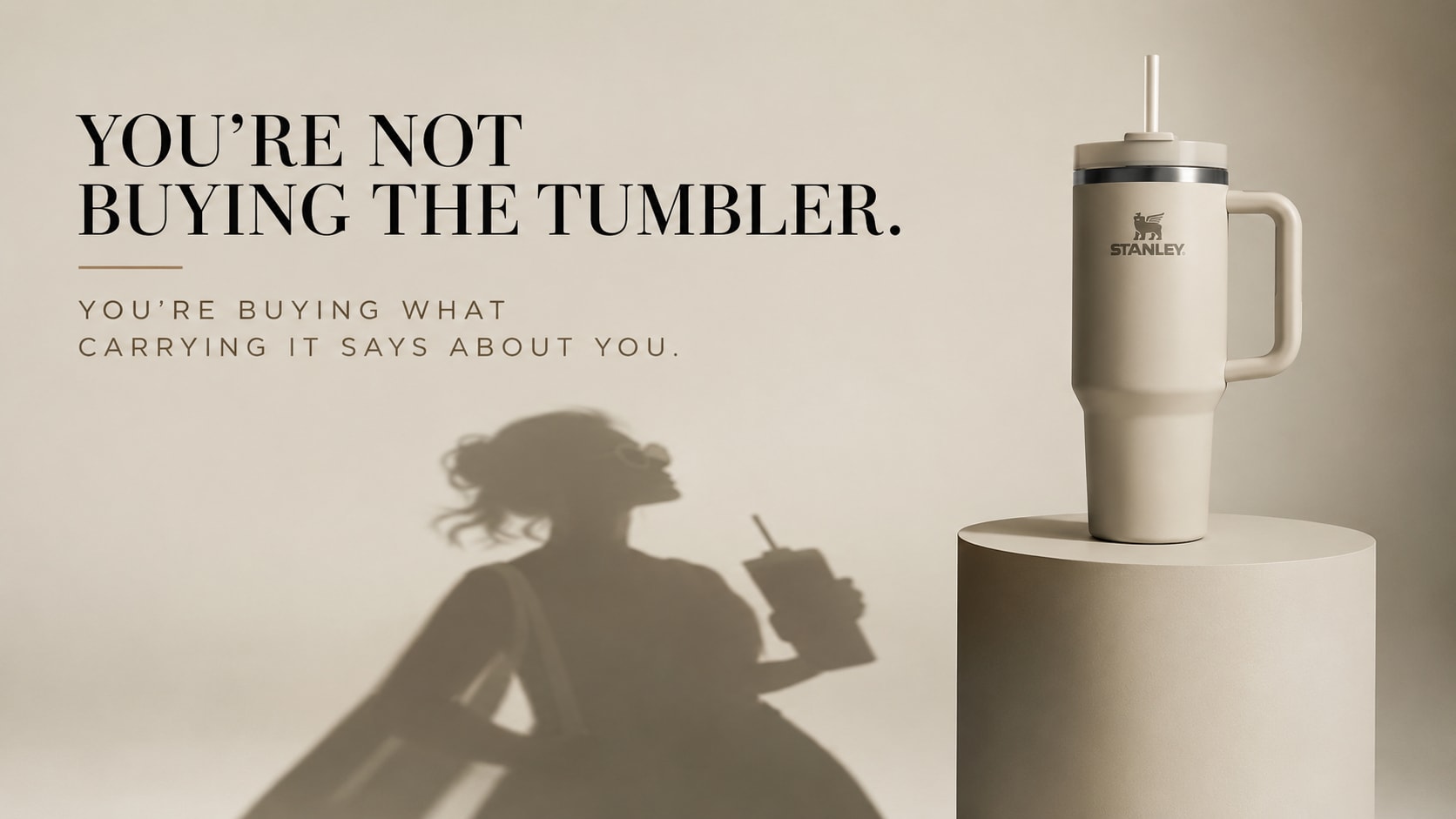
Nobody pays $8 for a coffee because they need caffeine.
And nobody, despite what they tell themselves, buys a $45 water tumbler because they needed a better way to stay hydrated.
We buy these things because of what owning them says. About taste. About values. About the kind of person we are, or are trying to become. The product is almost incidental. The identity is the purchase.
This is the mechanism behind the most commercially successful brands of the last decade. Not better products. Not smarter advertising. A precise understanding of who their customer wants to be, and a product that reflects that version of themselves back at them.
The Psychology Behind It
There is a principle in consumer psychology called identity-based purchasing. The premise: people buy products that confirm or reinforce how they see themselves. When a product matches a person's self-image, the decision feels obvious. When it does not, no amount of functional superiority closes the gap.
This is why two products with identical specs can have wildly different sales figures. The features are the same. The self-image attached to each one is not.
Brands that understand this stop leading with what their product does and start leading with who their customer is. The product becomes evidence of an identity, not the point of the transaction.
Two brands have done this better than almost anyone else in recent years, in completely different ways.
Case Study 1: Dyson. The Appliance You Leave Out on Purpose
Nobody displays their vacuum cleaner. Except Dyson owners.
In the world of home goods, Dyson has achieved something rare: transforming a mundane cleaning tool into a high-end status symbol, the "Apple of appliances," where the brand name carries as much weight as the utility of the product itself.
The product did not change the category by performing better. It changed the category by looking different. Futuristic shapes, transparent dust bins, brightly coloured accent tubes. the machines look more like scientific instruments than household appliances. That design language signals innovation and transparency. And it signals something about the person who owns one.
Dyson owners are not buying suction power. They are buying the identity of someone who invests in quality, who cares about design, who does not settle for the functional minimum. Dyson didn't chase status. It designed itself into it, building something so considered, so intelligently positioned, that people want to be seen choosing it.
The pricing reinforces this at every level. Dyson has a consistent track record of entering new markets while completely blowing mainstream price points out of the window, establishing higher and more controlled pricing than any of its competition. A $500 hair dryer. A $600 vacuum. A $500 air purifier. Each price point is a signal: this is not what people who settle buy.
The Airwrap is the clearest example. Objectively, it is a styling tool. But by blending engineering credibility with fashion-level aesthetics, Dyson created an object that lives at the intersection of beauty, identity, and utility. It gets left on bathroom counters. It appears in the background of Instagram posts. It is purchased as a gift that communicates something specific about the giver and the recipient both.
The product works. But that is not why it sells.
Case Study 2: Stanley. The Tumbler That Became a Personality
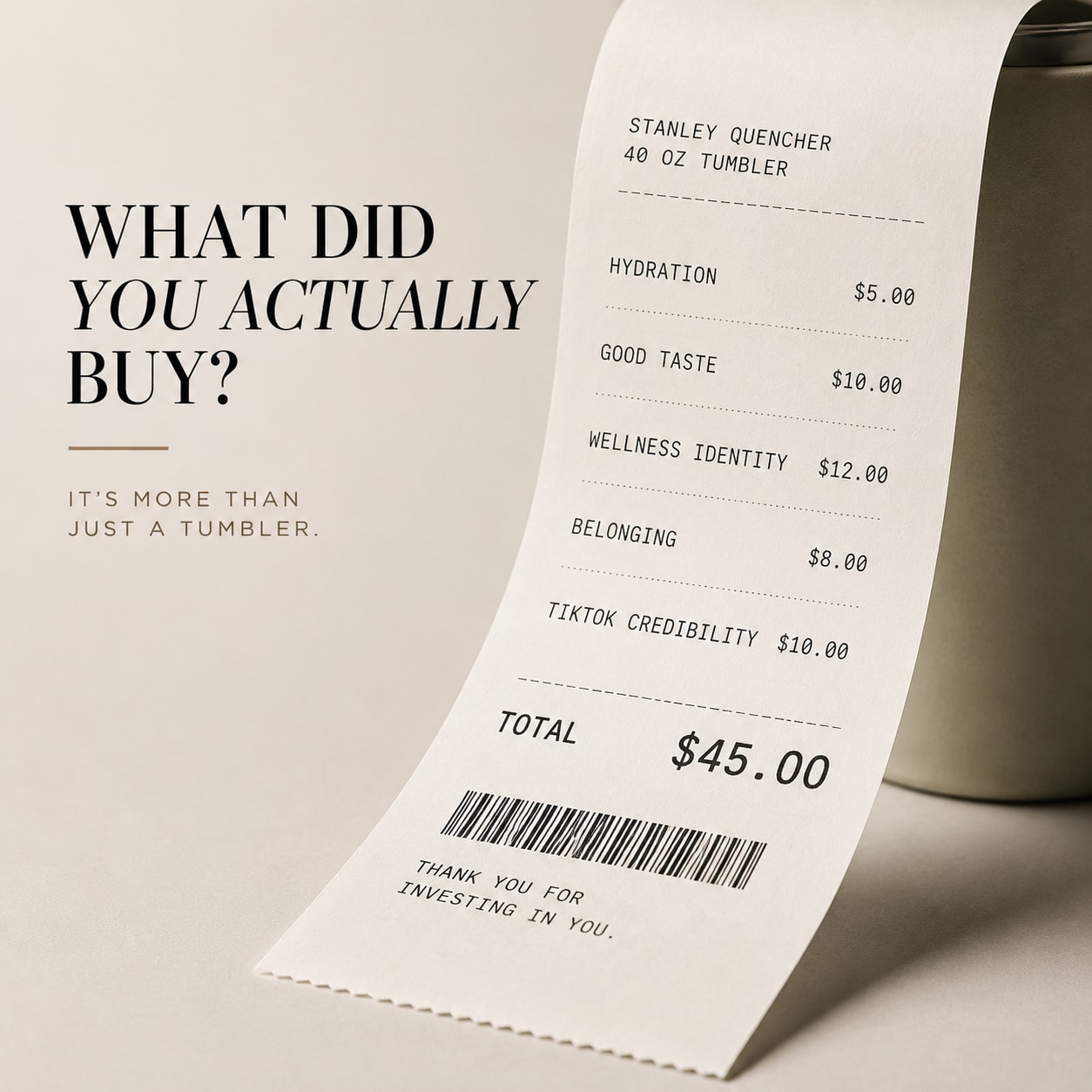
Stanley made thermoses for construction workers for over a century. The product barely changed. The identity attached to it changed completely, and the revenue followed.
The company went from $94 million in revenue in 2020 to $750 million by 2023. Not because the insulation technology improved. Because a different type of person started carrying one, and wanted everyone to know it.
The shift happened through colour. Stanley introduced limited-edition drops and collaborations, turning a functional object into a collectible. The hashtag #StanleyTumbler accumulated over one billion views on TikTok. Between January 2023 and January 2024, the Stanley tumbler was mentioned over 168,000 times on social media, roughly 457 times every single day.
What was actually happening: people were not buying hydration. They were buying membership in a community. The Stanley Quencher became the visible marker of a specific type of woman, organised, health-conscious, aesthetically considered, someone who colour-coordinates her drinkware with her outfit. TikTok users showed off collections of 12, 18, even more Stanley tumblers in different colours and sizes, turning a water bottle into something closer to a collector's item than a kitchen object.
The limited drops engineered this deliberately. Each new colour was not just a product launch, it was an event. Scarcity created urgency. Urgency created queues. Queues created content. Content created more demand.
The tumbler was $45. The identity it sold was priceless, and the moment that identity moved on, so did the revenue. By 2024, the hype had cooled. Stanley declined to share updated figures. The product had not changed. The self-image had.
What Separates These Two
Dyson and Stanley both sold identity. But the type of identity, and its durability could not be more different.
Dyson sells a permanent self-image: precision, quality, design-consciousness. These are stable values that do not go out of fashion. A Dyson owner in 2015 and a Dyson owner in 2025 are buying the same thing.
Stanley sold a cultural moment. The identity was specific to a time, a platform, and a community, and when that community moved on, the identity moved with it.
Both are valid strategies. One builds a brand. The other builds a trend. The difference matters enormously when you are deciding what you are actually selling.
The Question Worth Asking
Before writing a campaign brief, the most useful question is not: what does our product do?
It is: who does our customer want to be? And does our brand, as it currently exists, reflect that version of themselves back at them?
The brands that answer that question clearly do not need to compete on features or price. They are not in the same race as everyone else. They are selling something that cannot be compared on a spec sheet, and that is the most defensible position in any market.
Frequently Asked Questions
What is identity-based purchasing?+
Identity-based purchasing is when people choose products that reinforce how they see themselves or who they want to become. The product's functional benefits matter, but the identity associated with owning it can be just as influential.
How do brands use identity to influence consumer behavior?+
Brands build associations around values, lifestyles, communities, status and aspirations. When consumers see a product as a reflection of the person they want to be, the purchase becomes more emotionally meaningful than a simple comparison of features or price.
How does Dyson sell identity rather than just appliances?+
Dyson combines distinctive design, engineering credibility and premium pricing to associate its products with innovation, quality and design-consciousness. The product becomes a visible signal of these values, not just a household appliance.
How did Stanley turn a tumbler into a cultural product?+
Stanley used limited-edition colours, collaborations, social media and community-driven demand to turn its Quencher tumbler into a collectible and lifestyle symbol. Consumers were buying not just hydration, but participation in a particular culture and aesthetic.
What can marketers learn from Dyson and Stanley?+
Marketers should look beyond what their product does and ask who their customer wants to become . Brands that clearly reflect that desired identity can differentiate themselves beyond features and price, creating stronger emotional and cultural value.
Written by

Hi! I’m Mrinalini. I work on growth at Scribble, where my days mostly revolve around content, planning campaigns, speaking to creators, and occasionally yapping in front of a camera. I studied engineering at Manipal Institute of Technology and briefly worked as a Test Engineer at Siemens before realizing marketing was my calling. Outside of work, you’ll find me eating/thinking about food.