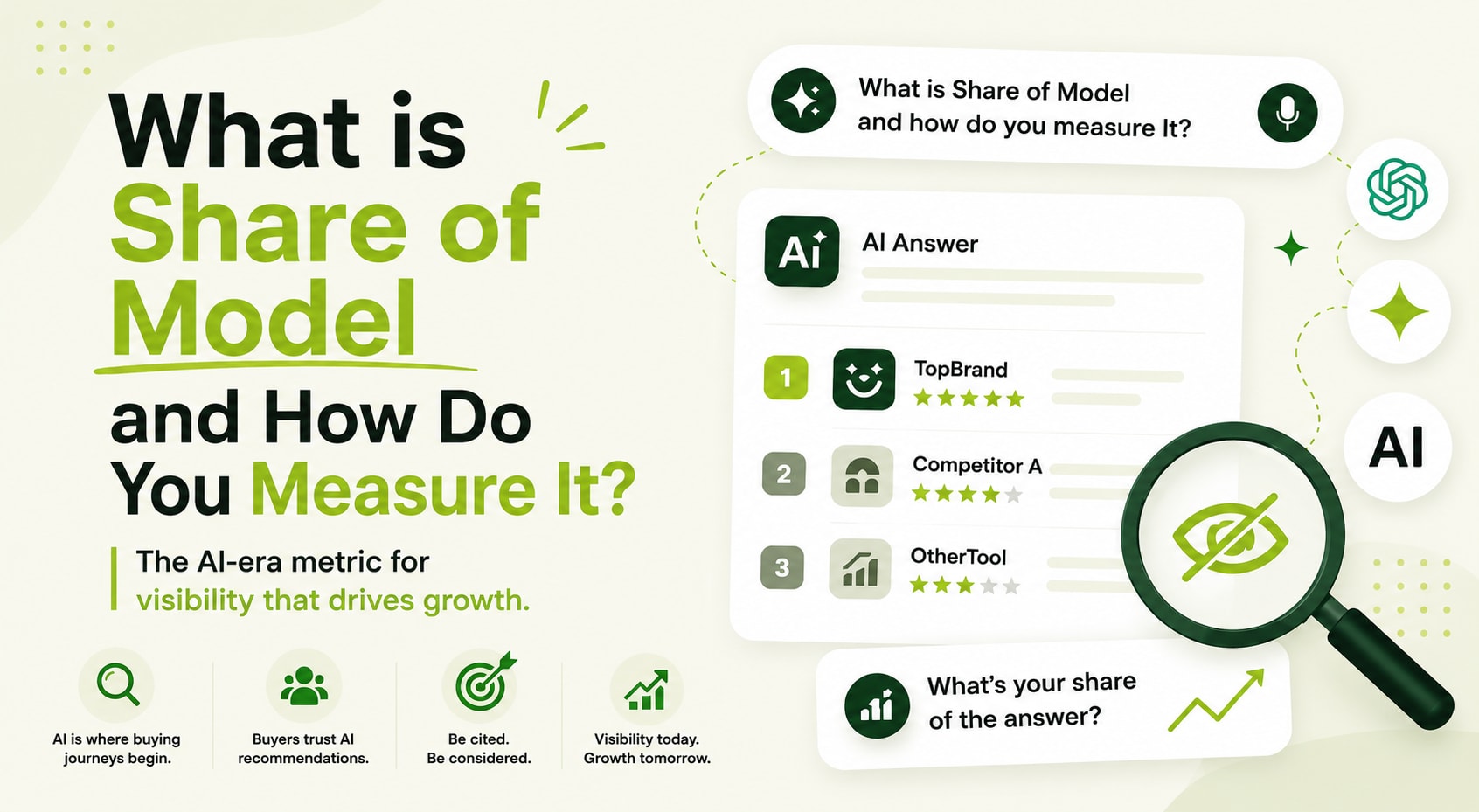
Share of model is the percentage of AI generated responses, recommendations, or citations that mention your brand, product or content. It is the AI-era equivalent of share of voice: instead of tracking how often your brand appears in paid ads or organic search results, you track how often large language models surface your brand when users ask relevant questions.
If a user asks ChatGPT, Claude, or Gemini “What’s the best project management tool for remote teams?” and your product is named in 3 out of 10 responses across a representative sample of queries, your share of model for that category is 30%.
That’s the definition. Everything below is about why it matters and how to actually measure it.
Why Share of Model is the Metric Marketers Can’t Ignore in 2025
Search rankings are no longer the only path to discovery. A growing share of consumer and B2B research now happens inside AI chat interfaces. And those interfaces don’t return ten blue links. They return one synthesized answer. Being present in that answer, or absent from it, has direct revenue consequences.
Traditional share of voice measured ad impressions and organic search visibility. Share of model measures something more fundamental: which brands does the AI consider authoritative enough to recommend?
This matters for three reasons:
1. AI Responses Compress the Consideration Set. When a model recommends two or three tools, users often start and end their evaluation there. Brands outside the model’s awareness don’t make the shortlist.
2. Visibility in AI Responses Compounds. Models are frequently updated on new data. Brands that build strong citation patterns now, through authoritative content, structured data and enough coverage, are more likely to stay visible as models retrain.
3. It is Measurable Today. Unlike some emerging metrics, the share of models can be tracked with a repeatable, systematic methodology right now. You don’t need proprietary access to model weights, you need a query set, a logging framework, and consistency.
How to Measure Share of Model?
Measuring share of model requires four components: a query bank, a sampling methodology, a response parser, and a reporting cadence.
Step 1: Build a Representative Query Bank
Your query bank is a set of prompts that a real buyer or user would ask an AI Assistant when researching your category. For a B2B SaaS company selling analytics software, this might include:
What are the bes intelligence tools for mid-market companies?
Compare alternative for non-technical teams
Which analysis platforms integrate with Salesforce?
Aim for 50-200 queries per category, spanning awareness-stage, consideration-stage, and decision-stage intents. Skew those toward conversational phrasing because that’s how people actually prompt AI tools.
Step 2: Run Queries Systematically Across Models
Submit each query to the AI models your audience uses. As of mid-2025, that typically means ChatGPT, Claude, Gemini and Perplexity at a minimum. Run each query multiple times per model and log every output. Not that responses vary due to temperature settings.
Use the API for scalability and consistency. Browser-based testing introduces session variables and personalisation that contaminate your sample.
Step 3: Parse and Tag Brand Mentions
For each response, identify which brands are mentioned and in what context. A mention is not equal to a recommendation. Categorise each appearance:
Primary Recommendation: The model names the brand first or frames it as the top choice
Secondary Recommendation: Included in a list without strong endorsement
Cautionary Mention: Cited as a weaker option or one with known limitations.
Absent: Not mentioned at all.
Your share of model score is calculated per query category as follows:
Share of model = (your brand mentions/total brand mentions across all responses) x 100
Track this separately by model, by query intent and by mention type. A brand that dominates primary recommendations but never appears in secondary lists has a different strategic profile than one that shows up everywhere as a list filler.
Step 4: Establish a Reporting Cadence
Share of model is a directional metric that requires longitudinal tracking to be useful. Run your full query bank monthly. Spot check weekly on high-priority query clusters. The goal is to detect movement. Both your own trajectory and competitors’.
What Drives Share of Model and How To Improve It
Understanding what causes models to recommend a brand is still an evolving field but the evidence points to several consistent factors.
Content depth and authority. Models are trained on text. Brands that have published comprehensive, well-structured, frequently cited content in a category are more likely to appear in responses about that category. This means genuine thought leadership. Not keyword stuffed pages. This matters now in the AI era more than it ever did in the SEO one.
Third-party Collaboration. A model is more confident recommending a brand when multiple independent sources agree. Analysts reports, review sites, press coverage, and community forums all feed model training data. Earned media is the new backlink.
Structured and Accessible Data. Brands with clear, crawlable information give models the raw material to generate confident, specific recommendations. For example, pricing, use cases, integrations, customer types, etc. Vague or jargon heavy websites are harder for models to summarise accurately.
Recency of Coverage. Many models are updated on rolling data windows. Brands that generate fresh, substantive coverage maintain higher salience in model outputs over time.
For a deeper look at how AI-era content strategy connects to discoverability, check out our piece on GEO optimisation.
Share of Model v Share of Voice v Share of Search
Metric | What It Measures | Where It Lives |
Share of Voice | Brand visibility in paid and earned media relative to competitors | Ad Platforms, PR tools |
Share of Search | Branded search volume as a share of category search volume | Google Search Console, Keyword Tools |
Share of Model | Brand mentions in AI-generated responses as a share of all brand mentions | API Query Logging, Custom Tracking |
Share of search is a useful indicator for brand health and was popularised as a proxy for market share. Share of model is the next iteration of that idea but adapted for a world where AI interfaces increasingly mediate the relationship between consumers and information.
The three metrics should be tracked together. A brand can have a high share of voice, declining share of search, and near-zero share of model. And a near-zero share of model is a warning sign that its visibility is concentrated in a channel that is losing relevance for discovery.
Wondering how discoverable your brand is across ChatGPT, Gemini, Perplexity, Claude, and other AI platforms?
Check whether your brand is invisible to AI here.
Get a free GEO Audit from ScribbleAI here.
Frequently Asked Questions
Is share of model the same as the "AI share of voice"?+
The terms are often used interchangeably, but share of model is more specific: it refers to mentions within AI-generated responses, whereas AI share of voice can also include AI-powered ad placements or recommendation engines. Share of model is the cleaner term for tracking LLM visibility.
How many queries do I need for a statistically meaningful measurement?+
For most categories, 50–100 queries per intent cluster, run 3–5 times each across two or more major models, gives you a directional signal. For high-stakes category decisions, expand to 200+ queries and increase repetitions.
Can I track share of models without API access?+
Manual tracking is possible at a small scale but introduces too much variability for reliable trend data. API access is strongly recommended for anything beyond an initial audit.
How often do AI models update, and how does that affect my scores?+
Major models update on timelines that are not always publicly disclosed, but meaningful shifts in model knowledge typically happen over weeks to months, not days. Monthly tracking cadence is appropriate for most brands; weekly spot checks are useful during periods of active content publishing or major coverage events.
Written by

I’m Ramaa, a writer and creator at Scribble. I’ve written two books, and writing is something I always find my way back to, whether that’s articles, scripts, captions, or overly long notes app rambles I swear will “be useful later.” I enjoy thinking about why people create, how ideas spread online, and what makes content feel genuinely human. When I’m not writing, I look after regulatory compliance and legal admin at Scribble, and I’m a graduate of the School of Policy, New Delhi. Outside of work, I’m a musician and an avid reader.